
Verwandte Artikel zu Integrative Alexander Technique Practice for Performing...
Inhaltsangabe
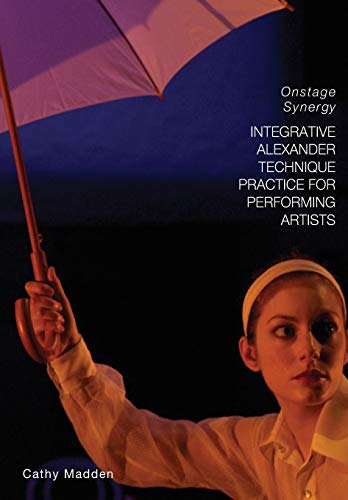
An educational method used to improve performance, the Alexander Technique teaches people to replace unnecessary muscular and mental effort with consciously coordinated responses, maximizing effectiveness while also relieving, if necessary, any chronic stiffness or stress. Integrative Alexander Technique Practice for Performing Artists presents the empirical research of Cathy Madden, a teacher and coach with more than thirty-five years of experience with the technique. She addresses common concerns, such as concentration, relaxation, discipline-specific techniques, warm-ups, performer/audience relationships, stage fright and critical responses, and explores the role of the senses, emotions, learned behaviour, human consciousness studies and neuroscience in the application of the techniques.
Die Inhaltsangabe kann sich auf eine andere Ausgabe dieses Titels beziehen.
Über die Autorin bzw. den Autor
Cathy Madden is principal lecturer for the University of Washington's Professional Actor Training program, director of the Alexander Technique Training and Performance Studio in Seattle, and associate director and research director for BodyChance in Japan. She was a founding member and is a former chair of Alexander Technique International.
Auszug. © Genehmigter Nachdruck. Alle Rechte vorbehalten.
Integrative Alexander Technique Practice for Performing Artists: Onstage Synergy
By Cathy MaddenIntellect Ltd
Copyright © 2014 Intellect Ltd
All rights reserved.
ISBN: 978-1-78320-218-8All rights reserved.
Contents
Acknowledgements, ix,
Introduction, 1,
Part One: Performing Artists' Foundation for Using the Alexander Technique,
Chapter 1: An Actor Began This, 11,
Chapter 2: How Does the Alexander Technique Work?, 19,
Chapter 3: The Design of Our Instrument: An Introduction, 33,
Chapter 4: First Experiments in the Alexander Technique, 49,
Chapter 5: Concentration Is a Lousy Word for All Performing Artists! (And All People!), 59,
Chapter 6: Congruency: Relax Is a Lousy Word for Performing Artists, 71,
Chapter 7: The Omnisensory Experience (Including the Kinesthetic Circus and a Look at Emotions), 81,
Chapter 8: Psychophysical Definitions, 95,
Chapter 9: Constructive Planning, 105,
Chapter 10: Freedom of Choice, 119,
Chapter 11: Integrating the Alexander Technique with Your Technique, 129,
Chapter 12: Some Discipline-Specific Notes Regarding Technique, 143,
Chapter 13: F.M. Alexander's Story, 159,
Part Two: Alexander Technique Revivification of the Journey of Performing,
Chapter 14: The Journey of Performing: Defining Performance Basics with the Alexander Technique, 169,
Chapter 15: The Journey of Performing: The Specific Circumstances, 181,
Chapter 16: The Journey of Performing: When the Journey Is in a Fictional World, 201,
Chapter 17: The Journey of Performing: Beginning, Middle and End, 209,
Chapter 18: The Journey of Performing: The Psychophysically Phrased Active Verb, 223,
Chapter 19: The Journey of Performing: Coordinating Together (Performer-to-Performer Relationships), 233,
Chapter 20: The Journey of Performing: Coordinating with the Audience, 243,
Chapter 21: The Journey of Performing: Stage Readiness (no more 'stage fright'!), 255,
Chapter 22: The Journey of Performing: Constructive Critic and Celebration, 267,
Chapter 23: The Journey of Performing: Coordinated Creativity, 279,
Part Three: Onstage Synergy,
Chapter 24: Onstage Synergy: Template Variations and Studied Rehearsed Plans, 293,
Chapter 25: Onstage Synergy: Preparation and Warm-Ups, 311,
Chapter 26: Onstage Synergy: Rehearsing, 323,
Chapter 27: Onstage Synergy: Performing, 335,
Chapter 28: Onstage Synergy, 345,
Appendix One: AT Rehearsals Reference Guide, 353,
Appendix Two: Finding an Alexander Technique Teacher, 359,
Appendix Three: Performance Chroniclers, 363,
Appendix Four: Keynote Address, Alexander Technique and Performing Arts Conference, 367,
Works Cited, 375,
Index, 383,
CHAPTER 1
An Actor Began This
Imagine that you are an actor having trouble with your voice. You consult all the voice and speech teachers and medical people you know, and still the trouble persists. Then imagine that an important theater invites you to perform your one-person show on its stage ... in two weeks. What do you do?
What Australian actor F. Matthias (F.M.) Alexander (1869–1955) did was to consult his doctor. The doctor told him not to speak until the performance two weeks later. F.M. did as he was told and began his evening of solo Shakespeare in full voice. Sometime during the performance, he lost his voice and apparently 'croaked' his way to the finish.
He returned to his doctor, who couldn't explain what had happened. Alexander asked, 'Is it not fair, then, to conclude that it was something I was doing that evening in using my voice that was the cause of the trouble?' (Alexander 1984: 8). After all, he had had his voice at the beginning of the performance, just not at the end. The doctor agreed, yet wasn't able to give Alexander any more guidance.
Although this was bad news for Alexander, it would become good news for us, as it sent him on a journey of discovery that resulted in what we now call the Alexander Technique. Fairly early in this extended exploration (which is thought to have taken seven to nine years), Alexander's voice improved. However, he continued to investigate, as it became evident that his work offered more than voice improvement. While he was discovering more effectiveness in his own behaviors, his friends noticed how he was changing and wanted him to share what he was doing. And so he experimented with teaching others what he was himself learning.
Alexander's initial experiments revolved around the act of communicating. He wanted a process he could use on his own while acting. He had little use for a passive technique that could be done to him, nor anything utilized separately from his acting process. He needed something that would work in action. This quality of the Alexander Technique – that it can be used while you are in action or activity – sets it apart from many other psychophysical techniques, particularly for those of us who are professional communicators.
What does it do for performers?
Michel Saint-Denis is the acting teacher probably responsible for the inclusion of the Alexander Technique in many acting training courses. He designed the programs at RADA, Juilliard and the Comédie-Française. In his book Training for the Theatre, he says:
'The Alexander Technique, invented by F. Matthias Alexander and described in his book The Use of the Self, is a method by which the student can free himself of postural bad habits and become aware of the meeting point of his body and mind. At the same time the Technique corrects the alignment of his body and his coordination in general.
(Saint-Denis 1982: 105)
Performers have been advocates for the Alexander Technique throughout its history. Anecdotes about its effectiveness come from all the performing arts. When a physician who was also a professional musician came to my studio in pain from how he was playing, his first words were 'I don't believe in all this hooey hooey stuff, but my musician friends say that this works, so show me'. Some months later, he reported that he had said to a fellow surgeon who complained of back pain during a long surgery, 'I told you to study the Alexander Technique. My back doesn't hurt'.
In an interview with Jean-Louis Rodrigue, Trisha Brown said, 'The Alexander Technique helps to integrate the individual dancer plus all the systems that he or she has been exposed to' (quoted in Rodrigue 1986: 5). Evangeline Benedetti, former cellist of the New York Philharmonic, said in an article for Direction magazine, 'The Alexander Technique has become an integral part of my playing and performing. My playing has become easier, my movements more graceful, the ability to express myself musically has become more immediate and supple' (Benedetti 1991: 305). Performers know that something about this process works!
My personal story
In graduate school at Washington University in St. Louis, my first experience of the multifaceted usefulness of the Alexander Technique occurred when I played Cordelia in a university production of King Lear, with Morris Carnovsky as Lear. Carnovsky was one of the original members of the Group Theatre, had played Lear all over the world and was an alumnus of Washington University. Given this amazing opportunity, I worked diligently to prepare for the role. Performing with Carnovsky was as powerful an experience as I had imagined, and I was proud of my work and grateful for having played Cordelia.
A few months after the show closed,...
„Über diesen Titel“ kann sich auf eine andere Ausgabe dieses Titels beziehen.
Suchergebnisse für Integrative Alexander Technique Practice for Performing...

Beispielbild für diese ISBN
Integrative Alexander Technique Practice for Performing Artists: Onstage Synergy
Anbieter: ThriftBooks-Dallas, Dallas, TX, USA
Verkäuferbewertung 5 von 5 Sternen

Paperback. Zustand: Good. No Jacket. Pages can have notes/highlighting. Spine may show signs of wear. ~ ThriftBooks: Read More, Spend Less. Artikel-Nr. G1783202181I3N00
Gebraucht kaufen
EUR 19,88
Versand gratis
Versand innerhalb von USA
Versand innerhalb von USA
Anzahl: 1 verfügbar
Beispielbild für diese ISBN
Integrative Alexander Technique Practice for Performing Artists : Onstage Synergy
Anbieter: Better World Books, Mishawaka, IN, USA
Verkäuferbewertung 5 von 5 Sternen
Zustand: Good. Pages intact with minimal writing/highlighting. The binding may be loose and creased. Dust jackets/supplements are not included. Stock photo provided. Product includes identifying sticker. Better World Books: Buy Books. Do Good. Artikel-Nr. 68384653-6
Gebraucht kaufen
EUR 27,23
Versand gratis
Versand innerhalb von USA
Versand innerhalb von USA
Anzahl: 1 verfügbar
Beispielbild für diese ISBN
Integrative Alexander Technique Practice for Performing Artists: Onstage Synergy
Anbieter: WorldofBooks, Goring-By-Sea, WS, Vereinigtes Königreich
Verkäuferbewertung 5 von 5 Sternen
Paperback. Zustand: Very Good. The book has been read, but is in excellent condition. Pages are intact and not marred by notes or highlighting. The spine remains undamaged. Artikel-Nr. GOR014992326
Gebraucht kaufen
EUR 29,13
EUR 6,60 Versand
Versand von Vereinigtes Königreich nach USA
Versand von Vereinigtes Königreich nach USA
Anzahl: 1 verfügbar
Beispielbild für diese ISBN
Integrative Alexander Technique Practice for Performing Artists
Anbieter: PBShop.store US, Wood Dale, IL, USA
Verkäuferbewertung 5 von 5 Sternen
PAP. Zustand: New. New Book. Shipped from UK. Established seller since 2000. Artikel-Nr. CX-9781783202188
Beispielbild für diese ISBN
Integrative Alexander Technique Practice for Performing Artists
Anbieter: PBShop.store UK, Fairford, GLOS, Vereinigtes Königreich
Verkäuferbewertung 5 von 5 Sternen
PAP. Zustand: New. New Book. Shipped from UK. Established seller since 2000. Artikel-Nr. CX-9781783202188
Neu kaufen
EUR 48,70
EUR 5,92 Versand
Versand von Vereinigtes Königreich nach USA
Versand von Vereinigtes Königreich nach USA
Anzahl: 15 verfügbar
Beispielbild für diese ISBN
Integrative Alexander Technique Practice for Performing Artists: Onstage Synergy
Anbieter: Revaluation Books, Exeter, Vereinigtes Königreich
Verkäuferbewertung 5 von 5 Sternen
Paperback. Zustand: Brand New. 389 pages. 9.25x6.75x1.00 inches. In Stock. Artikel-Nr. __1783202181
Neu kaufen
EUR 45,52
EUR 14,73 Versand
Versand von Vereinigtes Königreich nach USA
Versand von Vereinigtes Königreich nach USA
Anzahl: 1 verfügbar
Beispielbild für diese ISBN
Integrative Alexander Technique Practice for Performing Artists: Onstage Synergy
Anbieter: Ria Christie Collections, Uxbridge, Vereinigtes Königreich
Verkäuferbewertung 5 von 5 Sternen
Zustand: New. In English. Artikel-Nr. ria9781783202188_new
Neu kaufen
EUR 62,37
EUR 13,30 Versand
Versand von Vereinigtes Königreich nach USA
Versand von Vereinigtes Königreich nach USA
Anzahl: Mehr als 20 verfügbar
Beispielbild für diese ISBN
Integrative Alexander Technique Practice for Performing Artists: Onstage Synergy
Anbieter: Revaluation Books, Exeter, Vereinigtes Königreich
Verkäuferbewertung 5 von 5 Sternen
Paperback. Zustand: Brand New. 389 pages. 9.25x6.75x1.00 inches. In Stock. Artikel-Nr. 1783202181
Neu kaufen
EUR 80,24
EUR 14,73 Versand
Versand von Vereinigtes Königreich nach USA
Versand von Vereinigtes Königreich nach USA
Anzahl: 1 verfügbar