
Verwandte Artikel zu Wiener Chic: A Locational History of Vienna Fashion...
Inhaltsangabe
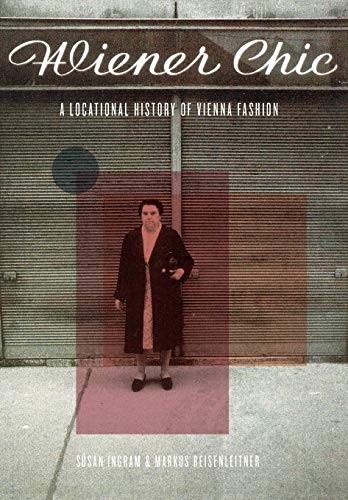
Vienna may not be synonymous with fashion like its metropolitan counterparts Paris and Milan, but it is a fashionable city, one that historically has been structured by changing fashions and fashionable appearances. Like the Litfaßsäule in Orson Welles’s 1949 urban noir masterpiece The Third Man, into which Harry Lime escapes in order to avoid capture and which hapless visitors today presume are merely surfaces for advertising, there are many overlooked aspects of Vienna’s distinct style and attitude. By focusing on fashion, Wiener Chic narrates Vienna’s history through an interpretation of the material dimensions of Viennese cultural life―from architecture to arts festivals to the urban fabric of street chic.
The first book that connects Vienna and fashion with urban theory, Wiener Chic draws on material that is virtually unknown in an English-language context to give readers an insider’s vantage point on an underappreciated European fashion capital.
Die Inhaltsangabe kann sich auf eine andere Ausgabe dieses Titels beziehen.
Über die Autorin bzw. den Autor
Susan Ingram is associate professor of humanities at York University.
Auszug. © Genehmigter Nachdruck. Alle Rechte vorbehalten.
Wiener Chic
A Location History of Vienna Fashion
By Susan Ingram, Markus ReisenleitnerIntellect Ltd
Copyright © 2013 Intellect Ltd
All rights reserved.
ISBN: 978-1-78320-184-6All rights reserved.
Contents
List of Illustrations,
Preface,
Introduction: Vienna's Culture of Appearance,
Part I: Chic Formations: The Cinematically Historical Underpinnings of Vienna's Urban Imaginary,
Chapter 1: Baroque Chic: Fashioning Courtly Spaces,
Chapter 2: Ringstrasse Chic: Vienna Moderns,
Chapter 3: Prolo Chic,
Chapter 4: ITL[Ausländer]ITL Chic,
Part II: Staging Fashion in Vienna,
Chapter 5: Museum Chic,
Chapter 6: Designer Chic,
Conclusion: Vienna Now, Not Never,
References,
Filmography,
CHAPTER 1
Baroque Chic: Fashioning Courtly Spaces
The Habsburgs come to town: Establishing Vienna's baroque imaginary
"When I walk along the Ring I always get the feeling that a modern Potemkin has wanted to create, in the visitor to Vienna, the impression of a city exclusively inhabited by nobles."
(Adolf Loos, cited in Stewart 78)
Vienna's global imaginary might be shaped by the imperial grandeur that is part of its baroque legacy, but Vienna was not always a court city. Nor has it ever been a court city like any other. As the seat of the Holy Roman Emperor, it hosted, for several centuries, the largest court in the European realm (Kauffmann 31), and that court determined the city's character more intensively and for a longer period of time than is true of other European court cities, whether London, Paris, St. Petersburg, or Madrid; only in the Istanbul of the Ottomans do we find something of comparable length and impact. The Habsburg legacy in Vienna is complex and motivates our decision to translate the designation Residenzstadt as court city rather than imperial city. The Driver and Gilbert edited collection Imperial Cities, which explores "the role of imperialism in the cultural history of the modern European metropolis" (Driver and Gilbert 3), is indicative of the tendency in contemporary, especially postcolonial, scholarship to focus on the colonial empires of the modern period rather than their ancient, medieval or early modern predecessors. Vienna's Habsburg heritage seamlessly bridges the city's pre-modern and modern pasts and requires a designation that sidesteps the danger of reducing that heritage to its baroque glory. One can see this tendency to blend the pre-modern and modern in the exhibition that Diana Vreeland spearheaded at the Metropolitan Museum of Art from December 1979 to August 1980 on "Fashions of the Hapsburg [sic] Era: Austria-Hungary." The catalogue of the exhibition opens with an essay by Joseph Wechsberg on the "Glory of Vienna" that, in turn, opens with "[t]he oldest known relic, a small figure of a woman, known as 'Venus of Willendorf' [that] was found northwest of Vienna [... and] is believed to date from the Old Stone Age, from about 20,000 BC [sic]" (Cone 21). Wechsberg proceeds to rattle off the city's accomplishments but soon finds himself caught up in the city's legendary taste culture. Vienna's past becomes a blur of music and bonhomie à la Musner: "Even in those days the Viennese liked music and celebrations. The city became known as a place for good living. Many nobles 'stayed much longer than their affairs demanded.' Same as today" (21). The days in question refer to Ottokar II's occupation of the city in the thirteenth century, but one sees how easily the city's courtly traditions can be dehistoricized and used to reduce past and present to a dreamlike fantasy of the splendiferous style that has come to be associated with the Habsburgs.
Although Vienna was first settled by the Celts in 500 BCE and called "Vindobona" by the Romans, for whom the Danube served as the northeastern border of their empire, it was not until the late Middle Ages that Vienna began to acquire the accoutrements that later became determinative for its urban mythology (ibid.). During the Early and High Middle Ages the predecessors of the Habsburgs as Austrian rulers, the Babenberg family, held itinerant courts, as was customary for the period, with Vienna being just one among other, equally important, central places of residence such as Innsbruck and Wiener Neustadt. Only in the late Middle Ages under the newly established dynasty of the Habsburgs did Vienna emerge as the most important city in this territory. The power vacuum created when the last Babenberger, the appositely named Friedrich der Streitbare (the Quarrelsome) who fell in battle with the Hungarians in 1246, was filled first by Ottokar II of Bohemia and then challenged by Rudolph I of Habsburg. Ottokar is credited with rebuilding the city after it was devastated twice by fire and with moving the court from Am Hof to the Hofburg (Lehne and Johnson 15), while Rudolph, who deposed him after a five-week siege in 1276, established what ended up being over 600 years of more or less uninterrupted Habsburg presence in the city, something that got off to a rather rocky start with further destructive fires and bouts of the Black Death. The rivalry that developed in the second half of the fourteenth century between the archduke Rudolph IV, who was withheld the honour of becoming an Elector in the Holy Roman Empire, and his father-in-law in Prague, the Wittelsbacher Holy Roman Emperor Karl IV, and the concomitant vying for prestige of the two powerful dynasties, left its impact on Vienna's urban fabric in the form of the Stephansdom and the founding of the university, the "Alma Mater Rudolphina 1365" (Vocelka 2001, 14), offsetting Prague's hegemonic status as a centre. Subsequently, the practice of the Habsburgs dividing their lands among their heirs led to political turmoil, factionalism, and a generally confusing situation during the late Middle Ages, with Graz and Innsbruck competing with Vienna as residences of branches of the Habsburgs, and the citizens of Vienna demonstrating their independence and political weight. This situation did not altogether change with the unification of the lands under Maximilian I (1493–1519), for whom Vienna was again just one among other places of residence, with Innsbruck his favourite. By 1510, all Vienna had become was the permanent place of assembly of the diets of what is now Lower Austria (Vocelka 2001, 15).
The situation changed when the Bohemian Crown and a smaller part of the Hungarian lands fell to the Habsburgs through the death of Louis Jagiello in 1526 at the important Battle of Mohács, which in many respects was far more influential for future Central European developments than the (vastly overrated) Peace of Westphalia of 1648. Maximilian's successor Ferdinand I (1522–64) became the ruler over a multinational empire (in 1556 he was also elected emperor of the Reich, establishing a tradition that would last until 1806), with centralized institutions and a constantly increasing imperial household and opportunities for the nobility to gain status and wealth by "being around." Vienna was the logical choice as court centre for Ferdinand, and during the sixteenth century the central agencies of the Austrian lands as well as the Reich were moved there. Ferdinand had already broken any political resistance on the part of Vienna's citizenry in 1522 (the Blutgericht – bloody court), and, after the successful defence against an Ottoman siege in 1529, he set up the Habsburg court there in 1533 and began fortifying the inner city with bastions to replace the heavily damaged medieval walls that...
„Über diesen Titel“ kann sich auf eine andere Ausgabe dieses Titels beziehen.
Suchergebnisse für Wiener Chic: A Locational History of Vienna Fashion...

Beispielbild für diese ISBN
Wiener Chic: A Locational History of Vienna Fashion (Urban Chic)
Anbieter: Powell's Bookstores Chicago, ABAA, Chicago, IL, USA
Verkäuferbewertung 5 von 5 Sternen

Paperback. Zustand: Used-Very Good. Pbk. Some shelf-wear. Else clean copy. Artikel-Nr. 1818811
Gebraucht kaufen
EUR 16,62
EUR 4,48 Versand
Versand innerhalb von USA
Versand innerhalb von USA
Anzahl: 1 verfügbar
Beispielbild für diese ISBN
Wiener Chic
Anbieter: PBShop.store US, Wood Dale, IL, USA
Verkäuferbewertung 5 von 5 Sternen
PAP. Zustand: New. New Book. Shipped from UK. Established seller since 2000. Artikel-Nr. CX-9781783201846
Beispielbild für diese ISBN
Wiener Chic
Anbieter: PBShop.store UK, Fairford, GLOS, Vereinigtes Königreich
Verkäuferbewertung 5 von 5 Sternen
PAP. Zustand: New. New Book. Shipped from UK. Established seller since 2000. Artikel-Nr. CX-9781783201846
Neu kaufen
EUR 25,08
EUR 4,99 Versand
Versand von Vereinigtes Königreich nach USA
Versand von Vereinigtes Königreich nach USA
Anzahl: 15 verfügbar