
Verwandte Artikel zu Throwing the Body into the Fight: A Portrait of Raimund...
Inhaltsangabe
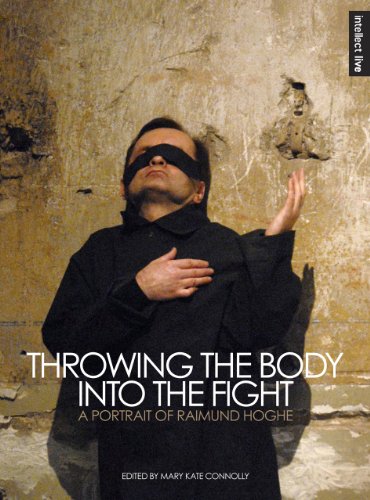
Throwing the Body into the Fight is the first English-language publication dedicated to the German choreographer Raimund Hoghe. Curated and edited by Mary Kate Connolly, the book operates as a collage, drawing together a variety of international voices to create a fragmented portrait of the artist. Lavishly illustrated with photographs by Rosa Frank, who has collaborated closely with Hoghe for two decades, this book will be welcomed by all who admire a man described by the New York Times—in its review of Hoghe’s 2012 “Pas de Deux” with Japanese dancer Takashi Ueno—as “a lover of romance and beautiful things.”
Die Inhaltsangabe kann sich auf eine andere Ausgabe dieses Titels beziehen.
Über die Autorin bzw. den Autor
Mary Kate Connolly is a writer, editor, and curator based in London, UK.
Auszug. © Genehmigter Nachdruck. Alle Rechte vorbehalten.
Throwing the Body into the Fight
A Portrait of Raimund Hoghe
By Mary Kate Connolly, Rosa Frank, Boris Charmatz, Laurent GoumarreIntellect Ltd
Copyright © 2013 Individual Contributors
All rights reserved.
ISBN: 978-1-78320-034-4All rights reserved.
Contents
In Conversation, 7,
Editor's Note 18 In Conversation, 9,
An Introduction to Raimund Hoghe by Mary Kate Connolly, 21,
Lettere Amorose: Lois Keidan, 32,
Raimund Hoghe's Emblems of Absence by Gerald Siegmund, 37,
In Conversation, 51,
Lettere Amorose: Finola Cronin, 52,
Luca Giacomo Schulte, 54,
Rosa Frank, 60,
In Conversation, 63,
Undone by Martin Hargreaves, 65,
Lettere Amorose: Philipp Gehmacher, 78,
In Conversation, 82,
Guerre et Paix by Laurent Goumarre, 85,
Young People, Old Voices, 90,
In Conversation, 92,
Lorenzo De Brabandere 98 Emmanuel Eggermont, 96,
Ornella Balestra, 100,
Lettere Amorose: Boris Charmatz, 102,
In Conversation, 106,
Stay a While: Raimund Hoghe's Histories by Dominic Johnson, 109,
Lettere Amorose: Meryl Tankard, 114,
In Conversation, 116,
Lettere Amorose: Franko B, 118,
In Conversation, 120,
Photo Archive, 124,
Contributor Biographies, 134,
Credits, 140,
CHAPTER 1
Lois Keidan
Lettere Amorose
As is the way with the most interesting artists, I first heard about Raimund Hoghe, not from a critic or a curator, but from another artist, Ajaykumar. Artists always know about significant artists and ideas way ahead of others, and this is often the case for those artists who are marginalized within more traditional cultural frameworks because of the radical nature of their practices and approaches. For an artist so explicitly addressing issues of cultural identity, disability and sexuality as Raimund Hoghe was in his first solo performance Meinwärts, it was, sadly, no surprise that he was ignored by most critics and curators. It took them years to catch up, but catch up they did, and I am delighted that Raimund is now one of the most celebrated choreographers and performance makers in the world.
But back to 1994 and Ajaykumar. Catherine Ugwu and I were running the performance space at the Institute of Contemporary Arts in London and were developing new programming strands that set out to reflect, contextualize and support the highly politicized performances being created by a new generation of artists in the UK and internationally (especially those forged in the culture wars raging across the USA). Ajay was keen to tell us about a German artist he had recently met, Raimund Hoghe, and a piece he had created about the life and death of the Jewish German singer Joseph Schmidt in the 1940s, and the ways in which Hoghe used Schmidt's experiences to mirror the AIDS pandemic and the rise of neo Nazis in the 1990s.
We were excited and intrigued, and immediately invited Raimund to London to present Meinwärts in a season we were curating about the relationships between biography and autobiography; how artists were telling the stories of themselves through the lives of others. Meinwärts proved to be one of the most exhilarating and moving performances that many of us had experienced for years. Unlike Hoghe's presentations of the piece in Germany and Austria where, he told us, many in the audience had walked out in disgust at its content, audiences in London were rapt and in turn Raimund felt that he had, at last, found a context for his work in Live Art.
Of course things have changed enormously since those days and Raimund's work is now feted by the Dance world as much as the Live Art world, graces the world's grandest stages and is acclaimed by critics. But what has not changed is the uncompromising nature of Hoghe's work and his extraordinary vision and integrity as an artist.
CHAPTER 2Gerald Siegmund
Raimund Hoghe's Emblems of Absence
The empty stage is lined by five young men with lowered heads and downcast eyes. They listen attentively to the Mozart tune that fills the air. One by one, the little man in black calls out their names. One by one they leave the stage to take a seat in the auditorium. The sound of their names reverberates in our head. They are gone, and where they once were, only emptiness remains. They have changed sides. They are with us now, but since they have thus opened up the space of the stage, by extension we might equally well have been where they once were. They become stand-ins for us, stand-ins in the place where we are not – which is the stage. Their absence is marked in the course of the performance by a bunch of flowers that Raimund Hoghe leaves in their stead. At the end, when Lettere Amorose is over, he will call them by name again. They will rise from their seats to take up again the places they had at the beginning. But now, they hold on to a bunch of flowers.
Flowers take the place of a person, who is a substitute for everybody in the audience. What we watch is therefore our own absence from the scene that is performed for us. An absence that is made felt by stressing it. Objects stand in for something absent – that is one way of characterizing the performances of Raimund Hoghe.
After the young men have left, Hoghe brings on lots of other objects from the wings. A glass of water and small bundle of flowers, little paravants, a pair of wooden Japanese shoes, Mikado sticks and, above all, various pieces of fabric which he will unfold in the course of the performance. He will dip the flowers in the glass to toss the water over his shoulder while kneeling on a long piece of cloth. He will hide behind the paravants like a small boy would lie behind them seeking shelter from the wind on a beach. He will build houses with little sticks and then destroy them again. He will traipse across the stage wearing the shoes with his head covered by a veil.
The connection between Raimund Hoghe's art and ritual, which I will explore in this text, has its origin in this time-consuming attention to detail. Every step and every gesture are meticulously articulated by a performer who is completely absorbed in what he does. He appears calm and composed, almost neutral, displaying no emotions while performing. Rigidly he adheres to a fixed sequence of steps and gestures whose rules are not to be altered, or the act performed might lose its magical power. In little choreographies, Hoghe performs geometrical patterns on the floor. He structures space and time as if the world would lose its coherence if the patterns were broken. But perhaps the world is already broken, and Hoghe establishes order where there is none simply by performing. He casts a spell over his objects in order to work miracles. All this draws on ritual practices, but as I would like to argue, it is at the same time closely linked to a poetic practice. Both ritual and poetry make use of the strategic device of repetition that serves a commemorative purpose. Raimund Hoghe's poetic rituals remember the absence of bodies and people, an absence that remains inscribed into the very presence of performing. To conceptualise this, I will draw on Walter Benjamin's theory of allegory and melancholy to define Hoghe's art as the production of what I call 'emblems of absence.'
A Space for His Body
In all of his pieces, Raimund Hoghe acts as a master of ceremonies. Just watch him lead dancer Sarah Chase back to her seat in the first row of the auditorium in Sarah, Vincent et moi, while he protectively...
„Über diesen Titel“ kann sich auf eine andere Ausgabe dieses Titels beziehen.
Suchergebnisse für Throwing the Body into the Fight: A Portrait of Raimund...

Beispielbild für diese ISBN
Throwing the Body Into the Fight: A Portrait of Raimund Hoghe (Intellect Live)
Anbieter: Anybook.com, Lincoln, Vereinigtes Königreich
Verkäuferbewertung 5 von 5 Sternen

Zustand: Good. This is an ex-library book and may have the usual library/used-book markings inside.This book has soft covers. In good all round condition. Please note the Image in this listing is a stock photo and may not match the covers of the actual item,550grams, ISBN:9781783200344. Artikel-Nr. 9762411
Gebraucht kaufen
EUR 5,33
EUR 15,55 Versand
Versand von Vereinigtes Königreich nach USA
Versand von Vereinigtes Königreich nach USA
Anzahl: 1 verfügbar
Beispielbild für diese ISBN
Throwing the Body into the Fight: A Portrait of Raimund Hoghe (Intellect Live)
Anbieter: Phatpocket Limited, Waltham Abbey, HERTS, Vereinigtes Königreich
Verkäuferbewertung 5 von 5 Sternen
Zustand: Good. Your purchase helps support Sri Lankan Children's Charity 'The Rainbow Centre'. Ex-library, so some stamps and wear, but in good overall condition. Our donations to The Rainbow Centre have helped provide an education and a safe haven to hundreds of children who live in appalling conditions. Artikel-Nr. Z1-T-006-02115
Gebraucht kaufen
EUR 10,39
EUR 12,69 Versand
Versand von Vereinigtes Königreich nach USA
Versand von Vereinigtes Königreich nach USA
Anzahl: 1 verfügbar
Beispielbild für diese ISBN
Throwing The Body Into The Fight
Anbieter: Majestic Books, Hounslow, Vereinigtes Königreich
Verkäuferbewertung 4 von 5 Sternen

Zustand: New. pp. 140. Artikel-Nr. 57997741
Neu kaufen
EUR 21,15
EUR 7,75 Versand
Versand von Vereinigtes Königreich nach USA
Versand von Vereinigtes Königreich nach USA
Anzahl: 1 verfügbar
Beispielbild für diese ISBN
Throwing The Body Into The Fight: A Portrait Of Raimund Hoghe
Anbieter: Romtrade Corp., STERLING HEIGHTS, MI, USA
Verkäuferbewertung 5 von 5 Sternen
Zustand: New. This is a Brand-new US Edition. This Item may be shipped from US or any other country as we have multiple locations worldwide. Artikel-Nr. ABBB-177252