
Verwandte Artikel zu Piercing Time: Paris After Marville and Atget 1865-2012
Inhaltsangabe
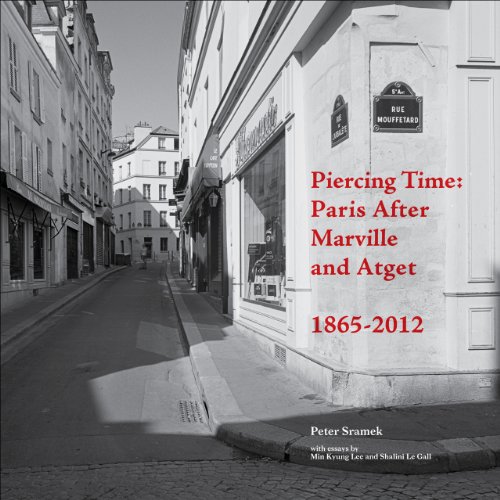
Piercing Time examines the role of photography in documenting urban change by juxtaposing contemporary "rephotographs" taken by the author with images of nineteenth century Paris taken by Charles Marville, who worked under Georges Haussmann, and corresponding photographs by Eugène Atget taken in the early twentieth century. Revisiting the sites of Marville's photographs with a black cloth, tripod, and view camera, Peter Sramek creates here a visually stunning book that investigates how urban development, the use of photography as a documentary medium, and the representation of urban space reflect attitudes towards the city. The essays that run alongside these fascinating images discuss subjects such as the aesthetics of ruins and the documentation of the demolitions that preceded Haussmannization, as well as the different approaches taken by Marville and Atget to their work. The book also includes contemporary interviews with local Parisians, extracts from Haussmann's own writing, and historical maps that allow for an intriguing look at the shifting city plan.Sure to be of interest to lovers of the city, be they Parisians or visitors, Piercing Time provides a unique snapshot of historical changes of the past 150 years. But it will also be of enduring value to scholars. The accurate cataloguing and high quality reproductions of the images make it a resource for a significant portion of the Marville collection in the Musée Carnavalet, and it will aid further research in urban history and change in Paris over the past century and a half. Photographers will also be drawn to the book for its new thinking in relation to documentary methodologies.
Die Inhaltsangabe kann sich auf eine andere Ausgabe dieses Titels beziehen.
Über die Autorin bzw. den Autor
Peter Sramek is a visual artist with a practice in photography and book arts. As professor emeritus at OCAD University in Canada, he has worked to develop innovative curriculum in the arts over more than four decades. Since 2010, development of the INTAC network has been a key focus for his ongoing efforts to expand experiential and cross-cultural learning opportunities for students. He is the author of Piercing Time: Paris After Marville and Atget 1865-2012, also published by Intellect Books.
Auszug. © Genehmigter Nachdruck. Alle Rechte vorbehalten.
Piercing Time: Paris After Marville and Atget 1865-2012
By Peter SramekIntellect Ltd
Copyright © 2013 Intellect Ltd
All rights reserved.
ISBN: 978-1-78320-033-7All rights reserved.
Contents
Acknowledgements, 7,
Introduction, 8,
A Paris Diagonal, 10,
Rephotographic Practices, 14,
Marville Rephotographs Paris: 1865 and 1877, 16,
Atget and Rephotography, 19,
Methodologies, 20,
Performing the City Cultural Heritage and Modernity, 24,
Avenue de l'Opéra, 30,
Le Percement de l'avenue de l'Opéra Charles Marville and the Aesthetics of Ruins – Shalini Le Gall, 56,
Halles - Auxerre, 64,
Constructing Nineteenth-Century Paris through Cartography and Photography – Min Kyung Lee, 100,
Ile-de-la-Cité, 158,
Saint-Séverin - Place Maubert, 176,
Montagne-Sainte-Geneviève, 242,
La Bièvre - Rue Monge, 320,
Saint-Marcel - Gobelins, 390,
The Marville Archive, 432,
Technical Notes, 436,
Bibliography Indexes, 437,
Photographs by Charles Marville, 438,
Photographs by Eugène Atget, 443,
Cartography and Illustrations, 445,
Locations, 446,
About the Authors, 451,
Photography Credits, 453,
CHAPTER 1
A Paris Diagonal
Peter Sramek
The Second Empire period, which saw the urban renewal of Paris under Napoleon III and his Prefect, Georges-Eugène Haussmann, also gave rise to the photographic record which Charles Marville was commissioned to complete. His documentation of the streets slated for demolition led to a methodical recording of Paris as it existed in the mid-1860s. The scale and particularity of this project was unprecedented in the field of urban photography. Artists using drawing, engraving or watercolour had of course done similar illustrative documentation, so the idea of producing a systematic visual record was not new. Putting photography to this task heralded a new world for documenting human endeavours. Peter Barberie (2007), in his work on Marville's earlier commission to photograph the renewed Bois de Boulogne, deconstructs the vision and meanings behind such photographic documentation. When considering urban documentation in particular, other examples of extensive projects also exist elsewhere, such as in the collection of the Fratelli Alinari Studio in Florence, which, although working later in the century, provides an example of a systematic recording of art and monumental architecture, in this case to build a collection of views for commercial sale. The concept of cataloguing, prevalent in this time, was applied naturally to the new medium of photography, which could so readily be put to the task of producing a visual record to be classified, categorized and collected.
Planned urban change by edict was well-known in Paris long before Louis Napoleon drew lines on his great map of the city. Going back to Charles V (1364-1380) and his establishing of the Administration des Bâtiments Royaux (Tung 2001: 292) one can trace urban projects initiated by a series of monarchs. One thinks of the creation of the place des Vosges in 1605 and the rue de Rivoli in 1801. Tung (2001: 277) points out that '[t]he general concept of comprehensive planning was associated with the exercise of absolute autocratic power' and this was an underlying understanding as Napoleon III and Baron Haussmann took control of Paris. Nonetheless, the creation of new mandated streets under Haussmann, with his severe cutting through of existing buildings, had never been experienced on such a scale. It is no surprise that photography was engaged to record such radical urban change.
More unusual in the context of such dramatic urban planning may be Marville's assigned task of documenting the old before it disappeared, rather than representing the process of renewal itself. However, interest in 'Old Paris' was not new when Marville was commissioned by the Services des Travaux Historiques. This department was created in 1865 under Napoleon III and immediately undertook a compendium publication on vieux Paris. Photographs and engravings were to play an important role in this publication. This was later abandoned in 1871 with the fall of the Second Empire and the materials dispersed to various archives, including the Musée Carnavalet. It is unclear if Marville was directly involved in any way with this project, but it reflects the interest in documenting historical Paris even in the midst of a push to modernize. Despite his radical approach to urban renovation, Haussmann displayed an interest in preserving a record of the past, suggesting the purchase of the Hôtel Carnavalet to establish a new museum of the history of the city. Although we now equate old photographs with a nostalgia for and romantic vision of the past, these sensibilities were present in Paris before the birth of the medium that could stop time so eloquently. The 1830s had seen a rising consciousness of issues related to preservation and there was a growing concern with the loss of the character of the city. In 1831, Victor Hugo had published Notre-Dame de Paris ('The Hunchback of Notre Dame') in which he rails against the degradation of historical architecture:
There remains today but a very imperceptible vestige of the Place de Grève, such as it existed then; it ... would soon have disappeared, perhaps submerged by that flood of new houses which so rapidly devours all the ancient façades of Paris. (Book 2, Chapter II)
If we had leisure to examine with the reader, one by one, the diverse traces of destruction imprinted upon the old church, time's share would be the least, the share of men the most, especially the men of art, since there have been individuals who assumed the title of architects during the last two centuries ... The centuries, the revolutions, which at least devastate with impartiality and grandeur, have been joined by a cloud of school architects, licensed, sworn, and bound by oath; defacing with the discernment and choice of bad taste. (Book 3, Chapter I)
There were those of course who championed the modern future of the city and for them the photograph represented the new industrial age, an age of scientific certainties and observable proofs. With its ability to record detail in such a 'scientific' manner, it is no surprise that photography was so quickly engaged to both capture the old and herald the new. The impetus to have Marville record the streets about to be demolished may just as likely have been motivated by the desire to preserve proof of positive change as to build a visual record of heritage lost. With attitudes prevalent on both sides, photography could provide material for either. Under Haussmann, Marville was only commissioned to photograph the old, rather than to record the forward march of demolition and reconstruction. Demolitions only come to the fore in his images from the late 1870s, when he was asked by the city to photograph for the Universal Exposition. For this commission, the objective was explicitly to illustrate modernization and he photographed new boulevards across Paris and the, then current, demolitions for the completion of the avenue de l'Opéra (see Le Gall in this volume).
When viewed today, Marville's photographs provide a comprehensive visual record of Paris as it existed at this focal point of change. Unlike maps, with their quasi-temporal layers of information and their distillation of location into line, photographs show what was there in front of the lens – at least the stationary...
„Über diesen Titel“ kann sich auf eine andere Ausgabe dieses Titels beziehen.
Suchergebnisse für Piercing Time: Paris After Marville and Atget 1865-2012

Foto des Verkäufers
Piercing Time: Paris After Marville and Atget 1865-2012
Verlag:
Intellect, Bristol, 2013
ISBN 10: 1783200332
ISBN 13: 9781783200337
Gebraucht
Hardcover
Erstausgabe
Anbieter: Jeff Hirsch Books, ABAA, Wadsworth, IL, USA
Verkäuferbewertung 5 von 5 Sternen

First Edition. First edition. Small oblong hardcover. 453 pages. Text by Peter Sramek and with essays by Min Kyung Lee and Shalini Le Gall. Includes numerous black and white images. A near fine copy in illustrated boards with some slight bumping to the top corners. No dust jacket as issued. Artikel-Nr. 162593
Gebraucht kaufen
EUR 133,40
EUR 6,04 Versand
Versand innerhalb von USA
Versand innerhalb von USA
Anzahl: 1 verfügbar
Beispielbild für diese ISBN
Piercing Time
Anbieter: PBShop.store UK, Fairford, GLOS, Vereinigtes Königreich
Verkäuferbewertung 5 von 5 Sternen
HRD. Zustand: New. New Book. Shipped from UK. Established seller since 2000. Artikel-Nr. CW-9781783200337
Neu kaufen
EUR 160,32
EUR 12,96 Versand
Versand von Vereinigtes Königreich nach USA
Versand von Vereinigtes Königreich nach USA
Anzahl: 15 verfügbar
Beispielbild für diese ISBN
Piercing Time
Anbieter: PBShop.store US, Wood Dale, IL, USA
Verkäuferbewertung 5 von 5 Sternen
HRD. Zustand: New. New Book. Shipped from UK. Established seller since 2000. Artikel-Nr. CW-9781783200337
Neu kaufen
EUR 177,18
Versand gratis
Versand innerhalb von USA
Versand innerhalb von USA
Anzahl: 15 verfügbar
Beispielbild für diese ISBN
Piercing Time: Paris after Marville and Atget 1865-2012
Anbieter: Ria Christie Collections, Uxbridge, Vereinigtes Königreich
Verkäuferbewertung 5 von 5 Sternen
Zustand: New. In. Artikel-Nr. ria9781783200337_new
Neu kaufen
EUR 172,49
EUR 14,00 Versand
Versand von Vereinigtes Königreich nach USA
Versand von Vereinigtes Königreich nach USA
Anzahl: 20 verfügbar
Beispielbild für diese ISBN
Piercing Time Paris after Marville and Atget 18652012
Anbieter: Revaluation Books, Exeter, Vereinigtes Königreich
Verkäuferbewertung 5 von 5 Sternen
Hardcover. Zustand: Brand New. 576 pages. 9.00x9.00x1.25 inches. In Stock. Artikel-Nr. __1783200332
Neu kaufen
EUR 186,93
EUR 23,37 Versand
Versand von Vereinigtes Königreich nach USA
Versand von Vereinigtes Königreich nach USA
Anzahl: 2 verfügbar
Foto des Verkäufers
Sramek, P: Piercing Time
Anbieter: moluna, Greven, Deutschland
Verkäuferbewertung 5 von 5 Sternen
Zustand: New. Examines the role of photography in documenting urban change by juxtaposing contemporary rephotographs taken by the author with images of nineteenth-century Paris taken by Charles Marville, who worked under Georges Haussmann, and corresponding photographs. Artikel-Nr. 596838517
Neu kaufen
EUR 166,99
EUR 48,99 Versand
Versand von Deutschland nach USA
Versand von Deutschland nach USA
Anzahl: Mehr als 20 verfügbar
Beispielbild für diese ISBN
Piercing Time
Anbieter: Kennys Bookstore, Olney, MD, USA
Verkäuferbewertung 5 von 5 Sternen
Zustand: New. Examines the role of photography in documenting urban change by juxtaposing contemporary "rephotographs" taken by the author with images of nineteenth-century Paris taken by Charles Marville, who worked under Georges Haussmann, and corresponding photographs by Eugene Atget taken in the early twentieth century. Num Pages: 456 pages, 300 colour plates, 210 halftones, 22 maps. BIC Classification: 1DDF; AJB; AJC; JFSG. Category: (G) General (US: Trade). Dimension: 228 x 224 x 39. Weight in Grams: 1938. . 2013. Hardcover. . . . . Books ship from the US and Ireland. Artikel-Nr. V9781783200337
Neu kaufen
EUR 255,14
EUR 9,07 Versand
Versand innerhalb von USA
Versand innerhalb von USA
Anzahl: 15 verfügbar