
Verwandte Artikel zu Cultural Migrants and Optimal Language Acquisition...
Cultural Migrants and Optimal Language Acquisition (Second Language Acquisition, 91) - Hardcover
Buch 94 von 188: Second Language Acquisition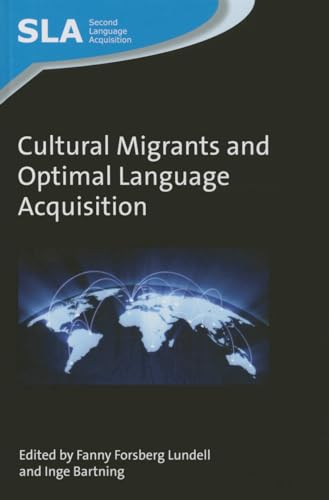
Inhaltsangabe
This volume investigates cultural migrants: people who, from their own free will, move to another country because of their interest in the target language and culture. Chapters include studies on cultural migrants acquiring French, Italian, Spanish and English and consider linguistic, psycholinguistic, sociolinguistic and pragmatic aspects of language acquisition. Cultural migrants have social and psychological advantages when acquiring a second language as adults, and the study of their linguistic knowledge and production increases our understanding of the possibilities and limits of L2 ultimate attainment. The work thus fills a gap in our understanding of high-level proficiency and will be of interest to researchers working in the field of SLA, as well as to social scientists studying the relationship between language, culture and integration.
Die Inhaltsangabe kann sich auf eine andere Ausgabe dieses Titels beziehen.
Über die Autorinnen und Autoren
Fanny Forsberg Lundell is Associate Professor of French Linguistics at Stockholm University. Besides publishing extensively on formulaic language in French and Spanish as second languages, with a particular focus on high-level proficiency, she also works on pragmatics, conversation analysis and spoken language in general. Recently, her work includes psychological perspectives on high-level L2 attainment.
Inge Bartning is Professor Emerita of French at Stockholm University. She has taught and published in the domain of French syntax, semantics and pragmatics. In the last two decades her main interest has been in French L2 acquisition, in particular the domain of developmental stages, advanced learners and ultimate attainment of morphosyntax, discourse and information structure.
Fanny Forsberg Lundell is Associate Professor of French Linguistics at Stockholm University. Besides publishing extensively on formulaic language in French and Spanish as second languages, with a particular focus on high-level proficiency, she also works on pragmatics, conversation analysis and spoken language in general. Recently, her work includes psychological perspectives on high-level L2 attainment.
Inge Bartning is Professor Emerita of French at Stockholm University. She has taught and published in the domain of French syntax, semantics and pragmatics. In the two last decades her main interest has been in French L2 acquisition, in particular the domain of developmental stages, advanced learners and ultimate attainment of morphosyntax, discourse and information structure.
Fanny Forsberg Lundell is Associate Professor of French Linguistics at Stockholm University. Besides publishing extensively on formulaic language in French and Spanish as second languages, with a particular focus on high-level proficiency, she also works on pragmatics, conversation analysis and spoken language in general. Recently, her work includes psychological perspectives on high-level L2 attainment.Inge Bartning is Professor Emerita of French at Stockholm University. She has taught and published in the domain of French syntax, semantics and pragmatics. In the last two decades her main interest has been in French L2 acquisition, in particular the domain of developmental stages, advanced learners and ultimate attainment of morphosyntax, discourse and information structure.
Auszug. © Genehmigter Nachdruck. Alle Rechte vorbehalten.
Cultural Migrants and Optimal Language Acquisition
By Fanny Forsberg Lundell, Inge BartningMultilingual Matters
Copyright © 2015 Fanny Forsberg Lundell, Inge Bartning and the authors of individual chapters
All rights reserved.
ISBN: 978-1-78309-403-5All rights reserved.
Contents
Contributors,
Cultural Migrants: Introducing a New Concept in SLA Research Fanny Forsberg Lundell and Inge Bartning,
Part 1: Focus on Cultural Migrants,
1 Beyond Native-like? The Lexical Profile of a Cultural Migrant in Italy Anna Gudmundson and Camilla Bardel,
2 Successful Profiles in High-level L2 French – 'c'est un choix de vie' Fanny Forsberg Lundell and Inge Bartning,
3 Reported Use and Perception of tu and vous Among Less Integrated and Highly Integrated Anglophone Cultural Migrants in France Amanda Edmonds and Catherine Guesle-Coquelet,
4 L2 English Vocabulary in a Long-residency Swedish Group Compared to a Group of English Native Speakers Britt Erman and Margareta Lewis,
Part 2: Culture as a Decisive Factor in L2 Attainment,
5 Migratory Experience and Second Language Acquisition Among Polish and Chinese Migrants in Dublin, Ireland Chloé Diskin and Vera Regan,
6 Acculturation as the Key to the Ultimate Attainment? The Case of Polish-English Bilinguals in the UK Kate Hammer and Jean-Marc Dewaele,
7 The Role of Sociopsychological Factors in Long-term L2 Achievement of L1 Chinese Learners of L2 Spanish Gisela Granena,
Concluding Chapter: What Can SLA Learn From Cultural Migrants? Fanny Forsberg Lundell and Inge Bartning,
Index,
CHAPTER 1
Beyond Native-like? The Lexical Profile of a Cultural Migrant in Italy
Anna Gudmundson and Camilla Bardel
Introduction
In this study we analyse lexical variation and lexical sophistication in cross-sectional data from six Swedish L2 users of Italian, who regularly visit Italy or have lived in the country for long periods, but then moved back to Sweden and enrolled in courses in Italian at Stockholm University. The main focus of this chapter, however, is a longitudinal study of a very advanced learner of Italian, a young Swedish woman, Alva, who has chosen to live in Italy for personal reasons. Her level of oral proficiency is very high when it comes to grammar and pronunciation. As regards her vocabulary, there are no formal deviances from the target norm. Aspects of her vocabulary are compared, using lexical profiling data based on the tools Vocd and LOPP f, to that of native speakers of Italian, and in addition to the profiling data, we also carry out a qualitative analysis of her vocabulary, focusing mainly on the low-frequency words and on the words that differ between Alva and the native speakers. Analysing the words that are unique in Alva's production, that is, words that are not used in any of the native speakers' productions, allows us to see if, and in that case how, an advanced learner's vocabulary may differ from that of native speakers. A frequency-based perspective is adopted, according to which high-frequency words are assumed to be learnt earlier than low-frequency words (Cobb & Horst, 2004).
What characterises a cultural migrant from a sociolinguistic and a proficiency point of view? By the term cultural migrant, we mean someone who, for one reason or the other, is personally interested in the target language and culture, and therefore moves to, or spends a lot of time in, a country where the target language is spoken.
According to Forsberg Lundell and Bartning (this volume) cultural migrants are people who decide 'out of their free will, to move to another country permanently and learn another language. The culture of the target language country is highly appealing to them and they make an active choice to live in this new culture'. They are also, according to Forsberg Lundell and Bartning (this volume), often well integrated, with high degrees of education, something that leads to good chances to practice the L2. While the effect of practice in a second language is still an issue of debate (DeKeyser, 2007), it is assumed here that time spent in the TL country under the circumstances characterised by the motivation of someone who has chosen to live in a particular country may promote a high level of L2 attainment.
The informant Alva satisfies all the prerequisites of the above definition of a cultural migrant. In addition to her case, the other informants investigated in this study can be said to fulfil part of the definition. The main difference between them and Alva is that they have moved back to Sweden, their home country. The periods they have spent in Italy are in some cases also shorter than the time spent by Alva, in others longer. Characteristic for the whole group is that they all have high degrees of education, and they all have positive attitudes towards Italy and the Italian language, and during their stays in the country they were all immersed in the target language culture (see Tables 1.1 and 1.2 for detailed information about the informants). In Schumann's (1986) terms, the degree of acculturation can be assumed to be high in all the informants, and thus, as Schumann's acculturation model suggests, their chances of achieving high levels of L2 attainment are high: 'Learners will acquire the target language to the degree they acculturate to the target language group' (Schumann, 1986: 379).
As already mentioned, the particular linguistic aspect of interest in this study is vocabulary use. To our knowledge, the vocabulary of cultural migrants has not been much investigated (but see Forsberg-Lundell & Lindqvist, 2014). It seems reasonable to assume that someone living in the TL country has optimal chances to develop the L2 vocabulary, thanks to a rich input and many opportunities for practice in interaction.
The level of vocabulary richness in oral production can be measured with a number of different measures, ranging from the type-token ratio and more elaborated variants thereof (Daller et al., 2003) to mere judgements made by language teachers (Tidball & Treffers-Daller, 2008). In this study, we will discuss the results obtained from two measures, the D measure, or Vocd (Malvern et al., 2004), which measures lexical variation, and the Lexical Oral Production Profile (LOPPf), a recently developed instrument for measuring lexical sophistication in Italian oral production, by means of proportion of low-frequency words. The production of the learners is compared to frequency bands based on the 3000 most frequent words from target language corpora and the words that fall outside the 3000 most frequent words are the so-called offlist words. In some studies (e.g. Lindqvist et al., 2011) the words that fall outside the 2000 most frequent words, i.e. band 3-words and offlist words, are considered advanced. Hence, LOPPf is an instrument used for measuring lexical sophistication defined as the proportion of low-frequency words in the total of words produced (Laufer & Nation, 1995). Lexical variation, or diversity, can be measured by the simple type/token ratio (TTR), a calculation of the number of types divided by the number of tokens in a text. However, it has been pointed out by many that a problem with TTR is its sensitivity to text length: 'The more words (tokens) a text has, the less likely it is that new words (types) will occur' (McCarthy & Jarvis, 2007: 460). The longer the text, the more often words are repeated, high-frequency words will be repeated more often, in comparison to low-frequency words, and this tendency will...
„Über diesen Titel“ kann sich auf eine andere Ausgabe dieses Titels beziehen.
Suchergebnisse für Cultural Migrants and Optimal Language Acquisition...

Beispielbild für diese ISBN
CULTURAL MIGRANTS AND OPTIMAL LANGUAGE ACQUISITION
Anbieter: Romtrade Corp., STERLING HEIGHTS, MI, USA
Verkäuferbewertung 5 von 5 Sternen

Zustand: New. This is a Brand-new US Edition. This Item may be shipped from US or any other country as we have multiple locations worldwide. Artikel-Nr. ABBB-193467
Beispielbild für diese ISBN
Cultural Migrants and Optimal Language Acquisition (Second Language Acquisition)
Anbieter: Majestic Books, Hounslow, Vereinigtes Königreich
Verkäuferbewertung 4 von 5 Sternen

Zustand: New. pp. 248. Artikel-Nr. 373591581
Neu kaufen
EUR 118,38
EUR 7,68 Versand
Versand von Vereinigtes Königreich nach USA
Versand von Vereinigtes Königreich nach USA
Anzahl: 1 verfügbar
Beispielbild für diese ISBN
Cultural Migrants and Optimal Language Acquisition (Second Language Acquisition, 91)
Anbieter: Ria Christie Collections, Uxbridge, Vereinigtes Königreich
Verkäuferbewertung 5 von 5 Sternen
Zustand: New. In English. Artikel-Nr. ria9781783094035_new
Neu kaufen
EUR 133,89
EUR 13,34 Versand
Versand von Vereinigtes Königreich nach USA
Versand von Vereinigtes Königreich nach USA
Anzahl: 2 verfügbar
Beispielbild für diese ISBN
Cultural Migrants and Optimal Language Acquisition
Anbieter: Revaluation Books, Exeter, Vereinigtes Königreich
Verkäuferbewertung 5 von 5 Sternen
Hardcover. Zustand: Brand New. 240 pages. 9.37x6.61x0.79 inches. In Stock. Artikel-Nr. __1783094036
Neu kaufen
EUR 139,66
EUR 14,77 Versand
Versand von Vereinigtes Königreich nach USA
Versand von Vereinigtes Königreich nach USA
Anzahl: 2 verfügbar