
Verwandte Artikel zu Identity and Language Learning: Extending the Conversation
Inhaltsangabe
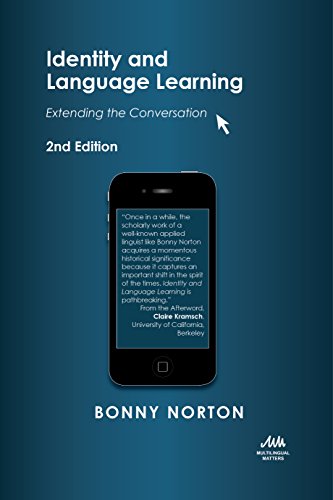
Identity and Language Learning draws on a longitudinal case study of immigrant women in Canada to develop new ideas about identity, investment, and imagined communities in the field of language learning and teaching. Bonny Norton demonstrates that a poststructuralist conception of identity as multiple, a site of struggle, and subject to change across time and place is highly productive for understanding language learning. Her sociological construct of investment is an important complement to psychological theories of motivation. The implications for language teaching and teacher education are profound. Now including a new, comprehensive Introduction as well as an Afterword by Claire Kramsch, this second edition addresses the following central questions: - Under what conditions do language learners speak, listen, read and write? - How are relations of power implicated in the negotiation of identity? - How can teachers address the investments and imagined identities of learners? The book integrates research, theory, and classroom practice, and is essential reading for students, teachers and researchers in the fields of language learning and teaching, TESOL, applied linguistics and literacy. This book is open access under a CC BY ND licence.
Die Inhaltsangabe kann sich auf eine andere Ausgabe dieses Titels beziehen.
Über die Autorin bzw. den Autor
Bonny Norton is a Professor and Distinguished University Scholar in the Department of Language and Literacy Education, University of British Columbia, Canada. She is committed to social change through the power of ideas and the integration of theory, research, and practice. In 2010 she was the inaugural recipient of the “Senior Researcher Award� by the Second Language Research group of AERA (American Educational Research Association) and in 2012 was inducted as an AERA Fellow. Her website can be found at http: //www.educ.ubc.ca/faculty/norton/
Auszug. © Genehmigter Nachdruck. Alle Rechte vorbehalten.
Identity and Language Learning
Extending the Conversation
By Bonny NortonMultilingual Matters
Copyright © 2013 Bonny Norton
All rights reserved.
ISBN: 978-1-78309-055-6All rights reserved.
Contents
Preface, ix,
Introduction, 1,
1 Fact and Fiction in Language Learning, 41,
2 Researching Identity and Language Learning, 58,
3 The World of Adult Immigrant Language Learners, 76,
4 Eva and Mai: Old Heads on Young Shoulders, 97,
5 Mothers, Migration and Language Learning, 124,
6 Second Language Acquisition Theory Revisited, 146,
7 Claiming the Right to Speak in Classrooms and Communities, 170,
Afterword: Claire Kramsch, 192,
References, 202,
Index, 211,
CHAPTER 1
Fact and Fiction in Language Learning
As Saliha takes the envelope, she says, 'Merci beaucoup, Madame Rivest.' Stepping out the door, she switches the plastic bag containing her work clothes from her right hand to her left hand and extends her right hand to Madame Rivest and says, 'Bonjour, Madame Rivest' and smiles. These are the first real words she has uttered since she woke up that morning.
In the elevator, going down, Saliha is alone. She checks the contents of the envelope and smiles with satisfaction. Before the elevator reaches the ground floor, Saliha has time to reflect on her day. She has earned enough for the week's food and cigarettes. Last week, she paid the last instalment for her tuition at Plato College. She is tired but life is under control. Her only regret is that she hasn't answered Madame Rivest in longer sentences. But she chases away her regrets with a light shrug and admits the reality.
We come here to speak like them, she thinks; but it will be a long time before they let us practise.
Ternar, 1990, pp. 327–8
Although Saliha is a fictional character, her story is real to many language learners, whether in Canada, Colombia or Korea. Saliha is eager to learn the language of her new community in Quebec and she understands the need to practice the French that she is learning in the formal context of Plato College. However, although 'immersed' in the francophone community, Saliha has little opportunity to practice French because of the nature of the work she does and the way relations of power are structured in her workplace. In the course of a long day at work, the only words she has uttered are 'Merci beaucoup, Madame Rivest' and 'Bonjour, Madame Rivest'. It is with regret that she notes she has not answered Madame Rivest in longer sentences. The reality that Saliha has to confront is that Madame Rivest has the power to influence when she can speak, how much she can speak and what she can speak about. Saliha acknowledges that it will be a long time before Madame Rivest will 'let' her practice speaking the target language.
In this chapter, I draw on Saliha's fictional story in Quebec, Canada to begin an exploration of the relationship between identity and language learning, between the individual language learner and the larger social world. I use her story to illustrate notions of power, identity and investment, and conceptions of ethnicity, gender and class. In the following chapters of the book, I move from Saliha's fictional world in Quebec to the lived experiences of five immigrant women learning English in the neighboring province of Ontario, Canada. I demonstrate that the opportunities these women had to practice English were structured by unequal relations of power in the home and workplace. I illustrate how the women responded to and acted upon these relations of power to create opportunities to practice speaking English, and the extent to which they succeeded in their efforts. I argue, however, that their efforts must be understood with reference to their investment in English and their changing identities across historical time and social space. Thus the ideas and themes introduced in this chapter will re-emerge in later chapters, demonstrating, I believe, that truth is indeed stranger than fiction, life more intriguing than art.
SaLiha and the SLA Canon
Saliha would struggle to recognize herself in current theories of second language acquisition (SLA). She could be overwhelmed by perspectives from psycholinguistics, sociolinguistics, neurolinguistics, classroom research, bilingual education and social psychology. She would probably agree, however, as Spolsky (1989) notes, that the more she is exposed to and practices French, the more proficient she will become. Extensive exposure to French, in relevant kinds and amounts, and the opportunity to practice the target language will reap many rewards for her. She will learn to discriminate between the sounds of the language, have the opportunity to analyze the language into its constituent parts, learn how its constituent parts can be recombined grammatically into larger units, and develop control over the grammatical and pragmatic structures of French. Saliha would be mystified, however, by Spolsky's distinction between the natural or informal environment of the target language community and the formal environment of the classroom:
The distinction between the two is usually stated as a set of contrasting conditions. In natural second language learning, the language is being used for communication, but in the formal situation it is used only to teach. In natural language learning, the learner is surrounded by fluent speakers of the target language, but in the formal classroom, only the teacher (if anyone) is fluent. In natural learning, the context is the outside world, open and stimulating; in formal learning, it is the closed four walls of the classroom. In natural language learning, the language used is free and normal; in the formal classroom it is carefully controlled and simplified. Finally, in the natural learning situation, attention is on the meaning of the communication; in the formal situation, it is on meaningless drills. (1989, p. 171)
'How much communicating did I do today?' Saliha may well ask, 'How meaningful are my conversations with Madame Rivest?' Because many SLA theorists have not addressed the experiences of language learners with reference to inequitable relations of power between language learners and target language speakers, they have struggled to theorize the relationship between the individual language learner and the larger social world. In general, artificial distinctions have been drawn between the learner and the language learning context. On the one hand, the individual is described with respect to a host of affective variables such as her or his motivation to learn a second language. The personality of the individual is described as introverted or extroverted, inhibited or uninhibited. It is assumed that the learner's attitudes towards the target language community determine how motivated the second language learner is, and that levels of anxiety determine how much comprehensible input becomes cognitive intake. The social, on the other hand, generally refers to group differences between the language learner group and the target language group. Where there is congruence between the second language group and the target language group, the social distance between them is considered to be minimal, which in turn facilitates the acculturation of the second language group into the target language group and enhances language learning (Schumann, 1976a). Where there is great social distance between the groups, little acculturation is considered to take place, and as a result members of the second language group are deemed not to...
„Über diesen Titel“ kann sich auf eine andere Ausgabe dieses Titels beziehen.
Suchergebnisse für Identity and Language Learning: Extending the Conversation

Beispielbild für diese ISBN
Identity and Language Learning
Anbieter: PBShop.store UK, Fairford, GLOS, Vereinigtes Königreich
Verkäuferbewertung 5 von 5 Sternen

HRD. Zustand: New. New Book. Shipped from UK. Established seller since 2000. Artikel-Nr. CX-9781783090556
Neu kaufen
EUR 83,93
EUR 5,91 Versand
Versand von Vereinigtes Königreich nach USA
Versand von Vereinigtes Königreich nach USA
Anzahl: 15 verfügbar
Beispielbild für diese ISBN
Identity and Language Learning
Anbieter: PBShop.store US, Wood Dale, IL, USA
Verkäuferbewertung 5 von 5 Sternen
HRD. Zustand: New. New Book. Shipped from UK. Established seller since 2000. Artikel-Nr. CX-9781783090556
Beispielbild für diese ISBN
Identity and Language Learning: Extending the Conversation
Anbieter: Ria Christie Collections, Uxbridge, Vereinigtes Königreich
Verkäuferbewertung 5 von 5 Sternen
Zustand: New. In English. Artikel-Nr. ria9781783090556_new
Neu kaufen
EUR 101,95
EUR 13,28 Versand
Versand von Vereinigtes Königreich nach USA
Versand von Vereinigtes Königreich nach USA
Anzahl: Mehr als 20 verfügbar
Beispielbild für diese ISBN
Identity and Language Learning: Extending the Conversation
Anbieter: Revaluation Books, Exeter, Vereinigtes Königreich
Verkäuferbewertung 5 von 5 Sternen
Hardcover. Zustand: Brand New. 2nd edition. 216 pages. 9.25x6.25x0.75 inches. In Stock. Artikel-Nr. x-1783090553
Neu kaufen
EUR 166,71
EUR 11,77 Versand
Versand von Vereinigtes Königreich nach USA
Versand von Vereinigtes Königreich nach USA
Anzahl: 2 verfügbar