
Verwandte Artikel zu Climate Change and Global Equity (Anthem Environment...
Climate Change and Global Equity (Anthem Environment and Sustainability: Anthem Frontiers of Global Political Economy, Band 2) - Hardcover
Buch 1 von 25: Anthem Frontiers of Global Political Economy and Development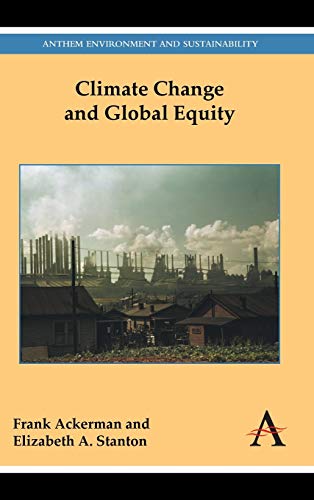
Inhaltsangabe
Ambitious measures to reduce carbon emissions are all too rare in reality, impeded by economic and political concerns rather than technological advances. In this collection of essays, Frank Ackerman and Elizabeth A. Stanton show that the impact of inaction on climate change will be far worse than the cost of ambitious climate policies.
After setting out the basic principles which must shape contemporary climate economics, Ackerman and Stanton consider common flaws in climate change policy – from mistaken assumptions that dismiss the welfare of future generations and anticipate little or no growth in low-income countries, to unrealistic projections of climate damages that dismiss catastrophic risks – and offer their own insightful remedies. They question the usefulness of conventional integrated assessment models (IAMs) that model the long-term interaction between economic growth and climate change, and propose an alternative in their Climate and Regional Economics and Development (CRED) model.
In this incisive work, Stanton and Ackerman offer a timely and original contribution to the fields of climate economics and global equity.
Ambitious measures to reduce carbon emissions are all too rare in reality, impeded by economic and political concerns rather than technological advances. In this timely collection of essays, Frank Ackerman and Elizabeth A. Stanton show that the impact of inaction on climate change will be far worse than the cost of ambitious climate policies.
Die Inhaltsangabe kann sich auf eine andere Ausgabe dieses Titels beziehen.
Über die Autorin bzw. den Autor
Frank Ackerman is a senior economist at Synapse Energy Economics and lecturer at Massachusetts Institute of Technology, and has written numerous books and articles on the economics of climate change, energy and environmental policy.
Elizabeth A. Stanton is a senior economist at Synapse Energy Economics and has written widely on the economics of equity and environment, climate change, energy efficiency and renewable energy.
Auszug. © Genehmigter Nachdruck. Alle Rechte vorbehalten.
Climate Change and Global Equity
By Frank Ackerman, Elizabeth A. StantonWimbledon Publishing Company
Copyright © 2014 Frank Ackerman and Elizabeth A. Stanton
All rights reserved.
ISBN: 978-1-78308-020-5All rights reserved.
Contents
Introduction, vii,
Publication History, xi,
Part I: Perspectives on Climate and Equity,
Chapter 1. Climate Economics in Four Easy Pieces, 3,
Chapter 2. Carbon Markets Are Not Enough, 13,
Chapter 3. Modeling Pessimism: Does Climate Stabilization Require a Failure of Development?, 21,
Chapter 4. The Tragedy of Maldistribution: Climate, Sustainability and Equity, 37,
Part II: Analyses of Climate Damages,
Chapter 5. Climate Impacts on Agriculture: A Challenge to Complacency?, 57,
Chapter 6. Did the Stern Review Underestimate US and Global Climate Change?, 67,
Chapter 7. Can Climate Change Save Lives? A Comment on "Economy-Wide Estimates of the Implications of Climate Change: Human Health", 79,
Part III: Theory and Methods of Integrated Assessment,
Chapter 8. Inside the Integrated Assessment Models: Four Issues in Climate Economics, 93,
Chapter 9. Limitations of Integrated Assessment Models of Climate Change, 115,
Chapter 10. Negishi Welfare Weights in Integrated Assessment Models: The Mathematics of Global Inequality, 133,
Part IV: Applications of Integrated Assessment Models,
Chapter 11. Climate Risks and Carbon Prices: Revising the Social Cost of Carbon, 151,
Chapter 12. Epstein–Zin Utility in DICE: Is Risk Aversion Irrelevant to Climate Policy?, 169,
Chapter 13. Fat Tails, Exponents, Extreme Uncertainty: Simulating Catastrophe in DICE, 183,
Chapter 14. Climate Damages in the FUND Model: A Disaggregated Analysis, 203,
Chapter 15. Climate Policy and Development: An Economic Analysis, 217,
Appendix. Supplementary Data for Chapter 3, 231,
Notes, 235,
References, 249,
CHAPTER 1
CLIMATE ECONOMICS IN FOUR EASY PIECES
Frank Ackerman
Conventional economic analysis is rapidly replacing the arguments of the climate skeptics as the principal justification for inaction on climate change. It is important to create an alternative economics that is consistent with the urgency expressed by the latest climate science. This chapter presents four broad principles that are fundamental to a better analysis of climate economics. First, your grandchildren's lives are important: a low discount rate is needed to validate concern about far-future outcomes. Second, we need to buy insurance for the planet: prevention of catastrophic worst-case risks, not response to average, expected outcomes, should be the motivation for climate policy. Third, climate damages are too valuable to have prices: the impossibility of putting meaningful prices on human life, endangered species and ecosystems defeats attempts at cost-benefit analysis of climate policy. Fourth, some costs are better than others: the "costs" of active climate policies will create jobs, incomes and new technologies, while avoiding the physical destruction of the much worse costs of an increasingly extreme climate.
Introduction
Once upon a time, debates about climate policy were primarily about the science. Initially, at least in the United States, an inordinate amount of attention was focused on the handful of "climate skeptics" who challenged the scientific understanding of climate change. The influence of the skeptics, however, is rapidly fading; few people were swayed by their arguments, and doubt about the major results of climate science is no longer important in shaping public policy.
As the climate science debate is reaching closure, the climate economics debate is heating up. The controversial issue now is the fear that overly ambitious climate initiatives could hurt the economy. Economists emphasizing that fear have, in effect, replaced the climate skeptics as the intellectual enablers of inaction. For example, William Nordhaus, the US economist best known for his work on climate change, pays lip service to scientists' calls for decisive action. He finds, however, that the "optimal" policy is a very small carbon tax that would reduce greenhouse gas emissions only 25 percent below "business-as-usual" levels by 2050 – in other words, allowing emissions to rise well above current levels by mid-century. Richard Tol, a European economist who has written widely on climate change, favors an even smaller carbon tax of just $2 per ton of carbon dioxide (Lomborg 2007). That would amount to all of $0.02 per gallon of gasoline, a microscopic "incentive" for change that consumers would simply ignore.
There are other voices in the climate economics debate; in particular, the Stern Review offers a different perspective (Stern 2006). Stern's analysis is much less wrong than the traditional Nordhaus-Tol approach, but even Stern has not challenged conventional wisdom enough. It is important to understand, challenge and replace the conventional fear of a damaged economy, because economists' doubts and conclusions about climate change echo throughout public debate; economic analysis has a major impact on the decisions that politicians and governments are willing to take. There is much more than an academic theory at stake.
What will it take to build a better economics of climate change? The problem is not in the technicalities; economists of all stripes are generally quite good at working out the technical implications of their underlying assumptions. The question is: what underlying assumptions are required to create a climate economics that is consistent with the urgency expressed by the latest climate science? The assumptions that matter are big, nontechnical principles, capable of being expressed in bumper sticker format. Here are the four bumper stickers for a better climate economics:
• Your grandchildren's lives are important
• We need to buy insurance for the planet
• Climate damages are too valuable to have prices
• Some costs are better than others
Each of these is elaborated below.
Your Grandchildren's Lives Are Important
The most widely debated challenge of climate economics is the valuation of the very long run. The time spans involved are well beyond those encountered in most areas of economics. For ordinary loans and investments, both the costs today and the resulting future benefits typically occur within a single lifetime. In such cases, it makes sense to think in terms of the same person experiencing and comparing the costs and the benefits.
In the case of climate change, the most important consequences of today's choices will be felt by generations to come, long after all of us making those choices have passed away. As a result, the costs of reducing emissions today, and the benefits in the far future, will not be experienced by the same people. The economics of climate change is centrally concerned with our relationship to our descendants whom we will never meet. As a bridge to that unknowable future, consider your grandchildren – the last generation that most of us will ever know.
Economists routinely deal with future costs and benefits by "discounting" them, or converting them to "present values" – a process that is simply compound interest in reverse. Suppose that you want your grandchildren to receive $100 (in today's dollars, corrected for inflation) 60 years from now. How much would you have to put in a bank account today to ensure that the $100 will be there 60 years from now? The answer is $55 at 1 percent...
„Über diesen Titel“ kann sich auf eine andere Ausgabe dieses Titels beziehen.
Suchergebnisse für Climate Change and Global Equity (Anthem Environment...

Beispielbild für diese ISBN
Climate Change and Global Equity (Anthem Environment and Sustainability)
Anbieter: Books From California, Simi Valley, CA, USA
Verkäuferbewertung 4 von 5 Sternen

Hardcover. Zustand: Very Good. Artikel-Nr. mon0003151379
Gebraucht kaufen
EUR 57,72
EUR 4,46 Versand
Versand innerhalb von USA
Versand innerhalb von USA
Anzahl: 6 verfügbar
Beispielbild für diese ISBN
Climate Change and Global Equity
Anbieter: PBShop.store UK, Fairford, GLOS, Vereinigtes Königreich
Verkäuferbewertung 5 von 5 Sternen

HRD. Zustand: New. New Book. Shipped from UK. Established seller since 2000. Artikel-Nr. CX-9781783080205
Neu kaufen
EUR 78,37
EUR 6,01 Versand
Versand von Vereinigtes Königreich nach USA
Versand von Vereinigtes Königreich nach USA
Anzahl: 15 verfügbar
Beispielbild für diese ISBN
Climate Change and Global Equity
Anbieter: PBShop.store US, Wood Dale, IL, USA
Verkäuferbewertung 5 von 5 Sternen
HRD. Zustand: New. New Book. Shipped from UK. Established seller since 2000. Artikel-Nr. CX-9781783080205
Beispielbild für diese ISBN
Climate Change and Global Equity (Anthem Environment and Sustainability)
Anbieter: Revaluation Books, Exeter, Vereinigtes Königreich
Verkäuferbewertung 5 von 5 Sternen
Hardcover. Zustand: Brand New. 220 pages. 9.00x6.00x1.00 inches. In Stock. Artikel-Nr. x-1783080205
Neu kaufen
EUR 175,89
EUR 14,98 Versand
Versand von Vereinigtes Königreich nach USA
Versand von Vereinigtes Königreich nach USA
Anzahl: 2 verfügbar