
Verwandte Artikel zu Who's Afraid of the Easter Rising? 19162016
Inhaltsangabe
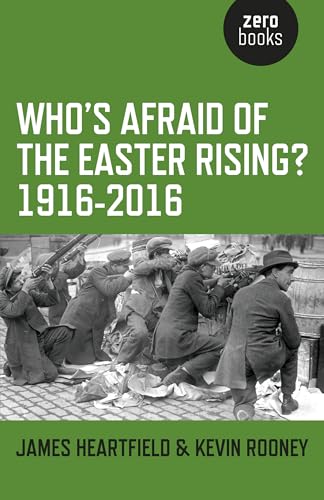
One hundred years ago, Easter 1916, Irish revolutionaries rose against the British Empire proclaiming a Republic from the steps of the General Post Office in Dublin. The men and women of the Easter Rising were defeated by the overwhelming force of the British Army, in five days of intense fighting. Their leaders were executed. But the Easter Rising lit a fire that ended with the whole country turning against Westminster’s rule, and founding a nation. But today, the heirs to the Irish state are embarrassed about 1916. They are ashamed that their state owes its origins to a revolution. Along with academics and other commentators in the press and on television they dismiss the Rising as the work of violent fanatics, and the defeat of constitutional politics. Who’s Afraid of the Easter Rising? explains why today’s Dublin elite are recoiling from the origins of their state in a popular struggle. Where the critics paint the Rising as an armed conspiracy, we explain that it was in fact a revolt against war; not a militaristic upsurge, but the first challenge to the awful slaughter of the First World War. The Statesmen of Europe sacrificed millions upon the altar of war. Their recruiting sergeants in Ireland, Edward Carson and John Redmond sent 200,000 Irishmen into the slaughter and nearly 50,000 were killed. The Easter Rising drew a halt to British recruitment, and the blow to the Empire was the first crack in a growing revolt against the war, followed by the Russian Revolution in 1917, and the German revolution the following year – which ended the conflict. The Easter Rising was an inspiration to those who were challenging the Empires of Europe, from India to Vietnam, from New Zealand to Moscow; it was an inspiration to British activists like John Maclean and Sylvia Pankhurst; and it was an inspiration to the Irish men and women who rose up against British rule to free their nation.
Die Inhaltsangabe kann sich auf eine andere Ausgabe dieses Titels beziehen.
Über die Autorinnen und Autoren
James Heartfield has worked as a journalist, for a television company, as a lecturer and an editor. He lives in North London with his wife and two daughters.
Kevin Rooney is a teacher and writer. He first took part in the Commemoration of the Easter Rising in Belfast, 1972.
James Heartfield has worked as a journalist, for a television company, as a lecturer and an editor. He lives in North London with his wife and two daughters.
Kevin Rooney is a teacher and writer. He first took part in the Commemoration of the Easter Rising in Belfast, 1972.
Auszug. © Genehmigter Nachdruck. Alle Rechte vorbehalten.
Who's Afraid of the Easter Rising? 1916–2016
By James Heartfield, Kevin RooneyJohn Hunt Publishing Ltd.
Copyright © 2014 James Heartfield and Kevin Rooney
All rights reserved.
ISBN: 978-1-78279-887-3All rights reserved.
Contents
Introduction: Who fears to speak of the Easter Rising?,
Chapter one: History wars,
Chapter two: The Rising in history,
Chapter three: A shot that echoed around the world,
Chapter four: Revising the Rising,
Chapter five: Historical memory and the peace process,
Endnotes,
CHAPTER 1
History wars
Who's afraid of the Easter Rising? 100 years ago, on Easter Monday 1916, a few hundred men started a rebellion against British rule in Ireland. They seized the General Post Office in Dublin where they read out a proclamation inaugurating the Irish Republic. Though they fought bravely their forces were divided before the Rising began. After a week of intense artillery bombardment the Rising was crushed, the rebels rounded up and their leaders executed.
Within three years the Irish people had turned their back on the British Empire and elected a rebel parliament. What looked to many at the time like a quixotic act turned out to be the 'blood sacrifice' that would set Ireland on the road to freedom.
The Rising of 1916 was celebrated on the 50 anniversary in 1966 as the foundational act of the Irish Republic. A film was made, medals were struck, and the act was celebrated across the land. 25 years later on the 75 anniversary, in 1991, the Taoiseach Charlie Haughey rushed through a 'short, dignified ceremony' and issued some stamps commemorating the Rising. The whole event was over so quickly that some of the officials taking part were locked out of the Post Office.
The commemoration of historical events can be important affairs for states; the ownership of the past establishes the hierarchy in the present. Telling a national story is a way of building solidarity. But the origins of the Irish state of today in the Rising of 1916, and the independence struggle that followed it, have proved deeply uncomfortable to its present-day leaders.
Between the anniversaries of 1966 and 1991 people's idea of the Rising had changed. Heroic sacrifice it seemed on the 50 anniversary, but 25 years later a lot of people were saying that it was the act of political extremists – even Fascists – that put the gun into Irish politics, at a terrible cost in human lives over the decades.
Between 1966 and 1991 all changed when guerrilla war broke out once again in the six north-eastern counties of the Province of Ulster – that part of Ireland that had not joined the Free State in 1921, but instead had been kept in the United Kingdom. The so-called 'troubles' broke out in 1969, a conflict first between Civil Rights protestors and the Northern Irish State, quickly overcome by a state of war between Irish republicans and the British Army; that war led many to despair that Irish republicanism would always tend towards violence.
Many remembered that the young men and women who took up the gun had often been moved by the 1966 celebrations commemorating the Easter Rising 50 years earlier. Innocent and cheerful celebrations, but did they inspire a new generation to take up arms in the cause of the Irish Republic?
Some of those who took part in the first civil rights protests in the Six Counties in 1969–70 wondered where the bright future of those days had gone. The mood of sixties protest gave way to sour warfare and even sectarianism. Does Ireland suffer under the burden of too much history, they worried?
Genuflecting to the totems of the Easter Rising was less liberation than conformism, they thought, the past weighing down upon the future. Historians and political scientists set about re-examining the history, bravely tearing down the heroes of yesteryear in books and articles. An oedipal revolt against the men of Easter began.
Truth to tell there was always a strong streak of distaste for the Easter Rising. Most obviously the British statesmen, military leaders and British propagandists and historians have painted a harsh picture of the Rising and the traditions it gave rise to – which is hardly surprising since the rebellion was made against them. In the Six Counties, the political leaders of the Northern Irish State and the Orange Order that sustained them carried a special hatred for the men and women who challenged British rule in Ireland. In the south of Ireland, too, the respectable people who only wanted to hold together an orderly state and make their peace with the British Empire were shamed by that constant reprimand that the Easter Rising was to them: why is Ireland still divided?
Looking back at the history of Ireland in the 20 century many have properly focussed their attention on what is specific and unique to the country and its traditions. But looking today, in this parade of centenary commemorations, it is hard not to be struck by just how much the story of Ireland's uprising was a part and parcel of a conflict that was taking place across the whole world, the Great War, the First World War, from 1914 to 1919.
'The Easter Rising damaged the Irish psyche', said the former Taoiseach, John Bruton at a debate at the Irish Embassy on the centenary of the Irish Home Rule Bill, 1 July 2014. The Rising was 'completely unnecessary', and 'led directly to the brutal violence of the war of independence and the civil war that followed'. The Rising's leader Patrick Pearse 'had justified the provos' – the Provisional IRA.
These words are striking because the Easter Rising, the rebellion of 1916 led by Patrick Pearse, has until recently been held to be the beginning of Ireland's emergence as an independent state, with a government chosen by its own people – the very government that John Bruton led.
In Ireland today the history of the independence movement that sustained the people for so long is being re-written.
With the 100 anniversary of the rising approaching the Irish Times was genuinely worried. 'The Rising was a complex event', they wrote: 'There is a danger that shorn of context, it can be presented as a glorification of the cult of violence, as happened in 1966'. The spectre of the 50 anniversary of the Rising, in 1966, is almost as problematic as the original event of 1916. That is because many believe that the forthright celebration of that anniversary led directly to the outbreak of conflict in the still-occupied Six Counties of northern Ireland in 1969. So, for example, a special report by the British-Irish Parliamentary Assembly worries that Eamon De Valera's celebrations in 1966 'may have contributed to the environment from which the troubles may have emerged later in the decade'. Celebrating history in Ireland, it seems, is fraught with fears of stirring up ancient hatreds.
The Rising, claims the leading political commentator Stephen Collins, was a violent conspiracy that was out of keeping with the Irish Parliamentary Party of John Redmond. 'Most of our modern political leaders have far more in common with the values of the old Irish Parliamentary Party and its leader than they have with those who directed the activities of the Irish Republican Brotherhood' – the militants of the Rising. 'Yet our current generation of politicians', writes Collins, are 'falling over themselves to pay obeisance to revolutionary leaders whose values they don't actually share'. Angered by the revolutionary moment embedded in Irish politics, Collins protests that 'the majority of law-abiding people who live by...
„Über diesen Titel“ kann sich auf eine andere Ausgabe dieses Titels beziehen.
Suchergebnisse für Who's Afraid of the Easter Rising? 19162016

Foto des Verkäufers
Who's Afraid of the Easter Rising? 19162016
Anbieter: WeBuyBooks, Rossendale, LANCS, Vereinigtes Königreich
Verkäuferbewertung 5 von 5 Sternen

paperback. Zustand: Very Good. Most items will be dispatched the same or the next working day. A copy that has been read, but is in excellent condition. Pages are intact and not marred by notes or highlighting. The spine remains undamaged. Artikel-Nr. rev4825142943
Gebraucht kaufen
EUR 2,64
EUR 5,90 Versand
Versand von Vereinigtes Königreich nach USA
Versand von Vereinigtes Königreich nach USA
Anzahl: 1 verfügbar
Beispielbild für diese ISBN
Who's Afraid of the Easter Rising? 19162016
Anbieter: WorldofBooks, Goring-By-Sea, WS, Vereinigtes Königreich
Verkäuferbewertung 5 von 5 Sternen
Paperback. Zustand: Very Good. The book has been read, but is in excellent condition. Pages are intact and not marred by notes or highlighting. The spine remains undamaged. Artikel-Nr. GOR008680201
Gebraucht kaufen
EUR 2,71
EUR 6,68 Versand
Versand von Vereinigtes Königreich nach USA
Versand von Vereinigtes Königreich nach USA
Anzahl: 1 verfügbar
Beispielbild für diese ISBN
Who's Afraid of the Easter Rising? 19162016
Anbieter: WorldofBooks, Goring-By-Sea, WS, Vereinigtes Königreich
Verkäuferbewertung 5 von 5 Sternen
Paperback. Zustand: Fair. A readable copy of the book which may include some defects such as highlighting and notes. Cover and pages may be creased and show discolouration. Artikel-Nr. GOR015070237
Gebraucht kaufen
EUR 2,71
EUR 6,68 Versand
Versand von Vereinigtes Königreich nach USA
Versand von Vereinigtes Königreich nach USA
Anzahl: 1 verfügbar
Beispielbild für diese ISBN
Who's Afraid of the Easter Rising? 1916-2016
Verlag:
Hunt Publishing Limited, John, 2015
ISBN 10: 1782798870
ISBN 13: 9781782798873
Gebraucht
Softcover
Anbieter: Better World Books Ltd, Dunfermline, Vereinigtes Königreich
Verkäuferbewertung 5 von 5 Sternen
Zustand: Good. Pages intact with minimal writing/highlighting. The binding may be loose and creased. Dust jackets/supplements are not included. Stock photo provided. Product includes identifying sticker. Better World Books: Buy Books. Do Good. Artikel-Nr. 17432167-20
Gebraucht kaufen
EUR 5,71
EUR 5,96 Versand
Versand von Vereinigtes Königreich nach USA
Versand von Vereinigtes Königreich nach USA
Anzahl: 1 verfügbar
Beispielbild für diese ISBN
Who's Afraid of the Easter Rising? 1916-2016
Verlag:
Hunt Publishing Limited, John, 2015
ISBN 10: 1782798870
ISBN 13: 9781782798873
Gebraucht
Softcover
Anbieter: Better World Books Ltd, Dunfermline, Vereinigtes Königreich
Verkäuferbewertung 5 von 5 Sternen
Zustand: Good. Former library copy. Pages intact with minimal writing/highlighting. The binding may be loose and creased. Dust jackets/supplements are not included. Includes library markings. Stock photo provided. Product includes identifying sticker. Better World Books: Buy Books. Do Good. Artikel-Nr. 19165686-20
Gebraucht kaufen
EUR 5,71
EUR 5,96 Versand
Versand von Vereinigtes Königreich nach USA
Versand von Vereinigtes Königreich nach USA
Anzahl: 2 verfügbar
Beispielbild für diese ISBN
Who's Afraid of the Easter Rising? 1916-2016
Anbieter: Sell Books, Elland, YORKS, Vereinigtes Königreich
Verkäuferbewertung 5 von 5 Sternen
paperback. Zustand: Very Good. Most of our very good books have only minor imperfections such as shelf wear consistent with a new book that's sat on a bookshop shelf for a year or two. Occasionally we may miss other minor imperfections as we have to grade books at speed. Our books are dispatched from a Yorkshire former cotton mill. We list via barcode/ISBN so please note that the images are stock images and may not be the exact copy you receive, furthermore the details about edition and year might not be accurate as many publishers reuse the same ISBN for multiple editions and as we simply scan a barcode or enter an ISBN we do not check the validity of the edition data when listing. If you're looking for an exact edition please don't order (at least not without checking with us first, although we don't always have time to check). We aim to dispatch prompty, the service used will depend on order value and book size. We can ship to most countries, see our shipping policies. Payment is via Abe only. Artikel-Nr. SBAB-L-BIE00614-RAG-20240221-VG
Gebraucht kaufen
EUR 2,87
EUR 9,25 Versand
Versand von Vereinigtes Königreich nach USA
Versand von Vereinigtes Königreich nach USA
Anzahl: 2 verfügbar
Beispielbild für diese ISBN
Who's Afraid of the Easter Rising? 1916-2016
Anbieter: Revaluation Books, Exeter, Vereinigtes Königreich
Verkäuferbewertung 5 von 5 Sternen
Paperback. Zustand: Brand New. 160 pages. 8.50x5.50x0.50 inches. In Stock. Artikel-Nr. zk1782798870
Neu kaufen
EUR 18,72
EUR 11,92 Versand
Versand von Vereinigtes Königreich nach USA
Versand von Vereinigtes Königreich nach USA
Anzahl: 1 verfügbar