
Verwandte Artikel zu Environmental Radiochemical Analysis V (Special Publication...
Environmental Radiochemical Analysis V (Special Publication (Royal Society of Chemistry), 351, Band 351) - Hardcover
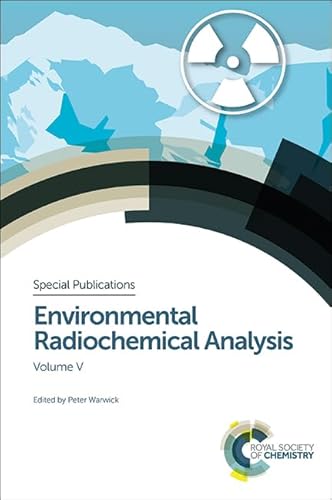
Inhaltsangabe
Incidents in the past have made scientists aware of the need for accurate methods of radionuclide analyses in order to estimate the risk to the public from released radioactivity .This book is an authoritative, up-to-date collection of research contributions presented at the 12th International Symposium on Environmental Radiochemical Analysis. Representing the work of leading scientists from across the globe it presents information on analytical radiochemistry, the behaviour of radionuclides in the environment, radioactively contaminated land, fate of radionuclides in natural and engineered environments and behaviour and analysis of nuclear and radionuclides in radioactive wastes. This essential work will be a key reference for graduates and professionals who work across fields involving analytical chemistry, environmental science and technology, and hazards and waste research and disposal.
Die Inhaltsangabe kann sich auf eine andere Ausgabe dieses Titels beziehen.
Über die Autorin bzw. den Autor
Peter Warwick, BA, MSc, PhD, FRSC, CCHem is Professor of Environmental Radiochemistry, Director of the Centre for Environmental Studies and Head of the Department of Chemistry at Loughborough University. Professor Warwick is a part Chairman of the Radiochemical Methods Group, Analytical Division, the Royal Society of Chemistry and was awarded the Becquerel Medal by them in 2002 for "outstanding contributions to radiochemistry". His major research interests are in the chemistry of nuclear active wastes disposal and in developing new methods of analyses for decommissioning wastes.
Von der hinteren Coverseite
Incidents in the past have made scientists aware of the need for accurate methods of radionuclide analyses in order to estimate the risk to the public from released radioactivity. This book is an authoritative, up-to-date collection of research contributions presented at the 12th International Symposium on Environmental Radiochemical Analysis. Representing the work of leading scientists from across the globe it presents information on radiochemical analysis, measurement of radioactivity, naturally occurring radioactive materials, radioactively contaminated land, fate of radionuclides in natural and engineered environments and behaviour and analysis of radionuclides in radioactive wastes. This essential work will be a key reference for graduates and professionals who work across fields involving analytical chemistry, environmental science and technology, and waste disposal.
Aus dem Klappentext
Incidents in the past have made scientists aware of the need for accurate methods of radionuclide analyses in order to estimate the risk to the public from released radioactivity. This book is an authoritative, up-to-date collection of research contributions presented at the 12th International Symposium on Environmental Radiochemical Analysis. Representing the work of leading scientists from across the globe it presents information on radiochemical analysis, measurement of radioactivity, naturally occurring radioactive materials, radioactively contaminated land, fate of radionuclides in natural and engineered environments and behaviour and analysis of radionuclides in radioactive wastes. This essential work will be a key reference for graduates and professionals who work across fields involving analytical chemistry, environmental science and technology, and waste disposal.
Auszug. © Genehmigter Nachdruck. Alle Rechte vorbehalten.
Environmental Radiochemical Analysis V
By Peter WarwickThe Royal Society of Chemistry
Copyright © 2015 The Royal Society of Chemistry
All rights reserved.
ISBN: 978-1-78262-155-3All rights reserved.
Contents
CHARACTERISATION OF RADIOACTIVELY CONTAMINATED LAND AT DOUNREAY, AN AREA WITH A HIGH NATURAL BACKGROUND J.A. Heathcote, 1,
THE USE OF IN SITU GAMMA MEASUREMENTS IN LAND SURVEYS P.D Rostron, J.A. Heathcote and M.H. Ramsey, 15,
TESTING OF A COMPUTER PROGRAMME FOR CALCULATING THE Sr-85 YIELD AS WELL AS FALLOUT Sr-89 AND Sr-90 IN A SINGLE LSC MEASUREMENT WITH DETECTION LIMITS CONFORMING TO ISO 11929 D. Tait, T. Vagt, G. Kanisch and N. Roos, 30,
CHARTING A PATH TO THE FUTURE J. Martin, 39,
FALLOUT OF Pu-238 OVER MADAGASCAR FOLLOWING THE SNAP 9A SATELLITE FAILURE E. Holm, C. Rääf, N. Rabesiranana, R. Garcia-Tenorio and E. Chamizo, 44,
TRANSPORT AND ACCUMULATION OF STABLE METALS AND RADIONUCLIDES IN DULAS BAY, NORTH WALES H. Al-Qasmi, G.T.W. Law, N.D. Bryan and F.R. Livens, 50,
EXPERIMENTAL STUDIES ON THE UPTAKE OF TECHNETIUM-99 TO TERRESTRIAL CROPS L.W. Ewers and J. Brown, 61,
A PILOT STUDY OF THE LUNG SOLUBILITY OF RADIOACTIVE MATERIALS USED AT AWE T.J. Miller, 67,
AN IMPROVED METHOD FOR THE DETERMINATION OF IODINE-129 IN ENVIRONMENTAL AND NUCLEAR DECOMMISSIONING SAMPLES L. Townsend, M. Chimes, J. Gregory, C. Talbot-Eeckelaers and M. Wharton, 75,
ANALYTICAL CHALLENGES POSED BY NORM CONTAMINATED SITES D. Read, 81,
CHARACTERISATION OF HIGHLY TRITIATED WASTE STREAMS RESULTANT FROM THE OPERATION OF THE CHAPELCROSS POWER STATION PROCESS PLANT (CXPP) FOR THE PURIFICATION OF TRITIUM D. Bridgewater, 92,
OXALOHYDROXAMIC ACID AS A REDUCTOMETRIC TITRANT FOR THE DETERMINATION OF OXYGEN TO METAL RATIO IN NUCLEAR FUEL F. Khan and S. Agrawal, 95,
THE DETERMINATION OF TECHNETIUM-99 IN SOIL, SILT, SAND AND SEDIMENT BY ICP-MS USING ISOTOPICALLY ENRICHED RHENIUM AS A YIELD MONITOR M. Bell, A.M.J. Lees and N. Scott, 100,
AUTOMATED SYSTEM FOR NEUTRON ACTIVATION ANALYSIS S.S. Ismail, 111,
ALGAL BIOSORPTION – IS IT A VIABLE ALTERNATIVE IN TREATMENT OF RADIOACTIVELY CONTAMINATED EFFLUENTS? A. Kutner and V. Nesbitt, 122,
LONG TERM TRENDS IN FAR-FIELD EFFECTS OF MARINE RADIOACTIVITY MEASURED AROUND NORTHERN IRELAND V.E. Ly, S.M. Cogan, W.C. Camplin, L. Peake and K.S. Leonard, 134,
A SEARCH FOR DARMSTADTIUM IN NATURE J.W. Mietelski, P. Gaca and E. Tomankiewicz, 144,
A COMPARISON OF ANALYTICAL METHODS FOR SCREENING GROSS ALPHA AND BETA RADIOACTIVITY IN WATER BY LIQUID SCINTILLATION COUNTING AND GAS FLOW PROPORTIONAL COUNTING M.B. Nisti, A.O. Ferreira, M. P. Campos, C.H.R. Saueia and B.P. Mazzilli, 148,
SPINACH POWDER IS A SUITABLE MEDIUM FOR INTERLABORATORY COMPARISONS (ILC) OF ENVIRONMENTALLY RELEVANT NUCLIDES N. Roos and D. Tait, 152,
DETERMINATION OF RADIOACTIVITY LEVELS AND 222Rn EXHALATION RATES IN SOIL AROUND IPEN FACILITIES M.B. Nisti, C.H.R. Saueia and B.P. Mazzilli, 159,
UPTAKE OF NATURAL URANIUM BY NATIVE PLANTS GROWN IN A HIGH BACKGROUND RADIATION AREA E.I. Shabana, M. M.T. Qutub and A.A. Kinsara, 164,
DETERMINATION OF POLONIUM-210 AND LEAD-210 IN IRON- AND STEEL-MAKING MATERIALS F. Dal-Molin, D.R. Anderson and D. Read, 175,
WASTE MANAGEMENT CHARACTERISATION STRATEGY : FROM RAW WASTE TO WASTE CONTAINERS FOR LONG TERM DISPOSAL C. Lamouroux, G. Piot, P. Strock and F. Cochin, 185,
BEHAVIOUR OF RADIONUCLIDES AND ENVIRONMENTALLY SIGNIFICANT ELEMENTS IN NUCLEAR FUEL ELEMENT DEBRIS (FED) C.G. Holmes, J.A. Caborn, C.R. Harvey, N.A. Hodge, D.F. Lee, B. Kralj, D. Wickenden, A.Patel and C. Saunders, 195,
FUKUSHIMA ACCIDENT FALLOUT IN FOOD AND FODDER IN GERMANY D. Tait and N. Roos, 207,
UNCERTAINTIES IN MEASUREMENTS USING LSC QUENCH-CURVES G.J. Knetsch and P.J.M. Kwakman, 214,
Subject Index, 222,
Isotope Index, 225,
CHAPTER 1
CHARACTERISATION OF RADIOACTIVELY CONTAMINATED LAND AT DOUNREAY, AN AREA WITH A HIGH NATURAL BACKGROUND
J.A. Heathcote
D2003/Z10, Dounreay Site Restoration Ltd, Thurso KW14 7TZ, UK
1 PURPOSE OF PAPER
The Dounreay experimental reactor site is being decommissioned, with the expectation that some time before 2333, the land will be suitable for 'any reasonably foreseeable use', To achieve this, unacceptably contaminated materials must be identified and characterised for disposal as waste, and there must be a demonstration that residual materials meet relevant standards. Appropriate radio-analytical methods are essential to support these activities. Potential complications are the range of nuclear materials used at the Dounreay experimental site and the presence of a relatively high natural background. Radio-analytical techniques used must also be consistent with the commercial reality of the UK's decommissioning framework – there is no net financial benefit to the UK from decommissioning Dounreay since the land itself has little value, and therefore analytical methods must be cost-effective.
This paper reviews experience gained from using the full range of commercial analytical techniques, to identify how contamination can be distinguished from background, using γ-spectrometry and gross α+β measurement.
2 BACKGROUND TO DOUNREAY
Construction of the Dounreay experimental facility commenced in 1955 on the site of a World War II military airfield, to investigate the commercial feasibility of fast breeder reactor technology. Three reactors were built and operated
• DMTR U-fuelled thermal reactor, 1958 – 1969;
• 12R, U-fuelled fast breeder reactor, 1959 – 1977;
• PFR, MOX-fuelled fast breeder reactor, 1974 – 1994.
These were supported by fuel re-processing and fabrication plant, investigation laboratories, engineering workshops and ancillary facilities. The properties of uranium and plutonium fuels were investigated and a small amount of work was done with thorium fuels. Thorium is also present in refractory thoria in crucibles etc., where its high melting point is relevant, rather than its nuclear properties.
Reactor operations ceased in 1944 fuel re-processing ceased in 1997 and fuel manufacture ceased in 2004. The sole focus now is on decommissioning, with the intention that interventions will be complete by c. 2030 enabling the site to achieve Interim End State and enter a period of passive institutional control. During this period of institutional control the only processes operating are envisaged to be radioactive decay and passive chemical transformation, and the flow of water under gravity. Monitoring will be in place to confirm this. No later than 2333, it is expected that the site will reach a Final End State, when it is suitable for un-restricted use. It is envisaged that such use might be small-scale self-sufficient farming, which was the use of the land prior to construction of the airfield.
3 REQUIREMENTS OF SITE RESTORATION
At Final End State it is expected that the site will be removed from the nuclear licensing regime. The relevant test is "A demonstration that any residual activity, above background radioactivity, which remains on the site, which may or may not have arisen from licensable activities, will lead to a risk of death to an individual using the site for any reasonably foreseeable purpose, of no greater than 1 in a million per year".
A performance assessment has been made to calculate the incremental activity concentrations equivalent to the risk threshold specified in the de-licensing criterion. It is also necessary to be...
„Über diesen Titel“ kann sich auf eine andere Ausgabe dieses Titels beziehen.
Suchergebnisse für Environmental Radiochemical Analysis V (Special Publication...

Beispielbild für diese ISBN
Environmental Radiochemical Analysis: 5
Anbieter: Majestic Books, Hounslow, Vereinigtes Königreich
Verkäuferbewertung 4 von 5 Sternen

Zustand: New. 300. Artikel-Nr. 374929177
Neu kaufen
EUR 127,54
EUR 7,57 Versand
Versand von Vereinigtes Königreich nach USA
Versand von Vereinigtes Königreich nach USA
Anzahl: 4 verfügbar
Beispielbild für diese ISBN
Environmental Radiochemical Analysis V
Anbieter: PBShop.store UK, Fairford, GLOS, Vereinigtes Königreich
Verkäuferbewertung 5 von 5 Sternen

HRD. Zustand: New. New Book. Shipped from UK. Established seller since 2000. Artikel-Nr. CW-9781782621553
Neu kaufen
EUR 161,83
EUR 5,84 Versand
Versand von Vereinigtes Königreich nach USA
Versand von Vereinigtes Königreich nach USA
Anzahl: 1 verfügbar
Beispielbild für diese ISBN
Environmental Radiochemical Analysis V
Anbieter: PBShop.store US, Wood Dale, IL, USA
Verkäuferbewertung 5 von 5 Sternen
HRD. Zustand: New. New Book. Shipped from UK. Established seller since 2000. Artikel-Nr. CW-9781782621553
Beispielbild für diese ISBN
Environmental Radiochemical Analysis V (Special Publications, Volume 351)
Anbieter: Ria Christie Collections, Uxbridge, Vereinigtes Königreich
Verkäuferbewertung 5 von 5 Sternen
Zustand: New. In English. Artikel-Nr. ria9781782621553_new
Neu kaufen
EUR 178,29
EUR 13,14 Versand
Versand von Vereinigtes Königreich nach USA
Versand von Vereinigtes Königreich nach USA
Anzahl: 4 verfügbar
Foto des Verkäufers
ENVIRONMENTAL RADIOCHEMICAL ANALYSIS V
Anbieter: moluna, Greven, Deutschland
Verkäuferbewertung 5 von 5 Sternen
Zustand: New. Environmental Radiochemical Analysis V is a collection of original papers presented at the Twelfth International Symposium on Environmental Radiochemical Analysis held in September 2014.InhaltsverzeichnisrnrnCharacterisation Of Radioactively. Artikel-Nr. 31403708
Neu kaufen
EUR 175,05
EUR 48,99 Versand
Versand von Deutschland nach USA
Versand von Deutschland nach USA
Anzahl: 4 verfügbar
Foto des Verkäufers
Environmental Radiochemical Analysis V
Anbieter: AHA-BUCH GmbH, Einbeck, Deutschland
Verkäuferbewertung 5 von 5 Sternen
Buch. Zustand: Neu. Neuware - Incidents in the past have made scientists aware of the need for accurate methods of radionuclide analyses in order to estimate the risk to the public from released radioactivity .This book is an authoritative, up-to-date collection of research contributions presented at the 12th International Symposium on Environmental Radiochemical Analysis. Representing the work of leading scientists from across the globe it presents information on analytical radiochemistry, the behaviour of radionuclides in the environment, radioactively contaminated land, fate of radionuclides in natural and engineered environments and behaviour and analysis of nuclear and radionuclides in radioactive wastes. This essential work will be a key reference for graduates and professionals who work across fields involving analytical chemistry, environmental science and technology, and hazards and waste research and disposal. Artikel-Nr. 9781782621553
Neu kaufen
EUR 223,20
EUR 30,50 Versand
Versand von Deutschland nach USA
Versand von Deutschland nach USA
Anzahl: 2 verfügbar