
Verwandte Artikel zu An Editor’s Burial: Journals and Journalism...
Inhaltsangabe
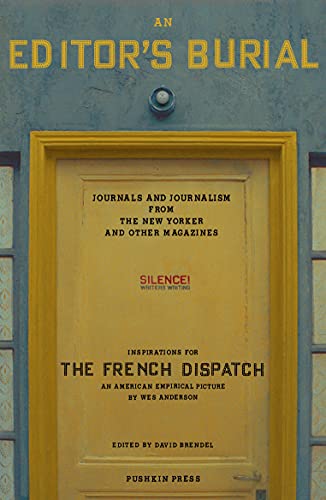
Inspirations for Wes Anderson's The French Dispatch- fascinating essays on the expatriate experience in Paris by some of the twentieth century's finest writers.
A glimpse of post-war France through the eyes and words of 14 (mostly) expatriate journalists including Mavis Gallant, James Baldwin, A.J. Liebling, S.N. Behrman, Luc Sante, Joseph Mitchell, and Lillian Ross; plus, portraits of their editors William Shawn and New Yorker founder Harold Ross. Together: they invented modern magazine journalism. Includes an introductory interview by Susan Morrison with Anderson about transforming fact into a fiction and the creation of his homage to these exceptional reporters.
Die Inhaltsangabe kann sich auf eine andere Ausgabe dieses Titels beziehen.
Über die Autorin bzw. den Autor
Wes Anderson's films include Bottle Rocket, Rushmore, The Royal Tenenbaums, Fantastic Mr Fox, Isle of Dogs and Moonrise Kingdom. The Paris Dispatch is forthcoming in July 24, 2020.
Von der hinteren Coverseite
Inspirations for Wes Anderson's The French Dispatch - fascinating essays on Paris by some of the twentieth century's finest writers.
Auszug. © Genehmigter Nachdruck. Alle Rechte vorbehalten.
Art Talker
Calvin Tomkins
1977
A fiery redhead with the speed of light, a cloud of
blue chiffon, and a hearty This lecture is about a very
good-looking man with rather thin legs who was born just under
five hundred years ago and had ideas about hospitality which
most of us would find it hard to put into practice who but
Rosamond Bernier, talking about François I of France, on a
recent Wednesday evening at the Metropolitan Museum of Art?
We are not alone in thinking Mme. Bernier the most stylish art
talker around. A recent lecture series in the Met s Grace Rainey
Rogers Auditorium was sold out two months in advance. Her
invigoratingly literate television interviews with Philip Johnson,
the architect, on CBS-TV s Camera Three made the three
Sunday mornings when they were shown astonishingly bearable
for a much larger audience. Could we catch up with this
scintillating creature (who has been married since 1975 to John
Russell, the Times s equally scintillating art critic) and importune
her with a few questions? We could and we did.
Imagine being paid to talk! Mme. Bernier said to us over
lunch in a midtown French restaurant the other day. I ve been a
listener all my professional life, and here I am talking everybody s
head off. Mme. Bernier s lecturing self, it seems, rose quite
recently from the ashes of her former, publishing-and-writing
self. After twenty-odd very busy years in Paris, where she and
her ex-husband, Georges Bernier, founded the magazine L OEil
in 1955 and made it into one of the century s best art journals,
she was, as she put it, left absolutely flat when, in 1969, she
lost both Bernier and L OEil through divorce. All at once, I
had nothing to do, she said. I just cried all day. Friends did
what they could to cheer her up, but nothing really helped
until Michael Mahoney, an art historian, persuaded her to
give fourteen lectures on modern art to his students at Trinity
College in Hartford in the fall of 1970. I was terrified at the
start, but it worked, she said. I m probably the only person
you know who hasn t been psychoanalyzed. Those lectures
literally saved my life.
Mme. Bernier, who was born in Philadelphia but grew up
mostly in London, approached her subject from the point of
view of an active participant. Having arrived in Paris in 1946
as European feature editor for the American Vogue, she followed
her natural bent toward art by becoming a close friend
of virtually all the important European artists of the period.
Picasso took to her because she spoke fluent Spanish as well as
French, and she was the first to see and report on his postwar
paintings. Matisse saw to it that she wrote the first article on
the chapel he was designing in Vence. Miró, Braque, Max
Ernst, and many other artists gave her exclusive interviews and
became lifelong Bernier-philes, and from 1955 on they all took
a personal interest in the development of L OEil. In her lectures
at Trinity, she was careful to avoid the famous-men-who-havebreathed-
on-me sort of gossip, but her close connection with
the Paris art scene, her memory for the telling detail, and her
own infectious delight in recapturing the atmosphere of the
period made for a wonderfully vivid presentation.
The Hartford success led to an invitation from Rice University,
in Houston, where she spent a month in 1971 as a guest of John
and Dominique de Menil. Roberto Rossellini was staying with
them, too, and we became great friends, she told us. Wha
„Über diesen Titel“ kann sich auf eine andere Ausgabe dieses Titels beziehen.
Suchergebnisse für An Editor’s Burial: Journals and Journalism...

Foto des Verkäufers
An Editor's Burial: Journals and Journalism from the New Yorker and Other Magazines
Anbieter: WeBuyBooks, Rossendale, LANCS, Vereinigtes Königreich
Verkäuferbewertung 5 von 5 Sternen

paperback. Zustand: Very Good. Most items will be dispatched the same or the next working day. A copy that has been read, but is in excellent condition. Pages are intact and not marred by notes or highlighting. The spine remains undamaged. Artikel-Nr. rev6801846780
Gebraucht kaufen
EUR 2,40
EUR 6,35 Versand
Versand von Vereinigtes Königreich nach USA
Versand von Vereinigtes Königreich nach USA
Anzahl: 1 verfügbar
Beispielbild für diese ISBN
An Editor's Burial: Journals and Journalism from the New Yorker and Other Magazines
Anbieter: WorldofBooks, Goring-By-Sea, WS, Vereinigtes Königreich
Verkäuferbewertung 5 von 5 Sternen
Paperback. Zustand: Very Good. The book has been read, but is in excellent condition. Pages are intact and not marred by notes or highlighting. The spine remains undamaged. Artikel-Nr. GOR011915704
Gebraucht kaufen
EUR 2,55
EUR 6,62 Versand
Versand von Vereinigtes Königreich nach USA
Versand von Vereinigtes Königreich nach USA
Anzahl: 2 verfügbar
Beispielbild für diese ISBN
An Editor's Burial: Journals and Journalism from the New Yorker and Other Magazines
Verlag:
Pushkin Press 02/t /07 O, 2021
ISBN 10: 1782276645
ISBN 13: 9781782276647
Gebraucht
Softcover
Anbieter: Bahamut Media, Reading, Vereinigtes Königreich
Verkäuferbewertung 4 von 5 Sternen

Zustand: Very Good. Shipped within 24 hours from our UK warehouse. Clean, undamaged book with no damage to pages and minimal wear to the cover. Spine still tight, in very good condition. Remember if you are not happy, you are covered by our 100% money back guarantee. Artikel-Nr. 6545-9781782276647
Gebraucht kaufen
EUR 5,40
EUR 8,25 Versand
Versand von Vereinigtes Königreich nach USA
Versand von Vereinigtes Königreich nach USA
Anzahl: 2 verfügbar
Beispielbild für diese ISBN
An Editor's Burial: Journals and Journalism from the New Yorker and Other Magazines
Verlag:
Pushkin Press 02/t /07 O, 2021
ISBN 10: 1782276645
ISBN 13: 9781782276647
Gebraucht
Softcover
Anbieter: AwesomeBooks, Wallingford, Vereinigtes Königreich
Verkäuferbewertung 5 von 5 Sternen
Zustand: Very Good. This book is in very good condition and will be shipped within 24 hours of ordering. The cover may have some limited signs of wear but the pages are clean, intact and the spine remains undamaged. This book has clearly been well maintained and looked after thus far. Money back guarantee if you are not satisfied. See all our books here, order more than 1 book and get discounted shipping. . Artikel-Nr. 7719-9781782276647
Gebraucht kaufen
EUR 12,15
EUR 4,87 Versand
Versand von Vereinigtes Königreich nach USA
Versand von Vereinigtes Königreich nach USA
Anzahl: 2 verfügbar
Beispielbild für diese ISBN
An Editor's Burial
Anbieter: PBShop.store UK, Fairford, GLOS, Vereinigtes Königreich
Verkäuferbewertung 5 von 5 Sternen
PAP. Zustand: New. New Book. Shipped from UK. Established seller since 2000. Artikel-Nr. FC-9781782276647
Neu kaufen
EUR 14,06
EUR 4,92 Versand
Versand von Vereinigtes Königreich nach USA
Versand von Vereinigtes Königreich nach USA
Anzahl: 15 verfügbar
Beispielbild für diese ISBN
An Editor?s Burial: Journals and Journalism from the New Yorker and Other Magazines
Anbieter: Majestic Books, Hounslow, Vereinigtes Königreich
Verkäuferbewertung 4 von 5 Sternen
Zustand: New. pp. 288. Artikel-Nr. 369220625
Neu kaufen
EUR 14,78
EUR 7,68 Versand
Versand von Vereinigtes Königreich nach USA
Versand von Vereinigtes Königreich nach USA
Anzahl: 3 verfügbar
Beispielbild für diese ISBN
An Editor's Burial: Journals and Journalism from the New Yorker and Other Magazines
Verlag:
Pushkin Press, 2021
ISBN 10: 1782276645
ISBN 13: 9781782276647
Gebraucht
Soft cover
Erstausgabe
Anbieter: AproposBooks&Comics, London, Vereinigtes Königreich
Verkäuferbewertung 4 von 5 Sternen
Soft cover. Zustand: Near Fine. 1st Edition. SCRIBBLE ON TOP OF PAGES AND SLIGHT CREASE ON SPINE. Artikel-Nr. 290525/mus/1KJJ1
Gebraucht kaufen
EUR 5,78
EUR 17,67 Versand
Versand von Vereinigtes Königreich nach USA
Versand von Vereinigtes Königreich nach USA
Anzahl: 1 verfügbar
Beispielbild für diese ISBN
An Editor s Burial: Journals and Journalism from the New Yorker and Other Magazines
Anbieter: Kennys Bookstore, Olney, MD, USA
Verkäuferbewertung 5 von 5 Sternen
Zustand: New. 2021. Paperback. . . . . . Books ship from the US and Ireland. Artikel-Nr. V9781782276647
Neu kaufen
EUR 17,05
EUR 9,38 Versand
Versand innerhalb von USA
Versand innerhalb von USA
Anzahl: Mehr als 20 verfügbar
Beispielbild für diese ISBN
An Editor's Burial: Journals and Journalism from the New Yorker and Other Magazines
Anbieter: Ria Christie Collections, Uxbridge, Vereinigtes Königreich
Verkäuferbewertung 5 von 5 Sternen
Zustand: New. In English. Artikel-Nr. ria9781782276647_new
Neu kaufen
EUR 16,32
EUR 11,07 Versand
Versand von Vereinigtes Königreich nach USA
Versand von Vereinigtes Königreich nach USA
Anzahl: 13 verfügbar
Beispielbild für diese ISBN
An Editor's Burial: Journals and Journalism from the New Yorker and Other Magazines
Anbieter: Revaluation Books, Exeter, Vereinigtes Königreich
Verkäuferbewertung 5 von 5 Sternen
Paperback. Zustand: Brand New. 288 pages. 7.75x5.00x1.00 inches. In Stock. Artikel-Nr. __1782276645
Neu kaufen
EUR 17,33
EUR 11,82 Versand
Versand von Vereinigtes Königreich nach USA
Versand von Vereinigtes Königreich nach USA
Anzahl: 1 verfügbar