
Verwandte Artikel zu Is That A Fact?: Frauds, Quacks, and the Real Science...
Inhaltsangabe
Dr. Joe Schwarcz takes on the quacks and doles out the facts in this eye-opening look at the science around us
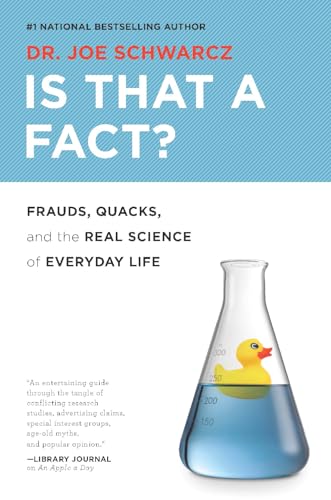
Eat this and live to 100. Don’t, and die. Today, hyperboles dominate the media, which makes parsing science from fiction an arduous task when deciding what to eat, what chemicals to avoid, and what’s best for the environment. In Is That a Fact?, bestselling author Dr. Joe Schwarcz carefully navigates the storm of misinformation to help us separate fact from folly and shrewdness from foolishness. Are GMOs really harmful? Or could they help developing countries? Which “miracle weight loss foods” gained popularity through exuberant data dredging? Is BPA dangerous or just a victim of unforgiving media hype? Is organic better? Dr. Joe questions the reliability and motives of “experts” in this easy-to-understand yet critical look at what’s fact and what’s plain nonsense.
Die Inhaltsangabe kann sich auf eine andere Ausgabe dieses Titels beziehen.
Über die Autorinnen und Autoren
Dr. Joe Schwarcz is director of McGill University’s Office for Science and Society, dedicated to demystifying science and separating sense from nonsense. He is a popular lecturer, both to students and to the larger public. He hosts The Dr. Joe Show on Montreal radio and is the author of over a dozen bestselling titles. Dr. Joe lives in Montreal, Quebec.
Dr. Joe Schwarcz is director of McGill University’s Office for Science and Society, dedicated to demystifying science and separating sense from nonsense. He is a popular lecturer, both to students and to the larger public. He hosts The Dr. Joe Show on Montreal radio and is the author of over a dozen bestselling titles. Dr. Joe lives in Montreal, Quebec.
Auszug. © Genehmigter Nachdruck. Alle Rechte vorbehalten.
Is That a Fact?
Frauds, Quacks, and the Real Science of Everyday Life
By Joe SchwarczECW PRESS
Copyright © 2014 Joe Schwarcz
All rights reserved.
ISBN: 978-1-77041-190-6All rights reserved.
Contents
IN THE BEGINNING,
Is That a Fact?, 1,
Chance Favors the Prepared Mind, 6,
The Chemistry of Our World Is Too Complex to Be Simplified, 9,
Callers Have Questions ..., 14,
BLACK,
Quackery Is Not an Issue to Duck, 19,
The "Cancer Conspiracy", 22,
Yikes, I'm Infested!, 26,
Full of It, 30,
Poking into the Pukeweed Doctor, 33,
Vinegar Claims Leave a Sweet and Sour Taste, 36,
Diagnosing Pathological Science, 40,
Mountebanks, 43,
Double Helix Water, 47,
Fakes, Phonies, and Impostors, 50,
The Trouble With Homeopathy, 54,
Seeing Is Believing, 64,
A Look at Braco the Gazer, 67,
Celebrities and Cerebral Claptrap, 70,
Rhinoceros Horn Is Useful—for Its Original Owner, 74,
The Skinny on the HCG Weight Loss Scheme, 77,
Doctors Who Kill, 81,
GRAY,
Fishy Claims for Fish Oil Supplements, 87,
Swallowing Blueberries, Apples, and Hype, 91,
An Antidote to the Poisonous Tomato Legend, 95,
Leeches Then and Now, 98,
Crying Wolf, 101,
What's for Dinner?, 104,
Twinkies, M&Ms, and Weight Loss, 108,
The Rise, Fall, and Possible Rise of Tropical Oils, 111,
Thinking About Coconut Oil, 115,
Free Radicals Bad, Antioxidants Good: Is That So?, 118,
A Health and Education Act? Really?, 122,
Apple Picking of Data Leaves a Bad Taste, 126,
Deer Antlers Could Have Athletes Skating on Thin Ice, 129,
The Questionable Wizardry of Dr. Oz, 132,
Breatharians and Nutritarians, 139,
Pink Slime—Jamie Oliver Chooses the Wrong Bone to Pick, 143,
Quackery Can Tarnish Silver's Medical Luster, 146,
Salt Therapy, 150,
The Funny Business of Selling Water, 153,
Buckyballs Roll into the Pit of Folly, 157,
Scientists Smell a Rat in French GMO Rat Study, 161,
WHITE,
It's in the Can!, 165,
A Natural Conundrum, 168,
Out of the Mouths of Babes, 171,
Cats, Calamities, and Static Cling, 175,
Chemistry in the Spotlight—for a Tragic Reason, 178,
Just Ironing Things Out, 182,
Meat Production: A Smelly Business, 185,
Reflecting on the History of Mirrors, 189,
Dry Ice—It's Sublime!, 194,
The Cuddle Chemical Versus Personality, 197,
Lighter, Brighter, Safer!, 201,
Chemical Demonstrations Can Get Mighty Hot, 204,
The Many Faces of Neoprene, 207,
From Twitching Worms to Non-Browning Apples, 211,
A Squeeze on Orange Juice Production, 214,
Sleeping Gas—It's a Dream!, 217,
The Electrifying Lectures of Sir Humphry Davy, 221,
The Ups and Downs of Antibiotics, 224,
The Saga of the Flaming Rocks, 228,
Popping Off About Gluten-Free Rice Krispies, 231,
Geyser Gets a Little Help From Chemistry, 234,
Possums and Kiwis, 237,
Beep ... Beep ... It's Moscow Calling!, 241,
Be Glad They're Asking About Liquids and Gels, 245,
Smashing Atoms to Smithereens, 248,
Justice Full of Beans, 251,
Of Mice and Men and Apples and Oranges, 255,
Imported Fruit May Harbor Terrorists, 258,
The Mesmerizing Power of Belief, 261,
IN THE END,
Our Posthumous Footprint, 265,
Index, 271,
CHAPTER 1
IN THE BEGINNING
Is That a Fact?
"Is that a fact?" "They say that ..." "I heard that ..." Just listen in on a few conversations around the water cooler and it won't be long before one of these phrases rings out. After all, this is the Communication Age. We are connected through cell phones, radio, TV, and, of course, the web. We talk, we Tweet, we link, we text, we Facebook. We are informed. But in many cases, unfortunately, we are also misinformed.
We suffer from information overload. Just Google a subject and within a second, you can be flooded with a million references. It is therefore more important than ever to be able to analyze those references and know how to separate sense from nonsense. And that's where learning comes in. Information has to be scrutinized in the light of what is already known. But learning must be coupled with critical thinking. Confucius said it very well: "Learning without thought is labor lost; thought without learning is perilous."
The University of Google is well stocked with information, but its students are left to flounder when it comes to determining whether that information is reliable. Accounts of miraculous cancer cures, the rants of anti-vaccine activists, the exploits of so-called psychics, and the claims of various alternative healers may sound very seductive, but stand to lose their luster in the light of scientific education. It would, however, be incorrect to suggest that education is the vaccine against folly. The annals of history are replete with examples of educated people who have succumbed to nonsense. Sir Arthur Conan Doyle, a physician by training, believed in fairies and in communicating with the dead. Curiously, he was the creator of Sherlock Holmes, who was a logician extraordinaire and eschewed such silliness.
Indeed, it was Holmes who reminded us, "It is a capital mistake to theorize before one has data. Insensibly one begins to twist facts to suit theories instead of theories to suit facts." These days, those of us who follow Holmes's dictum and put evidence-based science on a pedestal often get criticized for challenging claims we consider to be unscientific. "They laughed at Galileo," the promoters of such claims say, "and at Columbus, and at the Wright Brothers." But, as Carl Sagan pointed out, the fact that some geniuses were laughed at does not imply that all who are laughed at are geniuses. They also laughed at Bozo the Clown.
Our best bet in order to differentiate the Bozos from the prospective Galileos is to push for more science education at all levels, with a strong emphasis on the importance of critical thinking. Furthermore, it should be realized that when it comes to separating sense from nonsense, mental prowess is not enough. Benjamin Franklin was right on when he opined, "Genius without education is like silver in a mine." Indeed, the value is there, but the silver is not of much use until you extract it. But how do you go about this extraction? How do we know who is right and who is wrong? How do we know what is a fact and what is not? How do I know what I claim to know? that is a question I had to contemplate recently when a student innocently asked me, "And how do you know that?"
I had just finished a lecture on toxicology in which I had described the problem of cyanide poisoning by cassava, a tuber similar to the potato that is a staple in some parts of Africa. However, with some varieties of cassava, there's an issue: if not properly processed, it can harbor a lethal amount of cyanide. (This is not the case with the cassava grown in the Caribbean.) But soaking the peeled tuber in water for several days releases enzymes that degrade the cyanide-storage compound linamarin, causing the toxic cyanide to be dissipated into the air as hydrogen cyanide. Unfortunately, cases of acute cyanide poisoning have occurred when famine conditions forced a shortening of the soaking time. Since even proper processing doesn't remove all the cyanide, chronic low-level exposure can lead to goiter or even konzo, a type of paralysis.
I've described the cyanide connection in lectures numerous...
„Über diesen Titel“ kann sich auf eine andere Ausgabe dieses Titels beziehen.
Suchergebnisse für Is That A Fact?: Frauds, Quacks, and the Real Science...

Beispielbild für diese ISBN
Is That a Fact?: Frauds, Quacks, and the Real Science of Everyday Life
Anbieter: BooksRun, Philadelphia, PA, USA
Verkäuferbewertung 5 von 5 Sternen

Paperback. Zustand: Very Good. No. It's a well-cared-for item that has seen limited use. The item may show minor signs of wear. All the text is legible, with all pages included. It may have slight markings and/or highlighting. Artikel-Nr. 1770411909-11-6
Gebraucht kaufen
EUR 5,09
Versand gratis
Versand innerhalb von USA
Versand innerhalb von USA
Anzahl: 1 verfügbar
Beispielbild für diese ISBN
Is That a Fact?: Frauds, Quacks, and the Real Science of Everyday Life
Anbieter: World of Books (was SecondSale), Montgomery, IL, USA
Verkäuferbewertung 5 von 5 Sternen
Zustand: Good. Good condition ex-library book with usual library markings and stickers. Artikel-Nr. 00108348494
Gebraucht kaufen
EUR 5,42
Versand gratis
Versand innerhalb von USA
Versand innerhalb von USA
Anzahl: 1 verfügbar
Beispielbild für diese ISBN
Is That a Fact?: Frauds, Quacks, and the Real Science of Everyday Life
Anbieter: ThriftBooks-Atlanta, AUSTELL, GA, USA
Verkäuferbewertung 5 von 5 Sternen
Paperback. Zustand: Very Good. No Jacket. Former library book; May have limited writing in cover pages. Pages are unmarked. ~ ThriftBooks: Read More, Spend Less. Artikel-Nr. G1770411909I4N10
Gebraucht kaufen
EUR 5,86
Versand gratis
Versand innerhalb von USA
Versand innerhalb von USA
Anzahl: 1 verfügbar
Beispielbild für diese ISBN
Is That a Fact?: Frauds, Quacks, and the Real Science of Everyday Life
Anbieter: Wonder Book, Frederick, MD, USA
Verkäuferbewertung 5 von 5 Sternen
Zustand: Very Good. Very Good condition. A copy that may have a few cosmetic defects. May also contain light spine creasing or a few markings such as an owner's name, short gifter's inscription or light stamp. Artikel-Nr. I21A-04197
Gebraucht kaufen
EUR 6,32
Versand gratis
Versand innerhalb von USA
Versand innerhalb von USA
Anzahl: 1 verfügbar
Beispielbild für diese ISBN
Is That a Fact? : Frauds, Quacks, and the Real Science of Everyday Life
Anbieter: Better World Books, Mishawaka, IN, USA
Verkäuferbewertung 5 von 5 Sternen
Zustand: Very Good. Former library copy. Pages intact with possible writing/highlighting. Binding strong with minor wear. Dust jackets/supplements may not be included. Includes library markings. Stock photo provided. Product includes identifying sticker. Better World Books: Buy Books. Do Good. Artikel-Nr. 8694723-6
Gebraucht kaufen
EUR 6,46
Versand gratis
Versand innerhalb von USA
Versand innerhalb von USA
Anzahl: 2 verfügbar
Beispielbild für diese ISBN
Is That a Fact? : Frauds, Quacks, and the Real Science of Everyday Life
Anbieter: Better World Books, Mishawaka, IN, USA
Verkäuferbewertung 5 von 5 Sternen
Zustand: Good. Former library copy. Pages intact with minimal writing/highlighting. The binding may be loose and creased. Dust jackets/supplements are not included. Includes library markings. Stock photo provided. Product includes identifying sticker. Better World Books: Buy Books. Do Good. Artikel-Nr. 7933911-75
Gebraucht kaufen
EUR 6,46
Versand gratis
Versand innerhalb von USA
Versand innerhalb von USA
Anzahl: 1 verfügbar
Beispielbild für diese ISBN
Is That a Fact?: Frauds, Quacks, and the Real Science of Everyday Life
Anbieter: Ammareal, Morangis, Frankreich
Verkäuferbewertung 5 von 5 Sternen
Softcover. Zustand: Très bon. Edition 2014. Ammareal reverse jusqu'à 15% du prix net de cet article à des organisations caritatives. ENGLISH DESCRIPTION Book Condition: Used, Very good. Edition 2014. Ammareal gives back up to 15% of this item's net price to charity organizations. Artikel-Nr. I-431-772
Gebraucht kaufen
EUR 3,15
EUR 16,50 Versand
Versand von Frankreich nach USA
Versand von Frankreich nach USA
Anzahl: 1 verfügbar
Beispielbild für diese ISBN
Is That a Fact? Frauds, Quacks, and the Real Science of Everyday Life
Anbieter: Anybook.com, Lincoln, Vereinigtes Königreich
Verkäuferbewertung 5 von 5 Sternen
Zustand: Fair. This is an ex-library book and may have the usual library/used-book markings inside.This book has soft covers. Clean from markings. In fair condition, suitable as a study copy. Please note the Image in this listing is a stock photo and may not match the covers of the actual item,500grams, ISBN:9781770411906. Artikel-Nr. 7064342
Gebraucht kaufen
EUR 9,48
EUR 15,81 Versand
Versand von Vereinigtes Königreich nach USA
Versand von Vereinigtes Königreich nach USA
Anzahl: 1 verfügbar
Beispielbild für diese ISBN
Is that a Fact?: Frauds, Quacks, and the Real Science of Everyday Life
Anbieter: WorldofBooks, Goring-By-Sea, WS, Vereinigtes Königreich
Verkäuferbewertung 5 von 5 Sternen
Paperback. Zustand: Very Good. The book has been read, but is in excellent condition. Pages are intact and not marred by notes or highlighting. The spine remains undamaged. Artikel-Nr. GOR010710173
Gebraucht kaufen
EUR 20,77
EUR 6,51 Versand
Versand von Vereinigtes Königreich nach USA
Versand von Vereinigtes Königreich nach USA
Anzahl: 1 verfügbar