
Inhaltsangabe
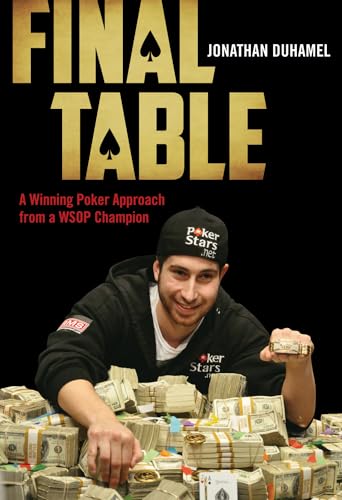
A poker champ shares the story behind his biggest winWhat makes a World Series of Poker Main Event champion? Is it knowledge of math or psychology? Is it the ability to determine other players’ hands? In Jonathan Duhamel’s Final Table, discover what it takes to win $8.9 million in one tournament. Duhamel takes readers through crucial game moments and traces his strategic thinking. Should he go all-in? Should he fold? What is the right balance between risk and caution? Duhamel reveals the specific qualities winning poker players need. Learn about Jonathan’s development as a poker player from his earliest days through to his online playing, into tournaments and the decision to go pro. Whether you’re a Friday night player or a professional, Final Table will entertain and educate you.
Die Inhaltsangabe kann sich auf eine andere Ausgabe dieses Titels beziehen.
Über die Autorinnen und Autoren
Jonathan Duhamel is the winner of the 2010 World Series of Poker, becoming the first Canadian to do so and earning nearly nine million dollars. He lives in Montreal, Quebec.
Jonathan Duhamel is the winner of the 2010 World Series of Poker, becoming the first Canadian to do so and earning nearly nine million dollars. He lives in Montreal, Quebec.
Jonathan Duhamel won the 2010 World Series of Poker, the Deauville high roller event at 2011’s European Poker Tour Series, and made four final tables at 2012’s PokerStars Caribbean Poker Adventure. He lives in Montréal, Québec.
Auszug. © Genehmigter Nachdruck. Alle Rechte vorbehalten.
Final Table
A Winning Poker Approach from a WSOP Champion
By Jonathan Duhamel, Christina PalassioECW PRESS
Copyright © 2011 Les Éditions de L'Homme
All rights reserved.
ISBN: 978-1-77041-113-5All rights reserved.
CHAPTER 1
Passion
"Lots of pros aren't passionate about what they do, and it shows. I love poker. I love everything about it. It's the best game in the world. I'm always trying to improve my game and to move up. I have a huge advantage over those of my opponents who only play because it's their job." — Phil Ivey
Everything starts with passion ...
That said, this kind of passion isn't one that I seemed predestined to have. We often assume that children inherit their parents' quirks and qualities, even though it's seldom the case. But neither poker nor any other betting game ever made it past the doorstep of our house while I was growing up. My father, Luc Duhamel, who has worked as a machinist at Pratt and Whitney for the past 30 years, and my mother, Johanne Grenier, a teller at the Desjardins credit union in Boucherville, taught me from a very young age that money doesn't grow on trees ... or on cards.
My parents instilled in me the values of hard work, self-discipline and integrity early on. They taught by example. At 13, I was spending most of my summer picking strawberries on farms in the Montérégie region. At 16, I was putting in more than 30 hours a week in the stockroom of the Provigo grocery store in Boucherville. I've never been afraid of work, be it physical or intellectual. That's still true today. It wasn't until I was in my early twenties that the idea that I might be able to make a lot of money playing poker started to germinate in my mind.
* * *
I remember very clearly the first time I played poker. I was 15 or 16. It was a Friday night in Boucherville, and I was hanging out with some friends in a friend's basement watching TV. A totally typical night, one like so many others from that time in my life. And that's when my initiation took place. The older brother of the friend whose house we were in came down to hang out with us and suggested we play a game of five-card draw. We ended up playing all night, without any stakes — just for fun.
I don't know if you can use the term "love at first sight" to describe such unremarkable circumstances, but let's just say that I was immediately taken by the game. It was simple and complex all at the same time. It had strategy, suspense, doubt and excitement, and it involved calculations that appealed to my mathematical side. And then there was the luck factor. The game might not have been so appealing if it wasn't for that key element. It was like a game of chess with a dose of chance thrown in. The combination of all of those elements led me to fall in love with poker, and it's a feeling that has never wavered.
Soon after that night, I started playing several nights a week with some kids from the neighborhood, but always for very small stakes. Betting made the game more complete and thrilling, but it wasn't the heart of why we liked to play. That had more to do with the game itself. We started out playing five-card draw and then moved on to all sorts of other variations. Initially, Texas Hold'em didn't appeal to us much because we thought it didn't offer much action. We preferred a variation where we could bluff more, which seemed to open up the game and make it a lot more exciting. But as we got better, Texas Hold'em became our favorite variation. Hold'em requires much more skill and strategy than the traditional five-card game, partly because five of your seven cards are community cards that are shared by all players. And the fact that it's easier to play and to understand makes it easier to find other people to play. That's why it's become so popular over the past decade.
I think back fondly on that period of learning and discovery. I spent a lot of time on the internet in those days, seeking out information, adding to my body of knowledge, studying strategy and, eventually, playing at free-to-play tables. At some point, one of my friends put down $20 online, and I watched as he played it. After that, I started betting small amounts, and participating in online tournaments in which I had a moderate amount of success. I think I've proven by now that I have the qualities necessary to get to the top of the game, but you'd be wrong to think it all happened by magic. It isn't magic for anyone. I lost more than I won, but I was constantly improving and, more importantly, my thirst for knowledge and my passion for the game always remained strong.
* * *
Passion for the game can take many different forms. For people who are motivated by risk, that passion can extend to any game of chance, from roulette to blackjack to backgammon. But that passion can also begin and end with poker, as it does with me. Or it can be conflated with the allure of easy money, which, I should stress, doesn't make for a very long career. And then there are people who have a real and ongoing infatuation with poker but who never feel the need to scale up their study of the game.
One thing's for sure though: anyone who's ever had real success at poker started out feeling that passion for the game, and they still feel it in one way or another. It's the trigger, the first step and the prerequisite for moving forward and winning in a consistent way.
ACCORDING TO JONATHAN: "I believe passion is a prerequisite for success — it's the fuel for the fire. You can work to keep it lit, but you can't create it if there isn't already a spark. That's what makes it such an invaluable asset."
The passion I'm referring to here is for the game of poker itself. I'm not talking about a lust for money or fame or victory, even though they tend to be the goal of most competitions. I'm also not talking about the enthusiasm of the casual player who likes to play but doesn't feel like investing in the game. What I'm talking about is an unquenchable thirst for knowledge and self-improvement. The foundation of that passion is humility, an awareness of one's weaknesses and shortcomings and the unshakeable belief in the possibility for improvement that comes from devoting time and effort to the game and being willing to make all the necessary sacrifices. Passion isn't the sole factor, but everything else follows from it. It's what compels you to do everything it takes to move forward, to acquire discipline, self-control, a good sense of observation and all the other skills I'll talk about in this book.
In this respect, the poker player's passion is no different from the passion that drives people to excel in other fields. Think of hockey players who start off with a love for the game and the skills to advance, but who have to put in years of practice and sacrifice to get to the NHL. Think of those young players who at 16, or even sometimes younger, leave their families and friends to go play in the junior leagues, where they spend hours every week traveling on buses from one small town to the next, bound by a rigorous routine and required to put in the effort that's needed to excel in an extremely competitive environment every single day. And they all do it without any guarantee they'll make it to the NHL. The thing that makes these kids willing to give up the regular life of a teenager is passion for the sport, and the hope that they might one day be part of an elite group.
I'm thinking here too of Guy Laliberté — founder of Cirque du Soleil — a man I'm lucky enough to know and whose company I enjoy immensely. Here's a guy who turned his...
„Über diesen Titel“ kann sich auf eine andere Ausgabe dieses Titels beziehen.
Weitere beliebte Ausgaben desselben Titels

Suchergebnisse für Final Table: A Winning Poker Approach from a WSOP Champion

Beispielbild für diese ISBN
Final Table: A Winning Poker Approach from a WSOP Champion
Anbieter: World of Books (was SecondSale), Montgomery, IL, USA
Verkäuferbewertung 5 von 5 Sternen

Zustand: Good. Good condition ex-library book with usual library markings and stickers. Artikel-Nr. 00104672392
Gebraucht kaufen
EUR 6,66
Versand gratis
Versand innerhalb von USA
Versand innerhalb von USA
Anzahl: 1 verfügbar
Beispielbild für diese ISBN
Final Table : A Winning Poker Approach from a WSOP Champion
Anbieter: Better World Books, Mishawaka, IN, USA
Verkäuferbewertung 5 von 5 Sternen
Zustand: Good. Pages intact with minimal writing/highlighting. The binding may be loose and creased. Dust jackets/supplements are not included. Stock photo provided. Product includes identifying sticker. Better World Books: Buy Books. Do Good. Artikel-Nr. 6263875-6
Gebraucht kaufen
EUR 6,67
Versand gratis
Versand innerhalb von USA
Versand innerhalb von USA
Anzahl: 1 verfügbar
Beispielbild für diese ISBN
Final Table : A Winning Poker Approach from a WSOP Champion
Anbieter: Better World Books, Mishawaka, IN, USA
Verkäuferbewertung 5 von 5 Sternen
Zustand: Good. Former library copy. Pages intact with minimal writing/highlighting. The binding may be loose and creased. Dust jackets/supplements are not included. Includes library markings. Stock photo provided. Product includes identifying sticker. Better World Books: Buy Books. Do Good. Artikel-Nr. 10012769-6
Gebraucht kaufen
EUR 6,67
Versand gratis
Versand innerhalb von USA
Versand innerhalb von USA
Anzahl: 1 verfügbar
Beispielbild für diese ISBN
Final Table: A Winning Poker Approach from a WSOP Champion
Anbieter: ThriftBooks-Dallas, Dallas, TX, USA
Verkäuferbewertung 5 von 5 Sternen
Paperback. Zustand: Very Good. No Jacket. May have limited writing in cover pages. Pages are unmarked. ~ ThriftBooks: Read More, Spend Less. Artikel-Nr. G1770411135I4N00
Gebraucht kaufen
EUR 7,96
Versand gratis
Versand innerhalb von USA
Versand innerhalb von USA
Anzahl: 1 verfügbar
Beispielbild für diese ISBN
Final Table: A Winning Poker Approach from a WSOP Champion
Anbieter: ThriftBooks-Atlanta, AUSTELL, GA, USA
Verkäuferbewertung 5 von 5 Sternen
Paperback. Zustand: Good. No Jacket. Former library book; Pages can have notes/highlighting. Spine may show signs of wear. ~ ThriftBooks: Read More, Spend Less. Artikel-Nr. G1770411135I3N10
Gebraucht kaufen
EUR 7,96
Versand gratis
Versand innerhalb von USA
Versand innerhalb von USA
Anzahl: 1 verfügbar
Beispielbild für diese ISBN
Final Table: A Winning Poker Approach from a Wsop Champion
Anbieter: Revaluation Books, Exeter, Vereinigtes Königreich
Verkäuferbewertung 5 von 5 Sternen
Paperback. Zustand: Brand New. 146 pages. 9.25x6.25x0.50 inches. In Stock. Artikel-Nr. __1770411135
Neu kaufen
EUR 14,48
EUR 11,73 Versand
Versand von Vereinigtes Königreich nach USA
Versand von Vereinigtes Königreich nach USA
Anzahl: 2 verfügbar
Beispielbild für diese ISBN
Final Table : A Winning Poker Approach from a WSOP Champion
Anbieter: Sell Books, Elland, YORKS, Vereinigtes Königreich
Verkäuferbewertung 5 von 5 Sternen
paperback. Zustand: Good. Our good condition books are generally good for reading but not for gifting or collecting. They could have imperfections such as creasing, fanning, inscriptions, margin notes, yellowing, staining on edge or cover or pages, bumps, scuffs, etc etc (sometimes multiple of these). It's a wide category that encompasses anything that isn't almost-new down to anything that is slightly better than poor. We would NOT recommend gifting Good books - these should be considered reading copies. Our books are dispatched from a Yorkshire former cotton mill. We list via barcode/ISBN so please note that the images are stock images and may not be the exact copy you receive, furthermore the details about edition and year might not be accurate as many publishers reuse the same ISBN for multiple editions and as we simply scan a barcode or enter an ISBN we do not check the validity of the edition data when listing. If you're looking for an exact edition please don't order (at least not without checking with us first, although we don't always have time to check). We aim to dispatch prompty, the service used will depend on order value and book size. We can ship to most countries, see our shipping policies. Payment is via Abe only. Artikel-Nr. mon0000071552
Gebraucht kaufen
EUR 14,34
EUR 14,25 Versand
Versand von Vereinigtes Königreich nach USA
Versand von Vereinigtes Königreich nach USA
Anzahl: 1 verfügbar
Beispielbild für diese ISBN
Final Table
Anbieter: Kennys Bookstore, Olney, MD, USA
Verkäuferbewertung 5 von 5 Sternen
Zustand: New. 2012. 1St Edition. Paperback. . . . . . Books ship from the US and Ireland. Artikel-Nr. V9781770411135
Neu kaufen
EUR 23,33
EUR 9,19 Versand
Versand innerhalb von USA
Versand innerhalb von USA
Anzahl: 1 verfügbar
Foto des Verkäufers
Final Table: A Winning Poker Approach from a WSOP Champion
Anbieter: moluna, Greven, Deutschland
Verkäuferbewertung 5 von 5 Sternen
Zustand: New. Artikel-Nr. 905380862
Neu kaufen
EUR 22,69
EUR 48,99 Versand
Versand von Deutschland nach USA
Versand von Deutschland nach USA
Anzahl: 2 verfügbar
Foto des Verkäufers
Final Table : A Winning Poker Approach from a WSOP Champion
Anbieter: AHA-BUCH GmbH, Einbeck, Deutschland
Verkäuferbewertung 5 von 5 Sternen
Taschenbuch. Zustand: Neu. Neuware - With stories of his most important games, and key moments in his rise to fame, Duhamel reveals the mindset of a champion at the games table and in everyday life. Artikel-Nr. 9781770411135
Neu kaufen
EUR 26,75
EUR 61,32 Versand
Versand von Deutschland nach USA
Versand von Deutschland nach USA
Anzahl: 2 verfügbar