
Verwandte Artikel zu Borderwork in Multicultural Australia
Inhaltsangabe
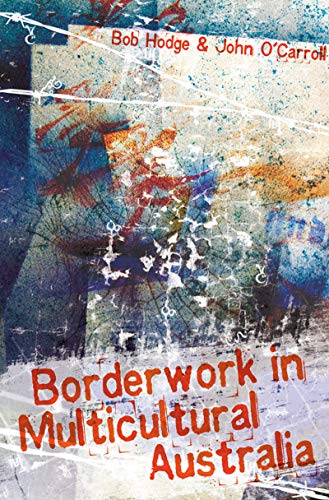
Australia's faith in multiculturalism has been shaken by ferocious attacks in the public arena over the past decade. Borderwork in Multicultural Australia, reviews the hot spots, reasserts the value of multiculturalism and argues that a multicultural society is the best bulwark against terrorism, racism and injustice.
Die Inhaltsangabe kann sich auf eine andere Ausgabe dieses Titels beziehen.
Über die Autorin bzw. den Autor
Bob Hodge is Foundation Professor of Humanities in the Centre for Cultural Research at the University of Western Sydney, and author of many books including Social Semiotics and Myths of Oz. John O'Carroll lectures in the School of Social Sciences and Liberal Studies at Charles Sturt University.
Auszug. © Genehmigter Nachdruck. Alle Rechte vorbehalten.
Borderwork in Multicultural Australia
By Bob Hodge, John O'CarrollAllen & Unwin
Copyright © 2006 Bob Hodge and John O'Carroll
All rights reserved.
ISBN: 978-1-74114-680-6All rights reserved.
Contents
Acknowledgments,
1 Trials and triumphs of multicultural Australia,
2 Borderwork,
3 Tolerance paradoxes,
4 Anglo-Celts in multicultural Australia,
5 Racism and schismogenesis,
6 Aboriginal Australia and multiculture,
7 Imagining Islam,
8 Austral/Asia,
9 Rethinking the Pacific,
10 Imagining multicultural Australia,
Appendix: Tools for analysing multiculture and borderwork,
References,
CHAPTER 1
Trials and triumphs of multicultural Australia
Introduction
This is a book for the current stage in Australia's ongoing search for its place and role in a multicultural global world. Not so long ago, most Australians took pride in their multicultural identity, but more recently this faith in multiculturalism has been badly damaged, by ferocious attacks from its enemies and a sense of crisis amongst its friends. A shadow has fallen across the land, an image of 'Fortress Australia', displacing the old talk of multiculturalism as if it were the mere construction of the 'chattering classes', cut off from the reality that has always been there. Discussions take place as though idealism and hope are now taboo. Yet without such aspirations, there could be no Australia as we know it. Without the commitment to tolerance and diversity that characterises the daily reality of multicultural Australia, it would be a very different place.
This book is intended for students fascinated by Australia's unique way of being multicultural, drawing on an undergraduate course we have taught for some years. It is also for anyone who wants to be inspired anew by the promise of multicultural Australia, without evading any of its difficulties — past and present. These aims explain the form and style of our book, why it is as it is, and what we do not try to do. Our aim as teachers is to stimulate good discussions (lively, diverse, well-informed, passionate, critical, open-minded, transformative) as the best foundation for good citizens.
Good discussions are not fact-free zones, however. There are many things we believe informed citizens of Australia ought to know about their history and society. We indicate some of these, pointing out where to go for those who wish to know more. We also have our own perspective, which comes across clearly enough, so that readers know where we stand. More important for us is that our readers also come to know better where they stand. For this reason, we do not gloss over the difficulties and contradictions in our own position as in others — a necessary approach to a topic that is so complex, so open to change.
The book proceeds by dealing with current 'hot topics', situating these against the social frameworks that give rise to them. These hot spots typically cluster around borders, boundaries that mark territories, identities, and values to be defended or proclaimed. Some of these borders are massive and concrete, seeming like facts of nature into which multicultural processes will have to fit, whether they like it or not. The border around Australia as a nation state sometimes seems like this, creating the self-evident identity of those it defines. Yet borders are not simple or self-evident — even the border that defines Australia. Borders are constructed at many levels, right down to the smallest and most private. They can be solid walls, fences, doors, clothes, or less material signposts or internalised rules. These countless borders cover social space like an infinitely complex network. Borders exist to be crossed, as well as to exclude. Borderwork is what we will call the many processes by which humans construct, maintain, police and negotiate a variety of relationships, whether based on similarities or difference, love or fear. Borders are often seen as the enemy of multiculturalism, as though multiculturalism is really only about harmony and ease of relationships. But multiculturalism is about managing differences and similarities alike, in ways that may be positive or negative in different circumstances, according to different perspectives. Borderwork is not opposed to multiculturalism: it is basic to it.
Our students have found it helpful to ground these debates in their own multicultural experiences, and that is what we will do in the book that follows. These experiences are mainly positive. Our own experience as teachers in this area is similar to the results of one study that found only about 10 per cent of Australians had a negative view about multiculturalism and cultural diversity, and these figures are not very different in rural Australia (Ang et al. 2002, p. 4). In spite of all the bad press, the vast majority of Australians know they live in a multicultural society, and they are delighted with the fact.
Unshrinking 'multiculturalism'
Part of the problem for multiculturalism is the word itself. The term has suffered drastic shrinkage over the years as it is used in public debates. It has become a code word for government policies towards minority immigrant 'ethnic' groups, and their quaint and colourful customs ('cultures'). There are many (multi) of these groups, but not many people all up compared with the majority group, 'Anglo-Celts' — who in this view have no ethnicity, no need for 'culture' themselves, and hence no vital stake in multiculturalism.
We want to unshrink this limited sense of what it means to call Australia a multicultural society. We draw attention to something remarkable that has happened in Australia's history. The British penal colony out of which the nation grew was as harsh, unjust and intolerant a society as you could care to name. But sometime between then and now a kind of miracle took place. A multicultural Australia emerged in which diversities are tolerated and valued, to a significant degree. How did it happen? What exactly is it that happened? What does it tell us about where it happened, about Australia? That is what the rest of the book tries to find out. We need this specific concept of multicultural Australia, to see it as something unique, formed by the play of many forces, inextricably connected with the core issues affecting all Australians.
Confusions in words may seem a minor matter, but such confusions can trap us as we use these words to think with. For instance, we find it useful to mark a clear difference between 'multicultural' and 'multiculturalism'. English -isms usually have negative connotations, and 'multiculturalism' is no exception. 'Multicultural', in contrast, has the potential to hold more diverse associations, describing everything about a society that is 'multicultural', not just a policy or problem (Hall 1990). Yet in popular discourse the -ism noun has taken over the adjective, sucking 'multicultural' into its orbit as though the adjective only describes whatever 'multiculturalism' is.
In presenting a new view of multicultural Australia, we have tried to go back to the very basics, to think anew about what multicultural Australia really is, and what it really does. We have used the new word multiculture to describe what happens in a multicultural society. For us, this noun refers to a shifting, dynamic interweaving of cultures and diversities such as that which exists in Australian society today, as well as to political policies and...
„Über diesen Titel“ kann sich auf eine andere Ausgabe dieses Titels beziehen.
Suchergebnisse für Borderwork in Multicultural Australia

Beispielbild für diese ISBN
Borderwork in Multicultural Australia
Anbieter: PBShop.store US, Wood Dale, IL, USA
Verkäuferbewertung 5 von 5 Sternen

PAP. Zustand: New. New Book. Shipped from UK. Established seller since 2000. Artikel-Nr. L2-9781741146806
Neu kaufen
EUR 75,93
Versand gratis
Versand innerhalb von USA
Versand innerhalb von USA
Anzahl: Mehr als 20 verfügbar
Beispielbild für diese ISBN
Borderwork in Multicultural Australia
Anbieter: PBShop.store UK, Fairford, GLOS, Vereinigtes Königreich
Verkäuferbewertung 5 von 5 Sternen
PAP. Zustand: New. New Book. Shipped from UK. Established seller since 2000. Artikel-Nr. L2-9781741146806
Neu kaufen
EUR 71,31
EUR 4,83 Versand
Versand von Vereinigtes Königreich nach USA
Versand von Vereinigtes Königreich nach USA
Anzahl: Mehr als 20 verfügbar
Beispielbild für diese ISBN
Borderwork in Multicultural Australia
Anbieter: Ria Christie Collections, Uxbridge, Vereinigtes Königreich
Verkäuferbewertung 5 von 5 Sternen
Zustand: New. In English. Artikel-Nr. ria9781741146806_new
Neu kaufen
EUR 77,55
EUR 10,88 Versand
Versand von Vereinigtes Königreich nach USA
Versand von Vereinigtes Königreich nach USA
Anzahl: Mehr als 20 verfügbar
Beispielbild für diese ISBN
Borderwork in Multicultural Australia
Anbieter: Revaluation Books, Exeter, Vereinigtes Königreich
Verkäuferbewertung 5 von 5 Sternen
Paperback. Zustand: Brand New. 252 pages. 8.00x5.50x0.75 inches. In Stock. Artikel-Nr. x-1741146801
Neu kaufen
EUR 90,65
EUR 14,52 Versand
Versand von Vereinigtes Königreich nach USA
Versand von Vereinigtes Königreich nach USA
Anzahl: 2 verfügbar
Beispielbild für diese ISBN
Borderwork in Multicultural Australia
Anbieter: Kennys Bookstore, Olney, MD, USA
Verkäuferbewertung 5 von 5 Sternen
Zustand: New. Artikel-Nr. V9781741146806
Neu kaufen
EUR 96,00
EUR 9,23 Versand
Versand innerhalb von USA
Versand innerhalb von USA
Anzahl: Mehr als 20 verfügbar