
Verwandte Artikel zu The Big Both Ways (A Cold Storage Novel, Band 1)
Inhaltsangabe
Alaska, 1935: Slippery Wilson is on his way out of town when he runs into a woman, her neice, and a crashed car. His life is about to get a lot more complicated.
It's 1935 and jobs are scarce, but Slippery Wilson walks off his job at a logging camp after a gruesome accident kills a coworker. He's headed for Seattle with all his savings; he plans to buy a piece of farmland and be his own boss.
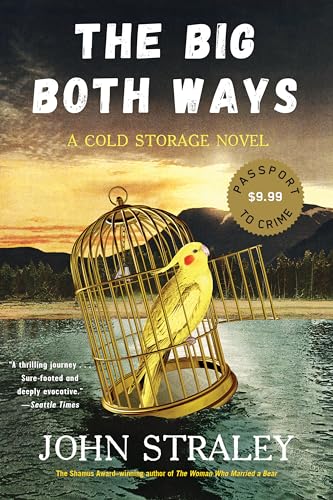
When he stops to help a woman get her car out of a ditch, his life takes a serious detour. The woman is Ellie Hobbs, an anarchist from the docks of Seattle who watches out for her young niece and dreams of flying planes. But right now, she's got one busted nose and has just stuffed a dead man's body into the trunk of her car. So begins the action that will take Slip, Ellie, her niece, and her noisy yellow bird on a heart-stopping adventure up the Inside Passage from Puget Sound to Alaska
Die Inhaltsangabe kann sich auf eine andere Ausgabe dieses Titels beziehen.
Über die Autorin bzw. den Autor
The youngest of five children, John Straley was born in Redwood City, California, in 1953. He received a BA in English from the University of Washington and, at the urging of his parents, a certificate of completion in horse shoeing. John never saw himself living in Alaska (where there are no horses left to shoe), but when his wife, Jan, a prominent whale biologist, announced she was taking a job in Sitka, the two headed north and never left. John worked for thirty years as a criminal defense investigator in Sitka, and many of the characters that fill his books were inspired by his work. Now retired, he lives with his wife in a bright green house on the beach and writes in his weather-tight office overlooking Old Sitka Rocks. The former Writer Laureate of Alaska, he is the author of ten novels.
Auszug. © Genehmigter Nachdruck. Alle Rechte vorbehalten.
ONE
Even though she had never traded sex for money, she was nothing now but a whore with a bloody nose. It was a hard fact to accept…but there it was.
She looked at the man curled in the trunk of the car, blood oiling over his white shirt. She had his broken watch in her hand, its intricate guts at a standstill, the second hand trembling between two painted tick marks on the face. It was only then that she started to cry. Her sobs leaked between her bloody fingers as she tried to stifle the sound. A mile to the west a car hissed over the pavement, and somewhere in the woods a screen door slammed.
She stepped toward him then. Tears flecked off her chin as she lifted the cold arm to place the watch back around his wrist. She was thinking that he might as well keep it, for however stupid it seemed, even in a world gone mad a broken watch could still be right twice a day.
It was May 1935. In April, Amelia Earhart had set a speed record on a solo flight from Los Angeles to Mexico City, and when she took off again she set another from Mexico City to New York. In the American southwest, a blizzard of dust scoured the tired farmland and the Roosevelt administration began relocating dust bowlers to a communal farming community in the Territory of Alaska. In August, Will Rogers and Wiley Post were to set off in their Lockheed Orion for Point Barrow, and on June 24, the miners of the Alaska-Juneau gold mine would riot when scabs started marching up the street to the hiring hall. All of these things would take on a new meaning to Slippery Wilson in the months to come but just then he was looking halfway up a big-butted Douglas fir tree listening to his bull buck tell him something through a wad of chew.
His given name was Jack, but his parents had called him Slippery. Like many people during the Depression he wanted to be hopeful. Others had told him that life was hard but he had not seen it that way. He had always been stubborn in his optimism. But now he was beginning to wonder.
“Well, I guess you better scamper up there and cut him down,” the bull buck said as he spit out a stream of tobacco juice onto the duff. They were standing in the northern woods of the Skagit River drainage, in Washington State. The wind was sour with the smell of pitch. Ninety feet up in a broken tree, Jud White was slumped dead from his climbing rope, where a partially rotten limb from the fir he was topping had hit him square in the chest. High up in the silent tree, Jud’s torso was at a sickening angle to his waist, his axe swinging from its lanyard attached to his belt.
“You better get up there and cut him down,” the bull buck repeated.
It was just after sunrise and the tired men around him had stopped rattling through the brush. Gray jays flitted in the slash of tangled branches. The hook tenders, who had already oiled up their bones with the first hard half hour of clambering down the cut, stood watching him to see what he was going to do. “No, I’m sorry,” he said to the bull buck, who was standing flat-footed amongst a tangle of rigging cable, “I’m going to draw my pay.” And he started walking out of the woods.
It had been three years since Slip had left the failing ranch in eastern Washington. Roosevelt had promised reclamation and electrification. The high desert country east of the Cascades would be a new Eden. Slip had watched the men hitchhiking with cardboard suitcases to the dam sites. He had picked apples, put up hay, and milked his family’s cows for his entire life, but when his father died and the bank took it all, he decided to follow those men up the river. As if to show him the rightness of his choice, the old cow kicked him one last time while he loaded her into the buyer’s truck, and even then he thought only of the thick, sweet milk she had given.
He sold his logging boots for five bucks to a cowhand with a cleft pallet who had been killing himself working on the rigging crew in his slick leather boots. Slip rolled his two changes of work clothes and a black suit he had used for funerals into a burlap bag that he tied off with a hank of rope. He pulled on his red mackinaw, grabbed his cap, and slung his bindle of clothes around his back. The last thing he did before walking out to the highway was to pull up the loose floorboard near his bunk. Tucked between the joists, Slip had hidden his tool kit. It was a long, open box with a few of the tools he had gotten from the farm before the men from the bank had come for their inventory. There was a fine Swedish handsaw, a brace, an assortment of bits, and a set of chisels that had never been abused. He had a square and a plumb line, a long-handled framing hammer, and a smaller claw hammer for finer work. He had a trim saw and a folding rule. There was an assortment of punches and nail sets and a carpenter’s level. He had a hand-made knife with his initials stamped into the leather sheath. The box had a strong leather sling and a canvas cover so he could travel easily without fear of spilling his tools on the ground.
He dug into his toolbox for a tobacco tin. He opened the tin and put two twenty dollar bills inside. This forty dollars represented his pay for the last two weeks, minus the money the company took out for their trouble. With that forty dollars he had well over two thousand dollars saved, and two thousand dollars could buy a future, with any extra going toward happiness.
Jud White had loved logging and was eager for Slip to love it too. Jud believed in it, he loved the bunkhouse and the tools. He loved the sweat and the smell of it. The rest of the boys worked for their wages and to build something somewhere else. Jud had been right square in the middle of his life. He woke up each morning exactly where he was supposed to be. He had been fully alive cutting trees, right up until the second that one killed him.
Slip shouldered his way past the men crowding toward the foreman’s shed. Already word had gotten round about two jobs that might open up. The skinny men drifted out of the brush like scarecrows come to life. They had been tenting off in the woods or in dry sections of culvert waiting for just this: someone to die or someone to quit. They didn’t care. They needed the work.
He grabbed some letters for friends in the bunkhouse, promising to post them when he got to a mailbox. He shook hands with the Filipino cooks and bent down to shake the hands of the truck mechanics in the grease pit. He wished them all good luck, then he walked south and stuck out his thumb. The saws on the landing were rattling in the cut as a crew lowered Jud White’s body down from the tree.
Dew was still on the grass alongside the road. The morning wrens and sparrows were calling to each other in the shade. Just under the whine of the saws, he could hear the white noise of the Skagit River roiling down the valley.
He got a ride with a kid from Sedro Woolley, who talked about his girlfriend and asked him for gas money. He got another ride from a salesman whose car was burning oil at an alarming rate, so Slip asked to be dropped off by the river, preferring to walk a while rather than be stuck with the...
„Über diesen Titel“ kann sich auf eine andere Ausgabe dieses Titels beziehen.
Suchergebnisse für The Big Both Ways (A Cold Storage Novel, Band 1)

Beispielbild für diese ISBN
The Big Both Ways (A Cold Storage Novel)
Anbieter: Wonder Book, Frederick, MD, USA
Verkäuferbewertung 5 von 5 Sternen

Zustand: Good. Good condition. A copy that has been read but remains intact. May contain markings such as bookplates, stamps, limited notes and highlighting, or a few light stains. Artikel-Nr. I01C-04068
Gebraucht kaufen
EUR 6,55
Versand gratis
Versand innerhalb von USA
Versand innerhalb von USA
Anzahl: 1 verfügbar
Beispielbild für diese ISBN
The Big Both Ways
Verlag:
Soho Press, Incorporated, 2019
ISBN 10: 1641291575
ISBN 13: 9781641291576
Gebraucht
Softcover
Anbieter: Better World Books, Mishawaka, IN, USA
Verkäuferbewertung 5 von 5 Sternen
Zustand: Very Good. Pages intact with possible writing/highlighting. Binding strong with minor wear. Dust jackets/supplements may not be included. Stock photo provided. Product includes identifying sticker. Better World Books: Buy Books. Do Good. Artikel-Nr. 45218285-6
Gebraucht kaufen
EUR 6,55
Versand gratis
Versand innerhalb von USA
Versand innerhalb von USA
Anzahl: 2 verfügbar
Foto des Verkäufers
The Big Both Ways
Anbieter: Rarewaves USA, HEBRON, KY, USA
Verkäuferbewertung 5 von 5 Sternen
Paperback. Zustand: New. Artikel-Nr. LU-9781641291576
Neu kaufen
EUR 10,11
Versand gratis
Versand innerhalb von USA
Versand innerhalb von USA
Anzahl: Mehr als 20 verfügbar
Beispielbild für diese ISBN
Big Both Ways, The: 1 (Cold Storage Novel)
Anbieter: Chiron Media, Wallingford, Vereinigtes Königreich
Verkäuferbewertung 5 von 5 Sternen
Paperback. Zustand: New. Brand new book, sourced directly from publisher. Dispatch time is 24-48 hours from our warehouse. Book will be sent in robust, secure packaging to ensure it reaches you securely. Artikel-Nr. 6666-GRD-9781641291576
Neu kaufen
EUR 8,56
EUR 5,98 Versand
Versand von Vereinigtes Königreich nach USA
Versand von Vereinigtes Königreich nach USA
Anzahl: 3 verfügbar
Beispielbild für diese ISBN
The Big Both Ways
Anbieter: PBShop.store UK, Fairford, GLOS, Vereinigtes Königreich
Verkäuferbewertung 5 von 5 Sternen
PAP. Zustand: New. New Book. Shipped from UK. Established seller since 2000. Artikel-Nr. GB-9781641291576
Neu kaufen
EUR 12,12
EUR 4,99 Versand
Versand von Vereinigtes Königreich nach USA
Versand von Vereinigtes Königreich nach USA
Anzahl: 3 verfügbar
Beispielbild für diese ISBN
The Big Both Ways (A Cold Storage Novel)
Anbieter: Majestic Books, Hounslow, Vereinigtes Königreich
Verkäuferbewertung 4 von 5 Sternen

Zustand: New. pp. 368. Artikel-Nr. 379743014
Neu kaufen
EUR 10,50
EUR 7,79 Versand
Versand von Vereinigtes Königreich nach USA
Versand von Vereinigtes Königreich nach USA
Anzahl: 3 verfügbar
Beispielbild für diese ISBN
The Big Both Ways
Anbieter: Revaluation Books, Exeter, Vereinigtes Königreich
Verkäuferbewertung 5 von 5 Sternen
Paperback. Zustand: Brand New. reprint edition. 368 pages. 7.50x5.00x1.00 inches. In Stock. Artikel-Nr. __1641291575
Neu kaufen
EUR 8,03
EUR 11,98 Versand
Versand von Vereinigtes Königreich nach USA
Versand von Vereinigtes Königreich nach USA
Anzahl: 2 verfügbar
Beispielbild für diese ISBN
The Big Both Ways
Anbieter: Kennys Bookshop and Art Galleries Ltd., Galway, GY, Irland
Verkäuferbewertung 5 von 5 Sternen
Zustand: New. 2019. Reprint. Paperback. . . . . . Artikel-Nr. V9781641291576
Neu kaufen
EUR 14,13
EUR 9,50 Versand
Versand von Irland nach USA
Versand von Irland nach USA
Anzahl: 3 verfügbar
Beispielbild für diese ISBN
The Big Both Ways (A Cold Storage Novel)
Anbieter: Biblios, Frankfurt am main, HESSE, Deutschland
Verkäuferbewertung 4 von 5 Sternen
Zustand: New. pp. 368. Artikel-Nr. 18383112435
Neu kaufen
EUR 15,10
EUR 9,95 Versand
Versand von Deutschland nach USA
Versand von Deutschland nach USA
Anzahl: 3 verfügbar
Beispielbild für diese ISBN
The Big Both Ways
Anbieter: Kennys Bookstore, Olney, MD, USA
Verkäuferbewertung 5 von 5 Sternen
Zustand: New. 2019. Reprint. Paperback. . . . . . Books ship from the US and Ireland. Artikel-Nr. V9781641291576
Neu kaufen
EUR 17,24
EUR 9,35 Versand
Versand innerhalb von USA
Versand innerhalb von USA
Anzahl: 3 verfügbar