
Verwandte Artikel zu What Is Time to a Pig? (A Cold Storage Novel, Band...
Inhaltsangabe
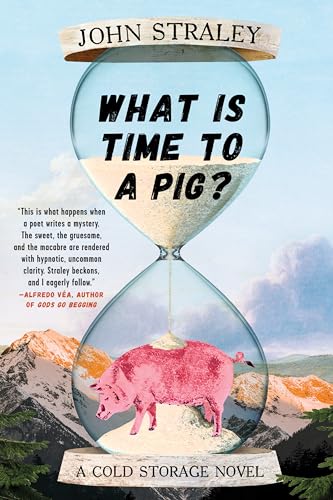
In this mind-bending crime novel by Shamus Award–winner John Straley, one man attempts to save his town from nuclear annihilation.
It’s been seven years since Gloomy Knob landed in the Ted Stevens High-Security Federal Penitentiary and five years since the end of the war, the one North Korea started when they sent a missile to Cold Storage, Alaska. Serving a life sentence for the murder of his sister, Gloomy spends histime trying to forget the past.
Then one day, Gloomy is snatched from his off-site work station. Instead of celebrating his newfound freedom, Gloomy comes unmoored—he feels he belongs in prison. But his kidnappers believe Gloomy knows where a second nuclear warhead is hidden and demand to know where it is. The clock is ticking, and Gloomy knows that unless he finds the missing warhead fast, or his wife, his friends, and the entire town of Cold Storage will be obliterated. The only problem? He has no idea where it is.
As Gloomy struggles to escape, the memories he fought hard to repress begin to creep out from the strange corners of his mind, first in rivulets, then in waves. In a drug-induced haze, Gloomy makes a discovery that may just bring him the closure he desires—if it doesn’t kill him first.
Die Inhaltsangabe kann sich auf eine andere Ausgabe dieses Titels beziehen.
Über die Autorin bzw. den Autor
John Straley was born in Redwood City, California. He received a BA in English from the University of Washington but settled in Sitka, Alaska, with his wife, Jan, a prominent whale biologist. John worked for thirty years as a criminal defense investigator, and many of the characters in his books were inspired by his work. Now retired, he lives with his wife in a bright green house on the beach and writes in his weathertight office overlooking Old Sitka Rocks. The former Writer Laureate of Alaska, he is the author of over ten novels, including Cold Storage, Alaska and the Shamus Award-winner The Woman Who Married a Bear, the first Cecil Younger investigation.
Auszug. © Genehmigter Nachdruck. Alle Rechte vorbehalten.
Chapter One
It might be easier to understand this story from the point of view of the mouse, for her motivations are simple: fear, hunger, procreation, and survival: living in the now as a Buddhist might understand it. But for us, the Western Homo sapiens who have grown past the mysteries of peek-a-boo magic tricks and object impermanence, the flow of time becomes a complicating factor. Besides, the mouse died few days from when we left her, tragically for her, but not for the human beings in this story, most of whom experienced life as a kind of hallucination, unstuck from traditional time as a result of being kept in cages where nothing happened according to their own will.
It was seven years after the US president’s war with North Korea, and the whole world had gone a little crazy. It was as if all the bottled-up frustration of the administration, the repressed class hatred and racism, the fear of the Other, and the unquenched greed had started to spray from sprinkler systems in every office, every classroom, every store, and every network in the country: icy water raining down through high-pressure rubber tubes onto everything and everyone. All bets were off, and the future was chaos. At least that’s how it seemed.
The fizzled North Korean missile was nothing more than a bundle of sparklers that sprinkled warheads over a small section of southeastern Alaska. The warheads had apparently been meant for Valdez, Prudhoe Bay, and down into Wyoming and Colorado. The North Koreans had thought to contaminate most of America’s oil supplies to frighten US leaders to the negotiating table, but what really happened was a mad rush by military and terrorist groups from around the globe to gather the missing nukes, while the rest of the world watched the US Army and subcontractors liberate the hungry North Koreans. First came fire and destruction, then a river of American food: MREs and then fatty grain-fed beef, along with televisions playing dubbed American films over steam tables laden with limp yellowy pork chops, grease-limp cheeseburgers, and boiled cabbage with brisket—all under the watchful eye of white men with black guns and sunglasses.
But none of that mattered to the men serving time out on the island where the Ted Stevens High-Security Federal Penitentiary had been built. “Olympus,” as it was known to its full-time inhabitants, or T.S.H.S.F.P. on their paperwork. The employees, who rotated on- and off-site, called it “Tough Shit.” Whatever you decided to call it, it was a concrete facility built on a rocky outcropping off the coast of Yakobi Island. The nearest civilian town was Cold Storage, Alaska. Now it was 17:30, October 31, 2027, almost five years after the final peace accord with China/North Korea and the end of hostilities. The world was still in a frenzy of nervous breast beating and anxiety about dodging the bullet of nuclear annihilation. The United States had somehow balanced its trade deficit with Asia, there was no more Republican Party but a new Democratic Business Party and the Constitutionalist Party of the American Nation. The evening meal had been served in the Red and Blue Units, and the White Unit was just finishing up its Sobriety, Substance, and Spirituality class in the cooldown space, which had thick windows overlooking the North Pacific and was plumbed with pipes to flood the room with either salt water from the surrounding ocean or imported military gas.
Gloomy Knob was the speaker on this day. Gloomy, of course, wasn’t his real name, but the name given to him as a boy by the community. Gloomy Knob had grown up in Cold Storage and had graduated from the local high school. He had earned money working in the woods cutting trees and working on machinery in Alaska, Washington, and Idaho. He had been living at home and building a cabin when he was arrested; he had been building a new life—or so he thought.
He was one of only two inmates who were locals. He and Ishmael Muhammad were the only two prisoners from Cold Storage held on Olympus. Gloomy had been given his nickname—and, really, the only name he used—for a cliff face in Glacier Bay he had liked to visit as a boy. Gloomy Knob was a bluff where to this day mountain goats loved to climb up and down from tidewater all the way to the alpine willows. It was a place where Tlingit elders went to gather goat hair that had sloughed onto the willow branches. Gloomy’s father, Clive, had taken him there, and his mother had shown him how the old people would make yarn and small panels of rough cloth that they eventually stitched together into a blanket. Clive had run a bar that also served as a small nondenominational and eclectic church in the tiny village of Cold Storage, which was how Gloomy Knob had become the unofficial nondenominational “pastor” of the clearly non-Christian and non-Islamic Sobriety, Substance, and Spirituality discussion group at Ted Stevens High-Security Federal Penitentiary, even though he abhorred most public speaking. Yes, Gloomy had become a preacher in jail.
“Gentlemen,” Gloomy began, “I will start today as I often do, with a story.”
The men groaned. They sat on shiny steep pillars that had emerged from the floor and were immovable. Tables and a lectern could also rise through the steel-plated concrete floor by hydraulic force when needed, but nothing could be moved or thrown. Twenty-eight men in lime-green jumpsuits sat on pillars. Some wore tight-fitting skullcaps, some had shaved heads. Some had vivid tattoos, while some conspicuously did not.
“So,” Gloomy continued despite protests, “a farmer was in his orchard with his pig, as a city slicker was driving by in his sports car, clearly in a hurry.”
“I got this already. The pig is a filthy beast. It represents the fallen sinner. The farmer is your false prophet, Jesus,” a man with a beard called out as others nodded.
“Gentlemen, please . . .” Gloomy raised his hands, palms up. “In some stories, a man is just a farmer and a pig is just a pig. Please . . .” And the grunting subsided.
“So, as the city slicker is driving by, the farmer lifts up the pig to the apple tree and lets the pig feed on an apple. The pig chews away on the nice big apple, and the farmer sets him back down. Then as the car gets closer, the farmer does it again, and the city slicker sees that this is a big fat pig, and the farmer is straining a lot to lift the animal up. The city slicker slams on the brakes and grinds to a stop, then jumps out of the sports car and walks over to the farmer.”
“What did he say?” a black inmate said unself-consciously.
“I will tell you, sir.” And Gloomy walks toward the inmates, a row of cameras in the ceiling following his every move.
“The city slicker says, ‘I was watching you, mister, and I think it would be much easier if you tried something else, Mr. Farmer.’”
“I’m sure he did!”
Now the black inmates were laughing.
“Thank you for the encouragement,” said Gloomy Knob, pausing to look each and every one of them gathered there in that antiseptic holding facility in the eye. “Then the farmer lifts that pig up again, straining every muscle. The pig eats another sweet and delicious apple, then the farmer sets the pig back down. The city...
„Über diesen Titel“ kann sich auf eine andere Ausgabe dieses Titels beziehen.
Suchergebnisse für What Is Time to a Pig? (A Cold Storage Novel, Band...

Beispielbild für diese ISBN
What Is Time to a Pig?
Anbieter: ThriftBooks-Atlanta, AUSTELL, GA, USA
Verkäuferbewertung 5 von 5 Sternen

Hardcover. Zustand: Very Good. No Jacket. Former library book; May have limited writing in cover pages. Pages are unmarked. ~ ThriftBooks: Read More, Spend Less. Artikel-Nr. G1641290846I4N10
Gebraucht kaufen
EUR 5,82
Versand gratis
Versand innerhalb von USA
Versand innerhalb von USA
Anzahl: 1 verfügbar
Beispielbild für diese ISBN
What Is Time to a Pig?
Anbieter: ThriftBooks-Dallas, Dallas, TX, USA
Verkäuferbewertung 5 von 5 Sternen
Hardcover. Zustand: Good. No Jacket. Pages can have notes/highlighting. Spine may show signs of wear. ~ ThriftBooks: Read More, Spend Less. Artikel-Nr. G1641290846I3N00
Gebraucht kaufen
EUR 5,82
Versand gratis
Versand innerhalb von USA
Versand innerhalb von USA
Anzahl: 1 verfügbar
Beispielbild für diese ISBN
What Is Time to a Pig?
Verlag:
Soho Press, Incorporated, 2020
ISBN 10: 1641290846
ISBN 13: 9781641290845
Gebraucht
Hardcover
Anbieter: Better World Books, Mishawaka, IN, USA
Verkäuferbewertung 5 von 5 Sternen
Zustand: Very Good. Former library copy. Pages intact with possible writing/highlighting. Binding strong with minor wear. Dust jackets/supplements may not be included. Includes library markings. Stock photo provided. Product includes identifying sticker. Better World Books: Buy Books. Do Good. Artikel-Nr. 38909570-6
Gebraucht kaufen
EUR 6,03
Versand gratis
Versand innerhalb von USA
Versand innerhalb von USA
Anzahl: 1 verfügbar
Beispielbild für diese ISBN
What Is Time to a Pig?
Verlag:
Soho Press, Incorporated, 2020
ISBN 10: 1641290846
ISBN 13: 9781641290845
Gebraucht
Hardcover
Anbieter: Better World Books: West, Reno, NV, USA
Verkäuferbewertung 5 von 5 Sternen
Zustand: Good. Former library copy. Pages intact with minimal writing/highlighting. The binding may be loose and creased. Dust jackets/supplements are not included. Includes library markings. Stock photo provided. Product includes identifying sticker. Better World Books: Buy Books. Do Good. Artikel-Nr. 18770662-75
Gebraucht kaufen
EUR 6,03
Versand gratis
Versand innerhalb von USA
Versand innerhalb von USA
Anzahl: 1 verfügbar
Beispielbild für diese ISBN
What Is Time to a Pig?
Verlag:
Soho Press, Incorporated, 2020
ISBN 10: 1641290846
ISBN 13: 9781641290845
Gebraucht
Hardcover
Anbieter: Better World Books: West, Reno, NV, USA
Verkäuferbewertung 5 von 5 Sternen
Zustand: Very Good. Former library copy. Pages intact with possible writing/highlighting. Binding strong with minor wear. Dust jackets/supplements may not be included. Includes library markings. Stock photo provided. Product includes identifying sticker. Better World Books: Buy Books. Do Good. Artikel-Nr. 38909570-6
Gebraucht kaufen
EUR 6,03
Versand gratis
Versand innerhalb von USA
Versand innerhalb von USA
Anzahl: 1 verfügbar
Beispielbild für diese ISBN
What Is Time to a Pig?
Verlag:
Soho Press, Incorporated, 2020
ISBN 10: 1641290846
ISBN 13: 9781641290845
Gebraucht
Hardcover
Anbieter: Better World Books, Mishawaka, IN, USA
Verkäuferbewertung 5 von 5 Sternen
Zustand: Good. Former library copy. Pages intact with minimal writing/highlighting. The binding may be loose and creased. Dust jackets/supplements are not included. Includes library markings. Stock photo provided. Product includes identifying sticker. Better World Books: Buy Books. Do Good. Artikel-Nr. 18770662-75
Gebraucht kaufen
EUR 6,03
Versand gratis
Versand innerhalb von USA
Versand innerhalb von USA
Anzahl: 2 verfügbar
Beispielbild für diese ISBN
What Is Time to a Pig?
Anbieter: ThriftBooks-Phoenix, Phoenix, AZ, USA
Verkäuferbewertung 5 von 5 Sternen
Hardcover. Zustand: Very Good. No Jacket. Former library book; May have limited writing in cover pages. Pages are unmarked. ~ ThriftBooks: Read More, Spend Less. Artikel-Nr. G1641290846I4N10
Gebraucht kaufen
EUR 9,39
Versand gratis
Versand innerhalb von USA
Versand innerhalb von USA
Anzahl: 1 verfügbar
Beispielbild für diese ISBN
What Is Time to a Pig?
Anbieter: Revaluation Books, Exeter, Vereinigtes Königreich
Verkäuferbewertung 5 von 5 Sternen
Hardcover. Zustand: Brand New. 255 pages. 8.50x5.75x1.00 inches. In Stock. Artikel-Nr. __1641290846
Neu kaufen
EUR 21,95
EUR 11,66 Versand
Versand von Vereinigtes Königreich nach USA
Versand von Vereinigtes Königreich nach USA
Anzahl: 1 verfügbar
Foto des Verkäufers
What Is Time To A Pig?
Anbieter: AHA-BUCH GmbH, Einbeck, Deutschland
Verkäuferbewertung 5 von 5 Sternen
Buch. Zustand: Neu. Neuware - From the wild and wonderful mind of Shamus Award-winning author John Straley comes a poetic masterpiece that explores the ugly truths of the prison industrial complex, the crumbling state of humanity, the role memory plays in the formation of the self, and much more. It's been seven years since Gloomy Knob landed in the Ted Stevens High-Security Federal Penitentiary and five years since the end of the war, the one North Korea started when they sent a missile to Cold Storage, Alaska. Serving a life sentence for the murder of his sister, Gloomy spends histime trying to forget about the past. Then one day, Gloomy is snatched from his off-site work station. Instead of celebrating his newfound freedom, Gloomy comes unmoored-he feels he belongs in prison. But his kidnappers believe Gloomy knows where a second nuclear warhead is hidden and demand to know where it is. The clock is ticking, and Gloomy knows he needs to find the missing warhead fast, or his wife, his friends, and the entire town of Cold Storage will be obliterated. The only problem is he has no idea where it is. As Gloomy struggles to escape, the memories he fought hard to repress begin to creep out from the strange corners of his mind, first in rivulets, then in waves. In a drug-induced haze, Gloomy makes a discovery that may just bring him the closure he desires-if it doesn't kill him first. Artikel-Nr. 9781641290845
Neu kaufen
EUR 38,52
EUR 30,50 Versand
Versand von Deutschland nach USA
Versand von Deutschland nach USA
Anzahl: 1 verfügbar
Foto des Verkäufers
What Is Time to a Pig?
Anbieter: moluna, Greven, Deutschland
Verkäuferbewertung 5 von 5 Sternen
Gebunden. Zustand: New. Über den AutorrnrnJohn Straley was born in Redwood City, California. He received a BA in English from the University of Washington but settled in Sitka, Alaska, with his wife, Jan, a prominent whale biologist. John worked for thirty yea. Artikel-Nr. 289257398
Neu kaufen
EUR 29,29
EUR 48,99 Versand
Versand von Deutschland nach USA
Versand von Deutschland nach USA
Anzahl: 1 verfügbar