
Verwandte Artikel zu Everything All at Once: How to Think Like a Science...
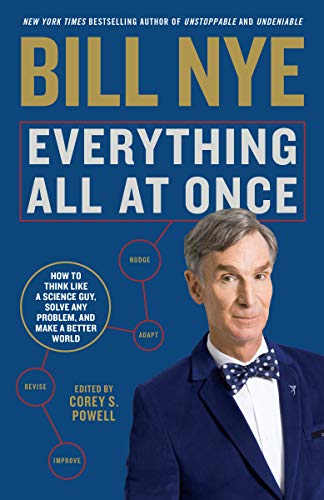
Everything All at Once: How to Think Like a Science Guy, Solve Any Problem, and Make a Better World - Softcover
Inhaltsangabe
In the New York Times bestseller Everything All at Once, Bill Nye shows you how thinking like a nerd is the key to changing yourself and the world around you.
Everyone has an inner nerd just waiting to be awakened by the right passion. In Everything All at Once, Bill Nye will help you find yours. With his call to arms, he wants you to examine every detail of the most difficult problems that look unsolvable—that is, until you find the solution. Bill shows you how to develop critical thinking skills and create change, using his “everything all at once” approach that leaves no stone unturned.
Whether addressing climate change, the future of our society as a whole, or personal success, or stripping away the mystery of fire walking, there are certain strategies that get results: looking at the world with relentless curiosity, being driven by a desire for a better future, and being willing to take the actions needed to make change happen. He shares how he came to create this approach—starting with his Boy Scout training (it turns out that a practical understanding of science and engineering is immensely helpful in a capsizing canoe) and moving through the lessons he learned as a full-time engineer at Boeing, a stand-up comedian, CEO of The Planetary Society, and, of course, as Bill Nye The Science Guy.
This is the story of how Bill Nye became Bill Nye and how he became a champion of change and an advocate of science. It’s how he became The Science Guy. Bill teaches us that we have the power to make real change. Join him in... dare we say it... changing the world.
Die Inhaltsangabe kann sich auf eine andere Ausgabe dieses Titels beziehen.
Über die Autorin bzw. den Autor
Bill Nye has been the public face of science and discovery for more than twenty years. Best known as the host of Emmy Award-winning PBS/Discovery Channel show Bill Nye the Science Guy, and current host of Netflix show Bill Nye Saves the World, Nye is a science educator, mechanical engineer, and New York Times bestselling author of Undeniable: Evolution and the Science of Creation and Unstoppable: Harnessing Science to Change the World. He is the CEO of The Planetary Society, holds a BS in mechanical engineering from Cornell University, and has seven honorary doctorate degrees.
Corey S. Powell is the science editor of Aeon and former editor-in-chief of American Scientist and Discover. He is a visiting scholar at NYU's SHERP program and a writer for Popular Science and Scientific American.
Auszug. © Genehmigter Nachdruck. Alle Rechte vorbehalten.
PART I
Principles of Nerd Living
CHAPTER 1
The Tao of Phi
This is a book about everything. It is about everything I know and about everything I think you should know, too.
I realize that may sound a little crazy, but I’m completely serious. We live in an age of unprecedented access to information. When you pick up your phone or open your laptop and go online, you are instantly connected to a trillion trillion bytes of data; that’s a 1 followed by 24 zeros. Every year another billion trillion bytes of data move around the Internet, carrying everything from those important videos with kitty cats to the arcane but fantastic detailed results of subatomic particle collisions at the Large Hadron Collider. In that sense, talking about “everything” is easy. Everything you and I know, and everything we need to know, is already out there for the taking.
Yet despite all those whizzing ones and zeros—the collective intelligence of billions of human brains—I still feel that we seem awfully . . . well, stupid. We’re not using all this shared wisdom to solve big problems. We’re not facing up to climate change. We haven’t figured out how to make clean, renewable, reliable energy available to everyone. Too many people die in avoidable auto accidents, succumb to curable diseases, do not get enough food and clean water, and still do not have access to the Internet’s great busy beehive mind. Despite being more connected than ever before, we’re not particularly generous toward, or understanding of, one another, preferring to hide behind denial and personal bias. The flood of information has effectively allowed us to know something about everything, but that knowing is clearly not enough. We need to be able to sort the facts and put our knowledge into action, and that is why I wrote this book.
I want to see humanity band together and change the world. I think it will take a special kind of personality to get this done: people who can handle the modern overflow of information, take in everything all at once, and select the parts that matter. It requires rigorous honesty about the nature of our problems. It requires creative irreverence in the search for solutions. The process of science and natural laws don’t care about our politics or preconceptions. They merely set the boundaries of what is possible, defining the outer limits of what we can achieve—or not, should we shy away from the challenge.
Fortunately, there is a large and growing clan of people who think that way, who love nothing better than using the tools of reason to solve the most unsolvable-looking puzzles. We call them “nerds,” and I humbly (proudly) count myself among them. I have spent a lifetime developing the nerd mindset and trying to master the admirable but often elusive qualities that come with it: persistence in the pursuit of a lofty goal, resilience to keep trying no matter what the obstacles are, humility for when one approach turns out to be a dead end, and the patience to examine the problem from every angle until a path forward becomes clear. If you already consider yourself one of us, then join me in doing more by applying your nerdiness to the big problems of the day, not just to trivia or minutia (although of course we will set aside plenty of time for those). And if you don’t consider yourself a nerd yet, join me all the same: You will soon discover that everybody has an inner nerd waiting to be awoken by the right passion. My whole life has been a series of those kinds of awakenings, moments of epiphany when
I became evermore aware of the joyous power of science, math, and engineering.
It happened to me with a jolt in the 11th grade in Washington, DC, when I took formal physics for the first time. In nerd culture, we might write that it was my phirst phormal physics, and we’d phind that phrasing rather phunny. The “ph” pronounced phonetically with the same fricative that produces the sound from the consonant “f” is from phi, the Greek letter φ. The Roman “p” looks vaguely like a Greek φ. In Greek, the “f” sounds a little breathy, so the Roman letter “h” serves to preserve that sound or tradition. I couldn’t help myself—I had to stop typing and look up the roots of the “ph” in our words “physics” and “phosphate.” When we see these “ph” words, we know they came to us from ancient Greek and then Latin. The scholars call it “transliteration,” meaning “across the letters.” Centuries ago a diligent, perhaps even enthusiastic, transliterator was inclined to add that “h” to the “p,” and here we are. Phew.
This little digression encapsulates what it means to be so into a topic, so phocused and phascinated by some aspect of nature or the human experience, that people consider you—or more important, you consider yourself—a nerd. For me to really enjoy some deliberate misspelled wordplay, I had to think about the background of φ, “ph,” and “f.” I called on my knowledge that most English speakers pronounce the letter φ like the second syllable in “Wi-Fi,” but Greek speakers pronounce φ like “fee,” as in “Fee-fi-fo-fum, / I smell the blood of a nerdy one.” And as I was checking that out, I recalled that φ has other intriguing connections to physics besides the linguistic one. It is the mathematical symbol denoting the golden ratio, a fundamental geometric proportion that appears widely in biology, economics, and especially art. In statistics, φ is a measure of the correlation between two separate factors, and so it is a crucial measure for distinguishing chance events from cause and effect in scientific experiments. Stick that in your back pocket.
You might regard the things I just told you as little more than bits of playful trivia, but I beg to differ. The knowledge I gained in my obsessive pursuit of φ changed me a little, and it just changed you, as well. The impulse to chase down details is central to the way I have solved problems throughout my life. It is also, not coincidentally, a defining nerd trait. Further evidence of my detail-oriented outlook: Long before the ubiquity of the Internet, my friends would say about me, “The party doesn’t start until Bill gets out the dictionary.” I like to know the background of words, the etymology, as well as the meanings of the words themselves. While I was ref lecting on the digraph “ph” just now, I was also reflecting on what started that train of thought—namely physics, the study of nature, specifically energy and motion—and the joy I felt when I was first (or phirst) exposed to it.
The word “scientist” was coined in 1833 by the English natural philosopher William Whewell. Before then, the term was “natural philosopher,” which sounds a little odd today but back then was a familiar expression. Philosophy is the study of knowledge; philosophers seek ways to know whether or not something is true, so natural philosophy was the study of what’s true in nature. Or, in modern terms, a scientist is a natural philosopher seeking objective truths.
We look for laws of nature that enable anyone to make concrete predictions regarding the outcomes of tests and experiments. Science belongs to anyone who loves to think and look for connections in nature. It’s not all about math and measurement, but wow, the math is what gives the predictions their precious precision. We can know the motions of distant worlds to such a degree of accuracy...
„Über diesen Titel“ kann sich auf eine andere Ausgabe dieses Titels beziehen.
Suchergebnisse für Everything All at Once: How to Think Like a Science...

Beispielbild für diese ISBN
Everything All at Once: How to Think Like a Science Guy, Solve Any Problem, and Make a Better World
Anbieter: World of Books (was SecondSale), Montgomery, IL, USA
Verkäuferbewertung 5 von 5 Sternen

Zustand: Good. Item in good condition. Textbooks may not include supplemental items i.e. CDs, access codes etc. Artikel-Nr. 00052592607
Gebraucht kaufen
EUR 4,73
Versand gratis
Versand innerhalb von USA
Versand innerhalb von USA
Anzahl: 5 verfügbar
Beispielbild für diese ISBN
Everything All at Once: How to Think Like a Science Guy, Solve Any Problem, and Make a Better World
Anbieter: World of Books (was SecondSale), Montgomery, IL, USA
Verkäuferbewertung 5 von 5 Sternen
Zustand: Very Good. Item in very good condition! Textbooks may not include supplemental items i.e. CDs, access codes etc. Artikel-Nr. 00101317508
Gebraucht kaufen
EUR 4,73
Versand gratis
Versand innerhalb von USA
Versand innerhalb von USA
Anzahl: 1 verfügbar
Beispielbild für diese ISBN
Everything All at Once : How to Think Like a Science Guy, Solve Any Problem, and Make a Better World
Verlag:
Potter/Ten Speed/Harmony/Rodale, 2018
ISBN 10: 1635652154
ISBN 13: 9781635652154
Gebraucht
Softcover
Anbieter: Better World Books, Mishawaka, IN, USA
Verkäuferbewertung 5 von 5 Sternen
Zustand: Very Good. Reprint. Pages intact with possible writing/highlighting. Binding strong with minor wear. Dust jackets/supplements may not be included. Stock photo provided. Product includes identifying sticker. Better World Books: Buy Books. Do Good. Artikel-Nr. 16073033-6
Gebraucht kaufen
EUR 6,09
Versand gratis
Versand innerhalb von USA
Versand innerhalb von USA
Anzahl: 2 verfügbar
Beispielbild für diese ISBN
Everything All at Once: How to Think Like a Science Guy, Solve Any Problem, and Make a Better World
Anbieter: Wonder Book, Frederick, MD, USA
Verkäuferbewertung 5 von 5 Sternen
Zustand: Good. Good condition. A copy that has been read but remains intact. May contain markings such as bookplates, stamps, limited notes and highlighting, or a few light stains. Artikel-Nr. U11B-05387
Gebraucht kaufen
EUR 6,33
Versand gratis
Versand innerhalb von USA
Versand innerhalb von USA
Anzahl: 1 verfügbar
Beispielbild für diese ISBN
Everything All at Once: How to Think Like a Science Guy, Solve Any Problem, and Make a Better World
Anbieter: ThriftBooks-Atlanta, AUSTELL, GA, USA
Verkäuferbewertung 5 von 5 Sternen
Paperback. Zustand: Good. No Jacket. Pages can have notes/highlighting. Spine may show signs of wear. ~ ThriftBooks: Read More, Spend Less. Artikel-Nr. G1635652154I3N00
Gebraucht kaufen
EUR 7,28
Versand gratis
Versand innerhalb von USA
Versand innerhalb von USA
Anzahl: 1 verfügbar
Beispielbild für diese ISBN
Everything All at Once: How to Unleash Your Inner Nerd, Tap into Radical Curiosity, and Solve Any Problem
Anbieter: Magers and Quinn Booksellers, Minneapolis, MN, USA
Verkäuferbewertung 5 von 5 Sternen
paperback. Zustand: Very Good. May have light to moderate shelf wear and/or a remainder mark. Complete. Clean pages. Artikel-Nr. 1400248
Gebraucht kaufen
EUR 5,87
EUR 3,51 Versand
Versand innerhalb von USA
Versand innerhalb von USA
Anzahl: 1 verfügbar
Beispielbild für diese ISBN
Everything All at Once: How to Unleash Your Inner Nerd, Tap into Radical Curiosity, and Solve Any Problem
Anbieter: WorldofBooks, Goring-By-Sea, WS, Vereinigtes Königreich
Verkäuferbewertung 5 von 5 Sternen
Paperback. Zustand: Very Good. The book has been read, but is in excellent condition. Pages are intact and not marred by notes or highlighting. The spine remains undamaged. Artikel-Nr. GOR009970502
Gebraucht kaufen
EUR 8,17
EUR 6,51 Versand
Versand von Vereinigtes Königreich nach USA
Versand von Vereinigtes Königreich nach USA
Anzahl: 4 verfügbar
Beispielbild für diese ISBN
Everything All at Once: How to Unleash Your Inner Nerd, Tap into Radical Curiosity and Solve Any Problem: How to Think Like a Science Guy, Solve Any Problem, and Make a Better World
Anbieter: Majestic Books, Hounslow, Vereinigtes Königreich
Verkäuferbewertung 4 von 5 Sternen

Zustand: New. Artikel-Nr. 370858101
Neu kaufen
EUR 19,43
EUR 7,56 Versand
Versand von Vereinigtes Königreich nach USA
Versand von Vereinigtes Königreich nach USA
Anzahl: 1 verfügbar
Beispielbild für diese ISBN
Everything All at Once: How to Unleash Your Inner Nerd, Tap into Radical Curiosity, and Solve Any Problem
Anbieter: Revaluation Books, Exeter, Vereinigtes Königreich
Verkäuferbewertung 5 von 5 Sternen
Paperback. Zustand: Brand New. reprint edition. 384 pages. 8.00x5.25x1.25 inches. In Stock. Artikel-Nr. x-1635652154
Neu kaufen
EUR 25,53
EUR 11,63 Versand
Versand von Vereinigtes Königreich nach USA
Versand von Vereinigtes Königreich nach USA
Anzahl: 2 verfügbar