
Verwandte Artikel zu It's a Miracle!?: What Modern Science Tells Us...
Inhaltsangabe
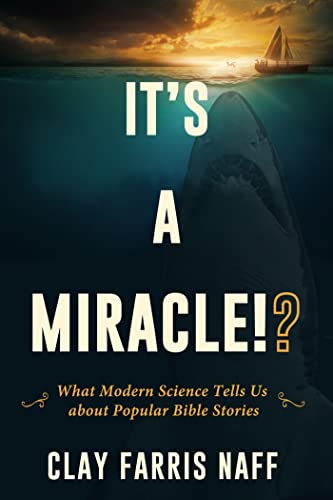
Fundamentalist Christians often use the Bible as a guide to the natural world, which inevitably leads them to reject much of what modern science says about the universe. But what if we were to use modern science as a guide to the Bible? What might a scientific reading of the Bible tell us not only about religion’s claims, but also about nature and our place in it? If God really did part the Red Sea, how might he have engineered such a feat? If Jesus really did raise Lazarus from the dead, under what circumstances might it have happened? In this witty and informative book, science writer Clay Farris Naff brings the miracles of the Bible into sharp focus through the lens of modern science. Whether you’re a religious skeptic or a true believer, you’ll find what comes into view is mind-bending, thought-provoking, and even amusing—and you’ll likely be left even more amazed and entranced by the universe we live in.
Die Inhaltsangabe kann sich auf eine andere Ausgabe dieses Titels beziehen.
Über die Autorin bzw. den Autor
Clay Farris Naff is the science and religion correspondent for Humanist magazine. An award-winning journalist and author, he has been a Tokyo correspondent for United Press International, a freelance reporter for National Public Radio, a science-and-religion columnist for the Metanexus Institute, and a freelance writer for Newsweek, Earth Magazine, and Scientific American, among other publications.
Auszug. © Genehmigter Nachdruck. Alle Rechte vorbehalten.
It's a Miracle!?
What Modern Science Tells Us About Popular Bible Stories
By Clay Farris NaffPitchstone Publishing
Copyright © 2018 Clay Farris Naff
All rights reserved.
ISBN: 978-1-63431-154-0All rights reserved.
Contents
Introduction: What's Science Got to Do with It?,
1. Creation Stories,
2. Water, Water Everywhere: The Great Flood,
3. Sodom and Gomorrah,
4. River of Blood,
5. What's the Buzz?,
6. Microbial Plagues Aplenty,
7. Grinding It Out,
8. Great Time to Be a Younger Sibling,
9. Parting of the Red, or Reed, Sea,
10. Manna from Heaven,
11. Joshua Fit the Battle of Jericho,
12. The Numbers Game,
13. Elijah & Elisha,
14. Jonah and the Great Fish,
15. Daniel's Mind-Reading Service,
16. The Fiery Furnace,
17. Daniel in the Lion's Den,
18. The Virgin Birth,
19. The Star of Bethlehem,
20. Introducing ... Jesus the Exorcist,
21. The Clean-Hands Miracle,
22. Jesus Feeds Lots of People,
23. The Transfiguration of Jesus,
24. Revival Show,
25. Lucky Lazarus,
26. Walking on Water,
27. Curing a Leper without Antibiotics,
28. An Oversupply of Demons and a Handy Herd of Swine,
29. A Fishy Tale,
30. The Meanest Miracle,
31. You Can't Keep a Good Man Down,
32. Hey! Where'd He Go?,
33. Death, What Is Thy Thing?,
34. All Stories Are True,
35. Are We the Sim Sons (& Daughters)?,
36. An Evo-Psych Solution,
About the Author,
CHAPTER 1
Creation Stories
"When we read about Creation in Genesis, we run the risk of imagining God was a magician, with a magic wand able to do everything. But that is not so."
— Pope Francis, October 2014
Perhaps the most surprising fact about the origin stories of the Bible and science is what they have in common. No, I'm not referring to the Big Bang. It's spiffy that Pope Francis, along with many fellow Catholics and most mainstream Protestants, regards the Big Bang theory as authentic, but a literal mind will find it hard to reconcile the science of cosmogony (cosmic origins) with this:
In the beginning when God created the heavens and the earth, the earth was a formless void and darkness covered the face of the deep, while a wind from God swept over the face of the waters. Then God said, "Let there be light"; and there was light. (Genesis 1:1–3, NRSV)
Wind? Waters? Both of those require oxygen, but it would be billions of years, science tells us, before any oxygen atoms were forged in the first generation of stars and then liberated in supernovae to roam the heavens and pair up with hydrogen.
Not even light could travel freely until long after the Big Bang. What we detect now as the cosmic microwave background radiation was liberated only when the Universe grew large enough to give photons some elbow room in the boiling particle soup. Cosmologists tell us that the Dark Ages that followed the Big Bang lasted some 400,000 years. Yet, Genesis 1 goes on to tell us:
And God saw that the light was good; and God separated the light from the darkness. God called the light Day, and the darkness he called Night. And there was evening and there was morning, the first day.
Day? What's a day before there's a Sun or Earth? Does God have a celestial grandfather clock? If so, it must ticktock mighty slow. For, according to the evidence-based scientific narrative, two generations of stars would rise and fall and nine billion years would drift by before the Earth was born.
The discrepancies only widen as we go on. Genesis 1 continues:
And God said, "Let the waters under the sky be gathered together into one place, and let the dry land appear." And it was so. God called the dry land Earth, and the waters that were gathered together he called Seas. And God saw that it was good. Then God said, "Let the earth put forth vegetation: plants yielding seed, and fruit trees of every kind on earth that bear fruit with the seed in it." And it was so. The earth brought forth vegetation: plants yielding seed of every kind, and trees of every kind bearing fruit with the seed in it. And God saw that it was good. And there was evening and there was morning, the third day.
And God said, "Let there be lights in the dome of the sky to separate the day from the night; and let them be for signs and for seasons and for days and years, and let them be lights in the dome of the sky to give light upon the earth." And it was so. God made the two great lights — the greater light to rule the day and the lesser light to rule the night — and the stars. God set them in the dome of the sky to give light upon the earth, to rule over the day and over the night, and to separate the light from the darkness. And God saw that it was good. And there was evening and there was morning, the fourth day. (Genesis 1: 9–19, NRSV)
Wait. A dome? You mean, like in a planetarium? That doesn't match up too well with our picture of the universe today. As you can readily imagine in the mind's eye, stars in a dome would all be about the same distance from an observer on Earth. What's more, set in a dome, no star could lie before or behind another. But starting in 1838, astronomers observed stellar parallax — the apparent shift of nearby stars in relation to much more distant stars as the Earth trundled around the Sun. As even nearby stars are immensely distant, parallax is hard to measure, but with better telescopes and recording methods, any clinging beliefs that stars lie in a dome vanished. A vast, dark ocean of stars gradually came to represent our sketch of reality.
By the early twentieth century, it became evident that stars gather in gravitationally bound blobs and swirls called galaxies. In 1929, astronomer Edwin Hubble showed that, like raisins in a rising loaf of bread, the galaxies are moving away from one another. The Milky Way, our home state, so to speak, contains about 100 billion stars — more than 10 times the number of people on Earth.
The Hubble Telescope and its space-based successors have shown that the number of galaxies is immense. By the most recent reckoning, there are at least 2 trillion galaxies in the visible universe. If ours is typical, that presses the number of stars beyond counting, let alone naming.
The contemporary scientific account dates the "creation" of the Universe to about 13.8 billion years ago. According to the most widely accepted interpretation of the evidence, an event called the "Big Bang" allowed an incomprehensibly tiny and dense dot of positive and negative energy to expand at breakneck speed. As it did, time and space took shape, and the fundamental forces of nature — gravity, electromagnetism, and the atomic strong and weak forces — shook out of the protoforce and largely dictated the course of events thereafter.
None of this matches up well with the biblical account. The idea that a great light (the Sun) and a lesser light (the Moon) separate the light from the dark on a universal scale now looks laughable. The Sun isn't even the most impressive bulb in the stellar string decorating our spiral arm of the Milky Way.
What on Earth (so to speak) do the biblical and scientific accounts have in common? They each come in multiple, contradictory versions.
So far, we've just dipped a toe into the waters of Genesis 1. But there's another account of creation in the Bible. Genesis 2 offers a version that differs in some key details from Genesis...
„Über diesen Titel“ kann sich auf eine andere Ausgabe dieses Titels beziehen.
Suchergebnisse für It's a Miracle!?: What Modern Science Tells Us...

Beispielbild für diese ISBN
It's a Miracle!?: What Modern Science Tells Us about Popular Bible Stories
Anbieter: ThriftBooks-Atlanta, AUSTELL, GA, USA
Verkäuferbewertung 5 von 5 Sternen

Paperback. Zustand: Good. No Jacket. Pages can have notes/highlighting. Spine may show signs of wear. ~ ThriftBooks: Read More, Spend Less. Artikel-Nr. G163431154XI3N00
Gebraucht kaufen
EUR 10,38
Versand gratis
Versand innerhalb von USA
Versand innerhalb von USA
Anzahl: 1 verfügbar
Beispielbild für diese ISBN
It's a Miracle!? : What Modern Science Tells Us about Popular Bible Stories
Anbieter: Robinson Street Books, IOBA, Binghamton, NY, USA
Verkäuferbewertung 4 von 5 Sternen

Paperback. Zustand: VERY Good. Prompt Shipment, shipped in Boxes, Tracking PROVIDEDReligion & ScienceVERY Good or Better trade paperback. Artikel-Nr. ware778TG109
Gebraucht kaufen
EUR 12,43
EUR 8,49 Versand
Versand innerhalb von USA
Versand innerhalb von USA
Anzahl: 1 verfügbar
Beispielbild für diese ISBN
It's a Miracle!?: What Modern Science Tells Us About Popular Bible Stories
Anbieter: Revaluation Books, Exeter, Vereinigtes Königreich
Verkäuferbewertung 5 von 5 Sternen
Paperback. Zustand: Brand New. 224 pages. 9.00x6.00x0.75 inches. In Stock. Artikel-Nr. x-163431154X
Neu kaufen
EUR 19,11
EUR 11,82 Versand
Versand von Vereinigtes Königreich nach USA
Versand von Vereinigtes Königreich nach USA
Anzahl: 2 verfügbar