
Inhaltsangabe
Voices and stories of veterans, their families, and their care providers, reveal what is necessary for postwar healing
This book argues that the elements that contribute to healing war trauma—including safety, connection, community, dialogue, mutual respect, diversity, and compassion—can help build a stronger nation. But this message comes with a warning and a challenge not just for caregivers, veterans service organizations, governmental departments, Congress, and the White House, but for all Americans. War creates incalculable suffering—not only among those on the front lines, but also among those left behind. For every soldier killed or injured on the battlefield, countless others are affected—particularly relatives and friends—often in isolation and silence. As a nation, the U.S. must do everything it can to repair the injuries caused by war, whether physical, emotional, or moral, both for those who served in Iraq, Afghanistan, and elsewhere, and for the country itself. Only after the nation provides the top-quality care our veterans have earned will we be able to begin to end our reliance on war and truly build a durable peace.
This book argues that the elements that contribute to healing war trauma—including safety, connection, community, dialogue, mutual respect, diversity, and compassion—can help build a stronger nation. But this message comes with a warning and a challenge not just for caregivers, veterans service organizations, governmental departments, Congress, and the White House, but for all Americans. War creates incalculable suffering—not only among those on the front lines, but also among those left behind. For every soldier killed or injured on the battlefield, countless others are affected—particularly relatives and friends—often in isolation and silence. As a nation, the U.S. must do everything it can to repair the injuries caused by war, whether physical, emotional, or moral, both for those who served in Iraq, Afghanistan, and elsewhere, and for the country itself. Only after the nation provides the top-quality care our veterans have earned will we be able to begin to end our reliance on war and truly build a durable peace.
Die Inhaltsangabe kann sich auf eine andere Ausgabe dieses Titels beziehen.
Über die Autorin bzw. den Autor
Joseph Bobrow is a psychoanalyst, Zen master, and author of Zen and Psychotherapy: Partners in Liberation. He is the founding director of Coming Home Project, whose evidence-based programs for Iraq and Afghanistan veterans, families, and care providers have served thousands nationwide. He teaches extensively, and lives in Santa Barbara. The Dalai Lama, Tenzin Gyatso, is the world's foremost Buddhist leader. He travels extensively, speaking eloquently in favor of ecumenical understanding, kindness, and compassion, respect for the environment, and, above all, world peace.
Auszug. © Genehmigter Nachdruck. Alle Rechte vorbehalten.
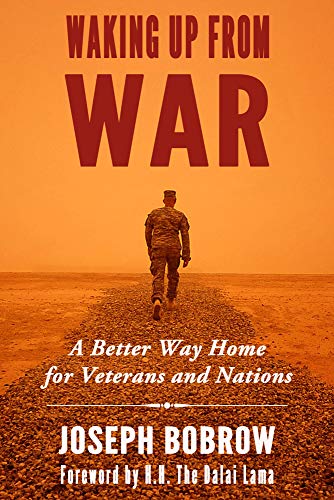
Waking Up from War
A Better Way Home for Veterans and Nations
By Joseph BobrowPitchstone Publishing
Copyright © 2015 Joseph Bobrow
All rights reserved.
ISBN: 978-1-63431-032-1All rights reserved.
Contents
Foreword by H. H. The 14th Dalai Lama,
Introduction,
I. Community Heals and Isolation Kills,
II. Turning Ghosts into Ancestors,
III. Resilience, Trauma, and the Limits of Plasticity,
IV. We Are Family,
V. Moral Injuries and Restoring Integrity,
VI. All the Way Home,
Coda,
Three Poems of Love and War,
Notes,
Acknowledgments,
About the Author,
CHAPTER 1
Community Heals and Isolation Kills
* * *
In 2008, my friend Keith Armstrong arranged a meeting with his boss, Charles Marmar, chief of psychiatry at the San Francisco VA, one of the elite VA hospitals and medical centers in the country. Dr. Marmar began, "Joe, patients come in to our clinics but they don't stay. What have you learned that might shed some light on this?" His posing the question seemed to convey an openness that brought me up short. I replied, "There needs to be a 'there' there." An awkward silence ensued, which I soon filled with a superfluous explanation, "Something to connect to. Troops come home to a community, not a set of isolated services."
Sayings from many traditions covey this "there" that is always right here with us. In the Bible, "The whole creation groans and labors together." John Muir wrote, "When we try to pick out anything by itself, we find it hitched to everything else in the universe." My Zen teacher, Robert Aitken Roshi, always said, "Time is short and we are all in this together." No one knows this better than troops in the war zone, who frequently say, "We fight for the guy to our right and the guy to our left."
We share with one another and with all creatures a profound interconnectedness that is vaster and more fundamental than any one of us individually. My friend and Coming Home Project collaborator, retired Air Force chaplain Steve Torgerson, likes to quote the writer G. K. Chesterton, "We are all in the same boat in a stormy sea, and we owe each other a terrible loyalty." My friend Col. David Rabb often reminds us, "Community heals, isolation kills."
Service members understand this implicitly because it is their on-the-ground reality in the face of death. Military families get it without being told that their well-being is inextricably intertwined with the well-being of others. The fate of others is intimately tied to our fate. When the Buddha experienced enlightenment under the bodhi tree, he is reported to have said, "At this moment all beings and I awaken together." Pediatrician and psychoanalyst Donald Winnicott wrote of a particularly vulnerable stage of infant development where we cannot say the word "baby" without saying "mother" (and I like to add "father"). The Buddha expressed it with deceptive simplicity, "This is because that is." We interare.
Cultures in Tatters
The institutions responsible for caring for our veterans and their families have not, alas, incorporated this fundamental reality.
As I came to see how veterans, family members, children, and providers were all impacted by war trauma, I also began to understand that the institutions responsible for their care were also affected. During the last year of our major grant, I began to travel extensively to forge contacts at VA, DoD, Congress, the White House, corporations, and large foundations, searching for long-term funding for our program. By then we had more than anecdotal accounts and personal testimonials to prove its effectiveness; we had data.
Crisscrossing the country, I learned some important lessons. First, organizations did not communicate with one another, especially VA and DoD. Relationships, when they existed at all, were fragmented and compartmentalized. Everyone I met with would ask me the same questions: "Where have you been? Who have you met with? What did they have to say?" Relatively naive and guileless, I tried to respond to their questions. Then it dawned on me: these people and the institutions they represented did not actually talk with one another or share information, much less coordinate their efforts to benefit service members and veterans. In questioning me, they wanted to gather some intel, and I sensed another motivation as well. They seemed genuinely curious about their colleagues in other organizations and what they were up to. As an outsider, I found myself in the role of connector. Like veterans and others who are facing overwhelming circumstances, employees compartmentalize in order to survive in dysfunctional systems. Yet when given the opportunity, they wanted to learn what was happening on "the outside."
I came to see first-hand how hunkered down and compromised our institutions are; how "tribal" identifications override the collaboration and coordination that could bring clear benefit to veterans and families. This was the case not just among different organizations. Within the same system, say a military branch, the disconnects were equally startling. The left hands did not know what the right hands were doing. One leader I met with genuinely thanked me when I asked him for more information about a major grant specifically designed for those his department served. He had not even heard about it. How could our institutions help veterans repair damaged connectivity when these institutions themselves were so fractured and their staffs so overwhelmed?
During a discussion with a senior military chaplain, I learned about a new program he was directing with the mission of harnessing spirituality to help fellow chaplains. We explored how Coming Home might help support the alarming number of chaplains buckling under impossible workloads. Due to staffing shortages, they were serving multiple tours and helping thousands of service members. It's not commonly known that military chaplains are the only helping professionals in the military required to maintain strict confidentiality. They therefore had no one with whom to share the horrific stories they were hearing from service members.
I thought it would be supportive to have a dedicated retreat for chaplains from this particular branch. The director asked me how many breakout groups there were at a Coming Home retreat. I said about six to twelve groups, and asked him how many chaplains he was considering sending. He repeated my words, "six to twelve." I didn't understand at first, but then I caught on. Constant trauma and threat without support had bred an organizational culture of paranoia and a fear of retribution so pronounced that there could only be one unit chaplain per group. The organizational dynamics were so toxic that a chaplain couldn't trust his colleagues to maintain confidentiality. The director confirmed that the esprit de corps was so compromised that offering a retreat just for chaplains would actually be counterproductive.
Troop camaraderie and morale, unit cohesion, and esprit de corps are military analogues of community. Community in the broadest sense is each of us, inasmuch as we constitute the sectors of civic life that veterans interact with on a daily basis: employment, education, housing, legal, law enforcement, health, and the government institutions responsible for implementing policy and caring for our veterans and families. Community also encompasses the leaders we elect and send to Congress and the White House to represent us, the leaders responsible for formulating policy, funding programs, and overseeing their...
„Über diesen Titel“ kann sich auf eine andere Ausgabe dieses Titels beziehen.
Weitere beliebte Ausgaben desselben Titels

Suchergebnisse für Waking Up from War: A Better Way Home for Veterans...

Beispielbild für diese ISBN
Waking up from War : A Better Way Home for Veterans and Nations
Anbieter: Better World Books: West, Reno, NV, USA
Verkäuferbewertung 5 von 5 Sternen

Zustand: Good. Pages intact with minimal writing/highlighting. The binding may be loose and creased. Dust jackets/supplements are not included. Stock photo provided. Product includes identifying sticker. Better World Books: Buy Books. Do Good. Artikel-Nr. 54482487-75
Gebraucht kaufen
EUR 5,80
Versand gratis
Versand innerhalb von USA
Versand innerhalb von USA
Anzahl: 1 verfügbar
Beispielbild für diese ISBN
Waking up from War : A Better Way Home for Veterans and Nations
Anbieter: Better World Books, Mishawaka, IN, USA
Verkäuferbewertung 5 von 5 Sternen
Zustand: Very Good. Former library copy. Pages intact with possible writing/highlighting. Binding strong with minor wear. Dust jackets/supplements may not be included. Includes library markings. Stock photo provided. Product includes identifying sticker. Better World Books: Buy Books. Do Good. Artikel-Nr. 15002337-6
Gebraucht kaufen
EUR 5,80
Versand gratis
Versand innerhalb von USA
Versand innerhalb von USA
Anzahl: 1 verfügbar
Beispielbild für diese ISBN
Waking up from War : A Better Way Home for Veterans and Nations
Anbieter: Better World Books, Mishawaka, IN, USA
Verkäuferbewertung 5 von 5 Sternen
Zustand: Very Good. Pages intact with possible writing/highlighting. Binding strong with minor wear. Dust jackets/supplements may not be included. Stock photo provided. Product includes identifying sticker. Better World Books: Buy Books. Do Good. Artikel-Nr. 39680796-6
Gebraucht kaufen
EUR 5,80
Versand gratis
Versand innerhalb von USA
Versand innerhalb von USA
Anzahl: 1 verfügbar
Beispielbild für diese ISBN
Waking Up from War: A Better Way Home for Veterans and Nations
Anbieter: ThriftBooks-Atlanta, AUSTELL, GA, USA
Verkäuferbewertung 5 von 5 Sternen
Hardcover. Zustand: Very Good. No Jacket. Former library book; May have limited writing in cover pages. Pages are unmarked. ~ ThriftBooks: Read More, Spend Less. Artikel-Nr. G1634310322I4N10
Gebraucht kaufen
EUR 6,70
Versand gratis
Versand innerhalb von USA
Versand innerhalb von USA
Anzahl: 1 verfügbar