
Verwandte Artikel zu American Intolerance: Our Dark History of Demonizing...
Inhaltsangabe
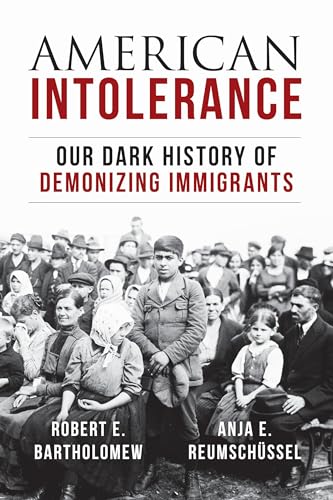
This historical review of the US treatment of immigrants and minority groups documents the suspicion and persecution that often met newcomers and those perceived to be different.
Contrary to popular belief, the poor and huddled masses were never welcome in America. Though the engraving on the base of the Statue of Liberty makes that claim, history reveals a far less-welcoming message. This comprehensive survey of cultural and racial exclusion in the United States examines the legacy of hostility toward immigrants over two centuries.
The authors document abuses against Catholics in the early 19th century in response to the influx of German and Irish immigrants; hostility against Mexicans throughout the Southwest, where signs in bars and restaurants read, "No Dogs, No Negros, No Mexicans"; "yellow peril" fears leading to a ban on Chinese immigration for ten years; punitive measures against Native Americans traditions, which became punishable by fines and hard labor; the persecution of German Americans during World War I and Japanese Americans during World War II; the refusal to admit Jewish refugees of the Holocaust; and the ongoing legacy of mistreating African Americans from slavery to the injustices of the present day.
Though the authors note that the United States has accepted tens of millions of immigrants during its relatively short existence, its troubling history of persecution is often overlooked. President Donald Trump's targeting of Muslim and Mexican immigrants is just the most recent chapter in a long, sad history of social panics about "evil" foreigners who are made scapegoats due to their ethnicity or religious beliefs.
Die Inhaltsangabe kann sich auf eine andere Ausgabe dieses Titels beziehen.
Über die Autorin bzw. den Autor
Robert E. Bartholomew is the author of fourteen previous books, most recently A Colorful History of Popular Delusions (with Peter Hassall) and American Hauntings (with Joe Nickell). He has also published more than sixty articles in professional journals, including the British Medical Journal and the International Journal of Social Psychiatry. Bartholomew has been interviewed in the New York Times, Smithsonian Magazine, USA Today, the Wall Street Journal, and on the History and Discovery channels. He is featured in an eight-part National Geographic series on UFOs. Bartholomew holds a PhD in medical sociology. He is a history instructor at Botany College, in Auckland, New Zealand.
Anja Reumschüssel is a freelance science journalist living in Hamburg, Germany. Her articles have been published in various German science and general-interest magazines, including GEO, National Geographic, and STERN. She recently published her book, Extremismus, about political and religious extremism in Germany.
Auszug. © Genehmigter Nachdruck. Alle Rechte vorbehalten.
From the Introduction
In this book, we examine several waves of panic in American history involving the exaggerated fear of immigrants. Outbreaks reflect popular stereotypes of groups targeted solely for their ethnicity or religious beliefs. During periods of great fear, there is a tendency to release pent-up tensions by creating scapegoats. Psychologists refer to this as the “kick-the-dog syndrome” or displaced aggression. When someone has a bad day at work, he may come home and yell at his wife, who in turn may scold her son for the smallest infraction. Having no one to take out his anger on—the son kicks the dog. A similar process occurs in society. During times of crisis, people search for scapegoats. Ironically, the most vulnerable are the easiest targets: immigrants, asylum-seekers, and minorities. This process of blaming others for society’s problems reduces anxiety and offers a simplistic explanation for complex issues of the day.
Despite its reputation as the world’s leading light for justice and equality, the United States has often failed to uphold these ideals. At the base of the Statue of Liberty rests a bronze tablet with the words: “From her beacon-hand glows worldwide welcome . . . ‘Give me your tired, your poor, your huddled masses yearning to breathe free. The wretched refuse of your teeming shore. Send these, the homeless, tempest-tost to me. I lift my lamp beside the golden door!’” Written by Jewish poet Emma Lazarus, these words have come to symbolize America’s history of welcoming immigrants from every corner of the globe, and embracing them regardless of skin color, ethnic heritage, or religious beliefs. Yet this often-touted pillar of American democracy with its emphasis on acceptance, tolerance, and diversity has been true only some of the time. It is more myth than reality. For at certain times in our history, the golden doors have been slammed shut, and the welcome mat removed. These periods of intolerance and fearmongering are fueled by sensational media reports and alarmist claims by politicians, police, lobbyists, and vigilante groups, who are worried over the new threat. Momentum soon snowballs into an unstoppable force that gives rise to harassment, persecution, and scapegoating.
During the nineteenth century, Americans endured the Great Catholic Scare, fostered a fear of Mexicans, imposed a ban on Chinese migrants, and engaged in the systematic persecution of Native Americans. At the time, “Indians” were not citizens and were considered foreigners in their own land. A second wave of scares arose during the twentieth century, amidst the fog of war: the German-American hysteria of World War I, the internment of Japanese Americans after the bombing of Pearl Harbor, and the Jewish refugee spy panic of World War II. In each instance, people of a particular ethnicity or religious affiliation were under suspicion for aiding and abetting the enemy, usually on the flimsiest of evidence and little more than rumor and hearsay. One prominent example were Jewish refugees who desperately sought sanctuary on American soil after fleeing Nazi brutality, only to be refused entry over fears that they were agents for Hitler. As a result, countless men, women, and children perished in the Holocaust. These events parallel the American government’s present-day reluctance to accept Islamic refugees, over fears that they are terrorists. The overwhelming majority of the world’s Muslims are peaceful, law-abiding citizens. In any given year, Americans are more likely to die from falling out of bed or slipping in their bathtub than at the hands of a terrorist.
Throughout history, every society has experienced scares involving sinister forces. Whether the threats are real or imaginary, fear stokes the flames of hysteria far beyond the actual danger posed to the public. Sociologists refer to these episodes as social panics. Over the past fifty years, there have been many examples. They range from sensational claims over the dangers of the spread of AIDS and video-game violence, to serial killers, overuse of mobile phones and the internet by teenagers, and Satanic cults. While no one denies that serial killers exist, or that teens are not preoccupied with social media, in each instance, the threat is dramatically overblown.
During the 1980s and early 1990s, there were a spate of claims about a network of Satanic cults abusing children and sacrificing infants during secret rituals. Many people were falsely accused. During the early 2000s, a similar panic emerged over the threat posed by online sexual predators, which prompted US Attorney General Alberto Gonzalez to name as his top priority in 2005 the apprehension of an estimated 50,000 online offenders. A flurry of news reports highlighted the problem. In May 2006, ABC News reported that one in five children had been approached by an online predator. This claim was traced to a study that defined “sexual solicitation” so broadly as to include teen-on-teen flirting. This explains why not one of the “solicitations” led to a sexual encounter or assault. As for the claim of 50,000 web predators, it turns out that it was from the TV show Dateline NBC. When pressed for their source, host Chris Hansen admitted that there was none; he had attributed the figure “to law enforcement, as an estimate.”
In chapter 1, we examine Roman Catholics. From 1830 to 1860, a fear of all things Catholic swept America. While followers were a feature of the social landscape since colonial times, anti-Catholic sentiments rose dramatically in the 1830s with the upswell of nativism, which held that established or native-born citizens were superior to new or recent arrivals. Nativists opposed all immigration, but especially the immigration of Catholics, who were rumored to owe their allegiance to the pope instead of the president of the United States. Followers were widely believed to be part of a conspiracy to bring down the government and install a Catholic leader. In the three decades before the Civil War, anti-Catholic propaganda was rife in the popular press. During the scare, riots broke out in several cities. One of the worst clashes took place in 1844 when the streets of Philadelphia ran red with blood as thirteen people died and Catholic homes and churches burned to the ground. Within this cauldron of suspicion and fear, misinformation and wild tales flourished. Rumors centered on claims that convents were hotbeds of depraved sexual activity and moral perversion, including accounts of orgies and the ritual killing of babies born to deflowered nuns.
Chapter 2 investigates the unequal treatment of Americans of Mexican ancestry since the 1840s, when the US “annexed” parts of Mexico and the inhabitants became citizens. Mexican Americans were portrayed as an inferior race that was dirty, lazy, and inherently prone to thievery and gang recruitment. Signs proclaiming “No Dogs, No Negroes, No Mexicans” were proudly displayed in the windows of many bars and restaurants across the American Southwest from the late nineteenth century to the early 1950s. Between 1848 and 1928, nearly six hundred people of Mexican heritage were lynched. During the Great Depression, upward of a million Mexicans were forced onto trains and sent back to Mexico over the misguided belief that they were taking “American” jobs. Many were lawful American citizens or residents who had every right to stay. When in 2015, then presidential candidate Donald Trump warned of Mexican immigrants being rapists and drug dealers, he evoked stereotypes that older Mexican Americans would vividly recall.
President Trump’s efforts to ban travelers and refugees from several Muslim-majority countries for fear...
„Über diesen Titel“ kann sich auf eine andere Ausgabe dieses Titels beziehen.
Suchergebnisse für American Intolerance: Our Dark History of Demonizing...

Beispielbild für diese ISBN
American Intolerance : Our Dark History of Demonizing Immigrants
Verlag:
Prometheus Books, Publishers, 2018
ISBN 10: 1633884481
ISBN 13: 9781633884489
Gebraucht
Hardcover
Anbieter: Better World Books, Mishawaka, IN, USA
Verkäuferbewertung 5 von 5 Sternen

Zustand: Good. Pages intact with minimal writing/highlighting. The binding may be loose and creased. Dust jackets/supplements are not included. Stock photo provided. Product includes identifying sticker. Better World Books: Buy Books. Do Good. Artikel-Nr. 15854399-6
Gebraucht kaufen
EUR 7,38
Versand gratis
Versand innerhalb von USA
Versand innerhalb von USA
Anzahl: 1 verfügbar
Beispielbild für diese ISBN
American Intolerance : Our Dark History of Demonizing Immigrants
Verlag:
Prometheus Books, Publishers, 2018
ISBN 10: 1633884481
ISBN 13: 9781633884489
Gebraucht
Hardcover
Anbieter: Better World Books, Mishawaka, IN, USA
Verkäuferbewertung 5 von 5 Sternen
Zustand: Very Good. Former library copy. Pages intact with possible writing/highlighting. Binding strong with minor wear. Dust jackets/supplements may not be included. Includes library markings. Stock photo provided. Product includes identifying sticker. Better World Books: Buy Books. Do Good. Artikel-Nr. 18302980-6
Gebraucht kaufen
EUR 7,38
Versand gratis
Versand innerhalb von USA
Versand innerhalb von USA
Anzahl: 1 verfügbar
Beispielbild für diese ISBN
American Intolerance: Our Dark History of Demonizing Immigrants
Anbieter: Powell's Bookstores Chicago, ABAA, Chicago, IL, USA
Verkäuferbewertung 5 von 5 Sternen
Hardcover. Zustand: Like New. Clean copy. May have remainder mark. Artikel-Nr. 2054456
Gebraucht kaufen
EUR 8,27
EUR 4,46 Versand
Versand innerhalb von USA
Versand innerhalb von USA
Anzahl: 15 verfügbar
Beispielbild für diese ISBN
American Intolerance: Our Dark History of Demonizing Immigrants
Anbieter: Books From California, Simi Valley, CA, USA
Verkäuferbewertung 4 von 5 Sternen

hardcover. Zustand: Acceptable. Zustand des Schutzumschlags: Includes dust jacket. Book is bending/warping. Dust jacket shows minor creasing and scuffing. Pages are clean, text and pictures are intact and unmarred. Acceptable reading copy. Artikel-Nr. mon0003855818
Gebraucht kaufen
EUR 9,44
EUR 4,45 Versand
Versand innerhalb von USA
Versand innerhalb von USA
Anzahl: 1 verfügbar
Foto des Verkäufers
American intolerance : our dark history of demonizing immigrants.
Anbieter: Kloof Booksellers & Scientia Verlag, Amsterdam, Niederlande
Verkäuferbewertung 4 von 5 Sternen
Zustand: as new. Amherst, New York : Prometheus Books, 2018. Hardcover. Dustjacket. 270 pp. 24 cm - This historical review of the US treatment of immigrants and minority groups documents the suspicion and persecution that often met newcomers and those perceived to be different. Contrary to popular belief, the poor and huddled masses were never welcome in America. Though the engraving on the base of the Statue of Liberty makes that claim, history reveals a far less-welcoming message. This comprehensive survey of cultural and racial exclusion in the United States examines the legacy of hostility toward immigrants over two centuries. The authors document abuses against Catholics in the early 19th century in response to the influx of German and Irish immigrants; hostility against Mexicans throughout the Southwest, where signs in bars and restaurants read, No Dogs, No Negros, No Mexicans ; yellow peril fears leading to a ban on Chinese immigration for ten years; punitive measures against Native Americans traditions, which became punishable by fines and hard labor; the persecution of German Americans during World War I and Japanese Americans during World War II; the refusal to admit Jewish refugees of the Holocaust; and the ongoing legacy of mistreating African Americans from slavery to the injustices of the present day. Though the authors note that the United States has accepted tens of millions of immigrants during its relatively short existence, its troubling history of persecution is often overlooked. President Donald Trump's targeting of Muslim and Mexican immigrants is just the most recent chapter in a long, sad history of social panics about evil foreigners who are made scapegoats due to their ethnicity or religious beliefs. Condition : as new copy. ISBN 9781633884489. Keywords : POLITICS, immigration studies ìmmigration & refugee law. Artikel-Nr. 291057
Gebraucht kaufen
EUR 16,95
EUR 30,00 Versand
Versand von Niederlande nach USA
Versand von Niederlande nach USA
Anzahl: 1 verfügbar
Beispielbild für diese ISBN
American Intolerance: Our Dark History of Demonizing Immigrants
Anbieter: Revaluation Books, Exeter, Vereinigtes Königreich
Verkäuferbewertung 5 von 5 Sternen
Hardcover. Zustand: Brand New. 270 pages. 9.50x6.50x1.00 inches. In Stock. Artikel-Nr. 1633884481
Neu kaufen
EUR 43,11
EUR 11,84 Versand
Versand von Vereinigtes Königreich nach USA
Versand von Vereinigtes Königreich nach USA
Anzahl: 1 verfügbar
Beispielbild für diese ISBN
American Intolerance : Our Dark History of Demonizing Immigrants
Verlag:
Globe Pequot Publishing, 2018
ISBN 10: 1633884481
ISBN 13: 9781633884489
Gebraucht
Hardcover
Anbieter: Buchpark, Trebbin, Deutschland
Verkäuferbewertung 5 von 5 Sternen
Zustand: Sehr gut. Zustand: Sehr gut | Seiten: 270 | Sprache: Englisch | Produktart: Bücher | This historical review of the US treatment of immigrants and minority groups documents the suspicion and persecution that often met newcomers and those perceived to be different.Contrary to popular belief, the poor and huddled masses were never welcome in America. Though the engraving on the base of the Statue of Liberty makes that claim, history reveals a far less-welcoming message. This comprehensive survey of cultural and racial exclusion in the United States examines the legacy of hostility toward immigrants over two centuries. The authors document abuses against Catholics in the early 19th century in response to the influx of German and Irish immigrants; hostility against Mexicans throughout the Southwest, where signs in bars and restaurants read, "No Dogs, No Negros, No Mexicans"; "yellow peril" fears leading to a ban on Chinese immigration for ten years; punitive measures against Native Americans traditions, which became punishable by fines and hard labor; the persecution of German Americans during World War I and Japanese Americans during World War II; the refusal to admit Jewish refugees of the Holocaust; and the ongoing legacy of mistreating African Americans from slavery to the injustices of the present day.Though the authors note that the United States has accepted tens of millions of immigrants during its relatively short existence, its troubling history of persecution is often overlooked. President Donald Trump's targeting of Muslim and Mexican immigrants is just the most recent chapter in a long, sad history of social panics about "evil" foreigners who are made scapegoats due to their ethnicity or religious beliefs. Artikel-Nr. 31117117/2
Gebraucht kaufen
EUR 14,97
EUR 105,00 Versand
Versand von Deutschland nach USA
Versand von Deutschland nach USA
Anzahl: 5 verfügbar