
Verwandte Artikel zu Let's Talk About Death: Asking the Questions that...
Let's Talk About Death: Asking the Questions that Profoundly Change the Way We Live and Die - Softcover
Inhaltsangabe
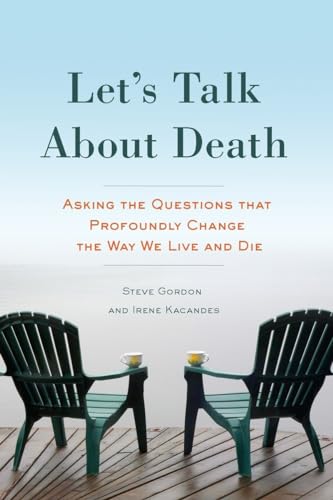
Experts in end-of-life care tell us that we should talk about death and dying with relatives and friends, but how do we get such conversations off the ground in a society that historically has avoided the topic? This book provides one example of such a conversation. The coauthors take up challenging questions about pain, caregiving, grief, and what comes after death. Their unlikely collaboration is itself connected to death: the murders of two of Irene's closest friends and Steve's support in perpetuating memories of those friends' lives and not just their violent ends.
The authors share the results of a no-holds-barred discussion they conducted for several years over email. Readers can consider a range of views on complicated issues to which there are no right answers. Letting ourselves pose certain questions has the potential to profoundly change the way we think about death, how we choose to die, and, just as importantly, the way we live.
Honest, probing, sensitive, and even humorous at times, the completely open discussions in this book will help readers deal with a topic that most of us try to avoid but that everyone will face eventually.
Die Inhaltsangabe kann sich auf eine andere Ausgabe dieses Titels beziehen.
Über die Autorin bzw. den Autor
Steve Gordon is a massage therapist and the founder, executive director, and primary massage therapist for a nonprofit program called The Hand to Heart Project (launched in 2007), which provides free in-home massage and compassionate touch to people with advanced cancer, including people in treatment as well as people nearing the end of life. Previous to becoming a massage therapist, he was a newspaper writer and editor, working for the Keene Sentinel (Keene, NH) and the Valley News (Lebanon, NH).
Irene Kacandes is the Dartmouth Professor of German Studies and Comparative Literature at Dartmouth College, where she is also involved in the Medical Humanities Initiative. President of the German Studies Association, Kacandes also chairs the Division of Autobiography, Biography, and Life Writing of the Modern Language Association. She’s authored two previous books and numerous scholarly articles, as well as edited anthologies, journals, and other books.
Auszug. © Genehmigter Nachdruck. Alle Rechte vorbehalten.
Let's Talk about Death
Asking the Questions That Profoundly Change the Way We Live and Die
By Steve Gordon, Irene KacandesPrometheus Books
Copyright © 2015 Steve Gordon and Irene Kacandes
All rights reserved.
ISBN: 978-1-63388-112-9All rights reserved.
Contents
Acknowledgments, 9,
Preface, 11,
Chapter 1: What Is Life with Death?, 17,
Chapter 2: Is Dying an Injustice?, 39,
Chapter 3: How Do I Handle Pain at End of Life?, 61,
Chapter 4: What about Caregiving?, 79,
Chapter 5: Is Sudden Death Different?, 105,
Chapter 6: What Comes after I Die?, 129,
Chapter 7: What about Grief?, 159,
Chapter 8: What's So Great about Mortality Anyway?, 183,
Afterword: Reaping the Benefits of Our Exchange, 209,
Appendices: Resources and Inspirations for Continued Thinking about Mortality, 215,
Appendix A,
Suggested Resources and Inspirations for Ordinary Mortals, 216,
Suggested Resources and Inspirations for Caregivers, 219,
Suggested Resources and Inspirations for Individuals with Life-Changing Illness and Their Families, 221,
Appendix B,
Suggested Resources and Inspirations for Group Discussion, 224,
Suggested Works of Literature Dealing with Mortality, 227,
Notes, 229,
Index, 239,
CHAPTER 1
WHAT IS LIFE WITH DEATH?
La Tour-de-Peilz, Switzerland 4 July 2011
Dear Steve,
Thank you for your offer to exchange letters with me this summer while I am living and writing in the town where my husband, Philippe, grew up. It is a beautiful port on the shores of Lake Geneva in the French-speaking part of Switzerland. From my little writing desk in the living room I can see over the treetops, roofs, and lake to a few of the smaller mountains in the French Alps. (The biggest peaks usually can't be seen from this location.) Over the years that I've been coming here I have grown closer and closer to my husband's tiny, welcoming family, and I've made a few friends of my own through playing tennis and visiting the library at the Université de Lausanne, a short jaunt from here. Still, even with the joy of reconnecting with them and my husband, who has already been here for several weeks, I realize I am longing to be in dialogue with you. Is that because we've managed to bond over the topic of loss, and I am feeling the imminent loss of my father at this moment?
Since that day in late April when you and I met face-to-face and walked and talked, and the few follow-up chats we managed to fit into our busy schedules, I've finished up the academic year at Dartmouth, gotten our house in Lebanon, NH, ready for our absence and the arrival of tenants, traveled to White Plains, New York, where I grew up and where my parents still live, and I have just arrived here in Switzerland. Whew, I am exhausted just writing that out, but even more exhausted from worrying about my father.
I believe I explained to you that my father has been in poor physical and mental health for some years now. He's not very old by today's standards, just eighty-one. But he's got diabetes, neuropathy, barely functioning kidneys, severely arthritic knees, and has already had a heart attack and open-heart surgery, all of which contribute to his limited mobility; some of those problems likely contribute to his increasingly severe dementia. We've been trying to take care of him at home. My mother does the greatest share of the caretaking, with part-time help from a home health aide. One of my sisters lives in New York City and makes the time to stop by often and check in on them, as does one of my brothers, who lives about an hour away. I go down from New Hampshire when I can take a break from my responsibilities at the university. (My other three siblings live thousands of miles away and have their own challenges to deal with right now.)
Dad had a terrible spring. He developed a urinary tract infection that was bad enough to send him to the hospital, where he then came down with new infections. He became so weak that he could no longer get in and out of bed, even with assistance, so eventually he entered a local rehabilitation home where he still is as I write you, and where the care, alas, has been inconsistent. Going back and forth to the hospital and acute-care facility and trying to deal with the healthcare system for more than a month has been exhausting for my mother and siblings. So it was an obvious choice to spend the time I had available between the end of the school year and departure for Europe being with my father and spelling my mother, sister, and brother from at least the daily grind of his care.
Seeing my father in so much pain, confusion, and distress was difficult, to be sure. When staff members who are patient and gentle were on duty, he remained calm, but when those who are generally in a rush were assigned to him, he would scream out in anticipation of the pain they were sure to cause him with a hurried and rough transfer from bed to wheelchair or wheelchair to toilet, from pajamas to clothes or vice versa. I would remind the staff to please tell him what was about to happen before they touched or moved him and to please stabilize his impossibly swollen and achy knees, but institutional protocol put me in the hallway more times than not, where I would shake from the sound of his screams and my own helplessness.
Once Dad was actually in the wheelchair or back in bed, I could be in charge. And that part felt easy, or at least very clear. My job was to try to comfort and engage him. Even when I had the sense that I wasn't succeeding at comforting or engaging him, I still felt the imperative to try over and over again. Patiently talking to him about anything and everything. Sitting in the corner of his room. Reading aloud little bits from the newspaper. Pushing him in his wheelchair outside. The June temperatures were generally warm but not yet scorching, and the place has a lovely garden and woods. I would point out to him the birds and rabbits near us and occasionally he would point one out to me. I would read him poetry. Rub his back. And often just sit in silence nearby.
Repeatedly I thought of you, Steve, and wondered how you actually do your work with the dying. I didn't wonder at all that you wanted to do it. Rather, I wondered about what kinds of massage you give to what kinds of patients. I wondered, too, how you know when to be active and when to quietly just be there, a silent witness to their suffering. A witness to their work of dying.
The other thing about these days spent with my father that I felt you would immediately understand was how easy it was for me to take an interest in the other residents in the facility. I tried to learn their names so that I could greet them when I passed them in the hall or outside. I smiled my widest smiles and shook hands with the stronger. I kissed several residents good-bye on my last visit and shed tears of recognition that I'd fallen in love with them and that chances were I would never see them again.
Why did all that come almost effortlessly? Where did that childhood disgust of the nursing homes we were made to visit as Girl Scouts disappear to? To put it another way, how did I get comfortable being with the elderly, the suffering, and the dying? I certainly never had a plan to become so. Knowing that I was there for just a few weeks definitely helped me to be as available to others as I could be. It helped me to engage with their pain and misery and to be on the lookout for joy and beauty so that I could share it with those around me. Could I have gotten up my energy and...
„Über diesen Titel“ kann sich auf eine andere Ausgabe dieses Titels beziehen.
Suchergebnisse für Let's Talk About Death: Asking the Questions that...

Beispielbild für diese ISBN
Let's Talk about Death: Asking the Questions That Profoundly Change the Way We Live and Die
Anbieter: ThriftBooks-Phoenix, Phoenix, AZ, USA
Verkäuferbewertung 5 von 5 Sternen

Paperback. Zustand: Very Good. No Jacket. Former library book; May have limited writing in cover pages. Pages are unmarked. ~ ThriftBooks: Read More, Spend Less. Artikel-Nr. G1633881121I4N10
Gebraucht kaufen
EUR 5,79
Versand gratis
Versand innerhalb von USA
Versand innerhalb von USA
Anzahl: 1 verfügbar
Beispielbild für diese ISBN
Let's Talk about Death: Asking the Questions That Profoundly Change the Way We Live and Die
Anbieter: ThriftBooks-Reno, Reno, NV, USA
Verkäuferbewertung 5 von 5 Sternen
Paperback. Zustand: Very Good. No Jacket. Former library book; May have limited writing in cover pages. Pages are unmarked. ~ ThriftBooks: Read More, Spend Less. Artikel-Nr. G1633881121I4N10
Gebraucht kaufen
EUR 5,79
Versand gratis
Versand innerhalb von USA
Versand innerhalb von USA
Anzahl: 1 verfügbar
Beispielbild für diese ISBN
Let's Talk about Death: Asking the Questions That Profoundly Change the Way We Live and Die
Anbieter: ThriftBooks-Reno, Reno, NV, USA
Verkäuferbewertung 5 von 5 Sternen
Paperback. Zustand: Fair. No Jacket. Former library book; Readable copy. Pages may have considerable notes/highlighting. ~ ThriftBooks: Read More, Spend Less. Artikel-Nr. G1633881121I5N10
Gebraucht kaufen
EUR 5,79
Versand gratis
Versand innerhalb von USA
Versand innerhalb von USA
Anzahl: 1 verfügbar
Beispielbild für diese ISBN
Let's Talk about Death: Asking the Questions That Profoundly Change the Way We Live and Die
Anbieter: ThriftBooks-Atlanta, AUSTELL, GA, USA
Verkäuferbewertung 5 von 5 Sternen
Paperback. Zustand: Good. No Jacket. Pages can have notes/highlighting. Spine may show signs of wear. ~ ThriftBooks: Read More, Spend Less. Artikel-Nr. G1633881121I3N00
Gebraucht kaufen
EUR 5,82
Versand gratis
Versand innerhalb von USA
Versand innerhalb von USA
Anzahl: 1 verfügbar
Beispielbild für diese ISBN
Let's Talk about Death: Asking the Questions That Profoundly Change the Way We Live and Die
Anbieter: ThriftBooks-Atlanta, AUSTELL, GA, USA
Verkäuferbewertung 5 von 5 Sternen
Paperback. Zustand: Very Good. No Jacket. May have limited writing in cover pages. Pages are unmarked. ~ ThriftBooks: Read More, Spend Less. Artikel-Nr. G1633881121I4N00
Gebraucht kaufen
EUR 5,82
Versand gratis
Versand innerhalb von USA
Versand innerhalb von USA
Anzahl: 1 verfügbar
Beispielbild für diese ISBN
Let's Talk about Death: Asking the Questions That Profoundly Change the Way We Live and Die
Anbieter: ThriftBooks-Dallas, Dallas, TX, USA
Verkäuferbewertung 5 von 5 Sternen
Paperback. Zustand: Very Good. No Jacket. Former library book; May have limited writing in cover pages. Pages are unmarked. ~ ThriftBooks: Read More, Spend Less. Artikel-Nr. G1633881121I4N10
Gebraucht kaufen
EUR 5,82
Versand gratis
Versand innerhalb von USA
Versand innerhalb von USA
Anzahl: 1 verfügbar
Beispielbild für diese ISBN
Let's Talk about Death: Asking the Questions That Profoundly Change the Way We Live and Die
Anbieter: ThriftBooks-Atlanta, AUSTELL, GA, USA
Verkäuferbewertung 5 von 5 Sternen
Paperback. Zustand: Good. No Jacket. Former library book; Pages can have notes/highlighting. Spine may show signs of wear. ~ ThriftBooks: Read More, Spend Less. Artikel-Nr. G1633881121I3N10
Gebraucht kaufen
EUR 5,82
Versand gratis
Versand innerhalb von USA
Versand innerhalb von USA
Anzahl: 1 verfügbar
Beispielbild für diese ISBN
Let's Talk About Death: Asking the Questions that Profoundly Change the Way We Live and Die
Anbieter: World of Books (was SecondSale), Montgomery, IL, USA
Verkäuferbewertung 5 von 5 Sternen
Zustand: Acceptable. Item in acceptable condition! Textbooks may not include supplemental items i.e. CDs, access codes etc. Artikel-Nr. 00094429786
Gebraucht kaufen
EUR 5,83
Versand gratis
Versand innerhalb von USA
Versand innerhalb von USA
Anzahl: 1 verfügbar
Beispielbild für diese ISBN
Let's Talk about Death : Asking the Questions That Profoundly Change the Way We Live and Die
Verlag:
Prometheus Books, Publishers, 2015
ISBN 10: 1633881121
ISBN 13: 9781633881129
Gebraucht
Softcover
Anbieter: Better World Books, Mishawaka, IN, USA
Verkäuferbewertung 5 von 5 Sternen
Zustand: Good. Former library copy. Pages intact with minimal writing/highlighting. The binding may be loose and creased. Dust jackets/supplements are not included. Includes library markings. Stock photo provided. Product includes identifying sticker. Better World Books: Buy Books. Do Good. Artikel-Nr. 12083735-6
Gebraucht kaufen
EUR 6,38
Versand gratis
Versand innerhalb von USA
Versand innerhalb von USA
Anzahl: 3 verfügbar
Beispielbild für diese ISBN
Let's Talk About Death: Asking the Questions that Profoundly Change the Way We Live and Die
Anbieter: WorldofBooks, Goring-By-Sea, WS, Vereinigtes Königreich
Verkäuferbewertung 5 von 5 Sternen
Paperback. Zustand: Very Good. The book has been read, but is in excellent condition. Pages are intact and not marred by notes or highlighting. The spine remains undamaged. Artikel-Nr. GOR007467972
Gebraucht kaufen
EUR 3,70
EUR 6,54 Versand
Versand von Vereinigtes Königreich nach USA
Versand von Vereinigtes Königreich nach USA
Anzahl: 1 verfügbar