
Verwandte Artikel zu Memphis Rent Party: The Blues, Rock & Soul in Music's...
Inhaltsangabe
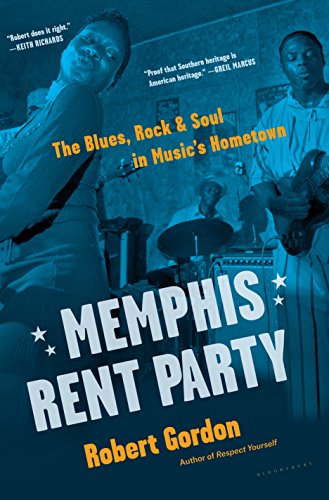
Profiles and stories of Southern music from the acclaimed author of Respect Yourself: Stax Records and the Soul Explosion.
Die Inhaltsangabe kann sich auf eine andere Ausgabe dieses Titels beziehen.
Über die Autorin bzw. den Autor
Robert Gordon has been writing about Memphis music and history for thirty years and is the author of It Came from Memphis, Can't Be Satisfied, The King on the Road, The Elvis Treasures, and Respect Yourself. He won a Grammy in 2011 for his liner notes to the Big Star box set Keep an Eye on the Sky. His film work includes producing and directing the documentary Respect Yourself: The Stax Records Story and also the Emmy-winning Best of Enemies. Gordon lives in Memphis.
Auszug. © Genehmigter Nachdruck. Alle Rechte vorbehalten.
Memphis Rent Party
The Blues, Rock & Soul in Music's Hometown
By ROBERT GORDONBloomsbury Publishing Plc
Copyright © 2018 Robert Gordon
All rights reserved.
ISBN: 978-1-63286-773-5All rights reserved.
Contents
Preface Give Me Something Different, 1,
Sam Phillips Sam on Dave, 11,
Jim Dickinson On the Edge, 20,
Ernest Willis Mississippi Reverie, 36,
Mose Vinson No Pain Pill, 44,
The Fieldstones Got to Move on Down the Line, 47,
Lead Belly Nobody in This World, 52,
Robert Johnson Hellhound on the Money Trail, 61,
Junior Kimbrough Mississippi Juke Joint, 78,
Charlie Feathers The Onliest, 86,
James Carr Way Out on a Voyage, 96,
Otha Turner's Fife and Drum Picnic Let Us Eat Goat, 112,
Mama Rose Newborn Useless Are the Flowers, 121,
Townes Van Zandt All the Federales Say, 135,
Jeff Buckley Northern Light, 140,
Bobby "Blue" Bland Love Throat, 147,
Tav Falco Panther Burns Forever Lasting, 153,
Jerry Lee Lewis Last Killer Standing, 166,
Cat Power Kool Kween, 186,
Jerry McGill Very Extremely Dangerous, 200,
Alex Chilton No Chitterlings Today, 206,
Afterword Stuck Inside the Memphis Blues Again, 213,
Acknowledgments, 219,
A Note on the Photographers, 223,
Digging Deeper for Different — Further Listening and Reading, 225,
Index, 239,
PREFACE
GIVE ME SOMETHING DIFFERENT
A story: well into his career, my friend and mentor Jim Dickinson was feeling embittered, was complaining about some music business bullshit. His pal cut him off, saying, "You were fortunate enough to witness the end of something truly great" — referring to the gradual dissolution of the original Memphis blues giants in the 1960s — "and you were intelligent enough to understand some of it." Memphis has always been willfully ignorant of the transcendent artists walking its streets, willfully negligent of the African-American culture that produced them. Jim had experienced a fleeting treasure that too few appreciated, a treasure no one could gentrify. The assessment chastened Jim, and bolstered him. It reset the context of everything.
I came along in Dickinson's wake, when many of the greats had already passed away — but not all of them. Not all by a long shot. When I first began hanging out at bluesman Furry Lewis's dilapidated duplex, I wasn't yet old enough to drive and it was harder for me to get a ride to that part of town than it was to buy Furry's pint of Ten High bourbon.
I'd learned of Furry at an outdoor Rolling Stones concert, Memphis, July 4, 1975. Mick Jagger delayed the band's performance until the sun went down, mistakenly assuming night in Memphis would be cooler and his makeup wouldn't run. To assuage the young audience's simmering restlessness, the Stones sent across town for a solo blues guitarist, about eighty years old, named Furry Lewis.
For this fourteen-year-old among fifty thousand rednecks on that hot football field, hearing Furry was life changing. The concert was an all-day 1970s spectacle, with three bands opening, plus the unscheduled bluesman. I'd enjoyed the warm-up acts; their big rock and roll sounds were just like their recordings, only livelier. But Furry's playing was unlike anything I could have anticipated; the still, small voice after the raging storms. His rhythms were slow, his songs full of space, his notes floated in the air. His music summoned us listeners instead of dazzling us with its size and force. His voice and laugh, the way the slide over his finger could elicit a moaning human voice from the guitar — there was an immediacy to his art that the Stones' big production could never match. The pageantry of the bands inspired awe while Furry's intimacy let me feel the wrinkles on the hands wrapped around the guitar neck, the texture of the strings; he let me hear the human being. The raw power of Furry's personality was so infused into his music and stories that his songs became his life, and he took me places I did not know, to times I couldn't have experienced. Transubstantiation.
I think I was familiar with the blues at the time — Memphis called itself "home of the blues." But I hadn't considered that the bluesmen might be alive.
And still playing.
In my town.
Thereafter, I was a seeker.
Less than two years later, a group Dickinson played in named Mud Boy and the Neutrons took the stage at a civic blues festival on Beale Street. This was 1977, my first time seeing Jim perform. Mud Boy was a bunch of white bohemians who'd come up playing alongside elderly black bluesmen in 1960s coffeehouses, creating new friendships that defied long-standing rules of segregation. But they were rockers. Mud Boy sounded like what the Stones would have if the Brits learned the music at the feet of the players instead of from black vinyl platters. Rather than spectacle, Mud Boy honed personality, allowing space for the music to breathe. I could hear Furry at the core of Mud Boy's music even though their instrumentation and presentation, with dancing girls shaking their moneymakers in the bright light of day, was much nearer to the Stones. The festival promoters, however, were less enthused by Mud Boy's raucous, lascivious take on the blues. This was a family event. Backstage, a band ally, Danny Graflund, heard the developing kerfuffle and ran onstage to whisper this little power-packed poem into Dickinson's ear:
They don't like the rock 'n' roll.
They don't like the dancing girls.
They're gonna pull the plug.
Midsong, the massive speakers crackled to silence. Catcalls and boos erupted from the audience. The band, incensed, shouted from the stage ("Tear down Beale Street, the symbol of oppression!"), and they paced like animals newly caged. Violence in Memphis is always on a patrolled simmer — this was less than ten years after Martin Luther King had been assassinated five blocks away — and cops assembled down front. The crowd was unforgiving, and as the tension mounted, I felt the bonding of mob mentality, the sense that this mass of angry, slightly drunk people could erupt. There were negotiations onstage and off, then the band reassembled — without the dancers — and the crowd's fury never ignited. I remember thinking that behind the near riot, at the core of Mud Boy's sound, was the power of Furry's solo blues.
As I got deeper in, my interest in the mainstream and what was popular went out the door. I was hooked on the feeling of the blues, on having my soul rattled instead of my bones. Rock and roll is hormonal fireworks, a temporal shout at earthly limits (which is why parents rocking out is so funny to kids). But the blues is a more sustained illumination, against the humiliation, rage, and sadness of life, and in turn invests the artist with not eternal youth but a scarred mortality, blessed with poetry.
The blues felt like home, even though my actual residence was a four-bedroom, two-and-a-half-bathroom version of the American dream complete with private schools, summer camps, and professional parents. I responded to the power of the blues, though I did not experience that kind of want. My father was an attorney and my mother had her master's degree and worked as a speech therapist. (Rebellious, I've stuttered all my life.) We had income enough to live in lovely suburban homes in nice neighborhoods. My brother and I had our own bicycles and bedrooms. We had money, we didn't suffer need, we felt safe.
I began listening to the...
„Über diesen Titel“ kann sich auf eine andere Ausgabe dieses Titels beziehen.
Suchergebnisse für Memphis Rent Party: The Blues, Rock & Soul in Music's...

Beispielbild für diese ISBN
Memphis Rent Party
Verlag:
Bloomsbury Publishing Plc, 2018
ISBN 10: 1632867737
ISBN 13: 9781632867735
Gebraucht
Hardcover
Anbieter: World of Books (was SecondSale), Montgomery, IL, USA
Verkäuferbewertung 5 von 5 Sternen

Hardback. Zustand: Good. "Blues, being the wellspring of all American music for over a century, is always worth studying. Robert does it right." --Keith Richards"An emotional map of musical Memphis. If you don't know these characters, let Robert Gordon introduce you." --Elvis Costello"Robert Gordon's book is proof that Southern heritage is American heritage, and all sorts of people--black and white, familiar and strange, dead and alive--are what it is." --Greil MarcusProfiles and stories of Southern music from the acclaimed author of Respect Yourself: Stax Records and the Soul Explosion.The fabled city of Memphis has been essential to American music--home of the blues, the birthplace of rock and roll, a soul music capital. We know the greatest hits, but celebrated author Robert Gordon takes us to the people and places history has yet to record. A Memphis native, he whiles away time in a crumbling duplex with blues legend Furry Lewis, stays up late with barrelhouse piano player Mose Vinson, and sips homemade whiskey at Junior Kimbrough's churning house parties. A passionate listener, he hears modern times deep in the grooves of old records by Lead Belly and Robert Johnson.The interconnected profiles and stories in Memphis Rent Party convey more than a region. Like mint seeping into bourbon, Gordon gets into the wider world. He beholds the beauty of mistakes with producer Jim Dickinson (Replacements, Rolling Stones), charts the stars with Alex Chilton (Box Tops, Big Star), and mulls the tragedy of Jeff Buckley's fatal swim. Gordon's Memphis inspires Cat Power, attracts Townes Van Zandt, and finds James Carr always singing at the dark end of the street. A rent party is when friends come together to hear music, dance, and help a pal through hard times; it's a celebration in the face of looming tragedy, an optimism when the wolf is at the door. Robert Gordon finds mystery in the mundane, inspiration in the bleakness, and revels in the individualism that connects these diverse encounters. Artikel-Nr. CIN1632867737G
Gebraucht kaufen
EUR 4,12
Versand gratis
Versand innerhalb von USA
Versand innerhalb von USA
Anzahl: 1 verfügbar
Beispielbild für diese ISBN
Memphis Rent Party : The Blues, Rock and Soul in Music's Hometown
Verlag:
Bloomsbury Publishing USA, 2018
ISBN 10: 1632867737
ISBN 13: 9781632867735
Gebraucht
Hardcover
Anbieter: Better World Books, Mishawaka, IN, USA
Verkäuferbewertung 5 von 5 Sternen
Zustand: Very Good. Former library copy. Pages intact with possible writing/highlighting. Binding strong with minor wear. Dust jackets/supplements may not be included. Includes library markings. Stock photo provided. Product includes identifying sticker. Better World Books: Buy Books. Do Good. Artikel-Nr. 14953947-6
Gebraucht kaufen
EUR 6,74
Versand gratis
Versand innerhalb von USA
Versand innerhalb von USA
Anzahl: 3 verfügbar
Beispielbild für diese ISBN
Memphis Rent Party : The Blues, Rock and Soul in Music's Hometown
Verlag:
Bloomsbury Publishing USA, 2018
ISBN 10: 1632867737
ISBN 13: 9781632867735
Gebraucht
Hardcover
Anbieter: Better World Books: West, Reno, NV, USA
Verkäuferbewertung 5 von 5 Sternen
Zustand: Good. Former library copy. Pages intact with minimal writing/highlighting. The binding may be loose and creased. Dust jackets/supplements are not included. Includes library markings. Stock photo provided. Product includes identifying sticker. Better World Books: Buy Books. Do Good. Artikel-Nr. 17135727-6
Gebraucht kaufen
EUR 6,74
Versand gratis
Versand innerhalb von USA
Versand innerhalb von USA
Anzahl: 1 verfügbar
Beispielbild für diese ISBN
Memphis Rent Party: The Blues, Rock & Soul in Music's Hometown
Anbieter: ThriftBooks-Atlanta, AUSTELL, GA, USA
Verkäuferbewertung 5 von 5 Sternen
Hardcover. Zustand: Very Good. No Jacket. Former library book; May have limited writing in cover pages. Pages are unmarked. ~ ThriftBooks: Read More, Spend Less. Artikel-Nr. G1632867737I4N10
Gebraucht kaufen
EUR 7,33
Versand gratis
Versand innerhalb von USA
Versand innerhalb von USA
Anzahl: 1 verfügbar
Beispielbild für diese ISBN
Memphis Rent Party: The Blues, Rock & Soul in Music's Hometown
Anbieter: ThriftBooks-Phoenix, Phoenix, AZ, USA
Verkäuferbewertung 5 von 5 Sternen
Hardcover. Zustand: Very Good. No Jacket. Former library book; May have limited writing in cover pages. Pages are unmarked. ~ ThriftBooks: Read More, Spend Less. Artikel-Nr. G1632867737I4N10
Gebraucht kaufen
EUR 7,33
Versand gratis
Versand innerhalb von USA
Versand innerhalb von USA
Anzahl: 1 verfügbar
Beispielbild für diese ISBN
Memphis Rent Party: The Blues, Rock, & Soul in Music's Hometown
Anbieter: Magers and Quinn Booksellers, Minneapolis, MN, USA
Verkäuferbewertung 5 von 5 Sternen
hardcover. Zustand: Very Good. May have light to moderate shelf wear and/or a remainder mark. Complete. Clean pages. Artikel-Nr. 1269815
Gebraucht kaufen
EUR 10,33
EUR 3,56 Versand
Versand innerhalb von USA
Versand innerhalb von USA
Anzahl: 1 verfügbar
Beispielbild für diese ISBN
Memphis Rent Party The Blues, Rock & Soul in Music's Hometown
Anbieter: Powell's Bookstores Chicago, ABAA, Chicago, IL, USA
Verkäuferbewertung 5 von 5 Sternen
Hardcover. Zustand: Very Good. Minimal shelf wear, clean internals. Remainder mark. Artikel-Nr. 2046005
Gebraucht kaufen
EUR 14,24
EUR 4,46 Versand
Versand innerhalb von USA
Versand innerhalb von USA
Anzahl: 7 verfügbar
Beispielbild für diese ISBN
Memphis Rent Party
Anbieter: PBShop.store US, Wood Dale, IL, USA
Verkäuferbewertung 5 von 5 Sternen
HRD. Zustand: New. New Book. Shipped from UK. Established seller since 2000. Artikel-Nr. HU-9781632867735
Beispielbild für diese ISBN
Memphis Rent Party
Anbieter: PBShop.store UK, Fairford, GLOS, Vereinigtes Königreich
Verkäuferbewertung 5 von 5 Sternen
HRD. Zustand: New. New Book. Shipped from UK. Established seller since 2000. Artikel-Nr. HU-9781632867735
Neu kaufen
EUR 20,69
EUR 5,92 Versand
Versand von Vereinigtes Königreich nach USA
Versand von Vereinigtes Königreich nach USA
Anzahl: 1 verfügbar
Beispielbild für diese ISBN
Memphis Rent Party: The Blues, Rock & Soul in Music's Hometown
Anbieter: WorldofBooks, Goring-By-Sea, WS, Vereinigtes Königreich
Verkäuferbewertung 5 von 5 Sternen
Paperback. Zustand: Fine. Artikel-Nr. GOR011861179
Gebraucht kaufen
EUR 21,51
EUR 6,61 Versand
Versand von Vereinigtes Königreich nach USA
Versand von Vereinigtes Königreich nach USA
Anzahl: 1 verfügbar