
Verwandte Artikel zu Financial Aid Handbook, Revised Edition: Getting the...
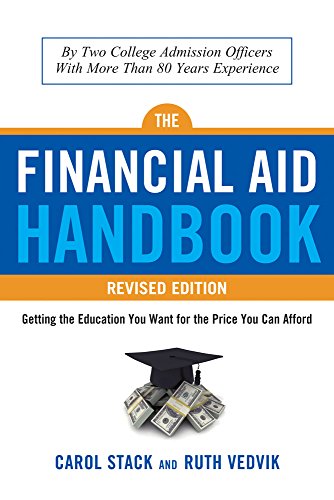
Financial Aid Handbook, Revised Edition: Getting the Education You Want for the Price You Can Afford - Softcover
Inhaltsangabe
The Financial Aid Handbook is the only book families need to find the right college at the right price.
This completely revised, up-to-date edition builds on the success of the original--the definitive, one-stop guide to the college selection and payment process, covering everything from basic timelines and tuition costs to predicting your scholarship award from colleges and taking ownership of student debt after graduation.
Updated to reflect the most recent changes in federal processes and timelines and including new chapters for undocumented and homeless students, this revised edition is a must-have for high school students and their parents.
The Financial Aid Handbook features straightforward language, engaging explanations, and hundreds of tips to maximize your financial aid--the scholarship funds that come from colleges themselves. No other book on the market teaches students and parents how to find real, four-year scholarships…and how to land them. It includes:
The nine biggest myths about paying for college.
A step-by-step guide to completing the FAFSA and PROFILE.
The ultimate guide to federal, state, and private student loans.
How to predict scholarship dollars with the Merit Aid Profile.
How to negotiate with the Financial Aid office.
This completely revised, up-to-date edition builds on the success of the original--the definitive, one-stop guide to the college selection and payment process, covering everything from basic timelines and tuition costs to predicting your scholarship award from colleges and taking ownership of student debt after graduation.
Updated to reflect the most recent changes in federal processes and timelines and including new chapters for undocumented and homeless students, this revised edition is a must-have for high school students and their parents.
The Financial Aid Handbook features straightforward language, engaging explanations, and hundreds of tips to maximize your financial aid--the scholarship funds that come from colleges themselves. No other book on the market teaches students and parents how to find real, four-year scholarships…and how to land them. It includes:
Die Inhaltsangabe kann sich auf eine andere Ausgabe dieses Titels beziehen.
Über die Autorinnen und Autoren
Carol Stack is the former director of admissions at Macalester College and Augsburg College, and served as a college counselor at both the International School of Brussels and St. John's International School in Waterloo, Belgium. For the past 20 years, Stack has worked as a principal at Hardwick Day, an enrollment consulting firm that works with the admissions and financial aid offices of colleges and universities. She has consulted on financial aid policy at dozens of colleges and universities from coast to coast. She lives in St. Paul, Minnesota.
Ruth Vedvik has held the position of director of admissions at the University of Illinois Urbana-Champaign, Ball State University, and Agnes Scott College. For the past 14 years, Vedvik has worked as a principal at Hardwick Day and served as interim vice president for enrollment at more than 20 colleges and universities. She lives in Champaign, Illinois.
Auszug. © Genehmigter Nachdruck. Alle Rechte vorbehalten.
The Financial Aid Handbook
Getting the Education You Want for the Price You Can Afford
By Carol Stack, Ruth VedvikRed Wheel/Weiser, LLC
Copyright © 2017 Carol Stack and Ruth Vedvik
All rights reserved.
ISBN: 978-1-63265-082-5All rights reserved.
Contents
Preface for the Revised Edition,
Introduction for Parents,
Introduction,
Chapter 1: The 9 Biggest Myths About Paying for College,
Chapter 2: The Basics,
Chapter 3: Let's Talk About Debt,
Chapter 4: You, Your Parents, and Their Money,
Chapter 5: For Parents: You, Your Children, and Your Money,
Chapter 6: Merit Aid and The MAP,
Chapter 7: The Cost-Based College Search,
Chapter 8: Everything You Need to Know Before You Hand in Your Paperwork,
Chapter 9: Merit Aid and the Application,
Chapter 10: Making the Choice: An Apples-to-Apples Comparison,
Chapter 11: An Intentional Alternative Plan,
Chapter 12: What's in a Name? Understanding Ratings and Rankings,
Chapter 13: What Color Is Your Passport? Advice for International Students,
Chapter 14: Are You a DREAMer? Advice for Undocumented Students,
Chapter 15: For Homeless and/or Unaccompanied Students,
Notes,
Index,
CHAPTER 1
The 9 Biggest Myths About Paying for College
How do you plan on paying for college?
If you're like most people, you will apply to five to 10 schools that you like, fill out your FAFSA, then cross your fingers and see who gives you the best offer. Then you will beg and plead with your parents, take out loans, and head off for college in the fall after your senior year. You may already have some idea of your family's finances; you're certainly going to apply for financial aid, if you've already picked up this book. Maybe you're planning on taking out some loans; but you'll figure all of it out after you have applied.
Perhaps you've already applied, and the FAFSA deadline is coming up — and you just want to know how to get the most money out of the government. Hand over the tricks, ladies! Give me some charts and instructions and let's be done with it!
Well, kid, we're sorry, but we can't do that. Like anything worth learning in college, you've got to listen to some old person drone on for a while. In your case, that "old person" is the two of us, Carol and Ruth.
If you've already applied to colleges, and you're just trying to use this book to figure out your FAFSA or apply for private scholarships, we have something terrible to tell you: You might not get a significant amount of aid.
The biggest scholarships and financial aid you can get — the kind that really matter — come from colleges themselves, and in order to get them, you've got to apply to the right kind of place. If it's already too late, and you're looking at taking on huge student loans, please turn immediately to Chapter 11. How much is too much to take out in student loans? Well, we consider anything more than $32,000 total, or $8,000 per year, to be unacceptable. (See Chapter 3 for more information about student loans.)
You might be thinking, Why does it matter how much I pay for college? College is an investment; I'll be able to pay it back if I get a good job. And the better the college I go to, the better the job I'll be able to get.
Unfortunately, that's not always true. But it's incredibly difficult to understand why that's not true; you are never given the opportunity to question it. Socrates is a man; all men are mortal; therefore Socrates is mortal. The more you pay for something, the more valuable it is; the more expensive the college, the better the education and the better the opportunities that follow. You've never been asked to question that kind of logic; it seems as natural as Socrates's conclusion that he is mortal. And you are an American teenager — going to college will happen no matter what. It's the new high school diploma. It is a foregone conclusion, an absolute must, a compulsory, mandatory event in your life. Here is your circumstance: You will turn 18, graduate from high school, and head off to college. Going to college does not feel like a choice. But going to college, and where you go to college, is a choice. The reason that it is a choice — and not mandatory — is because college is not free. It must be paid for. And because it must be paid for, you are a consumer, the same as someone selecting a new pair of jeans at the local mall.
When you think about colleges, there is a hierarchy in your brain of what is okay, what is pretty good, what is better, and what is best. There are a couple of assumptions you're going to make about college:
1. The more selective a college is, the better the college.
2. The more expensive the college is, the better the college.
These two things aren't necessarily true. You've got to question both of these assumptions.
We're going to spend the rest of this book explaining to you that much of what you think you know about colleges and universities is, in many ways, untrue. The most basic thing that we need you to understand is: Colleges are a business, and you are their target market.
This doesn't make you helpless. You're a consumer of education; you have the right to choose how you spend your money. The marketing of education, while intoxicating, is nowhere near as potent as tobacco marketing, for example. How many people have you met who are "addicted to learning" (other than scarily enthusiastic, middle-aged teachers with embroidered cat sweaters and "History is Fun!" pins)? Education marketing isn't nearly as potent, but nonetheless, the effect is the same: You and your peers are under the impression that the "better" the college you attend, the "better" the job you get will be.
This is reinforced by successful people with degrees from elite colleges — maybe you know them, or you read about them in the newspaper or in books or whatever. You might think that they're successful because of where they went to school, and that may be partially true. Going to school — any school — is important. A great education is extremely helpful in life, not in the least because it opens up your mind to all the possibilities of the world. But successful people are generally successful for two main reasons: First, they don't give up. Even when they fail, they pick themselves up and try something new. They are dogged and determined and have thick skins. And second, they're good at getting other people to trust them. Whether they are money managers, editors-in-chief, CEOs, or famous authors, they are trustworthy in some way or another.
Those are not qualities that one can purchase; those are personal traits that one earns, you might say, through a lifetime of hurling yourself into experiences and thinking, life is an adventure in the great unknown. No college can teach you that, although many, many colleges — easily 1,000 out of the 4,400 schools in the United States — will give you opportunities and experiences to figure that out on your own.
But again, college isn't free; colleges are businesses that need to charge you for their services. And their services are kind of strange. They're going to sell you a product (a diploma) that also comes with an experience (four years of reading and talking and studying). The idea is that the product (the diploma) will help you get a good, well-paying job, and that the experience (the four years of reading and talking and...
„Über diesen Titel“ kann sich auf eine andere Ausgabe dieses Titels beziehen.
Suchergebnisse für Financial Aid Handbook, Revised Edition: Getting the...

Beispielbild für diese ISBN
The Financial Aid Handbook - Revised Edition: Getting the Education You Want for the Price You Can Afford
Anbieter: World of Books (was SecondSale), Montgomery, IL, USA
Verkäuferbewertung 5 von 5 Sternen

Paperback. Zustand: Good. The Financial Aid Handbook is the only book families need to find the right college at the right price. This completely revised, up-to-date edition builds on the success of the original--the definitive, one-stop guide to the college selection and payment process, covering everything from basic timelines and tuition costs to predicting your scholarship award from colleges and taking ownership of student debt after graduation. Updated to reflect the most recent changes in federal processes and timelines and including new chapters for undocumented and homeless students, this revised edition is a must-have for high school students and their parents. The Financial Aid Handbook features straightforward language, engaging explanations, and hundreds of tips to maximize your financial aid--the scholarship funds that come from colleges themselves. No other book on the market teaches students and parents how to find real, four-year scholarships.and how to land them. It includes: The nine biggest myths about paying for college. A step-by-step guide to completing the FAFSA and PROFILE. The ultimate guide to federal, state, and private student loans. How to predict scholarship dollars with the Merit Aid Profile. How to negotiate with the Financial Aid office. Artikel-Nr. 00067892398
Gebraucht kaufen
EUR 4,33
Versand gratis
Versand innerhalb von USA
Versand innerhalb von USA
Anzahl: 4 verfügbar
Beispielbild für diese ISBN
Financial Aid Handbook, Revised Edition : Getting the Education You Want for the Price You Can Afford
Anbieter: Better World Books: West, Reno, NV, USA
Verkäuferbewertung 5 von 5 Sternen
Zustand: Good. Former library copy. Pages intact with minimal writing/highlighting. The binding may be loose and creased. Dust jackets/supplements are not included. Includes library markings. Stock photo provided. Product includes identifying sticker. Better World Books: Buy Books. Do Good. Artikel-Nr. 21366987-6
Gebraucht kaufen
EUR 6,58
Versand gratis
Versand innerhalb von USA
Versand innerhalb von USA
Anzahl: 1 verfügbar
Beispielbild für diese ISBN
Financial Aid Handbook, Revised Edition : Getting the Education You Want for the Price You Can Afford
Anbieter: Better World Books, Mishawaka, IN, USA
Verkäuferbewertung 5 von 5 Sternen
Zustand: Very Good. Former library copy. Pages intact with possible writing/highlighting. Binding strong with minor wear. Dust jackets/supplements may not be included. Includes library markings. Stock photo provided. Product includes identifying sticker. Better World Books: Buy Books. Do Good. Artikel-Nr. 53180000-6
Gebraucht kaufen
EUR 6,58
Versand gratis
Versand innerhalb von USA
Versand innerhalb von USA
Anzahl: 1 verfügbar
Beispielbild für diese ISBN
Financial Aid Handbook, Revised Edition : Getting the Education You Want for the Price You Can Afford
Anbieter: Better World Books, Mishawaka, IN, USA
Verkäuferbewertung 5 von 5 Sternen
Zustand: Fine. Used book that is in almost brand-new condition. May contain a remainder mark. Better World Books: Buy Books. Do Good. Artikel-Nr. 52437021-6
Gebraucht kaufen
EUR 6,58
Versand gratis
Versand innerhalb von USA
Versand innerhalb von USA
Anzahl: 1 verfügbar
Beispielbild für diese ISBN
Financial Aid Handbook, Revised Edition : Getting the Education You Want for the Price You Can Afford
Anbieter: Better World Books: West, Reno, NV, USA
Verkäuferbewertung 5 von 5 Sternen
Zustand: Fine. Used book that is in almost brand-new condition. May contain a remainder mark. Better World Books: Buy Books. Do Good. Artikel-Nr. 52437021-6
Gebraucht kaufen
EUR 6,58
Versand gratis
Versand innerhalb von USA
Versand innerhalb von USA
Anzahl: 1 verfügbar
Beispielbild für diese ISBN
Financial Aid Handbook, Revised Edition: Getting the Education You Want for the Price You Can Afford
Anbieter: ThriftBooks-Dallas, Dallas, TX, USA
Verkäuferbewertung 5 von 5 Sternen
Paperback. Zustand: Very Good. No Jacket. May have limited writing in cover pages. Pages are unmarked. ~ ThriftBooks: Read More, Spend Less. Artikel-Nr. G1632650827I4N00
Gebraucht kaufen
EUR 6,72
Versand gratis
Versand innerhalb von USA
Versand innerhalb von USA
Anzahl: 1 verfügbar
Beispielbild für diese ISBN
Financial Aid Handbook, Revised Edition: Getting the Education You Want for the Price You Can Afford
Anbieter: ThriftBooks-Atlanta, AUSTELL, GA, USA
Verkäuferbewertung 5 von 5 Sternen
Paperback. Zustand: Very Good. No Jacket. May have limited writing in cover pages. Pages are unmarked. ~ ThriftBooks: Read More, Spend Less. Artikel-Nr. G1632650827I4N00
Gebraucht kaufen
EUR 6,72
Versand gratis
Versand innerhalb von USA
Versand innerhalb von USA
Anzahl: 1 verfügbar
Beispielbild für diese ISBN
The Financial Aid Handbook, Revised Edition: Getting the Education You Want for the Price You Can Afford
Anbieter: Books From California, Simi Valley, CA, USA
Verkäuferbewertung 4 von 5 Sternen

Paperback. Zustand: Very Good. Artikel-Nr. mon0002118101
Gebraucht kaufen
EUR 3,68
EUR 4,46 Versand
Versand innerhalb von USA
Versand innerhalb von USA
Anzahl: 7 verfügbar
Beispielbild für diese ISBN
The Financial Aid Handbook - Revised Edition
Anbieter: PBShop.store UK, Fairford, GLOS, Vereinigtes Königreich
Verkäuferbewertung 5 von 5 Sternen
PAP. Zustand: Used - Very Good. Used - Like New Book. Shipped from UK. Established seller since 2000. Artikel-Nr. P1-9781632650825
Gebraucht kaufen
EUR 13,03
EUR 4,98 Versand
Versand von Vereinigtes Königreich nach USA
Versand von Vereinigtes Königreich nach USA
Anzahl: 4 verfügbar
Beispielbild für diese ISBN
The Financial Aid Handbook: Getting the Education You Want for the Price You Can Afford
Anbieter: Revaluation Books, Exeter, Vereinigtes Königreich
Verkäuferbewertung 5 von 5 Sternen
Paperback. Zustand: Brand New. revised edition. 256 pages. 9.00x6.25x0.75 inches. In Stock. Artikel-Nr. __1632650827
Neu kaufen
EUR 16,16
EUR 11,96 Versand
Versand von Vereinigtes Königreich nach USA
Versand von Vereinigtes Königreich nach USA
Anzahl: 1 verfügbar