
Verwandte Artikel zu Given: The Forgotten Meaning and Practice of Blessing
Inhaltsangabe
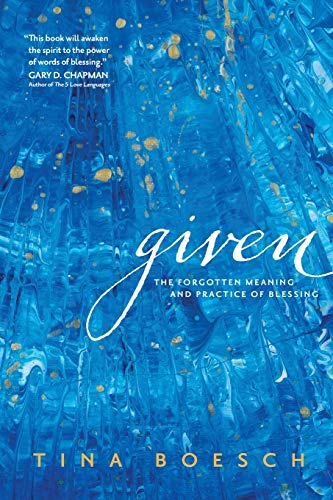
How do we express the good that God wants for those we love? How do we experience blessing through pain and suffering? Why would we bless even enemies? How do we keep spoken blessings in sync with God’s will? And how do we integrate blessing, a concept woven throughout the entire Bible, into the fabric of our everyday lives?
In Given, you will journey outside of your comfort zone, into a world of blessing as a relational calling—as a way God relates to you and a way you’re called to relate to others. You will travel across countries, cultures, and centuries of church history to expand your paradigm of a word ripe with significance. Along the way, you’ll be inspired to begin the essential Christian practice of being given by God as a blessing.
Journey with author Tina Boesch to discover your calling to a meaningful way of living and relating to God and others, inspired by Christ, who gave himself on the cross so that we could fully experience God’s blessing.
Die Inhaltsangabe kann sich auf eine andere Ausgabe dieses Titels beziehen.
Von der hinteren Coverseite
Begin to Live
We all have a deep ache to be blessed by God and to be a blessing. How do we bless those we love? How do we bless our enemies? How do we speak blessing into—and out of—pain and suffering? How do we keep the blessings we speak in sync with God’s will?
Living overseas, where blessing flowed freely through everyday conversations, Tina Boesch realized she had never learned its language. As you journey with Tina across countries, cultures, and centuries of church history, you’ll expand your understanding of a word that is ripe with significance.
Includes a reading and reflection guide that will equip you with tangible ways to begin the practice of giving yourself to others as a blessing.
Tina Boesch is a writer, an editor, and a designer and serves as an advocate for Baptist Global Response. She earned an MA in theology at Regent College in Vancouver, British Columbia, where she studied Christianity and culture. She has lived in seven countries on three continents. For fourteen years, Tina, her husband, and their three children called Istanbul, Turkey, home. They currently reside in Louisiana.
Auszug. © Genehmigter Nachdruck. Alle Rechte vorbehalten.
Given
The Forgotten Meaning and Practice of Blessing
By Kristina BoeschNavPress
Copyright © 2019 Kristina Boesch
All rights reserved.
ISBN: 978-1-63146-973-2All rights reserved.
Contents
CHAPTER 1: Blessing in the Beginning: Into Relationship, 1,
CHAPTER 2: Blessing That Frees Us to Follow: Letting Go, 23,
CHAPTER 3: Blessing a Child: Envisioning Future Hope, 43,
CHAPTER 4: Blessing That Creates Community: Seeing (and Being) Shine, 65,
CHAPTER 5: Inspiration for Blessing: Beyond Magic, 89,
CHAPTER 6: Sustaining Blessing: When Life Is Hard, 109,
CHAPTER 7: Blessing around the Table: Shared Abundance, 131,
CHAPTER 8: Blessing Even Enemies: The Arena of Grace, 153,
CHAPTER 9: Blessing That Cancels Curse: The Living Tree, 173,
CHAPTER 10: Transformation: Wrestling for Blessing, 191,
Acknowledgments, 211,
Reading and Reflection Guide, 217,
Notes, 251,
CHAPTER 1
BLESSING IN THE BEGINNING
INTO RELATIONSHIP
Life be in my speech, Sense in what I say, The bloom of cherries on my lips, Till I come back again. The love Christ Jesus gave Be filling every heart for me, The love Christ Jesus gave Filling me for every one.
TRADITIONAL SCOTTISH BLESSING, NINE TEENTH CENTURY
There are conversations that hang in the air. Some words dissipate like vapor, but others linger, their full force felt weeks, months, or even years later, as they settle in our minds and hearts. Having taken up residence, they push us into unexplored territories. Some conversations acquire a life all their own. One such conversation launched my search to understand the meaning of blessing.
I remember the clear winter day and the aching of the ash-colored branches stoic in the cold outside my apartment. I remember the cast of light slanting through the windows and the crisp outlines of buildings framing the glittering waters of the Bosporus, the strait that divides Europe and Asia and runs through the heart of Istanbul, Turkey. And I remember the earnest look of delight on my friend's bright face as we talked about my sister and her new baby.
We sat on my couch, relaxed in faded jeans and sock feet. As we chatted in Turkish, I sensed my friend's earnest joy — she longed to see the baby, to speak with my sister, to wish her well, to bless her. I soon found myself pushing aside delicate, tulip-shaped chai glasses to make space for my laptop on the coffee table in front of us so that we could video chat on Skype.
Just before we called, my friend paused. She wasn't confident she would say the right thing. So she asked me what to say in English to someone who's just had a baby. I replied matter-of-factly, "We say, 'Congratulations.'"
My Muslim friend looked dubious. "No," she pressed, "I mean what do Christians say as a blessing?"
I paused, bewildered by the pointedness of her question. I repeated, "Honestly, we just say, 'Congratulations.'"
Her brow knit, betraying her frustration. I could see disappointment hovering in her eyes. "You say congratulations all the time," she observed. "'Congratulations' isn't a blessing."
She was right. "Congratulations" isn't a blessing.
In Turkish, the gracious thing to say on the occasion of the birth of a baby is Anali babali büyütsün. Roughly translated, the words mean, "May you grow up together with your mother and father." The blessing conveyed by that concise phrase is magnificent. So much good is expressed by a simple, compact blessing. The phrase efficiently encapsulates a prayer for the health and protection of the baby, for the long life of the mother and father, and for the integrity of the family. No wonder "Congratulations" was a disappointment.
I certainly don't mean to say that "Congratulations" is a bad sentiment; it's just a thin one. Congratulations, a word with Latin roots and a Middle English pedigree, means that I share your joy, I give thanks with you. Celebrating with friends and rejoicing with those who rejoice is vital; it's a basic minimum for any relationship. But "Congratulations" is of the moment — it references only how I'm feeling now; it doesn't reach forward into what will be, into the good I hope to see unfold in the future. And it doesn't invite God to be present in our lives by expressing what he may accomplish in the days to come.
The future is the province of blessing. Blessings are prayers with the horizon in view. They communicate good that I long to see realized in your life, and they acknowledge, implicitly, that God alone is capable of accomplishing that good. Blessings carry us from the present moment into future grace. "Blessing ..." reflects the poet John O'Donohue, "animates on the deepest threshold between being and becoming."
While the conversation with my Turkish friend was simmering in my mind, I was learning to do life with my family in one of the most storied cities in the world — Istanbul, Turkey. I've lived most of the last twenty years overseas — in Italy, Bulgaria, Cyprus, and most recently, Turkey. Crossing cultures shakes me out of familiar, comfortable patterns of speaking and thinking, challenging me to acquire new ways of expressing myself that sometimes cast a clarifying light on the world.
As I was blundering my way through learning Turkish, I began to realize that many basic phrases I was using every day were simple blessings. To a baker making a traditional pastry: Elinize saglik, "Health to your hands." To a neighbor coming down with a cold: Geçmis olsun, "May it pass." To a bride at her wedding: Bir yastikta kocayin, "May you sleep together on the same pillow." To a student beginning the school year: Hayirli olsun, "May it be successful." To a friend leaving on a long drive: Yolun açik olsun, "May the way be open" (a blessing needed in a city of about fifteen million where gridlock is part of daily life). Sometimes, I heard the greeting that is also a profound blessing, Selamun aleykum, "Peace be with you."
Peace be with you — those words have such a powerful resonance. After Jesus' resurrection, they were the first words Jesus spoke to his disciples, who were cowering together in a locked room, immobilized by fear. He greeted them with a blessing of peace and then he commissioned them with the same blessing, saying, "Peace be with you! As the Father has sent me, I am sending you" (John 20:21, NIV, emphasis added). This peace is much more than a wish for the absence of conflict; this peace annihilates fear, heals brokenness, and restores relationship. This is the peace of shalom, a well-being that embraces body, mind, and soul, one that knits individuals together into flourishing community.
Or at least, that's what it should be. But the reality is that the words we say too often tend to lose their potency. When a blessing is reduced to a phrase we say out of habit, then it's drained of its significance. A blessing should be a sincere prayer that rises from our souls. When giving a blessing evolves into saying what we're expected to in a given situation, then it might be better not to say it at all. Perhaps this is the reason why some churches have abandoned the Christian practice of the sharing of peace during worship. I suspect they did so out of recognition that the people in the pews, arena seats, or folding chairs turning to greet their neighbors were mouthing words that no longer conveyed the good they were meant to embody. When the blessing of peace...
„Über diesen Titel“ kann sich auf eine andere Ausgabe dieses Titels beziehen.
Suchergebnisse für Given: The Forgotten Meaning and Practice of Blessing

Beispielbild für diese ISBN
Given: The Forgotten Meaning and Practice of Blessing
Verlag:
NavPress Publishing Group, 2019
ISBN 10: 1631469738
ISBN 13: 9781631469732
Gebraucht
Paperback
Anbieter: ThriftBooks-Atlanta, AUSTELL, GA, USA
Verkäuferbewertung 5 von 5 Sternen

Paperback. Zustand: Good. No Jacket. Pages can have notes/highlighting. Spine may show signs of wear. ~ ThriftBooks: Read More, Spend Less. Artikel-Nr. G1631469738I3N00
Gebraucht kaufen
EUR 7,27
Versand gratis
Versand innerhalb von USA
Versand innerhalb von USA
Anzahl: 1 verfügbar
Beispielbild für diese ISBN
Given: The Forgotten Meaning and Practice of Blessing
Verlag:
NavPress Publishing Group, 2019
ISBN 10: 1631469738
ISBN 13: 9781631469732
Gebraucht
Paperback
Anbieter: ThriftBooks-Atlanta, AUSTELL, GA, USA
Verkäuferbewertung 5 von 5 Sternen
Paperback. Zustand: Fair. No Jacket. Readable copy. Pages may have considerable notes/highlighting. ~ ThriftBooks: Read More, Spend Less. Artikel-Nr. G1631469738I5N00
Gebraucht kaufen
EUR 7,27
Versand gratis
Versand innerhalb von USA
Versand innerhalb von USA
Anzahl: 1 verfügbar
Beispielbild für diese ISBN
Given: The Forgotten Meaning and Practice of Blessing
Verlag:
NavPress Publishing Group, 2019
ISBN 10: 1631469738
ISBN 13: 9781631469732
Gebraucht
Paperback
Anbieter: ThriftBooks-Dallas, Dallas, TX, USA
Verkäuferbewertung 5 von 5 Sternen
Paperback. Zustand: Fair. No Jacket. Readable copy. Pages may have considerable notes/highlighting. ~ ThriftBooks: Read More, Spend Less. Artikel-Nr. G1631469738I5N00
Gebraucht kaufen
EUR 7,27
Versand gratis
Versand innerhalb von USA
Versand innerhalb von USA
Anzahl: 1 verfügbar
Beispielbild für diese ISBN
Given: The Forgotten Meaning and Practice of Blessing
Verlag:
NavPress Publishing Group, 2019
ISBN 10: 1631469738
ISBN 13: 9781631469732
Gebraucht
Paperback
Anbieter: ThriftBooks-Dallas, Dallas, TX, USA
Verkäuferbewertung 5 von 5 Sternen
Paperback. Zustand: Very Good. No Jacket. May have limited writing in cover pages. Pages are unmarked. ~ ThriftBooks: Read More, Spend Less. Artikel-Nr. G1631469738I4N00
Gebraucht kaufen
EUR 7,27
Versand gratis
Versand innerhalb von USA
Versand innerhalb von USA
Anzahl: 1 verfügbar
Beispielbild für diese ISBN
Given
Verlag:
NavPress Publishing Group, 2019
ISBN 10: 1631469738
ISBN 13: 9781631469732
Gebraucht
Paperback
Anbieter: World of Books (was SecondSale), Montgomery, IL, USA
Verkäuferbewertung 5 von 5 Sternen
Paperback. Zustand: Good. Begin to LiveWe all have a deep ache to be blessed by God and to be a blessing. How do we bless those we love? How do we bless our enemies? How do we speak blessing into--and out of--pain and suffering? How do we keep the blessings we speak in sync with God's will?Living overseas, where blessing flowed freely through everyday conversations, Tina Boesch realized she had never learned its language. As you journey with Tina across countries, cultures, and centuries of church history, you'll expand your understanding of a word that is ripe with significance.Includes a reading and reflection guide that will equip you with tangible ways to begin the practice of giving yourself to others as a blessing.Tina Boesch is a writer, an editor, and a designer and serves as an advocate for Baptist Global Response. She earned an MA in theology at Regent College in Vancouver, British Columbia, where she studied Christianity and culture. She has lived in seven countries on three continents. For fourteen years, Tina, her husband, and their three children called Istanbul, Turkey, home. They currently reside in Louisiana. Artikel-Nr. 00103193743
Gebraucht kaufen
EUR 7,33
Versand gratis
Versand innerhalb von USA
Versand innerhalb von USA
Anzahl: 3 verfügbar
Beispielbild für diese ISBN
Given
Verlag:
NavPress Publishing Group, 2019
ISBN 10: 1631469738
ISBN 13: 9781631469732
Gebraucht
Paperback
Anbieter: World of Books (was SecondSale), Montgomery, IL, USA
Verkäuferbewertung 5 von 5 Sternen
Paperback. Zustand: Fair. Begin to LiveWe all have a deep ache to be blessed by God and to be a blessing. How do we bless those we love? How do we bless our enemies? How do we speak blessing into--and out of--pain and suffering? How do we keep the blessings we speak in sync with God's will?Living overseas, where blessing flowed freely through everyday conversations, Tina Boesch realized she had never learned its language. As you journey with Tina across countries, cultures, and centuries of church history, you'll expand your understanding of a word that is ripe with significance.Includes a reading and reflection guide that will equip you with tangible ways to begin the practice of giving yourself to others as a blessing.Tina Boesch is a writer, an editor, and a designer and serves as an advocate for Baptist Global Response. She earned an MA in theology at Regent College in Vancouver, British Columbia, where she studied Christianity and culture. She has lived in seven countries on three continents. For fourteen years, Tina, her husband, and their three children called Istanbul, Turkey, home. They currently reside in Louisiana. Artikel-Nr. 00109225591
Gebraucht kaufen
EUR 7,33
Versand gratis
Versand innerhalb von USA
Versand innerhalb von USA
Anzahl: 1 verfügbar
Beispielbild für diese ISBN
Given : The Forgotten Meaning and Practice of Blessing
Verlag:
NavPress Publishing Group, 2019
ISBN 10: 1631469738
ISBN 13: 9781631469732
Gebraucht
Softcover
Anbieter: Better World Books, Mishawaka, IN, USA
Verkäuferbewertung 5 von 5 Sternen
Zustand: Good. Pages intact with minimal writing/highlighting. The binding may be loose and creased. Dust jackets/supplements are not included. Stock photo provided. Product includes identifying sticker. Better World Books: Buy Books. Do Good. Artikel-Nr. 40699824-75
Gebraucht kaufen
EUR 8,31
Versand gratis
Versand innerhalb von USA
Versand innerhalb von USA
Anzahl: 1 verfügbar
Beispielbild für diese ISBN
Given : The Forgotten Meaning and Practice of Blessing
Verlag:
NavPress Publishing Group, 2019
ISBN 10: 1631469738
ISBN 13: 9781631469732
Gebraucht
Softcover
Anbieter: Better World Books: West, Reno, NV, USA
Verkäuferbewertung 5 von 5 Sternen
Zustand: Very Good. Pages intact with possible writing/highlighting. Binding strong with minor wear. Dust jackets/supplements may not be included. Stock photo provided. Product includes identifying sticker. Better World Books: Buy Books. Do Good. Artikel-Nr. 21405260-6
Gebraucht kaufen
EUR 8,31
Versand gratis
Versand innerhalb von USA
Versand innerhalb von USA
Anzahl: 1 verfügbar
Beispielbild für diese ISBN
Given : The Forgotten Meaning and Practice of Blessing
Verlag:
NavPress Publishing Group, 2019
ISBN 10: 1631469738
ISBN 13: 9781631469732
Gebraucht
Softcover
Anbieter: Better World Books, Mishawaka, IN, USA
Verkäuferbewertung 5 von 5 Sternen
Zustand: Very Good. Pages intact with possible writing/highlighting. Binding strong with minor wear. Dust jackets/supplements may not be included. Stock photo provided. Product includes identifying sticker. Better World Books: Buy Books. Do Good. Artikel-Nr. 21405260-6
Gebraucht kaufen
EUR 8,31
Versand gratis
Versand innerhalb von USA
Versand innerhalb von USA
Anzahl: 1 verfügbar
Foto des Verkäufers
Given: The Forgotten Meaning and Practice of Blessing
Verlag:
NavPress Publishing Group, 2019
ISBN 10: 1631469738
ISBN 13: 9781631469732
Gebraucht
paperback
Anbieter: WeBuyBooks, Rossendale, LANCS, Vereinigtes Königreich
Verkäuferbewertung 5 von 5 Sternen
paperback. Zustand: Very Good. Most items will be dispatched the same or the next working day. A copy that has been read, but is in excellent condition. Pages are intact and not marred by notes or highlighting. The spine remains undamaged. Artikel-Nr. rev9143927634
Gebraucht kaufen
EUR 21,40
EUR 6,40 Versand
Versand von Vereinigtes Königreich nach USA
Versand von Vereinigtes Königreich nach USA
Anzahl: 1 verfügbar