
Inhaltsangabe
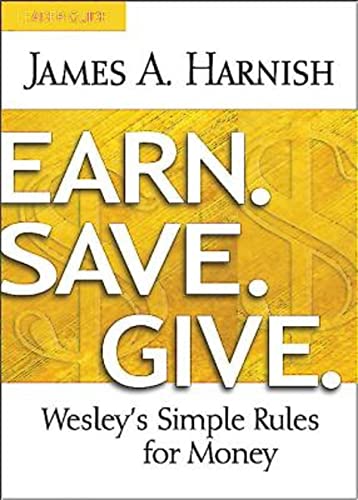
LONG: John Wesley boils fiscal responsibilities down to just three rules: Earn all you can. Save all you can. Give all you can. Sounds simple, right? Yes, but not easy, especially in today’s culture of consumerism. This twenty-first st century translation of Wesley’s money management philosophy will give everyone in your congregation—children and teenagers as well as adults of any age—a new way to think about money, not only during your stewardship program, but for the rest of their lives. Churchwide study guides, a leader guide, a DVD, and a Program Guide flash drive are available for this four-week program.
Die Inhaltsangabe kann sich auf eine andere Ausgabe dieses Titels beziehen.
Über die Autorin bzw. den Autor
James A. Harnish retired after 43 years of pastoral ministry in the Florida Annual Conference of the United Methodist Church. He was the founding pastor of St. Luke's United Methodist Church in Orlando and served for 22 years as the Senior Pastor of Hyde Park United Methodist Church in Tampa. He is the author of A Disciple's Heart: Growing in Love and Grace, Earn. Save. Give. Wesley's Simple Rules for Money, and Make a Difference: Following Your Passion and Finding Your Place to Serve. He was a consulting editor for The New Interpreter's Dictionary of the Bible and a contributor to The Wesley Study Bible. He and his wife, Martha, have two married daughters and five grandchildren in Florida and South Carolina.
Auszug. © Genehmigter Nachdruck. Alle Rechte vorbehalten.
Earn. Save. Give. Leader Guide
By James A. HarnishAbingdon Press
Copyright © 2015 Abingdon Press
All rights reserved.
ISBN: 978-1-63088-395-9All rights reserved.
Contents
To the Leader,
1. We Don't Need More Money; We Need Wisdom,
2. Earn All You Can,
3. Save All You Can,
4. Give All You Can,
Appendix: Just Do It! Plan for Saving All I Can,
Notes,
CHAPTER 1
We Don't Need More Money; We Need Wisdom
Planning the Session
Session Goals
As a result of conversations and activities connected with this session, group members should begin to:
• Reflect on biblical passages related to money and wisdom.
• Understand the meaning of both money and wisdom.
• Assess their relationships with money and wisdom.
• Explore John Wesley's teachings on the nature of money.
Biblical Foundation
Happy are those who find wisdom
and those who gain understanding.
Her profit is better than silver,
and her gain better than gold. (Proverbs 3:13-14)
Special Preparation
If group members are not familiar with one another, make nametags available.
Remember that there are more activities than most groups will have time to complete. As leader, you'll want to go over the session in advance and select or adapt the activities you think will work best for your group in the time allotted. Depending on which activities you select, you'll need to make some of the following special preparations.
• If possible in advance of the first session, ask participants to bring either a spiral-bound notebook or an electronic means of journaling, such as a tablet. Provide writing paper and pens for those who may need them. Also have a variety of Bibles available for those who do not bring one.
• Make sure all participants have a copy of the study book Earn. Save. Give. Invite them to read the Introduction and Chapter 1 in advance of the first session. You also should read this material.
• On a large sheet of paper or a board, print the following at the top: "Money is ..."
• On another sheet, print: "Wisdom is ..."
• Have available large sheets of blank paper or construction paper and colored markers for group activity.
• Depending on the size of your space, post some or all of the following Scripture references: 1 Kings 3:5-9; Proverbs 1:5-8; 2:6; 3:5, 7-10, 13-16; 4:7; 5:7; 8:23; 9:10; 11:15; 19:27; 23:19; Psalm 78:1-7; Matthew 6:33; Luke 16:8-9; 1 Timothy 6:10; James 1:5, 17.
Getting Started
Welcome
As participants arrive, welcome them to the study and invite them to make use of one of the available Bibles, if they did not bring one.
Opening Prayer
Gracious and Loving God, as we begin this study, open us to your presence and fill us—our time, our conversations, our reflections, our doubts, and our fears—with the joy of exploration and the wisdom of your love. We gather together in Jesus' name. Amen.
Opening Activities
When all participants have arrived, invite each person to introduce him- or herself by name and verbally complete one of the posted prompts ("Money is ..." or "Wisdom is ..."). When the circle is complete, invite general responses to each of the prompts and post them on the sheet or whiteboard. Participants may repeat their original response or add to it. Defining these terms provides a foundation and starting place for the study. Invite participants to add comments and new understandings to these definitions and lists during the weeks of the study.
If they have not already done so, invite group members to read the Introduction silently in the study book. Explore together:
• Author James A. Harnish suggests that money might be at the top of our lists if we could ask God for anything. Do you agree or disagree, and why?
• When you hear about the "wisdom of Solomon," what immediately comes to mind?
• Invite participants to read aloud 1 Kings 3:5-9 from at least three different translations. How do the various translations and paraphrases present Solomon's request in verse 9? (NRSV has "understanding mind"; NIV has "discerning heart"; CEB has "discerning mind"; The Message has "God-listening heart"; Good News has "wisdom.") Ask participants to describe the differences among these various phrases.
• Ask participants to read 1 Kings 3:11-14 aloud from various versions. Do you think the additional gifts to Solomon ("riches and honor" in NRSV; "wealth and fame" in CEB) are a blessing or curse? Why?
• Invite a volunteer to read the paragraph "Money Matters" in the Introduction. The author goes on to say that money matters for our souls and that wisdom is more valuable than money. Invite participants to respond to these ideas.
Learning Together
Video Study and Discussion
Pastor and author Jim Harnish introduces John Wesley—Christian theologian, evangelist, and founder of the Methodist movement—and Wesley's advice to "earn all you can, save all you can, give all you can." Harnish talks about the wisdom and challenges in that advice with three pastors: Justin Coleman, Judi Hoffman, and Erica Allen. Discuss:
• What are the biggest financial challenges faced by people in your community, church, and family? Give examples.
• How are those people coping with the challenges, and how can the church help?
• To the extent that you feel comfortable sharing, what are some examples of financial challenges, past or present, in your own life?
• What is your own experience regarding stewardship programs in churches?
Bible Study and Discussion
Throughout Chapter 1, the author examines biblical references to wisdom. Invite participants to form pairs. Each pair will take five minutes to read one of the following passages and share what it teaches about wisdom. It is unlikely that you will assign all the passages; assign at least the readings from Proverbs 2 and Matthew 7, and expand from there as your group size permits:
• Proverbs 1:5-8
• Proverbs 2:1-6
• Proverbs 3:5-10, 13-14
• Proverbs 9:7-10
• Matthew 6:19-21
• Matthew 6:25-33
• Matthew 7:24-29
• Matthew 24:45-51
• Philippians 4:12-13
• James 1:5-10
Invite the pairs back to the larger group to share insights from their conversations. If the group wants to add any new ideas or insights to the posted group "definition" of wisdom, invite participants to do so.
Book Study and Discussion
Money and Wisdom
In the opening section of Chapter 1, the author points to a commercial about "Stanley Johnson" and his relationship with money (consider viewing the brief video, which is available on YouTube; search for "Stanley Johnson commercial"). Harnish then shares some money-related concerns he encountered as a pastor.
In preparation for the conversation to follow about money and wisdom, ask participants to review Harnish's examples of money-related concerns ("As a pastor, I've seen ..." through the five bullet points) and consider how those examples relate to their own lives and their experiences with money. After a time of silent reflection, invite responses to one or more of the following questions:
• What is your happiest memory in connection with money?
• What is your...
„Über diesen Titel“ kann sich auf eine andere Ausgabe dieses Titels beziehen.
Weitere beliebte Ausgaben desselben Titels

Suchergebnisse für Earn Save Give Leader: Wesley's Simple Rules for...

Beispielbild für diese ISBN
Earn. Save. Give. Leader Guide: Wesley's Simple Rules for Money
Verlag:
Abingdon Press (edition Leaders Guide), 2015
ISBN 10: 1630883956
ISBN 13: 9781630883959
Gebraucht
Paperback
Anbieter: BooksRun, Philadelphia, PA, USA
Verkäuferbewertung 5 von 5 Sternen

Paperback. Zustand: Very Good. Leaders Guide. It's a well-cared-for item that has seen limited use. The item may show minor signs of wear. All the text is legible, with all pages included. It may have slight markings and/or highlighting. Artikel-Nr. 1630883956-11-1
Gebraucht kaufen
EUR 4,28
Versand gratis
Versand innerhalb von USA
Versand innerhalb von USA
Anzahl: 1 verfügbar
Beispielbild für diese ISBN
Earn. Save. Give. Leader Guide: Wesley's Simple Rules for Money
Anbieter: ThriftBooks-Atlanta, AUSTELL, GA, USA
Verkäuferbewertung 5 von 5 Sternen
Paperback. Zustand: Very Good. No Jacket. May have limited writing in cover pages. Pages are unmarked. ~ ThriftBooks: Read More, Spend Less. Artikel-Nr. G1630883956I4N00
Gebraucht kaufen
EUR 6,19
Versand gratis
Versand innerhalb von USA
Versand innerhalb von USA
Anzahl: 1 verfügbar
Beispielbild für diese ISBN
Earn. Save. Give. Leader Guide: Wesley's Simple Rules for Money
Anbieter: ThriftBooks-Dallas, Dallas, TX, USA
Verkäuferbewertung 5 von 5 Sternen
Paperback. Zustand: Very Good. No Jacket. May have limited writing in cover pages. Pages are unmarked. ~ ThriftBooks: Read More, Spend Less. Artikel-Nr. G1630883956I4N00
Gebraucht kaufen
EUR 6,19
Versand gratis
Versand innerhalb von USA
Versand innerhalb von USA
Anzahl: 1 verfügbar
Beispielbild für diese ISBN
Earn. Save. Give. Leader Guide : Wesley's Simple Rules for Money
Anbieter: Better World Books, Mishawaka, IN, USA
Verkäuferbewertung 5 von 5 Sternen
Zustand: Fine. Used book that is in almost brand-new condition. May contain a remainder mark. Better World Books: Buy Books. Do Good. Artikel-Nr. 56117781-6
Gebraucht kaufen
EUR 8,84
Versand gratis
Versand innerhalb von USA
Versand innerhalb von USA
Anzahl: 1 verfügbar
Beispielbild für diese ISBN
Earn, Save, Give: Wesley's Simple Rules for Money
Anbieter: Revaluation Books, Exeter, Vereinigtes Königreich
Verkäuferbewertung 5 von 5 Sternen
Paperback. Zustand: Brand New. ldg edition. 64 pages. 8.00x5.00x0.25 inches. In Stock. Artikel-Nr. x-1630883956
Neu kaufen
EUR 16,22
EUR 11,54 Versand
Versand von Vereinigtes Königreich nach USA
Versand von Vereinigtes Königreich nach USA
Anzahl: 2 verfügbar
Beispielbild für diese ISBN
Earn. Save. Give. Leader Guide: Wesley's Simple Rules for Money
Anbieter: Ria Christie Collections, Uxbridge, Vereinigtes Königreich
Verkäuferbewertung 5 von 5 Sternen
Zustand: New. In. Artikel-Nr. ria9781630883959_new
Neu kaufen
EUR 15,74
EUR 13,82 Versand
Versand von Vereinigtes Königreich nach USA
Versand von Vereinigtes Königreich nach USA
Anzahl: Mehr als 20 verfügbar
Foto des Verkäufers
Earn. Save. Give. Leader Guide: Wesley\ s Simple Rules for Money
Anbieter: moluna, Greven, Deutschland
Verkäuferbewertung 5 von 5 Sternen
Zustand: New. KlappentextA 3-Step Stewardship Program from John Wesley. Artikel-Nr. 596468671
Neu kaufen
EUR 21,64
EUR 48,99 Versand
Versand von Deutschland nach USA
Versand von Deutschland nach USA
Anzahl: Mehr als 20 verfügbar
Foto des Verkäufers
Earn. Save. Give. Leader Guide : Wesley's Simple Rules for Money
Anbieter: AHA-BUCH GmbH, Einbeck, Deutschland
Verkäuferbewertung 5 von 5 Sternen
Taschenbuch. Zustand: Neu. Neuware - John Wesley believed money was important as a way of expressing and living out Christian faith. To Wesley, the task was simple: earn all you can, save all you can, give all you can. In this essential little book, pastor and author James A. Harnish presents Wesley's concepts and beliefs in plain, useful language, suitable for individuals to grapple with and groups to discuss and act upon. This 64-page Leader Guide contains everything needed to guide a group through the small group study as part of the stewardship program. Includes session plans, discussion questions, and activities based on the book and DVD, as well as multiple format options. Artikel-Nr. 9781630883959
Neu kaufen
EUR 25,45
EUR 60,46 Versand
Versand von Deutschland nach USA
Versand von Deutschland nach USA
Anzahl: 2 verfügbar