
Verwandte Artikel zu Strong Heart, Sharp Mind: The 6-Step Brain-Body Balance...
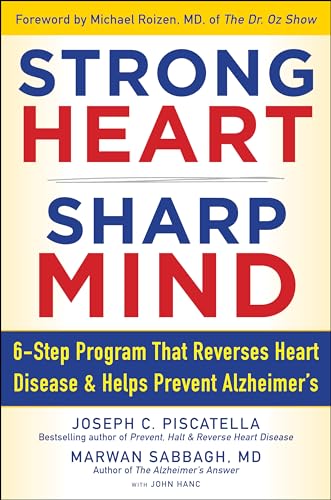
Strong Heart, Sharp Mind: The 6-Step Brain-Body Balance Program that Reverses Heart Disease and Helps Prevent Alzheimer’s with a Foreword by Dr. Michael F. Roizen - Hardcover
Inhaltsangabe
“[Piscatella and Sabbagh] show what’s good for keeping your heart pumping keeps your memories and passions alive. They give you a really great plan to follow. This book can help many and hopefully will help you and yours for years to come.” — From the Foreword by Michael Roizen, MD, Chief Medical Consultant for The Dr. Oz Show, and New York Times bestselling author
The science of why both heart and brain health are the key to wellness and longevity and ho w to cultivate a brain-body-balance to live a longer, healthier, and happier life.
Strong Heart, Sharp Mind: The 6-Step Brain-Body Balance Program that Reverses Heart Disease and Helps Prevent Alzheimer’s presents a cutting-edge, science-based program that teaches readers how to develop the habits and lifestyle practices that improve both heart and brain health. Readers will learn how they can prevent or forestall both the nation’s number-one killer–heart disease–as well as the affliction Americans fear most: Alzheimer’s disease. For the 108 million Americans 50 and over, creating what the authors call the “BRAIN-BODY-BALANCE” through the steps detailed in these pages can also improve quality of life and longevity, by synchronizing the interaction between our two most vital organs.
Joseph C. Piscatella, nationally-known, bestselling speaker and author of countless heart health books, and one of the longest-living survivors of coronary bypass surgery (43 years and counting!) and Cleveland Clinic neurologist Marwan Noel Sabbagh, M.D., one of the world’s foremost researchers in the fight against Alzheimer’s, employ the latest science and recommendations from other leading-edge thinkers and practitioners, to help readers optimize the connection between cardiac and neuro health—a nexus that until recently has been overlooked as a key to wellness and longevity. Together, "No Ordinary Joe" Piscatella and Dr. Sabbagh are poised to guide readers to this new intersection of heart-brain health, and take them through the necessary steps to make that connection between our most vital organs, for optimal wellness—and to protect them against the world's most lethal and feared diseases.
STRONG HEART, SHARP MIND blends science and solution in the form of a new, singular heart/brain-specific program and takes readers through the steps necessary to optimal wellness and a longer, happier life.
Die Inhaltsangabe kann sich auf eine andere Ausgabe dieses Titels beziehen.
Über die Autorinnen und Autoren
Joseph C. Piscatella is one of the country’s most respected experts on how to live a healthy lifestyle. As the author of 16 books – including mega-bestseller Don’t Eat Your Heart Out – host of three PBS television programs on heart health, a "Guest Expert" on WebMD, and a member of the NIH Expert Panel on Cardiac Rehabilitation, Joe presents the latest science on diet, exercise, stress and attitude. Joe also designs and facilitates the popular 6 Weeks to a HealthierYou ®, a popular community wellness program that is nationally recognized as one of the most effective population intervention programs for creating healthy habits. A popular speaker to corporate, association, medical and dental groups, over 2 million people have attended Joe’s programs. Joe's personal experience of coronary bypass surgery at age 32 gives him a practical perspective that audiences value. The prognosis at the time of surgery was that he would not live to age 40. Today, because of healthy lifestyle changes, he is 43 years post-surgery. What he did and how he did it are central to his writings and presentations. He uses the art of storytelling, contagious humor and decades of experience to help audiences remember the information and advice. Joe lives his message. He lives & works in the Seattle-Tacoma metro area. https://www.joepiscatella.com/
Dr. Marwan Noel Sabbagh, M.D. is a board certified neurologist and geriatric neurologist, and considered one of the leading experts in Alzheimer’s and dementia. Dr. Sabbagh is the Camille and Larry Ruvo Endowed Chair for Brain Health, Director of Cleveland Clinic Lou Ruvo Center for Brain Health in Las Vegas, on the editorial board for Journal of Alzheimer’s Disease and BMC Neurology and editor in chief of Neurology and Therapy. A leading investigator for many prominent national Alzheimer’s prevention and treatment trials, Dr. Sabbagh has authored and co-authored more than 320 medical and scientific articles on Alzheimer’s research. Dr. Sabbagh earned his undergraduate degree from the University of California, Berkeley and his medical degree from the University of Arizona in Tucson. He received his residency training in neurology at Baylor College of Medicine, Houston, Texas, and completed his fellowship in geriatric neurology and dementia at the University of California, San Diego School of Medicine, where he served on the faculty as assistant professor. Before joining the faculty of the Barrow Neurological Institute where he served for three years, Dr. Sabbagh was with the Banner Sun Health Research Institute for 15 years. Dr. Sabbagh is the author of The Alzheimer’s Answer: Reduce Your Risk and Keep Your Brain Healthy, with foreword by Justice Sandra Day O’Connor, and of The Alzheimer’s Prevention Cookbook: 100 Recipes to Boost Brain Health, and he has edited Palliative Care for Advanced Alzheimer’s and Dementia: Guidelines and Standards for Evidence Based Care and Geriatric Neurology. He has been recognized with numerous awards, including WestMarc Innovator Award, 2015; Fellow of the American Academy of Neurology, 2004; Arizona Business Journal, Healthcare Hero Finalist, 2004; Peter F Drucker Award co-recipient, 1998; and Travel Fellowship Award recipient, American Neurological Association, 1996. Dr. Sabbagh has dedicated his career to finding a cure for Alzheimer’s and other age-related neurodegenerative diseases and hopes to work himself out of a job. He lives & works in the Las Vegas metro area.
Dr. Michael Roizen M.D. is the Chief Wellness Officer ermitus at the Cleveland Clinic, Chief Medical Consultant on The Dr. Oz Show, author of four #1 New York Times best-selling books—and nine (9!) New York Times bestselling books total—and originator of the popular RealAge.com. He is board certified in anesthesiology and internal medicine and he is a Phi Beta Kappa graduate of Williams College and Alpha Omega Alpha honor society from University of California, San Francisco School of Medicine. Dr. Roizen been recognized with an Ellie, an Emmy, and the Paul G. Rogers Award from the National Library of Medicine for Best Medical Communicator. He also chaired an FDA advisory committee, served 16 years on U.S. Food and Drug Administration advisory committees and has published more than 188 peer-reviewed articles. Dr. Roizen is devoted to helping people live younger. https://www.sharecare.com/static/realage
John Hanc is a New York-based author, journalist, educator and runner, whose 14 books cover a wide range of topics, but usually involve people who do extraordinary, inspiring and sometimes crazy things. Among them are the award-winning memoirs The Coolest Race on Earth, about Hanc's participation in the Antarctica Marathon; Not Dead Yet, about Phil Southerland, a Type 1 diabetic and professional bike racer, and the founder of Team Type 1; and The Ultra Mindset, co-authored with champion ultra-endurance athlete Travis Macy. Hanc is a long-time contributor to Newsday, a frequent contributor to the New York Times and Smithsonian magazine's digital edition, and a contributing editor to Runner's World magazine. Over the years, his work has appeared in many other publications, extant and departed. For more information, visit his website www.johnhanc.com
Auszug. © Genehmigter Nachdruck. Alle Rechte vorbehalten.
Chapter 5: Functional Fitness for Heart-Brain Health to STRONG HEART, SHARP MIND: The 6-Step Brain-Body Balance Program that Reverses Heart Disease and Helps Prevent Alzheimer’s by Joseph C. Piscatella and Marwan Noel Sabbagh, M.D., with a Foreword by Michael F. Roizen, M.D.
In this chapter we discuss the importance of physical for heart health (something many people are aware of); its value in brain health (a fact that many may not realize); and—using new prescriptive material, including a regimen of neuro-cardio exercises that even many fitness professionals are not yet incorporating—its significance in promoting the nexus that this book examines, heart and brain health.
*****
In 2008, the federal government issued the first national guidelines for physical activity.
Some might joke that they were only 12,000 years late.
Humans have been physically active since our species first worked up an appetite. The hunter-gatherers we are descended from were engineered for movement. In a fascinating 2012 paper, neuroscientist Mark P. Mattson listed the many ways that this is so, including our long, elastic leg tendons, our sweat glands and sparse body hair, our swivel hips. And—of particular relevance to this book—our advanced cognitive capabilities, which suggest a brain-heart connection that helped distinguish humans from other species—and which we contend in this book is now being recognized as a critical nexus of human health.
All of these factors helped make us, quite literally, born to run—or at least walk briskly—over long distances. And because we were able to do that, starting about two million years ago and continuing through the end of the hunter-gatherer period, it could be argued that we were eventually able to create civilization.
Early humans didn't need to be told to keep track of their distance in miles, minutes or steps. And their sojourns weren't just in the pursuit of game. Researchers have speculated that a natural cycle of regular activity, intense and moderate, was likely the norm for most of human existence: one or two days of vigorous and strenuous exertion in the hunt for food. punctuated by one or two days of less intense activity, which might have included long walks to nearby villages or to trade with other clans and communities.
This activity pattern—episodes of vigorous and moderate exertion, accumulated throughout the day—is not dissimilar to the recommendations made in the modern guidelines.
And that's the important point here: The onus on physical activity and exercise, the contemporary fitness culture of marathon running, CrossFit gyms or Peloton bikes, may seem like a fad, but it's essentially a return to the kind of natural activity that our mind and bodies have been developed for— something that, like language and emotions, is a critical part of what it is to be human.
The Centers for Disease Control and Prevention said as much, in a white paper on physical activity in 1999. "Viewed through the perspective of evolutionary time, sedentary existence, possible for great numbers of people only during the last century, represents a transient, unnatural aberration."
In other words, we need to stop thinking about physical activity as something strange, new and uncomfortable—some kind of castor oil we are being forced to take by people in white lab coats. Rather, we should view it as something that is an inherent part of who we are, a skill or talent you never realized you had. And regardless of how fast or slow your ability to walk, you do have this ability. We all do. We've just made it easy for ourselves to forget that by relying on machines to do what our legs or lungs used to accomplish for us.
Of course, no one is suggesting we go back to being hunter-gatherers. So how do we reconnect with the patterns of exercise that are intrinsic to us as humans and accrue the enormous physical and (yes) mental health benefits of exercise?
That's what we will show you in this chapter. And we will go beyond the conventional wisdom that you may have heard. We'll show you why physical activity is good for both your heart and your brain—including some interesting new aspects of the fitness equation that can have profound effects on both.
Perhaps most importantly, we'll also show you how you can start incorporating this into your life and how, in tandem with other essential components of brain/heart health, physical activity, you can lower your risk of getting both heart disease and Alzheimer's disease (not to mention many other afflictions) and significantly improve the quality of your life.
*****
The 2008 guidelines, released by the Health and Human Services Department, were updated in 2018 to reflect the latest thinking. The basics, however, are still the same. Here's what they advise:
For health benefits, adults should do at least 150 minutes (2 hours, 30 minutes) a week of moderate-intensity activity or 75 minutes (1 hour, 15 minutes) a week of vigorous-intensity aerobic activity.
It's further recommended that adults should perform muscle-strengthening activities—exercises involve all major muscles groups—two times a week. Older adults should also include balance training.
We'll talk about all of this—and more. But let's underscore some of the guideline's other key points:
Adults should move more and sit less throughout the day: At this writing, many of us have spent weeks indoors because of the COVID-19 epidemic. While necessary to stop the spread, some public-health officials also reminded citizens to get out regularly for socially distanced exercise, even during the lockdown. They knew that long periods of sitting could create its own, slow-burning health crisis. (As one wag put it, “Television can be a weapon of mass destruction." The same could probably be said of the cell phone, the internet and social media!)
Some physical activity is better than none: Many people still think the only way exercise is going to be effective is if it's long, sustained, and intense. Go out and run or cycle or swim as hard as you can for as long as you can. When you drop to your hands and knees at the finish line, gasping for air, you've done what you're supposed to.
No!
That old no-pain, no-gain guideline is a recipe for how to quit or avoid exercising. While vigorous exercise has great value, research over the last few decades has really opened our eyes about the value of what could be called "small" exercise—moderate intensity, shorter duration, especially for those just starting out.
Got a Minute to Take Some Important Steps for Your Health?
Epidemiologist Steve Blair, professor emeritus at the University of South Carolina and the former president of the Cooper Institute for Aerobics Research, was a pioneer in establishing the value of short bouts of moderate-intensity activity. Dr. Blair has spoken about the Power of the Two Minute Walk, which he uses as a rejoinder to those who claim they don't have time for exercise. While two minutes is not sufficient to meet the guidelines, it is enough to surmount the largest hurdle facing most of us, when it comes to exercise: simply getting started.
Oh, and just by doing that two-minute walk—okay, maybe a couple times a day—you're already accruing some basic health benefits.
Dr. Blair and the national guidelines talk about minutes, but today many people like to count steps, on a pedometer or an app on their phone. A review of studies in the journal Medicine & Science in Sports & Exercise found that about...
„Über diesen Titel“ kann sich auf eine andere Ausgabe dieses Titels beziehen.
Suchergebnisse für Strong Heart, Sharp Mind: The 6-Step Brain-Body Balance...

Beispielbild für diese ISBN
STRONG HEART, SHARP MIND: The 6-Step Brain-Body Balance Program that Reverses Heart Disease and Helps Prevent Alzheimer?s
Anbieter: World of Books (was SecondSale), Montgomery, IL, USA
Verkäuferbewertung 5 von 5 Sternen

Hardback. Zustand: Very Good. ?[Piscatella and Sabbagh] show what?s good for keeping your heart pumping keeps your memories and passions alive. They give you a really great plan to follow. This book can help many and hopefully will help you and yours for years to come.? ? From the Foreword by Michael Roizen, MD, Chief Medical Consultant for The Dr. Oz Show, and New York Times bestselling authorThe science of why both heart and brain health are the key to wellness and longevity and ho w to cultivate a brain-body-balance to live a longer, healthier, and happier life. Strong Heart, Sharp Mind: The 6-Step Brain-Body Balance Program that Reverses Heart Disease and Helps Prevent Alzheimer?s presents a cutting-edge, science-based program that teaches readers how to develop the habits and lifestyle practices that improve both heart and brain health. Readers will learn how they can prevent or forestall both the nation?s number-one killer?heart disease?as well as the affliction Americans fear most: Alzheimer?s disease. For the 108 million Americans 50 and over, creating what the authors call the ?BRAIN-BODY-BALANCE? through the steps detailed in these pages can also improve quality of life and longevity, by synchronizing the interaction between our two most vital organs.Joseph C. Piscatella, nationally-known, bestselling speaker and author of countless heart health books, and one of the longest-living survivors of coronary bypass surgery (43 years and counting!) and Cleveland Clinic neurologist Marwan Noel Sabbagh, M.D., one of the world?s foremost researchers in the fight against Alzheimer?s, employ the latest science and recommendations from other leading-edge thinkers and practitioners, to help readers optimize the connection between cardiac and neuro health?a nexus that until recently has been overlooked as a key to wellness and longevity. Together, "No Ordinary Joe" Piscatella and Dr. Sabbagh are poised to guide readers to this new intersection of heart-brain health, and take them through the necessary steps to make that connection between our most vital organs, for optimal wellness?and to protect them against the world's most lethal and feared diseases.STRONG HEART, SHARP MIND blends science and solution in the form of a new, singular heart/brain-specific program and takes readers through the steps necessary to optimal wellness and a longer, happier life. Artikel-Nr. 00104454416
Gebraucht kaufen
EUR 4,04
Versand gratis
Versand innerhalb von USA
Versand innerhalb von USA
Anzahl: 2 verfügbar
Beispielbild für diese ISBN
STRONG HEART, SHARP MIND: The 6-Step Brain-Body Balance Program that Reverses Heart Disease and Helps Prevent Alzheimer?s
Anbieter: World of Books (was SecondSale), Montgomery, IL, USA
Verkäuferbewertung 5 von 5 Sternen
Hardback. Zustand: Good. ?[Piscatella and Sabbagh] show what?s good for keeping your heart pumping keeps your memories and passions alive. They give you a really great plan to follow. This book can help many and hopefully will help you and yours for years to come.? ? From the Foreword by Michael Roizen, MD, Chief Medical Consultant for The Dr. Oz Show, and New York Times bestselling authorThe science of why both heart and brain health are the key to wellness and longevity and ho w to cultivate a brain-body-balance to live a longer, healthier, and happier life. Strong Heart, Sharp Mind: The 6-Step Brain-Body Balance Program that Reverses Heart Disease and Helps Prevent Alzheimer?s presents a cutting-edge, science-based program that teaches readers how to develop the habits and lifestyle practices that improve both heart and brain health. Readers will learn how they can prevent or forestall both the nation?s number-one killer?heart disease?as well as the affliction Americans fear most: Alzheimer?s disease. For the 108 million Americans 50 and over, creating what the authors call the ?BRAIN-BODY-BALANCE? through the steps detailed in these pages can also improve quality of life and longevity, by synchronizing the interaction between our two most vital organs.Joseph C. Piscatella, nationally-known, bestselling speaker and author of countless heart health books, and one of the longest-living survivors of coronary bypass surgery (43 years and counting!) and Cleveland Clinic neurologist Marwan Noel Sabbagh, M.D., one of the world?s foremost researchers in the fight against Alzheimer?s, employ the latest science and recommendations from other leading-edge thinkers and practitioners, to help readers optimize the connection between cardiac and neuro health?a nexus that until recently has been overlooked as a key to wellness and longevity. Together, "No Ordinary Joe" Piscatella and Dr. Sabbagh are poised to guide readers to this new intersection of heart-brain health, and take them through the necessary steps to make that connection between our most vital organs, for optimal wellness?and to protect them against the world's most lethal and feared diseases.STRONG HEART, SHARP MIND blends science and solution in the form of a new, singular heart/brain-specific program and takes readers through the steps necessary to optimal wellness and a longer, happier life. Artikel-Nr. 00105092617
Gebraucht kaufen
EUR 4,04
Versand gratis
Versand innerhalb von USA
Versand innerhalb von USA
Anzahl: 5 verfügbar
Beispielbild für diese ISBN
Strong Heart, Sharp Mind: The 6-Step Brain-Body Balance Program That Reverses Heart Disease and Helps Prevent Alzheimer's with a Foreword by Dr. Micha
Anbieter: ThriftBooks-Dallas, Dallas, TX, USA
Verkäuferbewertung 5 von 5 Sternen
Hardcover. Zustand: Very Good. No Jacket. Former library book; May have limited writing in cover pages. Pages are unmarked. ~ ThriftBooks: Read More, Spend Less. Artikel-Nr. G163006193XI4N10
Gebraucht kaufen
EUR 5,97
Versand gratis
Versand innerhalb von USA
Versand innerhalb von USA
Anzahl: 1 verfügbar
Beispielbild für diese ISBN
Strong Heart, Sharp Mind: The 6-Step Brain-Body Balance Program That Reverses Heart Disease and Helps Prevent Alzheimer's with a Foreword by Dr. Micha
Anbieter: ThriftBooks-Atlanta, AUSTELL, GA, USA
Verkäuferbewertung 5 von 5 Sternen
Hardcover. Zustand: Very Good. No Jacket. Former library book; May have limited writing in cover pages. Pages are unmarked. ~ ThriftBooks: Read More, Spend Less. Artikel-Nr. G163006193XI4N10
Gebraucht kaufen
EUR 5,97
Versand gratis
Versand innerhalb von USA
Versand innerhalb von USA
Anzahl: 1 verfügbar
Beispielbild für diese ISBN
Strong Heart, Sharp Mind: The 6-Step Brain-Body Balance Program That Reverses Heart Disease and Helps Prevent Alzheimer's with a Foreword by Dr. Micha
Anbieter: ThriftBooks-Dallas, Dallas, TX, USA
Verkäuferbewertung 5 von 5 Sternen
Hardcover. Zustand: Very Good. No Jacket. May have limited writing in cover pages. Pages are unmarked. ~ ThriftBooks: Read More, Spend Less. Artikel-Nr. G163006193XI4N00
Gebraucht kaufen
EUR 5,97
Versand gratis
Versand innerhalb von USA
Versand innerhalb von USA
Anzahl: 1 verfügbar
Beispielbild für diese ISBN
Strong Heart, Sharp Mind: The 6-Step Brain-Body Balance Program That Reverses Heart Disease and Helps Prevent Alzheimer's with a Foreword by Dr. Micha
Anbieter: ThriftBooks-Atlanta, AUSTELL, GA, USA
Verkäuferbewertung 5 von 5 Sternen
Hardcover. Zustand: Very Good. No Jacket. May have limited writing in cover pages. Pages are unmarked. ~ ThriftBooks: Read More, Spend Less. Artikel-Nr. G163006193XI4N00
Gebraucht kaufen
EUR 5,97
Versand gratis
Versand innerhalb von USA
Versand innerhalb von USA
Anzahl: 1 verfügbar
Beispielbild für diese ISBN
Strong Heart, Sharp Mind: The 6-Step Brain-Body Balance Program that Reverses Heart Disease and Helps Prevent Alzheimerâs with a Foreword by Dr. Michael F. Roizen
Verlag:
Humanix Books (edition ), 2022
ISBN 10: 163006193X
ISBN 13: 9781630061937
Gebraucht
Hardcover
Anbieter: BooksRun, Philadelphia, PA, USA
Verkäuferbewertung 5 von 5 Sternen
Hardcover. Zustand: Very Good. With dust jacket. It's a well-cared-for item that has seen limited use. The item may show minor signs of wear. All the text is legible, with all pages included. It may have slight markings and/or highlighting. Artikel-Nr. 163006193X-11-1-29
Gebraucht kaufen
EUR 6,37
Versand gratis
Versand innerhalb von USA
Versand innerhalb von USA
Anzahl: 1 verfügbar
Beispielbild für diese ISBN
Strong Heart, Sharp Mind : The 6-Step Brain-Body Balance Program That Reverses Heart Disease and Helps Prevent Alzheimer's with a Foreword by Dr. Michael F. Roizen
Anbieter: Better World Books, Mishawaka, IN, USA
Verkäuferbewertung 5 von 5 Sternen
Zustand: Good. Pages intact with minimal writing/highlighting. The binding may be loose and creased. Dust jackets/supplements are not included. Stock photo provided. Product includes identifying sticker. Better World Books: Buy Books. Do Good. Artikel-Nr. 45143129-6
Gebraucht kaufen
EUR 6,73
Versand gratis
Versand innerhalb von USA
Versand innerhalb von USA
Anzahl: 2 verfügbar
Beispielbild für diese ISBN
Strong Heart, Sharp Mind : The 6-Step Brain-Body Balance Program That Reverses Heart Disease and Helps Prevent Alzheimer's with a Foreword by Dr. Michael F. Roizen
Anbieter: Better World Books, Mishawaka, IN, USA
Verkäuferbewertung 5 von 5 Sternen
Zustand: Good. Former library copy. Pages intact with minimal writing/highlighting. The binding may be loose and creased. Dust jackets/supplements are not included. Includes library markings. Stock photo provided. Product includes identifying sticker. Better World Books: Buy Books. Do Good. Artikel-Nr. 41909968-6
Gebraucht kaufen
EUR 6,73
Versand gratis
Versand innerhalb von USA
Versand innerhalb von USA
Anzahl: 1 verfügbar
Beispielbild für diese ISBN
Strong Heart, Sharp Mind : The 6-Step Brain-Body Balance Program That Reverses Heart Disease and Helps Prevent Alzheimer's with a Foreword by Dr. Michael F. Roizen
Anbieter: Better World Books, Mishawaka, IN, USA
Verkäuferbewertung 5 von 5 Sternen
Zustand: Fine. Used book that is in almost brand-new condition. May contain a remainder mark. Better World Books: Buy Books. Do Good. Artikel-Nr. 52309048-6
Gebraucht kaufen
EUR 6,73
Versand gratis
Versand innerhalb von USA
Versand innerhalb von USA
Anzahl: 1 verfügbar