
Verwandte Artikel zu The Shift: The Next Evolution in Baseball Thinking
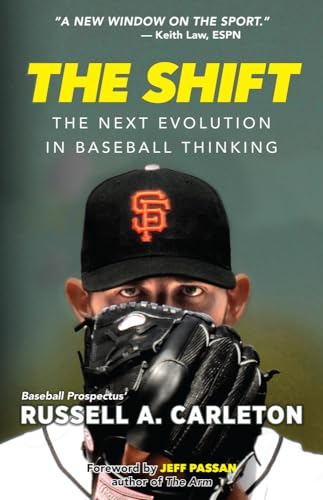
Inhaltsangabe
With its three-hour-long contests, 162-game seasons, and countless measurable variables, baseball is a sport which lends itself to self-reflection and obsessive analysis. It's a thinking game. It's also a shifting game. Nowhere is this more evident than in the statistical revolution which has swept through the pastime in recent years, bringing metrics like WAR, OPS, and BABIP into front offices and living rooms alike. So what's on the horizon for a game that is constantly evolving?
Positioned at the crossroads of sabermetrics and cognitive science, The Shift alters the trajectory of both traditional and analytics-based baseball thought. With a background in clinical psychology as well as experience in major league front offices, Baseball Prospectus' Russell Carleton illuminates advanced statistics and challenges cultural assumptions, demonstrating along the way that data and logic need not be at odds with the human elements of baseball—in fact, they're inextricably intertwined.
Covering topics ranging from infield shifts to paradigm shifts, Carleton writes with verve, honesty, and an engaging style, inviting all those who love the game to examine it deeply and maybe a little differently. Data becomes digestible; intangibles are rendered not only accessible, but quantifiable. Casual fans and statheads alike will not want to miss this compelling meditation on what makes baseball tick.
Die Inhaltsangabe kann sich auf eine andere Ausgabe dieses Titels beziehen.
Über die Autorin bzw. den Autor
Russell Carleton is a baseball writer, researcher, and fan, living in Atlanta. He has been a regular contributor to Baseball Prospectus since 2009, writing about advanced statistical analysis in baseball, with an emphasis on the gory mathematical details. He holds a Ph.D. in clinical psychology from DePaul University in Chicago, and has provided statistical consultation to several teams in Major League Baseball. Jeff Passan is a baseball columnist at Yahoo! Sports and author of the New York Times Bestseller The Arm: Inside the Billion-Dollar Mystery of the Most Valuable Commodity in Sports.
Auszug. © Genehmigter Nachdruck. Alle Rechte vorbehalten.
The Shift
The Next Evolution in Baseball Thinking
By Russell A. CarletonTriumph Books LLC
Copyright © 2018 Russell A. Carleton
All rights reserved.
ISBN: 978-1-62937-544-1All rights reserved.
Contents
Foreword by Jeff Passan,
Introduction: Rule 1,
1. The Most Dangerous Thing in the World,
2. How to Score Half a Run,
3. Why Does It Feel So Icky?,
4. The-Perfect-Team,
5. Why Didn't David Ortiz Just Bunt?,
6. This Isn't a Babysitter's Club,
7. Nitrogen and the Forgotten Fourth Starter,
8. Putting Down the Calculator,
9. Did You Say "Guessing"?,
10. Except That It's Not Actually True ...,
11. Dénouement,
Acknowledgments,
CHAPTER 1
The Most Dangerous Thing in the World
When I was in high school, there was a quiz-bowl show on one of the local TV stations, which was hosted by the weatherman for their evening newscast. During my senior year, my high school was invited to send a team to compete on the show. I was the captain of that team. It was the closest I ever got to being varsity anything. Like any team, we felt the need to practice our craft, so we met a couple of days a week after school in Brother Dave's classroom and we watched old episodes of the show. It seemed like the thing to do. This was a show about trivia questions, so we sat around answering trivia questions. Cross-country runners ran around the neighborhood together. Chess-club members played chess against each other. I tried to be faster than my friends at remembering the chemical symbol for lead.
The show always started out with a rapid-fire round where Weatherman Guy asked 10 "buzz in to be called on" questions to the three teams on the stage. The game alternated between these rapid-play lightning rounds and more relaxed rounds in which each team got a chance to answer questions with no competition, but in the lightning rounds, every question that one team answered was a question that the other teams couldn't. At the end of the show, the winning team got to shake hands with Weatherman Guy, and maybe they got a spot in the playoffs.
The TV station taped a couple dozen episodes over the course of a year, so that a bunch of schools from the greater Cleveland area could have their one shining moment. According to the rules, the nine schools that scored the most points during these preliminary matches earned a playoff spot. Looking back, it probably meant that getting into the playoffs had more to do with the quality of the competition, rather than a team's own smarts, but that wasn't the way I thought of it at the time. On the day of taping for our preliminary round, I got on that stage, listened to Weatherman Guy ask questions, and hit that buzzer just like we practiced. We won! Not to brag, but we also finished with the seventh most points overall for that year. Turns out that knowing random pieces of information could take you places in Cleveland. We were headed to the playoffs!
A few weeks later, that first playoff match went according to the plan. Weatherman Guy asked us about minutiae. We buzzed in. We got it right. We squashed the other two teams. After our victory, I was exhausted, but pleased with the thought that at some point in the future, we'd be coming back down to Channel 5 to tape the final. What I didn't know was that "some point in the future" was scheduled for 10 minutes later. The station wanted to tape all the playoff shows in the same day. It seemed that Weatherman Guy had other plans for next weekend.
Despite the exhaustion, this is what we had practiced for, and adrenaline started kicking in. How often does one have the chance to win a championship in anything, even if it was the nerdiest thing possible? We got situated and the camera operators pointed their cameras at us. Weatherman Guy did his "Welcome to the show ..." introduction that I was now hearing for the second time that day and informed us that the opening round of questions would be about geography. He would say the name of a famous landmark, and we had to identify the country in which it was located.
"Let's get started."
I was ready for this. Our team had already won twice. We were good. We were going to win this one too.
That's when things ran off the rails. Before Weatherman Guy even started asking the first question, someone from one of the other schools rang the buzzer. I knew we were going up against some smart people, but how could someone know the answer before Weatherman Guy had even said anything? That's when it happened. Weatherman Guy still read out the name of the landmark, because even if it was technically a quiz bowl, it was also a television show, and the people who would eventually watch this at home needed to hear the question. Because the other team had technically buzzed in first, they got the chance to answer.
Hang on a second ...
As soon as Weatherman Guy said "correct," I could again hear the sound of buzzer buttons being speed-pounded from the other two podiums, again all before Weatherman Guy even said anything. It took me until the fourth or fifth of these cycles until I realized what the other two teams were doing. To each side of the stage, there was a screen on which they showed the name of the landmark that Weatherman Guy was about to read, in text form. (It was also on the screen for the viewers at home.) As soon as the question appeared on the screen, the buzzer system went live. At that point, it was open season on those big red buttons. It still took a couple of seconds for Weatherman Guy to breathe in, read out the name of the landmark for the viewers at home, then look up to see which team's light was lit. That gave them enough time to formulate a response and have it ready when Weatherman Guy asked for it. The rest was a race to hit the button first.
We got wiped off the stage. I had practiced for a game in which there was a certain cadence of politeness. In the social norms that I grew up with, you didn't interrupt someone before they were done (or before they even started) talking. A quiz show was supposed to be about recalling pointless, but poignant, facts. Buzzing in was supposed to be the indicator that the buzzee had found the answer in their cerebral rolodex. Recall came first, then buzzing. For most of the half hour that we were on that stage, I couldn't move past those unwritten rules even when I realized that the other teams were gaming the system and racking up points because of it. It felt like I'd be breaking an honor code to copy their plan. Unfortunately, the scoreboard didn't care how I felt.
There was never actually a rule that said that we were required to wait for Weatherman Guy to finish — or even start — his sentence or that we had to know the answer before buzzing in. In fact, as part of his opening monologue, Weatherman Guy said that "the team that buzzes in first and gives the correct answer will get the points." The other teams had realized that buzzing in quickly was more important than figuring out the answer quickly. As long as someone on the team was able to pull up the answer within the three seconds that it took for the host to demand it, being a 10 of a second faster on recall than the other team didn't actually matter. In some sense, the other teams won the game before it even started. They didn't ask how the game had traditionally been played. They found a place where the rules were silent and an unenforceable social norm had filled in the gap. Then they found a way to exploit it to their advantage. I had spent my time solving one question —...
„Über diesen Titel“ kann sich auf eine andere Ausgabe dieses Titels beziehen.
Suchergebnisse für The Shift: The Next Evolution in Baseball Thinking

Beispielbild für diese ISBN
The Shift: The Next Evolution in Baseball Thinking
Anbieter: World of Books (was SecondSale), Montgomery, IL, USA
Verkäuferbewertung 5 von 5 Sternen

Paperback. Zustand: Very Good. With its three-hour-long contests, 162-game seasons, and countless measurable variables, baseball is a sport which lends itself to self-reflection and obsessive analysis. It's a thinking game. It's also a shifting game. Nowhere is this more evident than in the statistical revolution which has swept through the pastime in recent years, bringing metrics like WAR, OPS, and BABIP into front offices and living rooms alike. So what's on the horizon for a game that is constantly evolving? Positioned at the crossroads of sabermetrics and cognitive science, The Shift alters the trajectory of both traditional and analytics-based baseball thought. With a background in clinical psychology as well as experience in major league front offices, Baseball Prospectus' Russell Carleton illuminates advanced statistics and challenges cultural assumptions, demonstrating along the way that data and logic need not be at odds with the human elements of baseball--in fact, they're inextricably intertwined. Covering topics ranging from infield shifts to paradigm shifts, Carleton writes with verve, honesty, and an engaging style, inviting all those who love the game to examine it deeply and maybe a little differently. Data becomes digestib≤ intangibles are rendered not only accessible, but quantifiable. Casual fans and statheads alike will not want to miss this compelling meditation on what makes baseball tick. Artikel-Nr. 00105610495
Gebraucht kaufen
EUR 5,41
Versand gratis
Versand innerhalb von USA
Versand innerhalb von USA
Anzahl: 1 verfügbar
Beispielbild für diese ISBN
The Shift: The Next Evolution in Baseball Thinking
Anbieter: World of Books (was SecondSale), Montgomery, IL, USA
Verkäuferbewertung 5 von 5 Sternen
Paperback. Zustand: Good. With its three-hour-long contests, 162-game seasons, and countless measurable variables, baseball is a sport which lends itself to self-reflection and obsessive analysis. It's a thinking game. It's also a shifting game. Nowhere is this more evident than in the statistical revolution which has swept through the pastime in recent years, bringing metrics like WAR, OPS, and BABIP into front offices and living rooms alike. So what's on the horizon for a game that is constantly evolving? Positioned at the crossroads of sabermetrics and cognitive science, The Shift alters the trajectory of both traditional and analytics-based baseball thought. With a background in clinical psychology as well as experience in major league front offices, Baseball Prospectus' Russell Carleton illuminates advanced statistics and challenges cultural assumptions, demonstrating along the way that data and logic need not be at odds with the human elements of baseball--in fact, they're inextricably intertwined. Covering topics ranging from infield shifts to paradigm shifts, Carleton writes with verve, honesty, and an engaging style, inviting all those who love the game to examine it deeply and maybe a little differently. Data becomes digestib≤ intangibles are rendered not only accessible, but quantifiable. Casual fans and statheads alike will not want to miss this compelling meditation on what makes baseball tick. Artikel-Nr. 00101629884
Gebraucht kaufen
EUR 5,41
Versand gratis
Versand innerhalb von USA
Versand innerhalb von USA
Anzahl: 5 verfügbar
Beispielbild für diese ISBN
The Shift: The Next Evolution in Baseball Thinking
Anbieter: ThriftBooks-Phoenix, Phoenix, AZ, USA
Verkäuferbewertung 5 von 5 Sternen
Paperback. Zustand: Very Good. No Jacket. May have limited writing in cover pages. Pages are unmarked. ~ ThriftBooks: Read More, Spend Less. Artikel-Nr. G1629375446I4N00
Gebraucht kaufen
EUR 5,90
Versand gratis
Versand innerhalb von USA
Versand innerhalb von USA
Anzahl: 1 verfügbar
Beispielbild für diese ISBN
The Shift: The Next Evolution in Baseball Thinking
Anbieter: ThriftBooks-Atlanta, AUSTELL, GA, USA
Verkäuferbewertung 5 von 5 Sternen
Paperback. Zustand: Very Good. No Jacket. Former library book; May have limited writing in cover pages. Pages are unmarked. ~ ThriftBooks: Read More, Spend Less. Artikel-Nr. G1629375446I4N10
Gebraucht kaufen
EUR 5,92
Versand gratis
Versand innerhalb von USA
Versand innerhalb von USA
Anzahl: 1 verfügbar
Beispielbild für diese ISBN
The Shift: The Next Evolution in Baseball Thinking
Anbieter: ThriftBooks-Dallas, Dallas, TX, USA
Verkäuferbewertung 5 von 5 Sternen
Paperback. Zustand: Very Good. No Jacket. May have limited writing in cover pages. Pages are unmarked. ~ ThriftBooks: Read More, Spend Less. Artikel-Nr. G1629375446I4N00
Gebraucht kaufen
EUR 5,92
Versand gratis
Versand innerhalb von USA
Versand innerhalb von USA
Anzahl: 1 verfügbar
Beispielbild für diese ISBN
The Shift : The Next Evolution in Baseball Thinking
Anbieter: Better World Books: West, Reno, NV, USA
Verkäuferbewertung 5 von 5 Sternen
Zustand: Good. Former library copy. Pages intact with minimal writing/highlighting. The binding may be loose and creased. Dust jackets/supplements are not included. Includes library markings. Stock photo provided. Product includes identifying sticker. Better World Books: Buy Books. Do Good. Artikel-Nr. 40907622-75
Gebraucht kaufen
EUR 6,26
Versand gratis
Versand innerhalb von USA
Versand innerhalb von USA
Anzahl: 1 verfügbar
Beispielbild für diese ISBN
The Shift : The Next Evolution in Baseball Thinking
Anbieter: Better World Books, Mishawaka, IN, USA
Verkäuferbewertung 5 von 5 Sternen
Zustand: Good. Former library copy. Pages intact with minimal writing/highlighting. The binding may be loose and creased. Dust jackets/supplements are not included. Includes library markings. Stock photo provided. Product includes identifying sticker. Better World Books: Buy Books. Do Good. Artikel-Nr. 40907622-75
Gebraucht kaufen
EUR 6,26
Versand gratis
Versand innerhalb von USA
Versand innerhalb von USA
Anzahl: 1 verfügbar
Beispielbild für diese ISBN
The Shift: The Next Evolution in Baseball Thinking
Anbieter: WorldofBooks, Goring-By-Sea, WS, Vereinigtes Königreich
Verkäuferbewertung 5 von 5 Sternen
Paperback. Zustand: Fine. Artikel-Nr. GOR011133449
Gebraucht kaufen
EUR 9,24
EUR 6,51 Versand
Versand von Vereinigtes Königreich nach USA
Versand von Vereinigtes Königreich nach USA
Anzahl: 1 verfügbar
Beispielbild für diese ISBN
The Shift: The Next Evolution in Baseball Thinking
Anbieter: HALCYON BOOKS, LONDON, Vereinigtes Königreich
Verkäuferbewertung 5 von 5 Sternen
paperback. Zustand: Very Good. NEW EU 3 EURO CHARGE FOR IMPORTS IS INCLUDED IN OUR SHIPPING PRICE. ALL ITEMS ARE DISPATCHED FROM THE UK, ALL OVERSEAS ORDERS SENT BY TRACKABLE AIR MAIL. IF YOU ARE LOCATED OUTSIDE THE UK PLEASE ASK US FOR A POSTAGE QUOTE FOR MULTI VOLUME SETS BEFORE ORDERING. Artikel-Nr. mon0000962686
Gebraucht kaufen
EUR 6,59
EUR 20,93 Versand
Versand von Vereinigtes Königreich nach USA
Versand von Vereinigtes Königreich nach USA
Anzahl: 1 verfügbar
Beispielbild für diese ISBN
The Shift: The Next Evolution in Baseball Thinking
Anbieter: Kennys Bookstore, Olney, MD, USA
Verkäuferbewertung 5 von 5 Sternen
Zustand: New. Artikel-Nr. V9781629375441
Neu kaufen
EUR 28,48
EUR 9,23 Versand
Versand innerhalb von USA
Versand innerhalb von USA
Anzahl: Mehr als 20 verfügbar