
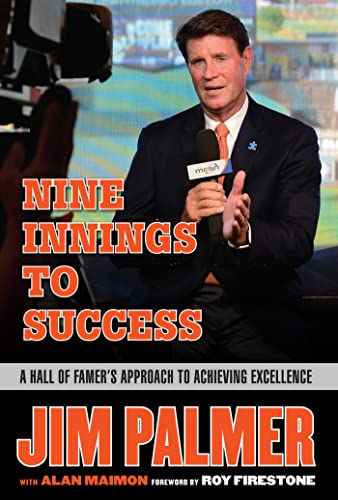
Verwandte Artikel zu Jim Palmer: Nine Innings to Success: A Hall of Famer's...
Inhaltsangabe
Jim Palmer was just 20 years old when he became the youngest pitcher ever to throw a World Series shutout, helping lead the Baltimore Orioles to their first-ever championship, in 1966. Two years later, Palmer's budding career almost ended due to arm problems. Yet, he mounted an inspiring comeback and reached the pinnacle of his profession, becoming the winningest pitcher of the 1970s and the only hurler to win a World Series game in three different decades. With three World Series rings, three Cy Young Awards and six All-Star selections to his name, an exemplary record as a spokesperson for charities and corporations, and his long tenure as a TV baseball analyst, Palmer is an authority on what it takes to succeed on and off of the field. Hall of Fame pitcher Jim Palmer and co-author Alan Maimon take readers inside the clubhouse, broadcast booth, and corporate world to tell the story of a one-of-a-kind career that serves as a how-to guide on succeeding in the workplace. Interspersed with memorable stories from his illustrious career with the Orioles, this book includes baseball wisdom and life-lessons learned from the one-of-a-kind Earl Weaver as well as colorful anecdotes about O's teammates like Cal Ripken, Jr and Rick Dempsey, and broadcast partners Howard Cosell and Al Michaels.
Die Inhaltsangabe kann sich auf eine andere Ausgabe dieses Titels beziehen.
Über die Autorin bzw. den Autor
Alan Maimon is an award-winning journalist who has worked with the Las Vegas Review-Journal, the Louisville Courier-Journal, and the New York Times. He is the coauthor of Andre Dawson's If You Love this Game . . . An MVP's Life in Baseball, Dallas Green's The Mouth That Roared, and Shane Victorino. He lives in Hopewell, New Jersey. Jim Palmer is a Hall of Fame pitcher who won 268 games in 19 seasons with the Baltimore Orioles. A three-time Cy Young Award winner and six-time all-star, Palmer was a key contributor to the Orioles' three World Series championship teams in 1966, 1970, and 1983. After his retirement in 1984, Palmer worked as an analyst for ABC Sports and ESPN. Palmer is also well-known for his roles as a spokesman for Jockey and The Money Store. Palmer currently works as a color commentator for Orioles games on MASN.
Auszug. © Genehmigter Nachdruck. Alle Rechte vorbehalten.
Jim Palmer: Nine Innings to Success
A Hall of Famer's Approach to Achieving Excellence
By Jim Palmer, Alan MaimonTriumph Books LLC
Copyright © 2016 Jim Palmer with Alan Maimon
All rights reserved.
ISBN: 978-1-62937-226-6All rights reserved.
Contents
FOREWORD BY ROY FIRESTONE,
INTRODUCTION,
1ST INNING: LEARNING,
2ND INNING: BECOMING SUCCESSFUL,
3RD INNING: PERSEVERANCE,
4TH INNING: BUILDING TRUST,
5TH INNING: EXCELLING,
6TH INNING: SUSTAINING SUCCESS,
7TH INNING: DIVERSIFYING,
7TH INNING STRETCH,
8TH INNING: APPRECIATION,
9TH INNING: ENJOYMENT,
EPILOGUE,
ACKNOWLEDGMENTS,
Photo Gallery,
CHAPTER 1
1st Inning: Learning
Life is about opportunity. And if success is important to you, you'll have no qualms about going wherever that opportunity surfaces. With that in mind, let's take a trip back in time to the summer of 1963. The location: a tiny hamlet in southern South Dakota called Winner, a rural outpost tucked away off a lonely stretch of highway somewhere between the towns of Mission and Ideal. One name seemed to be a misnomer; the other had some symbolism. Was the location ideal? No, not really. But was I on a mission to become a winner? Yes, absolutely.
Of all the summers of my youth, this one shaped up to be the most pivotal. I had just graduated from Scottsdale High School in Arizona, where I starred in baseball, football, and basketball. On the diamond I had established myself as enough of a prospect to earn a chance to try out for the Basin League, which was halfway through a two-decade run as a showcase for the nation's top amateur talent. I ended up making the team. Of all the players who passed through South Dakota that summer, I was the only one who hadn't entered college yet. My teammates in Winner included future Cy Young award winner Jim Lonborg, who at the time was just a humble biology major at Stanford.
The Winner Ritz-Carlton must have been booked because my teammates and I were all piled into the basement of a house with no air conditioning. The outside temperature would get up to 90 or 100 degrees during the day, creating a sauna-like atmosphere in the basement. Late at night, however, it cooled off enough to allow us to sleep through until mid-morning. At around 10:00 am, there'd be a knock at the basement door, and the poor guy, who I'm guessing juggled owner, general manager, manager, and wake-up call duties, would tell us to get up and report to our jobs, which the NCAA required that we have. Job? I didn't know I had one. But when I arrived at the ballpark and was handed a rake, I figured it out pretty quickly.
My routine in Winner was simple. Before games I raked the mound. And during games I stood on the mound and hoped opposing hitters didn't rake my pitches. That's how the summer went. We ended up losing in the Basin League playoffs, but my performance got the attention of Orioles scout Jim Russo and Harry Dalton, who ran the organization's farm system. It also drew the interest of Paul Richards, who had recently resigned as Orioles manager to become general manager of the Houston Colt .45s. I met with representatives from both teams when I returned home to Scottsdale, Arizona, and ended up signing a $40,000 contract with the Orioles. That was the best decision I ever made. As I once said in Sports Illustrated, if I had played my career for the Houston Astros, who didn't win their first pennant until I was 60 years old, I would likely have had a good but not great major league career.
I'll get back to South Dakota shortly. But for the moment, let's move down the map to Thomasville, Georgia, the town where the Orioles used to send their low-level minor leaguers for an eight-week intensive course in the fundamentals of the game. In Thomasville, I got my first introduction to "The Oriole Way." And from the day in 1964 that I showed up to camp there to the day that I retired from the game in 1984, I remained immersed in those principles. They shaped my career — and, to a significant extent, who I am. It wasn't an accident that I never played a game for another professional organization.
In Thomasville the players didn't live in a basement. In what may or may not have been an upgrade from cellar dwelling, they assigned us to an old army barracks that shared property with a facility that housed a bunch of World War II veterans. We dined in a mess hall and were roused from bed each morning by a bugle call. In that militaristic environment, the likes of Earl Weaver, who managed the Orioles' Double A farm club in Elmira, New York, and Cal Ripken Sr., who helmed a minor league team in Aberdeen, South Dakota, served as our MacArthur and Patton. They imparted a number of lessons, including that Orioles farmhands didn't cut corners. During an intra-squad scrimmage, I lined out to right field to end an inning. I ran hard out of the batter's box but only made it halfway to first base before the outfielder snared the ball. At that point, I turned and headed to the dugout, where I grabbed my glove and went out to the pitcher's mound. That night at dinner, one of our instructors, I think it was Earl, called me out in front of all the players for my perceived lack of hustle. "Did you run that ball out?" he asked me. "We run balls out in the Oriole organization. We run all the way to first."
This was the first time I laid eyes on the little pudgy guy whom I would come to regard as both a nemesis and a genius. Earl had run the Thomasville camp since 1961. I didn't get to know him well that spring and I don't recall seeing his explosive temper on display either. I just remember we had an incredible two months. I learned a lot about the game from Earl, Cal, and the other instructors. And their teachings paid immediate dividends. Pitted against other teams' best young players, we won 14 games in a row.
I thought I would have the chance to spend more quality time with Earl in 1964, but instead of getting assigned to his Double A team in Elmira, I received instructions to report to Cal's A ball squad in northern South Dakota. The town of Aberdeen had mosquitoes the size of B-52 bombers, but it also had a great mentor who taught me life lessons that I would constantly harken back to as I went through my career. Cal distilled his message into a few commandments.
You're never going to let anyone outwork you.
You're going to be a great teammate.
You're going to have fun — and part of having fun is winning.
You're going to have a passion to get a little better every day.
Cal also reminded us to always credit the people who made it possible for us to play the game professionally in the first place: the fans. Without them we were just guys playing baseball in an empty stadium. It's worth mentioning that Cal's four-year-old son, Cal Jr., joined us for the summer and soaked it all in. As I watched him run around the field before games, I thought to myself, Someday, this kid is going to play in 2,632 consecutive major league games. I'm kidding, of course. But there is definitely something to be said for growing up an Oriole.
At 18, I was one of the youngest players on an Aberdeen roster that featured nine future major leaguers. I roomed with Dave Leonhard, who was 23 and a college graduate. Davey and I didn't have a whole lot in common on paper, but we hit it off really well. Davey not only possessed a bachelor's degree in history, but he also had obtained it from one of the nation's premier institutions of higher learning, Johns Hopkins University. The baseball...
„Über diesen Titel“ kann sich auf eine andere Ausgabe dieses Titels beziehen.
Suchergebnisse für Jim Palmer: Nine Innings to Success: A Hall of Famer's...

Beispielbild für diese ISBN
Jim Palmer: Nine Innings to Success: A Hall of Famer's Approach to Achieving Excellence
Anbieter: Wonder Book, Frederick, MD, USA
Verkäuferbewertung 5 von 5 Sternen

Zustand: Good. Good condition. Very Good dust jacket. A copy that has been read but remains intact. May contain markings such as bookplates, stamps, limited notes and highlighting, or a few light stains. Artikel-Nr. O07O-00326
Gebraucht kaufen
EUR 6,43
Versand gratis
Versand innerhalb von USA
Versand innerhalb von USA
Anzahl: 1 verfügbar
Beispielbild für diese ISBN
Jim Palmer: Nine Innings to Success: A Hall of Famer's Approach to Achieving Excellence
Anbieter: Wonder Book, Frederick, MD, USA
Verkäuferbewertung 5 von 5 Sternen
Zustand: As New. Like New condition. Like New dust jacket. A near perfect copy that may have very minor cosmetic defects. Artikel-Nr. P15H-02279
Gebraucht kaufen
EUR 7,00
Versand gratis
Versand innerhalb von USA
Versand innerhalb von USA
Anzahl: 1 verfügbar
Beispielbild für diese ISBN
Jim Palmer: Nine Innings to Success: A Hall of Famer's Approach to Achieving Excellence
Anbieter: ThriftBooks-Atlanta, AUSTELL, GA, USA
Verkäuferbewertung 5 von 5 Sternen
Hardcover. Zustand: Very Good. No Jacket. Former library book; May have limited writing in cover pages. Pages are unmarked. ~ ThriftBooks: Read More, Spend Less. Artikel-Nr. G1629372269I4N10
Gebraucht kaufen
EUR 8,26
Versand gratis
Versand innerhalb von USA
Versand innerhalb von USA
Anzahl: 1 verfügbar
Beispielbild für diese ISBN
Jim Palmer: Nine Innings to Success: A Hall of Famer's Approach to Achieving Excellence
Anbieter: ThriftBooks-Atlanta, AUSTELL, GA, USA
Verkäuferbewertung 5 von 5 Sternen
Hardcover. Zustand: Good. No Jacket. Pages can have notes/highlighting. Spine may show signs of wear. ~ ThriftBooks: Read More, Spend Less. Artikel-Nr. G1629372269I3N00
Gebraucht kaufen
EUR 8,26
Versand gratis
Versand innerhalb von USA
Versand innerhalb von USA
Anzahl: 1 verfügbar
Beispielbild für diese ISBN
Jim Palmer: Nine Innings to Success: A Hall of Famer's Approach to Achieving Excellence
Anbieter: ThriftBooks-Dallas, Dallas, TX, USA
Verkäuferbewertung 5 von 5 Sternen
Hardcover. Zustand: Fair. No Jacket. Readable copy. Pages may have considerable notes/highlighting. ~ ThriftBooks: Read More, Spend Less. Artikel-Nr. G1629372269I5N00
Gebraucht kaufen
EUR 8,26
Versand gratis
Versand innerhalb von USA
Versand innerhalb von USA
Anzahl: 1 verfügbar
Beispielbild für diese ISBN
Jim Palmer: Nine Innings to Success: A Hall of Famer's Approach to Achieving Excellence
Anbieter: ThriftBooks-Atlanta, AUSTELL, GA, USA
Verkäuferbewertung 5 von 5 Sternen
Hardcover. Zustand: Very Good. No Jacket. May have limited writing in cover pages. Pages are unmarked. ~ ThriftBooks: Read More, Spend Less. Artikel-Nr. G1629372269I4N00
Gebraucht kaufen
EUR 8,26
Versand gratis
Versand innerhalb von USA
Versand innerhalb von USA
Anzahl: 1 verfügbar
Beispielbild für diese ISBN
Jim Palmer: Nine Innings to Success : A Hall of Famer's Approach to Achieving Excellence
Anbieter: Better World Books, Mishawaka, IN, USA
Verkäuferbewertung 5 von 5 Sternen
Zustand: Very Good. Pages intact with possible writing/highlighting. Binding strong with minor wear. Dust jackets/supplements may not be included. Stock photo provided. Product includes identifying sticker. Better World Books: Buy Books. Do Good. Artikel-Nr. 11316278-6
Gebraucht kaufen
EUR 8,57
Versand gratis
Versand innerhalb von USA
Versand innerhalb von USA
Anzahl: 1 verfügbar
Beispielbild für diese ISBN
Jim Palmer: Nine Innings to Success: A Hall of Famer's Approach to Achieving Excellence
Anbieter: World of Books (was SecondSale), Montgomery, IL, USA
Verkäuferbewertung 5 von 5 Sternen
Hardback. Zustand: Very Good. Jim Palmer was just 20 years old when he became the youngest pitcher ever to throw a World Series shutout, helping lead the Baltimore Orioles to their first-ever championship, in 1966. Two years later, Palmer's budding career almost ended due to arm problems. Yet, he mounted an inspiring comeback and reached the pinnacle of his profession, becoming the winningest pitcher of the 1970s and the only hurler to win a World Series game in three different decades. With three World Series rings, three Cy Young Awards and six All-Star selections to his name, an exemplary record as a spokesperson for charities and corporations, and his long tenure as a TV baseball analyst, Palmer is an authority on what it takes to succeed on and off of the field. Hall of Fame pitcher Jim Palmer and co-author Alan Maimon take readers inside the clubhouse, broadcast booth, and corporate world to tell the story of a one-of-a-kind career that serves as a how-to guide on succeeding in the workplace. Interspersed with memorable stories from his illustrious career with the Orioles, this book includes baseball wisdom and life-lessons learned from the one-of-a-kind Earl Weaver as well as colorful anecdotes about O's teammates like Cal Ripken, Jr and Rick Dempsey, and broadcast partners Howard Cosell and Al Michaels. Artikel-Nr. 00100201257
Gebraucht kaufen
EUR 11,12
Versand gratis
Versand innerhalb von USA
Versand innerhalb von USA
Anzahl: 1 verfügbar
Beispielbild für diese ISBN
Jim Palmer: Nine Innings to Success: A Hall of Famer's Approach to Achieving Excellence
Anbieter: Kennys Bookstore, Olney, MD, USA
Verkäuferbewertung 5 von 5 Sternen
Zustand: New. Artikel-Nr. V9781629372266
Neu kaufen
EUR 36,32
EUR 9,37 Versand
Versand innerhalb von USA
Versand innerhalb von USA
Anzahl: Mehr als 20 verfügbar
Beispielbild für diese ISBN
Jim Palmer: Nine Innings to Success: a Hall of Famer's Approach to Achieving Excellence
Anbieter: Revaluation Books, Exeter, Vereinigtes Königreich
Verkäuferbewertung 5 von 5 Sternen
Hardcover. Zustand: Brand New. 240 pages. 6.00x4.00x1.00 inches. In Stock. Artikel-Nr. 1629372269
Neu kaufen
EUR 47,12
EUR 14,77 Versand
Versand von Vereinigtes Königreich nach USA
Versand von Vereinigtes Königreich nach USA
Anzahl: 1 verfügbar