
Verwandte Artikel zu 100 Things Star Wars Fans Should Know & Do Before...
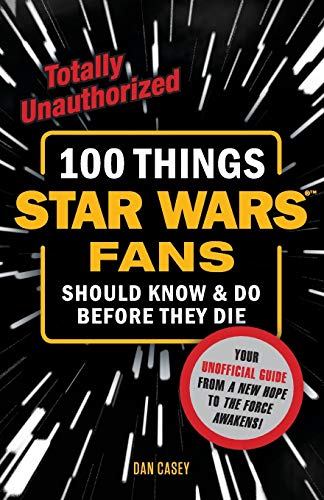
100 Things Star Wars Fans Should Know & Do Before They Die (100 Things...Fans Should Know) - Softcover
Inhaltsangabe
Perfect for Star Wars fans who think they already know everything
On May 25, 1977, the world of science fiction, film, and pop culture was changed forever with the release of Star Wars. The beginning of this epic space opera franchise would inspire an expanded universe of creativity, including books, comic books, theme parks, and much more. With extensive back stories, lore, and author Dan Casey&;s encyclopedic knowledge on the subject, this lively, detailed book explores the characters, storylines, and facts every true Star Wars fan should know. This guide covers the history of how a multibillion-dollar and beloved institution was born and went on to flourish. Dan Casey has collected every essential piece of Star Wars knowledge and trivia, including what infamous, cult classic TV movie introduced beloved bounty hunter Boba Fett, what Star Wars novel was released in 1976 before the first movie premiered, and what animal species is named after Han Solo. Whether you&;re a fan of the original film trilogy, an avid reader of the books, or can&;t wait to see what J. J. Abrams does with the next generation of movies, 100 Things Star Wars Fans Should Know & Do Before They Die is the perfect resource for all Star Wars fans looking to increase their knowledge of the storied franchise and look back on the most memorable moments of a galaxy &;far, far away.&;
On May 25, 1977, the world of science fiction, film, and pop culture was changed forever with the release of Star Wars. The beginning of this epic space opera franchise would inspire an expanded universe of creativity, including books, comic books, theme parks, and much more. With extensive back stories, lore, and author Dan Casey&;s encyclopedic knowledge on the subject, this lively, detailed book explores the characters, storylines, and facts every true Star Wars fan should know. This guide covers the history of how a multibillion-dollar and beloved institution was born and went on to flourish. Dan Casey has collected every essential piece of Star Wars knowledge and trivia, including what infamous, cult classic TV movie introduced beloved bounty hunter Boba Fett, what Star Wars novel was released in 1976 before the first movie premiered, and what animal species is named after Han Solo. Whether you&;re a fan of the original film trilogy, an avid reader of the books, or can&;t wait to see what J. J. Abrams does with the next generation of movies, 100 Things Star Wars Fans Should Know & Do Before They Die is the perfect resource for all Star Wars fans looking to increase their knowledge of the storied franchise and look back on the most memorable moments of a galaxy &;far, far away.&;
Die Inhaltsangabe kann sich auf eine andere Ausgabe dieses Titels beziehen.
Über die Autorin bzw. den Autor
Dan Casey is a critic, a commentator, and an on-camera host who has appeared on Nerdist, StarWars.com, TOKYOPOP, McSweeney&;s Internet Tendency, as well as FOX News&; Tech Take, AMC Movie Talk, and the Young Turk&;s Nerd Alert. He is the author of 100 Things Avengers Fans Should Know & Do Before They Die. He lives in Los Angeles.
Auszug. © Genehmigter Nachdruck. Alle Rechte vorbehalten.
100 Things Star Wars Fans Should Know & Do Before They Die
By Dan CaseyTriumph Books
Copyright © 2015 Daniel Casey
All rights reserved.
ISBN: 978-1-62937-164-1All rights reserved.
CHAPTER 1
A Galaxy Far, Far Away
Everything changed on May 25, 1977. To the untrained eye, it was just another endless day in what seemed like a year that threatened to drag on forever. In the Netherlands, two days prior, a group of Moluccan terrorists seized control of a train and a school in the Netherlands, holding more than 100 children hostage. Two months prior, KLM Flight 4805 and Pan Am Flight 1736 collided mid-air, killing 583 people in a horrific accident at the Tenerife airport in the Canary Islands; at the time, it was the deadliest accident in aviation history. In Dover, Massachusetts, residents reported seeing sights of an eerie monster dubbed the Dover Demon. On television, viewers were made to wrestle with their own demons as British journalist David Frost reopened old wounds with former President Richard Nixon in a four-night interview series. In short, the country — and even the world — felt as though it could use a new hope. On that Memorial Day weekend, that was exactly what they got, as a little-known sci-fi film called Star Wars opened in theaters and changed the course of cultural history.
The lights in the theaters faded to black as the reel-to-reel roared to life. After the classic Chuck Jones cartoon short Duck Dodgers in the 24½th Century played — something on which George Lucas insisted — the Fox fanfare filled the theater with its indelible drum roll and bright, piercing horns, heralding the arrival of something new. (In fact, this fanfare, originally created in 1933 by Alfred Newman, had fallen out of use by the time of Star Wars' premiere; it was another relic that Lucas insisted on reviving and appending to his baby.) Yet the fanfare was merely a preamble, a triumphant crescendo paving the way for 10 simple words in an icy blue font that would burn their way into the wrinkles of our brains: "A long time ago, in a galaxy far, far away ..."
This was the first indication that audience members weren't in for another run-of-the-mill sci-fi affair; these words had a fairy tale quality to them. That's because this wasn't "sci-fi" per se — it was space fantasy, a clever amalgamation of multiple genres to make an elemental tale of good and evil, light and dark, all set against a backdrop of the infinite. Of course, this thought barely had time to register for most viewers because suddenly the massive, yellow Star Wars logo filled the frame, accompanied by the thunderous arrival of John Williams' opening theme. Then, came the opening crawl, the sprawling wall of slowly scrolling text that crept up from the bottom of the screen, flying off into oblivion. (Note: the title Episode IV: A New Hope would not appear in the opening credits until the film's re-release in 1981.)
On its first day, the film opened in just 32 theaters across the country, and was set to open in 11 more over the coming days. There had only been one trailer for the film that had come out the previous Christmas, which promptly disappeared until, like Jesus, it returned for Easter. In spite of what seemed like a relative non-presence, the film had record-breaking ticket sales, grossing $255,000 on opening day. By the end of the weekend, it had grossed $2.5 million in ticket sales, technically placing it behind Smokey and the Bandit, which grossed $2.7 million across 386 screens. The numbers don't lie, though. A new king had been crowned.
The film became an instant cultural phenomenon. It spread like wildfire, all in an era before texting, Twitter, and Internet message boards. "On opening day I was on the East Coast and I did the morning-show circuit — Good Morning America," producer Gary Kurtz recalled in an interview. "In the afternoon I did a radio call-in show in Washington and this guy, this caller, was really enthusiastic and talking about the movie in really deep detail. I said, 'You know a lot abut the film.' He said, 'Yeah, yeah, I've seen it four times already.' And that was opening day. I knew something was happening." In fact, it is largely due to the popularity of Star Wars that theaters instated a policy of clearing out audiences in between shows; previously crowds could remain seated and watch the film again if they waited long enough.
Seeing the film immediately inducted the viewer into a sort of secret cabal with its own signifiers and vocabulary. "May the Force Be With You" buttons and homemade t-shirts emblazoned with Star Wars sayings became common sights, immediate indicators that you were in the know. Fans began trading theories and speculating about the film's vibrant backstory and the rich world Lucas had created. They were particularly curious about the nature of the Force. The film would go on to earn seven Academy Awards, $461 million in domestic box office receipts, and nearly $800 million in ticket sales worldwide. But more importantly, it had created a movement, a legion of diehard fans who weren't just obsessed with the intricacies of the galaxy far, far away.
This was, of course, just the beginning. Over the next 38 years, there would be five more Star Wars films, an ill-fated holiday special, two critically acclaimed animated series, countless video games, and a veritable merchandising empire. Honestly, if you can think of an item, there is a Star Wars-ified version of it (and it's likely housed at Rancho Obi-Wan for posterity). In total, the franchise has grossed more than $2.2 billion at the domestic box office, and more than $4.5 billion worldwide. Those box office receipts were just a fraction of the income generated by Star Wars; an April 2015 estimate stated that the franchise had generated $27 billion when toy sales, book sales, home video, and other assorted licensing fees were factored into the equation.
With statistics like that, it should come as no surprise that on October 30, 2012, the Walt Disney Corporation paid $4.05 billion to acquire Lucasfilm and all of its holdings, including the Star Wars brand. After giving his sweat, blood, and tears to this mythic story of good versus evil — two trilogies spanning the course of three decades — George Lucas was ready to pass the torch, the proverbial lightsaber, as it were. "For the past 35 years, one of my greatest pleasures has been to see Star Wars passed from one generation to the next," said Lucas in an official press release at the time. "It's now time for me to pass Star Wars on to a new generation of filmmakers. I've always believed that Star Wars could live beyond me, and I thought it was important to set up the transition during my lifetime."
Leading that new generation of filmmakers into the bold, new future are J.J. Abrams and Kathleen Kennedy, the respective Luke Skywalker and Obi-Wan Kenobi of this new era of Star Wars stories. After co-founding Amblin Entertainment with Steven Spielberg and Frank Marshall, Kennedy had a long, fruitful career in film that prepared her well to become president of Lucasfilm. Making a name for himself first as a maverick writer and director, J.J. Abrams proved that he was more than up to the task of tackling a revered franchise in a sci-fi setting when he rebooted Star Trek for Paramount. Now, the duo are preparing the first new Star Wars film in a decade, Star Wars Episode VII: The Force Awakens, combatting feverish fan expectation and ravenous paparazzi while they craft the film that will effectively kick off...
„Über diesen Titel“ kann sich auf eine andere Ausgabe dieses Titels beziehen.
Suchergebnisse für 100 Things Star Wars Fans Should Know & Do Before...

Beispielbild für diese ISBN
100 Things Star Wars Fans Shou
Anbieter: World of Books (was SecondSale), Montgomery, IL, USA
Verkäuferbewertung 5 von 5 Sternen

Zustand: Very Good. Item in very good condition! Textbooks may not include supplemental items i.e. CDs, access codes etc. Artikel-Nr. 00098287536
Gebraucht kaufen
EUR 3,87
Versand gratis
Versand innerhalb von USA
Versand innerhalb von USA
Anzahl: 1 verfügbar
Beispielbild für diese ISBN
100 Things Star Wars Fans Shou
Anbieter: World of Books (was SecondSale), Montgomery, IL, USA
Verkäuferbewertung 5 von 5 Sternen
Zustand: Good. Item in good condition. Textbooks may not include supplemental items i.e. CDs, access codes etc. Artikel-Nr. 00086783302
Gebraucht kaufen
EUR 3,87
Versand gratis
Versand innerhalb von USA
Versand innerhalb von USA
Anzahl: 1 verfügbar
Beispielbild für diese ISBN
100 Things Star Wars Fans Should Know & Do Before They Die (100 Things.Fans Should Know)
Verlag:
Triumph Books (edition ), 2015
ISBN 10: 1629371645
ISBN 13: 9781629371641
Gebraucht
Paperback
Anbieter: BooksRun, Philadelphia, PA, USA
Verkäuferbewertung 5 von 5 Sternen
Paperback. Zustand: Very Good. It's a well-cared-for item that has seen limited use. The item may show minor signs of wear. All the text is legible, with all pages included. It may have slight markings and/or highlighting. Artikel-Nr. 1629371645-8-1
Gebraucht kaufen
EUR 5,47
Versand gratis
Versand innerhalb von USA
Versand innerhalb von USA
Anzahl: 1 verfügbar
Foto des Verkäufers
100 Things Star Wars Fans Should Know & Do Before They Die (100 Things.Fans Should Know)
Anbieter: Redux Books, Grand Rapids, MI, USA
Verkäuferbewertung 5 von 5 Sternen
Paperback. Zustand: Very Good. Paperback. Pages are clean and unmarked. Covers show very minor shelving wear.; 100% Satisfaction Guaranteed! Ships same or next business day! Artikel-Nr. 132212010007
Gebraucht kaufen
EUR 6,37
Versand gratis
Versand innerhalb von USA
Versand innerhalb von USA
Anzahl: 1 verfügbar
Beispielbild für diese ISBN
100 Things Star Wars Fans Should Know & Do Before They Die (100 Things.Fans Should Know)
Anbieter: WorldofBooks, Goring-By-Sea, WS, Vereinigtes Königreich
Verkäuferbewertung 5 von 5 Sternen
Paperback. Zustand: Very Good. The book has been read, but is in excellent condition. Pages are intact and not marred by notes or highlighting. The spine remains undamaged. Artikel-Nr. GOR009533872
Gebraucht kaufen
EUR 4,18
EUR 6,61 Versand
Versand von Vereinigtes Königreich nach USA
Versand von Vereinigtes Königreich nach USA
Anzahl: 1 verfügbar
Foto des Verkäufers
100 Things Star Wars Fans Should Know & Do Before They Die (100 Things.Fans Should Know)
Anbieter: WeBuyBooks, Rossendale, LANCS, Vereinigtes Königreich
Verkäuferbewertung 5 von 5 Sternen
paperback. Zustand: Very Good. Most items will be dispatched the same or the next working day. A copy that has been read, but is in excellent condition. Pages are intact and not marred by notes or highlighting. The spine remains undamaged. Artikel-Nr. rev1201232777
Gebraucht kaufen
EUR 4,55
EUR 7,79 Versand
Versand von Vereinigtes Königreich nach USA
Versand von Vereinigtes Königreich nach USA
Anzahl: 1 verfügbar
Beispielbild für diese ISBN
100 Things Star Wars Fans Should Know & Do Before They Die
Anbieter: Revaluation Books, Exeter, Vereinigtes Königreich
Verkäuferbewertung 5 von 5 Sternen
Paperback. Zustand: Brand New. 404 pages. 8.50x5.75x0.75 inches. In Stock. Artikel-Nr. __1629371645
Neu kaufen
EUR 15,74
EUR 11,80 Versand
Versand von Vereinigtes Königreich nach USA
Versand von Vereinigtes Königreich nach USA
Anzahl: 1 verfügbar
Beispielbild für diese ISBN
100 Things Star Wars Fans Should Know & Do Before They Die
Anbieter: Kennys Bookstore, Olney, MD, USA
Verkäuferbewertung 5 von 5 Sternen
Zustand: New. Artikel-Nr. V9781629371641
Neu kaufen
EUR 24,28
EUR 9,37 Versand
Versand innerhalb von USA
Versand innerhalb von USA
Anzahl: Mehr als 20 verfügbar
Beispielbild für diese ISBN
100 Things Star Wars Fans Should Know & Do Before They Die
Anbieter: Revaluation Books, Exeter, Vereinigtes Königreich
Verkäuferbewertung 5 von 5 Sternen
Paperback. Zustand: Brand New. 404 pages. 8.50x5.75x0.75 inches. In Stock. Artikel-Nr. zk1629371645
Neu kaufen
EUR 23,02
EUR 11,80 Versand
Versand von Vereinigtes Königreich nach USA
Versand von Vereinigtes Königreich nach USA
Anzahl: 1 verfügbar