
Verwandte Artikel zu The Adventures of Big-Foot Wallace: The Texas Ranger...
Inhaltsangabe
The thrilling adventures of traveler, rancher, and fighter “Big-Foot” Wallace in a bygone era of the American frontier.
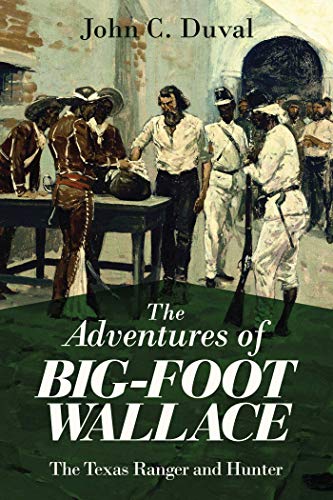
Amid the embroiling conflicts of frontiersmen, Mexicans, and war in Texas, 1837, William “Big-Foot” Wallace left his hometown of Virginia to avenge the deaths of his brother and cousin, soldiers executed by Mexicans. Upon joining the Texas Rangers, Wallace was swept into the clashes at Salado Creek, Hondo River, and the Battle of Monterrey during the Mexican-American War.
Measuring at 6 feet 2 inches tall and weighing 240 pounds, Big-Foot Wallace embodied the iron nerves and indomitable spirit of the Texan frontiersman. In one of his most famous and harrowing experiences during the Mier expedition, Wallace was captured by the Mexican army, blindfolded, and forced to draw from a pot of black and white beans to determine whether he would be imprisoned or executed. Wallace drew a white bean and lived. After the war, he returned from the wilderness to clean, civilized Virginia, and spent the rest of his days as a storytelling, yarn-spinning rancher.
John Duval, fellow Texas Ranger and Wallace’s best friend, gives a thrilling but factual account of the man’s life in a simple but engaging narrative style, combining action, suspense, and dry Texan humor. Wallace’s hairbreadth escapes and larger-than-life story are the perfect representation of the Old West in all its perils, comedy, and romance.
Skyhorse Publishing, along with our Arcade, Good Books, Sports Publishing, and Yucca imprints, is proud to publish a broad range of biographies, autobiographies, and memoirs. Our list includes biographies on well-known historical figures like Benjamin Franklin, Nelson Mandela, and Alexander Graham Bell, as well as villains from history, such as Heinrich Himmler, John Wayne Gacy, and O. J. Simpson. We have also published survivor stories of World War II, memoirs about overcoming adversity, first-hand tales of adventure, and much more. While not every title we publish becomes a New York Times bestseller or a national bestseller, we are committed to books on subjects that are sometimes overlooked and to authors whose work might not otherwise find a home.
Die Inhaltsangabe kann sich auf eine andere Ausgabe dieses Titels beziehen.
Über die Autorin bzw. den Autor
John C. Duval was born in 1816 to a distinguished family in Kentucky. Upon meeting fellow Texas Ranger Big-Foot Wallace, the two became fast friends. Duval went on to fight for the South in the Civil War, and retired to a backyard cabin in Texas to live out the remainder of his life as a surveyor and prospector, often visiting Wallace to talk about the old days. Duval wrote extensively about the nostalgia of the Old West, and was called the “first Texas man of letters.” Duval died in Fort Worth, Texas, in 1897, two years before Wallace.
Auszug. © Genehmigter Nachdruck. Alle Rechte vorbehalten.
The Adventures of Big-Foot Wallace
The Texas Ranger and Hunter
By John C. DuvalSkyhorse Publishing
Copyright © 2015 Skyhorse Publishing
All rights reserved.
ISBN: 978-1-62914-734-5All rights reserved.
CHAPTER 1
INTRODUCTORY.
IN 1867, while temporarily sojourning in the city of San Antonio, I had a severe attack of fever, from the effects of which I recovered but slowly. Thinking that fresh air and exercise would aid me in regaining my health and strength, I mounted my horse one fine morning in the latter part of October, and set out for the "ranch" of my quondam messmate and compadre, "Big-Foot Wallace," who held an uncertain tenure upon a tract of pasture land, situated on the Chacon, one of the head-waters of the Altascoso. I say, uncertain, for his right to and possession of the same is constantly disputed and ignored by predatory bands of savages, and Mexicans, and horse-thieves of all colors, grades, and nations.
Toward sundown, from the top of a considerable hill, I came in sight of Wallace's little ranch, snugly ensconced at the bottom of a valley, near the margin of a small lake, and protected from the northern blasts by a beautiful grove of spreading live-oaks. As I rode up I discovered Wallace under one of these trees, engaged in the characteristic occupation of skinning a deer, which was hanging head downward, suspended from one of its lower branches. Wallace did not recognize me at first, for it was many years since we had last met; but, as soon as I made myself known to him, he gave me a cordial shake of the hand, and invited me into his ranch, where, in a short time, he prepared a supper, to which I sat down, "nothing loath," for my appetite was sharpened by my long day's ride.
I staid with Wallace two weeks, or thereabouts, hunting, fishing, and riding around during the day, and entertained each night with "yarns" of his numerous "'scapes and scrapes, by flood and field." Many years previously, when Wallace and I were messmates together, in the first Ranging Company, enlisted in the service of the "Old Republic," under Colonel Jack Hays, I asked his consent to write out a narrative of his "adventures," to be published for the benefit of the public generally. But he seemed so much opposed to my doing so, that I did not press the matter upon him. His reasons for refusing to accede to my request were characteristic of the man. "He did not think the public would be interested in the history of one so little known;" and, "even if he had vanity enough to believe otherwise, he had not the least desire to see himself figuring in print." I determined once more to approach him on the subject, and this time I had better success than formerly, for finally (though evidently with reluctance) he consented that I should publish the following narrative of his adventures in Mexico and on the frontiers of Texas.
"There is," I said to Wallace, "one difficulty in the way of writing out your `adventures,' which I do not exactly know how to get over; and that is, you do not murder the king's English with every other word you speak. Now, in all the books I have ever read, in which backwoodsmen or frontiersmen figure, they are always made to talk without the least regard to the rules of grammar."
"I know," said Wallace, "that my education is a very limited one, but do give me credit for the little I have. People are not such fools as to think that a man cannot be a good hunter or ranger, merely because he speaks his own language passably well."
And so, in compliance with Wallace's request, in the following narrative of his "adventures," I have ignored the time-honored rule of making him speak in slang and misspelt words, and tell the story "just as it was told to me."
CHAPTER 2WALLACE'S INITIATION INTO THE MYSTERIES OF WOODCRAFT.
SOON after I came out to Texas, in 1837, said Wallace, being out of employment, and having no inclination to loaf around the "groceries" of a little village, I looked about for something to do; but for several weeks no "opening" presented itself. At length a surveyor, who was preparing for an expedition to locate lands upon the frontier, made me an offer to go with him, which I gladly accepted. At that time, as an Irishman would say, I was "as green as a red blackberry," and I frankly told the surveyor that I knew nothing about the woods, or how to get along in them. But he said that made no difference, as the rest of the party were all old frontiersmen, and it was well enough to have one "green-horn" along to make sport for the balance.
It was a week or ten days before we were ready to start, and in the mean time I prepared myself for the "expedition" as well as I knew how. I had brought with me from Virginia a good rifle, a pair of Derringer pistols, and a bowie-knife, (that you know was before the days of six-shooters,) so that there was no necessity for my hunting up firearms. I bought a good stout Spanish pony, with saddle, bridle, etc., and laid in an ample supply of ammunition and tobacco; and when the surveying party were ready to start, I joined them "armed and equipped as the law directs."
Our party consisted of a guard of two men, well armed and mounted, together with the surveyor, two chainmen, a marker, a hunter, and a cook, making in all sixteen men — a sufficient force to travel with safety, at that day, in the most dangerous part of the country. At that time, one American, well armed, was considered a match for eight or ten Indians, with their bows and arrows and miserable guns; but now, thanks to the traders, they are well furnished with good rifles and "six-shooters," and can hold their own, man for man.
The first day out, we travelled only a few miles, and encamped on a beautiful little clear stream, where I killed my first deer. I thought I had performed a wonderful feat, for I had never killed anything before larger than a squirrel or a 'possum, and I proudly returned to camp with the deer on my shoulders, trying all the time, though, to look as if the killing of a deer was no unusual thing with me. But the boys suspected me, and when I owned up that it was the first deer I had ever shot, two or three of them seized me, while as many more smeared my face and hands with the blood of the animal — a sort of ceremony, they said, by which I was "initiated" into the brotherhood of "mighty hunters." I suppose I was "initiated," as they called it, for I have killed many a hundred deer since that time, to say nothing of buffalo; bear, elk, wolves, panthers, Mexican lions, catamounts, and other "varmints" too numerous to mention.
CHAPTER 3ON THE ROUTE — THE OLD LADY AND THE TRUCK-PATCH.
THE next day we started just after sunrise, and travelled twenty-five miles over a beautiful rolling country, watered with clear streams, and encamped at night in a pecan grove near a fine spring. Just at dark, a large drove of turkeys flew up into the trees around, and we killed five or six of them, and spitted them before our fires. These, together with a fat doe killed by our hunter on the way, furnished us with an ample supply of provender, while an abundance of fine mesquit grass in the vicinity enabled our horses to fare as sumptuously as ourselves.
The next morning, after an early breakfast, we saddled up and again took the road, or rather our course, for there was no road, and went about twelve miles to a water-hole, where there was good grass, and where we "nooned" for a couple of hours. The country passed over was all high rolling prairie, interspersed with "mots" of elm and hackberry. While all hands were taking a comfortable snooze here, we came near losing our horses. A wolf or some...
„Über diesen Titel“ kann sich auf eine andere Ausgabe dieses Titels beziehen.
Suchergebnisse für The Adventures of Big-Foot Wallace: The Texas Ranger...

Beispielbild für diese ISBN
The Adventures of Big-Foot Wallace: The Texas Ranger and Hunter
Anbieter: World of Books (was SecondSale), Montgomery, IL, USA
Verkäuferbewertung 5 von 5 Sternen

Zustand: Good. Item in good condition. Textbooks may not include supplemental items i.e. CDs, access codes etc. Artikel-Nr. 00108453880
Gebraucht kaufen
EUR 5,42
Versand gratis
Versand innerhalb von USA
Versand innerhalb von USA
Anzahl: 1 verfügbar
Beispielbild für diese ISBN
The Adventures of Big-Foot Wallace: The Texas Ranger and Hunter
Anbieter: ThriftBooks-Dallas, Dallas, TX, USA
Verkäuferbewertung 5 von 5 Sternen
Paperback. Zustand: As New. No Jacket. Pages are clean and are not marred by notes or folds of any kind. ~ ThriftBooks: Read More, Spend Less. Artikel-Nr. G1629147346I2N00
Gebraucht kaufen
EUR 6,04
Versand gratis
Versand innerhalb von USA
Versand innerhalb von USA
Anzahl: 1 verfügbar
Beispielbild für diese ISBN
The Adventures of Big-Foot Wallace: The Texas Ranger and Hunter
Anbieter: ThriftBooks-Atlanta, AUSTELL, GA, USA
Verkäuferbewertung 5 von 5 Sternen
Paperback. Zustand: Very Good. No Jacket. Former library book; May have limited writing in cover pages. Pages are unmarked. ~ ThriftBooks: Read More, Spend Less. Artikel-Nr. G1629147346I4N10
Gebraucht kaufen
EUR 6,04
Versand gratis
Versand innerhalb von USA
Versand innerhalb von USA
Anzahl: 1 verfügbar
Beispielbild für diese ISBN
The Adventures of Big-Foot Wallace: The Texas Ranger and Hunter
Anbieter: Redux Books, Grand Rapids, MI, USA
Verkäuferbewertung 5 von 5 Sternen
Paperback. Zustand: Good. Paperback. Pages are clean and unmarked. Covers show light edge wear.; 100% Satisfaction Guaranteed! Ships same or next business day! Artikel-Nr. 142604170015
Gebraucht kaufen
EUR 6,15
Versand gratis
Versand innerhalb von USA
Versand innerhalb von USA
Anzahl: 1 verfügbar
Beispielbild für diese ISBN
The Adventures of Big-foot Wallace: The Texas Ranger and Hunter
Anbieter: Revaluation Books, Exeter, Vereinigtes Königreich
Verkäuferbewertung 5 von 5 Sternen
Paperback. Zustand: Brand New. reprint edition. 291 pages. 8.00x5.50x1.00 inches. In Stock. Artikel-Nr. 1629147346
Neu kaufen
EUR 29,22
EUR 11,61 Versand
Versand von Vereinigtes Königreich nach USA
Versand von Vereinigtes Königreich nach USA
Anzahl: 1 verfügbar