
Verwandte Artikel zu Short Course in Beer: An Introduction to Tasting and...
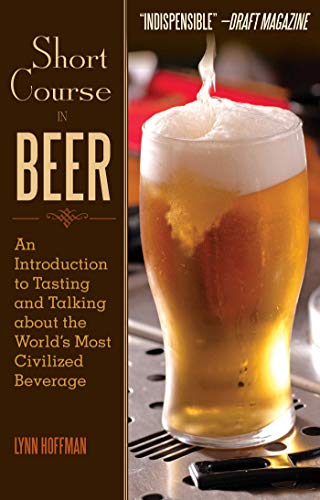
Short Course in Beer: An Introduction to Tasting and Talking about the World's Most Civilized Beverage - Softcover
Inhaltsangabe
Straightforward and opinionated, Short Course in Beer is designed to turn the novice beer lover into an expert imbiber and the casual drinker into an enthusiast. Readers will come to understand the beauty of beer and the sources of its flavor, as well as learn which beers are worth our time and which are not. With tongue in cheek, the author examines beer s historical connections to the Crusades, the Hundred Years War, and modern-day soccer riots. He talks frankly (and joyfully) about the effects of alcohol on the body and brain, he defends beer from its enemies, and ushers it out of the frat house and into the dining room. Discussion questions at the end of each chapter are designed to stimulate lively conversations, presumably over a glass of equally lively beer. At last a beer course for smarties!
Skyhorse Publishing, along with our Good Books and Arcade imprints, is proud to publish a broad range of cookbooks, including books on juicing, grilling, baking, frying, home brewing and winemaking, slow cookers, and cast iron cooking. We’ve been successful with books on gluten-free cooking, vegetarian and vegan cooking, paleo, raw foods, and more. Our list includes French cooking, Swedish cooking, Austrian and German cooking, Cajun cooking, as well as books on jerky, canning and preserving, peanut butter, meatballs, oil and vinegar, bone broth, and more. While not every title we publish becomes a New York Times bestseller or a national bestseller, we are committed to books on subjects that are sometimes overlooked and to authors whose work might not otherwise find a home.
Die Inhaltsangabe kann sich auf eine andere Ausgabe dieses Titels beziehen.
Über die Autorin bzw. den Autor
Lynn Hoffman is an award-winning writer, executive chef, photographer, and lecturer on fine wines, beer, and food history. He is a food and wine critic in Philadelphia, Pennsylvania.
Auszug. © Genehmigter Nachdruck. Alle Rechte vorbehalten.
Short Course in Beer
An Introduction to Tasting and Talking about the World's Most Civilized Beverage
By Lynn HoffmanSkyhorse Publishing
Copyright © 2012 Lynn Hoffman
All rights reserved.
ISBN: 978-1-62914-495-5All rights reserved.
Contents
Foreword,
Acknowledgments,
Chapter 1: Beer and the Nature of the Universe,
Chapter 2: The Flavor of Beer,
Chapter 3: Beer and Food,
Chapter 4: The Question of Alcohol,
Chapter 5: How Is Beer Made?,
Chapter 6: Enjoying Beer,
Chapter 7: A Dictionary of Beer Talk,
Chapter 8: A Dictionary of Beer Styles,
Chapter 9: Who Makes Beer?,
Appendix A: Beer Tourism,
Appendix B: Two Beer Poems to Be Recited When the Beer Is upon You,
Appendix C: The Reinheitsgebot,
Appendix D: Recommended Reading,
Final Thoughts,
CHAPTER 1
BEER
AND THE NATURE OF THE UNIVERSE
When you finish this chapter, you will have:
• an understanding of the connection between beer-making and one of mankind's most important inventions
• a sense of the relationship of beer and early concepts of the divine
• a healthy dislike for experiments in prohibition
• some ideas about beer's future
• the beginning of a sense of connoisseurship about that bubbly stuff with the head on it
Beer is, at its best, a philosopher's drink:
It stimulates sensitive souls to ask questions without arousing the arrogance that might lead them to easy answers.
Although we seem to have forgotten it, beer is worth our attention because it can be delightful, but it's also worth a moment's thought because it's been important in the daily lives of many people and cultures for centuries.
For instance: outside of the wine growing countries of the Mediterranean, most adults in Europe drank beer all day every day. Both water and milk were potentially dangerous. Beer and wine were both purified as they were made. So up until the seventeenth century, people — men, women, and children — drank some alcoholic beverage — wine, cider, or beer. They woke up with it and they went to bed with it. These drinks didn't contain as much alcohol as modern wines and beers, but everyone — mom, dad, the kids, the priest, and the king — were consuming alcohol all the time. Consider that life spans were short and that society was patriarchal. That meant that most of the world's business was run by relatively young men who had a bit of a buzz on. In that light, does European history start to make a bit more sense? Does it help you understand bizarre events like the Crusades or the Hundred Years War? If the crew of folks who surrounded you at the pub last night had been in charge, would things have been any different?
Press the rewind button; more questions. When the first agriculturalists settled down to tend and harvest cereals, were they interested in baking bread or in brewing beer? Did the shift from home-brewing to industrial production of beer change the economic role of women in European society?
Or try this: Does the prevalence of cheap, industrial beer indicate a decline in taste in Western society? Does it point to the primacy of price in consumer decision — making?
Let's take a look at some of the ways that simple beer connects us to the big questions.
Bread, Grain, and the Staff of Life
Everyone who looks at human history is eventually impressed by the presence of certain milestone events. These are the inventions, occurrences, conceptions and arrangements that make human life forever different. I'm not talking about the millions of ordinary changes that occur to humankind in the course of a year. Instead, I'm referring to really fundamental changes — things that alter the way we relate to one another and the way we see ourselves and the universe.
Printers and their ilk, for instance, are impressed by Gutenberg's invention of moveable type and see it as world-changing. Similar claims are made for the integrated circuit, Marconi's wireless, universal public education, and free libraries. Political scientists, historians, and journalists like to point to the events of 1776 and 1789 in Philadelphia. Engineers and economists like to cite the Industrial Revolution. Other scholars like the opposable thumb and forefinger or the discovery of the Pill.
From the perspective of daily life, the most fundamental, revolutionary change was the shift from food gathering to food production. For most of our history we were, like other animals, food-finders. We searched for something to eat and then picked it or killed it. At some point in our history, perhaps relying on observations of the natural life cycle of grain-bearing plants, some humans became food-cultivators or farmers. For years, pre-historians have insisted that the turn to farming was led by a desire for bread. It is just as likely that it was prompted by the love of beer.
The evidence suggests that the first food we cultivated was a grain — a grass-like plant that bore edible seeds. The seeds of grasses are wonderfully nutritious, even though they require some work to become palatable. Each seed contains a tiny proteinaceous plant embryo and the carbohydrates and fats necessary to sustain the embryo until it can produce its own food.
It would have been a simple step from observing the relationship of this year's seeds to next year's plants and seeds to helping that relationship along. This new kind of food production had some tremendous advantages. By planting and harvesting, it could be predicted when food would be available and where to find it. The awful periods of starvation that could result from a scarcity of game were a thing of the past. Not only that, but a lot more calories could be produced from farming a small plot of ground than by hunting and gathering on it. That meant that families didn't have to disperse in order to insure that at least some of them got food.
In fact, it then made sense for at least some members of a group to remain in one place for large parts of the year. Crops were more productive when they were attended and, of course, early farmers wanted to protect their food supplies from being harvested by other animals or other men.
The tendency of early food-planters to stay in one place set in motion the chain of events that led to cities and civilization. (The word "civilization" has at its root the Latin word for "city.")
Grains like wheat and barley aren't edible in their raw state — try chewing on a handful of barley from the local health food store and you'll see the problem immediately. Along with cultivation, there were other technologies that emerged or were refined to make grain into human feed. The first grains were probably cooked by parching on a fire-heated rock, but it wasn't long after true farming began that fired-clay techniques first developed into the manufacturing of pottery vessels for storing grain and cooking it in water, and the construction of ovens for baking it into true bread.
But the protein and starch load of grain isn't the only nutrition it has to offer. As we'll see in Chapter 4, sprouted grain breaks down its starch into sugar, and sugar can be converted easily into alcohol.
All this brewing and baking permitted and encouraged other crafts. Farmers were more efficient than hunters. They produced a lot more food than they consumed, so some of their fellow-citizens were freed from food making to do other things. The person with a flair for pot-making became a...
„Über diesen Titel“ kann sich auf eine andere Ausgabe dieses Titels beziehen.
Suchergebnisse für Short Course in Beer: An Introduction to Tasting and...

Beispielbild für diese ISBN
Short Course in Beer: An Introduction to Tasting and Talking About the World's Most Civilized Beverage
Anbieter: Revaluation Books, Exeter, Vereinigtes Königreich
Verkäuferbewertung 5 von 5 Sternen

Paperback. Zustand: Brand New. reprint edition. 218 pages. 8.00x5.25x0.75 inches. In Stock. Artikel-Nr. 1629144959
Neu kaufen
EUR 25,39
EUR 14,53 Versand
Versand von Vereinigtes Königreich nach USA
Versand von Vereinigtes Königreich nach USA
Anzahl: 1 verfügbar
Beispielbild für diese ISBN
Short Course in Beer : An Introduction to Tasting and Talking about the World's Most Civilized Beverage
Anbieter: Buchpark, Trebbin, Deutschland
Verkäuferbewertung 5 von 5 Sternen
Zustand: Sehr gut. Zustand: Sehr gut | Sprache: Englisch | Produktart: Bücher | "The short course in beer was originally published by Kunati Inc. in 2009"--Title page verso. Previous edition: 2012. Artikel-Nr. 24433050/2
Gebraucht kaufen
EUR 11,22
EUR 105,00 Versand
Versand von Deutschland nach USA
Versand von Deutschland nach USA
Anzahl: 1 verfügbar