
Verwandte Artikel zu 4321: A Novel
Inhaltsangabe
A New York Times Bestseller - A Los Angeles Times Bestseller
A Boston Globe Bestseller - A National Indiebound Bestseller
The Millions's "Most Anticipated;" Vulture's "Most Exciting Book Releases for 2017;" The Washington Post's Books to Read in 2017; Chicago Tribune's "Books We're Excited About in 2017;"
Town & Country's "5 Books to Start Off 2017 the Right Way;" Read it Forward, Favorite Reads of January 2017
"An epic bildungsroman . . . . Original and complex . . . . A monumental assemblage of competing and complementary fictions, a novel that contains multitudes."
--Tom Perrotta, The New York Times Book Review
"A stunningly ambitious novel, and a pleasure to read. . . . An incredibly moving, true journey."--NPR
Paul Auster's greatest, most heartbreaking and satisfying novel--a sweeping and surprising story of birthright and possibility, of love and of life itself.
Nearly two weeks early, on March 3, 1947, in the maternity ward of Beth Israel Hospital in Newark, New Jersey, Archibald Isaac Ferguson, the one and only child of Rose and Stanley Ferguson, is born. From that single beginning, Ferguson's life will take four simultaneous and independent fictional paths. Four identical Fergusons made of the same DNA, four boys who are the same boy, go on to lead four parallel and entirely different lives. Family fortunes diverge. Athletic skills and sex lives and friendships and intellectual passions contrast. Each Ferguson falls under the spell of the magnificent Amy Schneiderman, yet each Amy and each Ferguson have a relationship like no other. Meanwhile, readers will take in each Ferguson's pleasures and ache from each Ferguson's pains, as the mortal plot of each Ferguson's life rushes on.
As inventive and dexterously constructed as anything Paul Auster has ever written, yet with a passion for realism and a great tenderness and fierce attachment to history and to life itself that readers have never seen from Auster before. 4 3 2 1 is a marvelous and unforgettably affecting tour de force.
Hinweis: Seiten sind grob geschnittenDie Inhaltsangabe kann sich auf eine andere Ausgabe dieses Titels beziehen.
Über die Autorin bzw. den Autor
Paul Auster is the bestselling author of Winter Journal, Sunset Park, Invisible, The Book of Illusions, and The New York Trilogy, among many other works. He has been awarded the Prince of Asturias Award for Literature, the Prix Médicis étranger, an Independent Spirit Award, and the Premio Napoli. He is a member of the American Academy of Arts and Letters, the American Academy of Arts and Sciences, and is a Commandeur de l'Ordre des Arts et des Lettres. He lives in Brooklyn, New York.
Auszug. © Genehmigter Nachdruck. Alle Rechte vorbehalten.
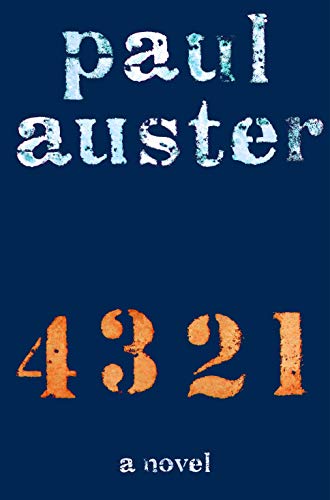
4 3 2 1
a novel
By Paul AusterHenry Holt and Company
Copyright © 2017 Paul Auster
All rights reserved.
ISBN: 978-1-62779-446-6All rights reserved.
CHAPTER 1
According to family legend, Ferguson's grandfather departed on foot from his native city of Minsk with one hundred rubles sewn into the lining of his jacket, traveled west to Hamburg through Warsaw and Berlin, and then booked passage on a ship called the Empress of China, which crossed the Atlantic in rough winter storms and sailed into New York Harbor on the first day of the twentieth century. While waiting to be interviewed by an immigration official at Ellis Island, he struck up a conversation with a fellow Russian Jew. The man said to him: Forget the name Reznikoff. It won't do you any good here. You need an American name for your new life in America, something with a good American ring to it. Since English was still an alien tongue to Isaac Reznikoff in 1900, he asked his older, more experienced compatriot for a suggestion. Tell them you're Rockefeller, the man said. You can't go wrong with that. An hour passed, then another hour, and by the time the nineteen-year-old Reznikoff sat down to be questioned by the immigration official, he had forgotten the name the man had told him to give. Your name? the official asked. Slapping his head in frustration, the weary immigrant blurted out in Yiddish, Ikh hob fargessen (I've forgotten)! And so it was that Isaac Reznikoff began his new life in America as Ichabod Ferguson.
He had a hard time of it, especially in the beginning, but even after it was no longer the beginning, nothing ever went as he had imagined it would in his adopted country. It was true that he managed to find a wife for himself just after his twenty-sixth birthday, and it was also true that this wife, Fanny, née Grossman, bore him three robust and healthy sons, but life in America remained a struggle for Ferguson's grandfather from the day he walked off the boat until the night of March 7, 1923, when he met an early, unexpected death at the age of forty-two — gunned down in a holdup at the leather-goods warehouse in Chicago where he had been employed as a night watchman.
No photographs survive of him, but by all accounts he was a large man with a strong back and enormous hands, uneducated, unskilled, the quintessential greenhorn know-nothing. On his first afternoon in New York, he chanced upon a street peddler hawking the reddest, roundest, most perfect apples he had ever seen. Unable to resist, he bought one and eagerly bit into it. Instead of the sweetness he had been anticipating, the taste was bitter and strange. Even worse, the apple was sickeningly soft, and once his teeth had pierced the skin, the insides of the fruit came pouring down the front of his coat in a shower of pale red liquid dotted with scores of pellet-like seeds. Such was his first taste of the New World, his first, never-to-be-forgotten encounter with a Jersey tomato.
Not a Rockefeller, then, but a broad-shouldered roustabout, a Hebrew giant with an absurd name and a pair of restless feet who tried his luck in Manhattan and Brooklyn, in Baltimore and Charleston, in Duluth and Chicago, employed variously as a dockhand, an ordinary seaman on a Great Lakes tanker, an animal handler for a traveling circus, an assembly-line worker in a tin-can factory, a truck driver, a ditchdigger, a night watchman. For all his efforts, he never earned more than nickels and dimes, and therefore the only things poor Ike Ferguson bequeathed to his wife and three boys were the stories he had told them about the vagabond adventures of his youth. In the long run, stories are probably no less valuable than money, but in the short run they have their decided limitations.
The leather-goods company made a small settlement with Fanny to compensate her for her loss, and then she left Chicago with the boys, moving to Newark, New Jersey, at the invitation of her husband's relatives, who gave her the top-floor apartment in their house in the Central Ward for a nominal monthly rent. Her sons were fourteen, twelve, and nine. Louis, the oldest, had long since evolved into Lew. Aaron, the middle child, had taken to calling himself Arnold after one too many schoolyard beatings in Chicago, and Stanley, the nine-year-old, was commonly known as Sonny. To make ends meet, their mother took in laundry and mended clothes, but before long the boys were contributing to the household finances as well, each one with an after-school job, each one turning over every penny he earned to his mother. Times were tough, and the threat of destitution filled the rooms of the apartment like a dense, blinding fog. There was no escape from fear, and bit by bit all three boys absorbed their mother's dark ontological conclusions about the purpose of life. Either work or starve. Either work or lose the roof over your head. Either work or die. For the Fergusons, the weak-minded notion of All-For-One-And-One-For-All did not exist. In their little world, it was All-For-All — or nothing.
Ferguson was not yet two when his grandmother died, which meant that he retained no conscious memories of her, but according to family legend Fanny was a difficult and erratic woman, prone to violent screaming fits and manic bursts of uncontrollable sobbing, who beat her boys with brooms whenever they misbehaved and was barred from entering certain local shops because of her vociferous haggling over prices. No one knew where she had been born, but word was that she had landed in New York as a fourteen-year-old orphan and had spent several years in a windowless loft on the Lower East Side making hats. Ferguson's father, Stanley, rarely talked about his parents to his son, responding to the boy's questions with only the vaguest of brief, guarded answers, and whatever bits of information young Ferguson managed to learn about his paternal grandparents came almost exclusively from his mother, Rose, by many years the youngest of the three second-generation Ferguson sisters-in-law, who in turn had received most of her information from Millie, Lew's wife, a woman with a taste for gossip who was married to a man far less hidden and far more talkative than either Stanley or Arnold. When Ferguson was eighteen, his mother passed on one of Millie's stories to him, which was presented as no more than a rumor, a piece of unsubstantiated conjecture that might have been true — and then again might not. According to what Lew had told Millie, or what Millie said he had told her, there was a fourth Ferguson child, a girl born three or four years after Stanley, during the period when the family had settled in Duluth and Ike was looking for work as an ordinary seaman on a Great Lakes ship, a stretch of months when the family was living in extreme poverty, and because Ike was gone when Fanny gave birth to the child, and because the place was Minnesota and the season was winter, an especially frigid winter in an especially cold place, and because the house they lived in was heated by only a single wood-burning stove, and because there was so little money just then that Fanny and the boys had been reduced to living on one meal a day, the thought of having to take care of another child filled her with such dread that she drowned her newborn daughter in the bathtub.
If Stanley said little about his parents to his son, he didn't say much about himself either. This made it difficult for Ferguson to form a clear picture of what his father had been like as a boy, or as a youth, or as a young man, or as anything at all until he married Rose two months after he turned thirty. From offhand...
„Über diesen Titel“ kann sich auf eine andere Ausgabe dieses Titels beziehen.
Suchergebnisse für 4321: A Novel

Beispielbild für diese ISBN
4 3 2 1 Roughcut
Anbieter: World of Books (was SecondSale), Montgomery, IL, USA
Verkäuferbewertung 5 von 5 Sternen

Zustand: Very Good. Item in very good condition! Textbooks may not include supplemental items i.e. CDs, access codes etc. Artikel-Nr. 00109448265
Gebraucht kaufen
EUR 4,93
Versand gratis
Versand innerhalb von USA
Versand innerhalb von USA
Anzahl: 1 verfügbar
Beispielbild für diese ISBN
4 3 2 1 Roughcut
Anbieter: World of Books (was SecondSale), Montgomery, IL, USA
Verkäuferbewertung 5 von 5 Sternen
Zustand: Good. Item in good condition. Textbooks may not include supplemental items i.e. CDs, access codes etc. Artikel-Nr. 00106722157
Gebraucht kaufen
EUR 4,93
Versand gratis
Versand innerhalb von USA
Versand innerhalb von USA
Anzahl: 1 verfügbar
Beispielbild für diese ISBN
4 3 2 1
Anbieter: ThriftBooks-Atlanta, AUSTELL, GA, USA
Verkäuferbewertung 5 von 5 Sternen
Hardcover. Zustand: Good. No Jacket. Former library book; Pages can have notes/highlighting. Spine may show signs of wear. ~ ThriftBooks: Read More, Spend Less. Artikel-Nr. G1627794468I3N10
Gebraucht kaufen
EUR 5,75
Versand gratis
Versand innerhalb von USA
Versand innerhalb von USA
Anzahl: 1 verfügbar
Beispielbild für diese ISBN
4 3 2 1
Anbieter: ThriftBooks-Dallas, Dallas, TX, USA
Verkäuferbewertung 5 von 5 Sternen
Hardcover. Zustand: Good. No Jacket. Former library book; Pages can have notes/highlighting. Spine may show signs of wear. ~ ThriftBooks: Read More, Spend Less. Artikel-Nr. G1627794468I3N10
Gebraucht kaufen
EUR 5,75
Versand gratis
Versand innerhalb von USA
Versand innerhalb von USA
Anzahl: 1 verfügbar
Beispielbild für diese ISBN
4 3 2 1
Anbieter: ThriftBooks-Dallas, Dallas, TX, USA
Verkäuferbewertung 5 von 5 Sternen
Hardcover. Zustand: Very Good. No Jacket. May have limited writing in cover pages. Pages are unmarked. ~ ThriftBooks: Read More, Spend Less. Artikel-Nr. G1627794468I4N00
Gebraucht kaufen
EUR 5,75
Versand gratis
Versand innerhalb von USA
Versand innerhalb von USA
Anzahl: 1 verfügbar
Beispielbild für diese ISBN
4 3 2 1
Anbieter: ThriftBooks-Dallas, Dallas, TX, USA
Verkäuferbewertung 5 von 5 Sternen
Hardcover. Zustand: Good. No Jacket. Pages can have notes/highlighting. Spine may show signs of wear. ~ ThriftBooks: Read More, Spend Less. Artikel-Nr. G1627794468I3N00
Gebraucht kaufen
EUR 5,75
Versand gratis
Versand innerhalb von USA
Versand innerhalb von USA
Anzahl: 1 verfügbar
Beispielbild für diese ISBN
4 3 2 1 : A Novel
Verlag:
Holt & Company, Henry, 2017
ISBN 10: 1627794468
ISBN 13: 9781627794466
Gebraucht
Hardcover
Erstausgabe
Anbieter: Better World Books, Mishawaka, IN, USA
Verkäuferbewertung 5 von 5 Sternen
Zustand: Good. 1st. Former library copy. Pages intact with minimal writing/highlighting. The binding may be loose and creased. Dust jackets/supplements are not included. Includes library markings. Stock photo provided. Product includes identifying sticker. Better World Books: Buy Books. Do Good. Artikel-Nr. 11246562-6
Gebraucht kaufen
EUR 6,45
Versand gratis
Versand innerhalb von USA
Versand innerhalb von USA
Anzahl: 15 verfügbar
Beispielbild für diese ISBN
4 3 2 1 : A Novel
Verlag:
Holt & Company, Henry, 2017
ISBN 10: 1627794468
ISBN 13: 9781627794466
Gebraucht
Hardcover
Erstausgabe
Anbieter: Better World Books: West, Reno, NV, USA
Verkäuferbewertung 5 von 5 Sternen
Zustand: Good. 1st. Former library copy. Pages intact with minimal writing/highlighting. The binding may be loose and creased. Dust jackets/supplements are not included. Includes library markings. Stock photo provided. Product includes identifying sticker. Better World Books: Buy Books. Do Good. Artikel-Nr. 11246562-6
Gebraucht kaufen
EUR 6,45
Versand gratis
Versand innerhalb von USA
Versand innerhalb von USA
Anzahl: 2 verfügbar
Beispielbild für diese ISBN
4 3 2 1 : A Novel
Verlag:
Holt & Company, Henry, 2017
ISBN 10: 1627794468
ISBN 13: 9781627794466
Gebraucht
Hardcover
Erstausgabe
Anbieter: Better World Books, Mishawaka, IN, USA
Verkäuferbewertung 5 von 5 Sternen
Zustand: Good. 1st. Pages intact with minimal writing/highlighting. The binding may be loose and creased. Dust jackets/supplements are not included. Stock photo provided. Product includes identifying sticker. Better World Books: Buy Books. Do Good. Artikel-Nr. 13122334-6
Gebraucht kaufen
EUR 6,45
Versand gratis
Versand innerhalb von USA
Versand innerhalb von USA
Anzahl: 1 verfügbar
Beispielbild für diese ISBN
4 3 2 1: A Novel
Verlag:
Henry Holt and Co. (edition First Edition), 2017
ISBN 10: 1627794468
ISBN 13: 9781627794466
Gebraucht
Hardcover
Erstausgabe
Anbieter: BooksRun, Philadelphia, PA, USA
Verkäuferbewertung 5 von 5 Sternen
Hardcover. Zustand: Very Good. First Edition. It's a well-cared-for item that has seen limited use. The item may show minor signs of wear. All the text is legible, with all pages included. It may have slight markings and/or highlighting. Artikel-Nr. 1627794468-11-6
Gebraucht kaufen
EUR 6,73
Versand gratis
Versand innerhalb von USA
Versand innerhalb von USA
Anzahl: 1 verfügbar