Inhaltsangabe
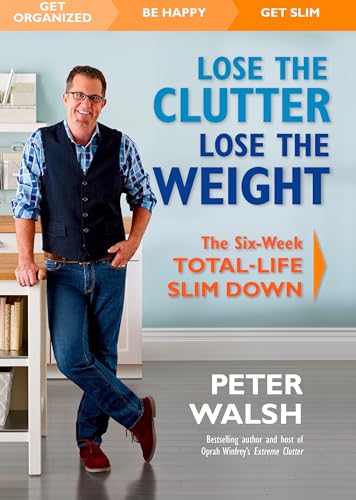
Acheive significant weight loss, a calmer mind, and a more organized, happier, efficient life
A houseful of clutter may not be the only reason people pack on extra pounds, but research proves that it plays a big role. A recent study showed that people with super-cluttered homes were 77 percent more likely to be overweight or obese! Why? Organization guru Peter Walsh thinks it's because people can't make their best choices—their healthiest choices—in a cluttered, messy, disorganized home.
In Lose the Clutter, Lose the Weight, Walsh weaves together a 6-week program that leads you step-by-step through decluttering your home, your body, and your life. He'll help you:
• Clear your home of excess "stuff" as you discover your vision for your personal space
• Clear your body of excess pounds as you follow a healthy, super-simple eating and exercise plan
• Clear your mind and spirit of the excess weight of too many possessions
With a room-by room organizing guide, dietitian-approved eating plan, exercise physiologist–developed fitness program, and quizzes to get to the root of your problem, Lose the Clutter, Lose the Weight is the only book you need to help you clear the clutter and zap the pounds.
Die Inhaltsangabe kann sich auf eine andere Ausgabe dieses Titels beziehen.
Über die Autorin bzw. den Autor
Peter Walsh is a popular organization expert who appears regularly on The Rachael Ray Show and writes a quarterly column for O: The Oprah Magazine. He has hosted several TV shows, including Clean Sweep and Extreme Clutter. He lives in Los Angeles.
Auszug. © Genehmigter Nachdruck. Alle Rechte vorbehalten.
Chapter 1
THE HIDDEN FORCES THAT MAKE YOUR HOME A MESS
Imagine a team of future archaeologists carefully examining the remains of one of today's typical homes. Hundreds of years from now, what would they think of the objects piled up in our rooms? Would they understand why we let our belongings take over so much of the space in our homes?
We don't have to wonder how archaeologists would interpret our early 21st- century homes. They're already trying to make sense of them now.
Earlier in her career, UCLA professor Jeanne Arnold, PhD, did the kind of work that the word archaeology more often brings to mind: examining bits of material left behind by ancient Native Americans. More recently, though, she shifted her focus to a very different society: modern-day Southern Californians. As part of an extended study, she and a team of researchers made in-depth explorations into 32 homes. They carefully photographed the rooms, noted exactly what types of household possessions the families treasured, and observed in real time how the residents used their homes. She wanted to find out what leads so many people to pack so much stuff inside and, once they bring it in, what they do with all of it.
All the families in these homes had kids. In all the homes, both parents worked. These were typical families with busy schedules and not a lot of time for cleaning and sorting. But Dr. Arnold and her colleagues didn't go out of their way to include homes that were especially cluttered. (They accepted families into the study without first seeing their homes.) Nor did they see evidence that the homeowners cleaned up before the team visited.
They found that many of these homes were so crowded that some of the rooms couldn't be used for their intended purposes. In three-quarters of the houses, the garage was so packed with items like sports equipment, boxes of files, lumber, and plastic bins filled with clothing that the cars were parked outside. The garage was too full to hold them.
Dr. Arnold and her team took nearly 20,000 photos in the homes, some of which ended up in a book that she co-authored about the project, Life at Home in the Twenty-First Century. One shows a shower stall where no one can bathe because it's stuffed knee-high with clothes. In another photo, no one can sit comfortably in front of the computer because the home office is so jammed with clutter. No one can relax on a couch because it's littered with stuffed animals. No one can sort laundry on top of the washer or dryer because they're covered with stacks of groceries.
CLUTTER DEFINED
The notion of "clutter" has different meanings. A household scene that looks like squalor to one might be "just a bit of a mess" to another. In this book, I'll use the word clutter a lot, and I'd like you to understand what I mean by this word.
Dr. Jeanne Arnold, the archaeologist who explores the modern world, and I see eye to eye on the three factors that turn household objects into clutter:
1. It's a lot of stuff. As you cast your eye around the room, it's hard to make sense of all the visual noise of colors and shapes. Merely owning an abundance of possessions doesn't necessarily mean that your home is cluttered, but it's a good start.
2. It's out of place. Here's where clutter begins. If you see a fork in the middle of your floor, you know it doesn't belong there. That's because forks have a very specific home, and it's not on the floor. A pile of clothes in the shower (where a person belongs) looks like clutter. Cases of sodas on the washing machine (where clothes should temporarily go) become clutter.
3. It's untidy. "A beautifully arranged bookshelf with hundreds and hundreds of books doesn't look like clutter--it looks like a nice collection, right? Whereas if the books are all falling out of the bookcase and some of them are stacked and things are sticking out of the books, it starts to look like clutter, since it's not tidy," Dr. Arnold says.
The totally uncluttered definition: Clutter is too much stuff scattered in the wrong place.
"Something like two-thirds of households had, based on a simple visual observation, an uncomfortable amount of stuff," she says. And by "uncomfortable," she means how an average visitor might feel upon entering the home. Most of the families living in these spaces, on the other hand, didn't seem to be too upset about the clutter around them or even to notice it.
"Many of the men in the households expressed no concern whatsoever about the untidy spaces or having lots of stuff. Moms more often commented on it, but only some of them commented on it using language that suggested that it caused them considerable stress," she said.
But it's hard to be truly blissful, calm, and relaxed in an untidy environment. Psychologists on the team found signs that a cluttered house could pose a threat to a peaceful state of mind. Women whose homes were more stressful--based partly on their home's clutter levels--had a pattern of changes in their cortisol levels that showed more chronic stress. Their levels of depressed mood also increased over the day.
When you truly need cortisol coursing through your system, it's great to have around. It shifts your body into a different mode--like shifting your car into a higher gear--so it's ready to fight or flee from an attacker. But long term, you don't want too much cortisol and other stress hormones flooding your system. Revving up your car for too long isn't good for the engine, and excess stress hormones in your system can, over time:
Keep you from sleeping
Make you feel sick to your stomach
Throw off your mental focus
Hurt your heart
Make you feel more anxious or depressed
Contribute to weight gain
A cluttered house isn't a good enough reason to do this to your body and your mind.
After many visits to messy homes, I've come to realize that clutter is a customary part of most families' lives and that many families have given up on trying to keep it under control. I've also learned that the accumulation of too much stuff in people's homes has more serious and negative effects on their lives than they realize. Clutter has:
A financial impact: Take, for example, the father who traveled constantly for work. He was wracked with guilt because he rarely spent time with his children, so he bought them toys to make up for his absence. When I started working with the family, all their credit cards were maxed out and the huge plastic containers of untouched toys that filled their garage had long ago begun to spill out into their yard.
An emotional impact: I met a mother who became obsessed with collecting plastic action figures and other memorabilia from a national restaurant franchise. Her 8- and 12-year-old daughters had never shared a family meal at the kitchen table because it was so cluttered with this stuff that they couldn't even see it.
A social impact: A young mother couldn't say no to the offers of hand-me- down clothes from her family and friends. Once she had the clothes, she felt too guilty to part with them. With three children under the age of 6, her home was so packed with kids' clothing that she felt too embarrassed to have anyone in for a visit. She became increasingly isolated and depressed.
A relationship impact: A couple collected "gifts" for family and friends, but never actually gave them away. Their surroundings were so cluttered that their grandchildren had never even visited their home.
While many of the homes I visit are much, much worse than the homes in Jeanne Arnold's book, in all of them I find families that are stressed, less happy than they could be, and unable to live the kind of lives they'd like. They're drowning in too much stuff. When we talk about their surroundings, without exception these conversations dredge...
„Über diesen Titel“ kann sich auf eine andere Ausgabe dieses Titels beziehen.
Weitere beliebte Ausgaben desselben Titels

Suchergebnisse für Lose the Clutter, Lose the Weight: The Six-Week Total-Life...

Beispielbild für diese ISBN
Lose the Clutter, Lose the Weight: The Six-Week Total-Life Slim Down
Anbieter: ThriftBooks-Reno, Reno, NV, USA
Verkäuferbewertung 5 von 5 Sternen

Hardcover. Zustand: Good. No Jacket. Missing dust jacket; Pages can have notes/highlighting. Spine may show signs of wear. ~ ThriftBooks: Read More, Spend Less. Artikel-Nr. G1623364841I3N01
Beispielbild für diese ISBN
Lose the Clutter, Lose the Weight: The Six-Week Total-Life Slim Down
Anbieter: ThriftBooks-Dallas, Dallas, TX, USA
Verkäuferbewertung 5 von 5 Sternen
Hardcover. Zustand: Good. No Jacket. Former library book; Pages can have notes/highlighting. Spine may show signs of wear. ~ ThriftBooks: Read More, Spend Less. Artikel-Nr. G1623364841I3N10
Beispielbild für diese ISBN
Lose the Clutter, Lose the Weight: The Six-Week Total-Life Slim Down
Anbieter: ThriftBooks-Atlanta, AUSTELL, GA, USA
Verkäuferbewertung 5 von 5 Sternen
Hardcover. Zustand: Good. No Jacket. Former library book; Pages can have notes/highlighting. Spine may show signs of wear. ~ ThriftBooks: Read More, Spend Less. Artikel-Nr. G1623364841I3N10
Beispielbild für diese ISBN
Lose the Clutter, Lose the Weight: The Six-Week Total-Life Slim Down
Anbieter: ThriftBooks-Atlanta, AUSTELL, GA, USA
Verkäuferbewertung 5 von 5 Sternen
Hardcover. Zustand: Very Good. No Jacket. Missing dust jacket; May have limited writing in cover pages. Pages are unmarked. ~ ThriftBooks: Read More, Spend Less. Artikel-Nr. G1623364841I4N01
Beispielbild für diese ISBN
Lose the Clutter, Lose the Weight: The Six-Week Total-Life Slim Down
Anbieter: ThriftBooks-Dallas, Dallas, TX, USA
Verkäuferbewertung 5 von 5 Sternen
Hardcover. Zustand: Good. No Jacket. Pages can have notes/highlighting. Spine may show signs of wear. ~ ThriftBooks: Read More, Spend Less. Artikel-Nr. G1623364841I3N00
Beispielbild für diese ISBN
Lose the Clutter, Lose the Weight: The Six-Week Total-Life Slim Down
Anbieter: ThriftBooks-Atlanta, AUSTELL, GA, USA
Verkäuferbewertung 5 von 5 Sternen
Hardcover. Zustand: Very Good. No Jacket. Former library book; May have limited writing in cover pages. Pages are unmarked. ~ ThriftBooks: Read More, Spend Less. Artikel-Nr. G1623364841I4N10
Beispielbild für diese ISBN
Lose the Clutter, Lose the Weight : The Six-Week Total-Life Slim Down
Verlag:
Potter/Ten Speed/Harmony/Rodale, 2015
ISBN 10: 1623364841
ISBN 13: 9781623364847
Gebraucht
Hardcover
Erstausgabe
Anbieter: Better World Books, Mishawaka, IN, USA
Verkäuferbewertung 5 von 5 Sternen
Zustand: Very Good. 1st Edition. Former library book; may include library markings. Used book that is in excellent condition. May show signs of wear or have minor defects. Artikel-Nr. GRP101707054
Beispielbild für diese ISBN
Lose the Clutter, Lose the Weight : The Six-Week Total-Life Slim Down
Verlag:
Potter/Ten Speed/Harmony/Rodale, 2015
ISBN 10: 1623364841
ISBN 13: 9781623364847
Gebraucht
Hardcover
Erstausgabe
Anbieter: Better World Books, Mishawaka, IN, USA
Verkäuferbewertung 5 von 5 Sternen
Zustand: Good. 1st Edition. Used book that is in clean, average condition without any missing pages. Artikel-Nr. 4039211-6
Beispielbild für diese ISBN
Lose the Clutter, Lose the Weight : The Six-Week Total-Life Slim Down
Verlag:
Potter/Ten Speed/Harmony/Rodale, 2015
ISBN 10: 1623364841
ISBN 13: 9781623364847
Gebraucht
Hardcover
Erstausgabe
Anbieter: Better World Books, Mishawaka, IN, USA
Verkäuferbewertung 5 von 5 Sternen
Zustand: Very Good. 1st Edition. Used book that is in excellent condition. May show signs of wear or have minor defects. Artikel-Nr. 6454521-6
Beispielbild für diese ISBN
Lose the Clutter, Lose the Weight : The Six-Week Total-Life Slim Down
Verlag:
Potter/Ten Speed/Harmony/Rodale, 2015
ISBN 10: 1623364841
ISBN 13: 9781623364847
Gebraucht
Hardcover
Erstausgabe
Anbieter: Better World Books, Mishawaka, IN, USA
Verkäuferbewertung 5 von 5 Sternen
Zustand: Good. 1st Edition. Former library book; may include library markings. Used book that is in clean, average condition without any missing pages. Artikel-Nr. GRP97470576