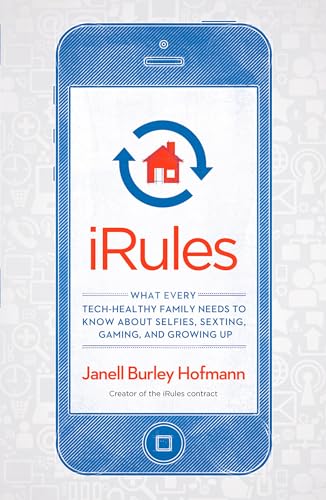
iRules: What Every Tech-Healthy Family Needs to Know about Selfies, Sexting, Gaming, and Growing up - Softcover
Inhaltsangabe
As Janell Burley Hofmann, mother of five, wrapped her 13-year-old's iPhone on Christmas Eve, she was overwhelmed by questions: "Will my children learn to sit and wonder without Googling? Should I know their passwords for online accounts? Will they experience the value of personal connection without technology?"
To address her concerns, she outlined boundaries and expectations in a contract for her son to sign upon receiving his first cell phone. When Hofmann's editor at The Huffington Post posted the contract, now known as iRules, it resonated on a massive scale and went viral, resulting in a tsunami of media coverage and requests. It quickly became apparent that people across the country were hungry for more.
In iRules, Hofmann provides families with the tools they need to find a balance between technology and human interaction through a philosophy she calls Slow Tech Parenting. In the book, she educates parents about the online culture tweens and teens enter the minute they go online, exploring issues like cyberbullying, friend fail, and sexting, as well as helping parents create their own iRules contracts to fit their families' needs. As funny and readable as it is prescriptive, iRules will help parents figure out when to unplug and how to stay in sync with the changing world of technology, while teaching their children self-respect, integrity, and responsibility.
Die Inhaltsangabe kann sich auf eine andere Ausgabe dieses Titels beziehen.
Über die Autorin bzw. den Autor
Janell Burley Hofmann is a parent coach who writes about parenting and technology for The Huffington Post; has a weekly spot on "American Public Media Marketplace," NPR, as tech etiquette consultant; and has been covered by major national media, including Good Morning America.
Auszug. © Genehmigter Nachdruck. Alle Rechte vorbehalten.
Awareness and Action
iRule: Talk! And Talk Some More!
My iRule: It is my phone. I bought it. I pay for it. I am loaning it to you. Aren't I the greatest?
When we became parents, we did not know this would be our fate. We did not know that the technology would burst into our lives with such intensity and appeal. We did not know that every one of us--including our children—would be engaged in a different and equally powerful way. Well, at least I didn't know. When I first became a mother in 1999, I was still finishing my bachelor's degree. We had a desktop computer and I used it for one sole purpose—word processing. I was a picture of focus as I finished papers and projects during newborn naps and in the wee hours of the night. Of course I had e-mail too. But it seemed secondary to calling someone on the phone or meeting for coffee and doughnuts. I remember when Gregory was about eighteen months old, we had cable Internet installed in the tiny corner room of our apartment. This was living. It was so fast. I could research and shop and listen and browse without being at a computer lab or using dial-up or waiting. I was in awe of the potential this one computer had and all the ways I could access the world—in an instant—from my humble home.
Just as Gregory's language skills started to develop, so did his interest in the computer. He'd wake up in the morning all warm and sleepy, and as I picked that sturdy baby body up into my arms, he'd say, "Elmo! 'Puter!" How sweet. I thought he was so smart. I mean, I'd never met a computer-loving baby. It was endearing, really. We would have breakfast and then sit down together at the "'puter" and play. He would be on my lap asking for "Sesame-dot-com" or "Bob the Builder." At first he would point and I would click and we'd play together, snuggled up and squealing over our favorite characters. But over time, he'd push my hand right out of the way and navigate the mouse himself. He wanted to sit alone: "No, Mom, I do it." He became obsessed with the games and stories and songs all at his fingertips, animated and exciting. The fun was predictable enough to delight, but a two-year-old could control or alter just enough of the action to make it worth coming back for more. He'd see computers in the homes of his grandparents and friends and beg for a turn. We had to start setting timers, distracting him, using tools to redirect his attention, and shutting down the computer completely for hours so use was nonnegotiable. I'm laughing now, as I dig through my memory for our tech beginnings, thinking that we have been creating and negotiating iRules for most of Greg's life.
But even then, though I saw how drawn to and immersed in the computer he was, I don't think I fully understood what was unfolding. Even if I had been told that someday very soon, Gregory could have that computer inside a small cell phone, with an added camera and various easy communication tools, and bring it anywhere he wanted in his back pocket, I would have never believed you. No person will ever need that, nevermind a child, I would have thought. But here we are. We are the generation of parents who are the bridge between "before" and "after" the technology. We lived our own childhoods without and we are raising the first generation with. We have the benefit of insight and wisdom gleaned from our tech-free past. But we have no one ahead of us leading the way to our tech future. So what can we do right now? How can we parent the technology in the present with the knowledge, tools, and instincts we have in this very moment in time?
I believe dialogue to be the most critical piece in raising children. Through parent-and-child conversation, we can solve, discuss, prevent, laugh, connect, disagree, understand, share, and grow. We need to start talking. We need to ask questions. We need to share stories. We need to talk to our partners and extended family members. We need to start conversations in the community with educators, pediatricians, neighbors. We need to assess our family's wants, needs, goals, and values in general and then apply them to the technology—even if our results look very different from someone else's. Because when we talk to our children, to our families, and within our communities, we do not feel alone. We share our perspectives and gather strength from both shared and opposing viewpoints. We start to feel secure in our views and we become stronger parents because of it.
When we feel overwhelmed as parents, we need to hold ourselves up. And high! We cannot back down from the knowledge that we are the parents. We are the authority. Not controlling, overbearing, no-freedom-to-make-a-mistake parents, but our children's models and lifelong guides. We can lovingly walk the path with them while enforcing boundaries and limits. Families must be proud of their choices and get in touch with their truth about raising a family. But parenting is part natural and part learned. We need to take our parenting seriously and to regard it as one of the greatest responsibilities we will ever have, which means making a commitment to trust our core parental instincts and seek out resources and services available to help us grow.
iRules may look different for each of us. For example, parents that don't pick their kids up from school until 7:00 p.m. may allow their children later tech hours than I do, because Greg gets home most days at 2:45. We all have different daily routines and needs, but we can use the same strategies to build our own sets of boundaries in our own homes. Before we begin with our first step, a Tech Talk, we must have specific conversations and assess a series of our own feelings and beliefs.
Before Your Tech Talk
You must come together! A key component of making your iRules a success is to have complete accord with your spouse, partner, or anyone parenting with you. This may mean scheduling discussions without the children present, ironing out varied views or opinions to maintain a united front, and allowing all of those involved in raising your children to contribute to the creation of your family iRules. This is crucial and cannot be avoided. Teamwork makes the dream work!
Although I composed our family iRules, Adam and I had been having discussions about our tech beliefs for years. He is a tech lover in some ways—he appreciates devices' functionality, purposes, streamlining--while I'm a tech lover in others—I value and use devices socially, for picture taking, texting, sharing. Both sets of interests impacted our iRules contract. As we watched the technology evolve and make its way to younger and younger children, we talked. We talked about articles we'd read and conversations we'd had with other people. Before I showed Greg our iRules contract, Adam looked at it, made changes and additions to make sure that we could both agree to parent it consistently.
As you begin these discussions about technology, ask yourself, how does the technology feel? Assess your own feelings and values about specific technologies. Do you feel confident in knowing how the technology works or are you intimidated? How do you feel when your children use that technology? When your daughter is staring down at the smartphone screen for hours, do you want to scream? If you see your son playing violent video games, do you cringe? When your toddler collapses on the floor crying for the iPad, do you feel helpless? Note these feelings so you can address specific boundaries head-on while being aware of your emotional temperature in each instance.
I have to admit that I can be tense around technology. I studied mass media in college, and the impacts that papers, projects, discussions, lectures, and my thesis research had have never left me. I saw how media use influences perception and behavior—especially media used without...
„Über diesen Titel“ kann sich auf eine andere Ausgabe dieses Titels beziehen.
Suchergebnisse für iRules: What Every Tech-Healthy Family Needs to Know...

Beispielbild für diese ISBN
iRules: What Every Tech-Healthy Family Needs to Know about Selfies, Sexting, Gaming, and Growing up
Verlag:
Rodale Books (edition ), 2014
ISBN 10: 1623363527
ISBN 13: 9781623363529
Gebraucht
Paperback
Anbieter: BooksRun, Philadelphia, PA, USA
Verkäuferbewertung 5 von 5 Sternen

Paperback. Zustand: Good. It's a preowned item in good condition and includes all the pages. It may have some general signs of wear and tear, such as markings, highlighting, slight damage to the cover, minimal wear to the binding, etc., but they will not affect the overall reading experience. Artikel-Nr. 1623363527-11-1
Beispielbild für diese ISBN
IRules : What Every Tech-Healthy Family Needs to Know about Selfies, Sexting, Gaming, AndGrowing Up
Verlag:
Potter/Ten Speed/Harmony/Rodale, 2014
ISBN 10: 1623363527
ISBN 13: 9781623363529
Gebraucht
Softcover
Anbieter: Better World Books, Mishawaka, IN, USA
Verkäuferbewertung 5 von 5 Sternen
Zustand: Good. Former library book; may include library markings. Used book that is in clean, average condition without any missing pages. Artikel-Nr. GRP102465693
Beispielbild für diese ISBN
iRules: What Every Tech-Healthy Family Needs to Know about Selfies, Sexting, Gaming, andGrowing up
Verlag:
Harmony/Rodale/Convergent, 2014
ISBN 10: 1623363527
ISBN 13: 9781623363529
Gebraucht
Paperback
Anbieter: ThriftBooks-Atlanta, AUSTELL, GA, USA
Verkäuferbewertung 5 von 5 Sternen
Paperback. Zustand: As New. No Jacket. Pages are clean and are not marred by notes or folds of any kind. ~ ThriftBooks: Read More, Spend Less. Artikel-Nr. G1623363527I2N00
Beispielbild für diese ISBN
iRules: What Every Tech-Healthy Family Needs to Know about Selfies, Sexting, Gaming, andGrowing up
Verlag:
Harmony/Rodale/Convergent, 2014
ISBN 10: 1623363527
ISBN 13: 9781623363529
Gebraucht
Paperback
Anbieter: ThriftBooks-Atlanta, AUSTELL, GA, USA
Verkäuferbewertung 5 von 5 Sternen
Paperback. Zustand: Good. No Jacket. Pages can have notes/highlighting. Spine may show signs of wear. ~ ThriftBooks: Read More, Spend Less. Artikel-Nr. G1623363527I3N00
Beispielbild für diese ISBN
Irules: What Every Tech-healthy Family Needs to Know About Selfies, Sexting, Gaming, and Growing Up
Anbieter: Revaluation Books, Exeter, Vereinigtes Königreich
Verkäuferbewertung 5 von 5 Sternen
Paperback. Zustand: Brand New. 240 pages. 8.50x5.50x1.00 inches. In Stock. Artikel-Nr. 1623363527
Neu kaufen
EUR 32,84
Versand:
EUR 11,37
Von Vereinigtes Königreich nach USA
Anzahl: 1 verfügbar
Foto des Verkäufers
iRules: What Every Tech-Healthy Family Needs to Know about Selfies, Sexting, Gaming, and Growing Up
Anbieter: moluna, Greven, Deutschland
Verkäuferbewertung 4 von 5 Sternen

Zustand: New. Über den AutorrnrnJanell Burley Hofmann is a parent coach who writes about parenting and technology for The Huffington Post has a weekly spot on American Public Media Marketplace, NPR, as tech etiquette consultant and has been covered b. Artikel-Nr. 904575314
Neu kaufen
EUR 21,44
Versand:
EUR 48,99
Von Deutschland nach USA
Anzahl: Mehr als 20 verfügbar
Foto des Verkäufers
iRules : What Every Tech-Healthy Family Needs to Know about Selfies, Sexting, Gaming, andGrowing up
Verlag:
Penguin Random House LLC Mai 2014, 2014
ISBN 10: 1623363527
ISBN 13: 9781623363529
Neu
Taschenbuch
Anbieter: AHA-BUCH GmbH, Einbeck, Deutschland
Verkäuferbewertung 5 von 5 Sternen
Taschenbuch. Zustand: Neu. Neuware - As Janell Burley Hofmann, mother of five, wrapped her 13-year-old's iPhone on Christmas Eve, she was overwhelmed by questions: 'Will my children learn to sit and wonder without Googling Should I know their passwords for online accounts Will they experience the value of personal connection without technology 'To address her concerns, she outlined boundaries and expectations in a contract for her son to sign upon receiving his first cell phone. When Hofmann's editor at The Huffington Post posted the contract, now known as iRules, it resonated on a massive scale and went viral, resulting in a tsunami of media coverage and requests. It quickly became apparent that people across the country were hungry for more.In iRules, Hofmann provides families with the tools they need to find a balance between technology and human interaction through a philosophy she calls Slow Tech Parenting. In the book, she educates parents about the online culture tweens and teens enter the minute they go online, exploring issues like cyberbullying, friend fail, and sexting, as well as helping parents create their own iRules contracts to fit their families' needs. As funny and readable as it is prescriptive, iRules will help parents figure out when to unplug and how to stay in sync with the changing world of technology, while teaching their children self-respect, integrity, and responsibility. Artikel-Nr. 9781623363529
Neu kaufen
EUR 25,21
Versand:
EUR 61,74
Von Deutschland nach USA
Anzahl: 2 verfügbar