
Verwandte Artikel zu Animal Models of Movement Disorders: Volume II (Neuromethods...
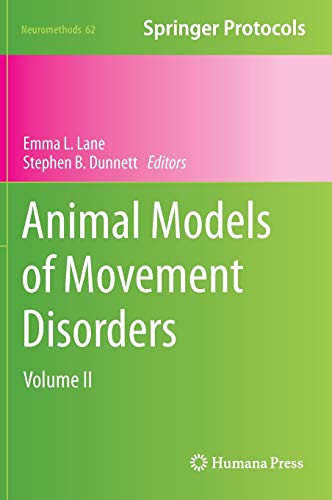
Inhaltsangabe
Movement is the way that animals interact with their environment and is under the organization and complex control of the brain and spinal cord. Multiple central nervous systems, including cortex, basal ganglia, cerebellum, and brainstem, interact to provide precise motor control and integration. Damage or disease within these systems cause profound motor disturbances in man, which can be effectively modeled in animals to develop a better understanding and treatment of the human condition. Animal Models of Movement Disorders introduces a variety of methods and techniques used to model and assess motor function in experimental animals from lower orders, such as drosophila and c. elegans, through vertebrate species including fish, to mammals, such as rodents and non-human primates. The most advanced contemporary models in each system are presented at multiple levels of analysis from molecular and genetic modeling, lesions, anatomy, neurochemistry, to imaging and behavior. Volume II of this detailed collection contains sections on the basal ganglia, neo- and allo-cortical systems, cerebellar and brain stem systems, as well as spinal cord systems.
Comprehensive and meticulous, Animal Models of Movement Disorders serves as a valuable reference for those studying motor disorders by covering methodologies in detail and providing the information necessary to consider both the appropriate models and assessment tools that can most informatively answer the key experimental issues in the field.
Die Inhaltsangabe kann sich auf eine andere Ausgabe dieses Titels beziehen.
Von der hinteren Coverseite
Movement is the way that animals interact with their environment and is under the organization and complex control of the brain and spinal cord. Multiple central nervous systems, including cortex, basal ganglia, cerebellum, and brainstem, interact to provide precise motor control and integration. Damage or disease within these systems cause profound motor disturbances in man, which can be effectively modeled in animals to develop a better understanding and treatment of the human condition. Animal Models of Movement Disorders introduces a variety of methods and techniques used to model and assess motor function in experimental animals from lower orders, such as drosophila and c. elegans, through vertebrate species including fish, to mammals, such as rodents and non-human primates. The most advanced contemporary models in each system are presented at multiple levels of analysis from molecular and genetic modeling, lesions, anatomy, neurochemistry, to imaging and behavior. Volume II of this detailed collection contains sections on the basal ganglia, neo- and allo-cortical systems, cerebellar and brain stem systems, as well as spinal cord systems.
Comprehensive and meticulous, Animal Models of Movement Disorders serves as a valuable reference for those studying motor disorders by covering methodologies in detail and providing the information necessary to consider both the appropriate models and assessment tools that can most informatively answer the key experimental issues in the field.
„Über diesen Titel“ kann sich auf eine andere Ausgabe dieses Titels beziehen.
Suchergebnisse für Animal Models of Movement Disorders: Volume II (Neuromethods...

Beispielbild für diese ISBN
Animal Models of Movement Disorders: Volume II (Neuromethods, 62)
Anbieter: Ria Christie Collections, Uxbridge, Vereinigtes Königreich
Verkäuferbewertung 5 von 5 Sternen

Zustand: New. In English. Artikel-Nr. ria9781617793004_new
Neu kaufen
EUR 184,28
EUR 17,61 Versand
Versand von Vereinigtes Königreich nach USA
Versand von Vereinigtes Königreich nach USA
Anzahl: Mehr als 20 verfügbar
Beispielbild für diese ISBN
Animal Models of Movement Disorders: Vol 62
Anbieter: Revaluation Books, Exeter, Vereinigtes Königreich
Verkäuferbewertung 5 von 5 Sternen
Hardcover. Zustand: Brand New. 1st edition. 443 pages. 10.00x7.00x1.25 inches. In Stock. Artikel-Nr. x-1617793000
Neu kaufen
EUR 248,22
EUR 17,68 Versand
Versand von Vereinigtes Königreich nach USA
Versand von Vereinigtes Königreich nach USA
Anzahl: 2 verfügbar
Beispielbild für diese ISBN
Animal Models of Movement Disorders
Anbieter: Kennys Bookstore, Olney, MD, USA
Verkäuferbewertung 5 von 5 Sternen
Zustand: New. Here are techniques for modeling and assessing motor function in experimental animals from lower orders through vertebrates to mammals. Vol. II covers basal ganglia, neo- and allo-cortical systems, cerebellar and brain stem systems and spinal cord systems. Editor(s): Lane, Emma L.; Dunnett, Stephen B. Series: Neuromethods. Num Pages: 458 pages, 48 black & white illustrations, 28 colour illustrations, 16 black & white tables, biograp. BIC Classification: MJN; PSAN; PSVL. Category: (P) Professional & Vocational. Dimension: 254 x 178 x 30. Weight in Grams: 1051. . 2011. 2011. Hardback. . . . . Books ship from the US and Ireland. Artikel-Nr. V9781617793004
Neu kaufen
EUR 257,99
EUR 9,36 Versand
Versand innerhalb von USA
Versand innerhalb von USA
Anzahl: 15 verfügbar