
Verwandte Artikel zu Making History
Inhaltsangabe
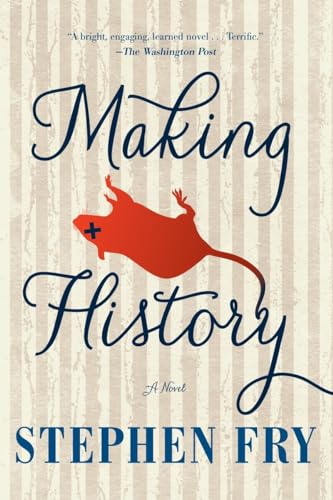
Stephen Fry tackles alternate history, asking: What if Hitler had never been born?
Michael Young is a graduate student at Cambridge who is completing his dissertation on the early life of Adolf Hitler. Leo Zuckerman is an aging German physicist and Holocaust survivor. Together they idealistically embark on an experiment to change the course of history. And with their success is launched a brave new world that is in some ways better than ours—but in most ways even worse. Fry’s sci-fi-tinged experiment in history makes for an ambitious and deeply affecting novel.
Die Inhaltsangabe kann sich auf eine andere Ausgabe dieses Titels beziehen.
Über die Autorin bzw. den Autor
Stephen Fry is an actor, producer, director, and writer who has appeared in numerous TV series and movies, including Jeeves and Wooster, Wilde, Gosford Park, V for Vendetta and The Hobbit: The Desolation of Smaug. He is the bestselling author of four novels, as well as several works of nonfiction, and divides his time between New York and the UK.
Auszug. © Genehmigter Nachdruck. Alle Rechte vorbehalten.
MAKING COFFEE
It starts with a dream . . .
It starts with a dream. This story, which can start everywhere and nowhere like a circle, starts, for me—and it is, after all, my story and no one else’s, never could be anyone else’s but mine—it starts with a dream I dreamed one night in May.
The wildest kind of dream. Jane was in it, stiff and starchy as a hotel napkin. He was there too. I didn’t recognize him of course. I hardly knew him then. Just an old man to nod to in the street or smile through a politely held library door. The dream rejuvenated him, transformed him from boneless, liverspotted old beardy into Mack Sennett barman with drooping black mustache tacked to a face hangdog long and white with undernourishment.
His face, for all that. Not that I knew it then.
In this dream he was in the lab with Jane: Jane’s lab, of course—the dream was not prophetic enough to foretell the dimensions of his lab, which I only got to know later—that is if the dream was prophetic at all, which it may well not have been. If you get me.
This is going to be hard.
Anyway, she was peering into a microscope and he was feeling her up from behind. He stroked between her thighs inside the long white coat. She was taking no notice, but I was outraged, outraged when the soft veef of hands rubbing nylon stopped and I knew that his fingers had reached the uppermost part of her long legs, the place where stocking ended and soft hot private flesh—hot private flesh belonging to me—began.
“Leave her alone!” I called from some unseen director’s corner, behind, as it were, the dream’s camera.
He gazed up at me with sad eyes that held me, as they always do, in the bright beam of their blue. Or always subsequently did, because I had, in my real waking life at that point, never so much as exchanged a single word with him.
“Wachet auf,” he says.
And I obey.
Strong light of a May morning whitening the dirty cream of cruddy curtains that we meant to change months ago.
“Morning, babe,” I murmur. “Double Gloucester . . . my mother always said cheese dreams.”
But she’s not there. Jane, that is, not my mother. My mother isn’t there either as a matter of fact. Certainly not. It absolutely isn’t that kind of story.
Jane’s half of the bed is cold. I strain my ears for the hissing of the shower or the crack of teacups banged clumsily on the draining board. Everything Jane does, outside of work, she does clumsily. She has this habit of turning her head away from her hands, like a squeamish student nurse picking up a raw appendix. The hand holding a cigarette end, for instance, might stretch leftwards to an ashtray, while she will look off to the right, grinding the butt into a saucer, a book, a tablecloth, a plate of food. I have always found uncoordinated women, nearsighted women, long, gawky, awkward women, powerfully attractive.
I have started to wake up now. The last granules of the dream fizz away and I am ready for the morning puzzle of self-reinvention. I stare at the ceiling and remember what there is to remember.
We will leave me lying there for the moment, reassembling myself. I am not entirely sure that I am telling this story the right way round. I have said that it is like a circle, approachable from any point. It is also, like a circle, unapproachable from any point.
History is my business.
What a way to start . . . history isn’t my business at all. I managed, at least, to stop myself from describing history as my “trade,” for which I reckon I can award myself some points. History is my passion, my calling. Or, to be more painfully truthful, it is my field of least incompetence. It is what, for the time being, I do. Had I the patience and the discipline I should have chosen literature. But, while I can read Middlemarch and The Dunciad or, I don’t know, Julian Barnes or Jay McInerney say, as happily as anyone, I have this little region missing in my brain, that extra lobe that literature students possess as a matter of course, the lobe that allows them the detachment and the nerve to talk about books (texts they will say) as others might talk about the composition of a treaty or the structure of a cell. I can remember at school how we would read together in class an ode by Keats, a Shakespeare sonnet or a chapter of Animal Farm. I would tingle inside and want to sob, just at the words, at nothing more than the simple progression of sounds. But when it came to writing that thing called an essay, I flubbed and floundered. I could never discover where to start. How do you find the distance and the cool to write in an academically approved style about something that makes you spin, wobble and weep?
I remember that child in the Dickens novel, Hard Times I think it is, the girl who had grown up with carnival people, spending her days with horses, tending them, feeding them, training them and loving them. There’s a scene where Gradgrind (it is Hard Times, I’ve just looked it up) is showing off his school to a visitor and asks this girl to define “horse” and of course the poor scrap dries up completely, just stutters and fumbles and stares hopelessly in front of her like a moron.
“Girl number twenty unable to define a horse!” Gradgrind says and turns with a great sneer to the smart little weasel, Bitzer, a cocksure street kid who’s probably never dared so much as pat a horse in his life, gets a kick out of throwing stones at them I expect. This little runt stands up with a smirk and comes out pat with “Quadruped. Graminivorous. Forty teeth . . .” and so on, to wild applause and admiration.
“Now girl number twenty you know what a horse is,” says Gradgrind.
Well, each time I was asked to write an essay at school, with a title like “Wordsworth’s Prelude is the Egotism without the Sublime: Discuss,” I felt, when I got back my paper marked E or F or whatever, as if I were the stuttering horse lover and the rest of the class, with their As and Bs, were the smart-arsed parroting runts who had lost their souls. You could only write successfully about books and poems and plays if you didn’t care, really care, about them. Hysterical schoolboy wank, for sure, an attitude compounded of nothing but egotism, vanity and cowardice. But how deeply felt. I went through all my school days convinced of this, that “literary studies” were no more than a series of autopsies performed by heartless technicians. Worse than autopsies: biopsies. Vivisection. Even movies, which I love more than anything, more than life itself, they even do it with movies these days. You can’t talk about movies now without a methodology. Once they start offering courses, you know the field is dead. History, I found, was safer ground for me: I didn’t love Rasputin or Talleyrand or Charles the Fifth or Kaiser Bill. Who could? A historian has the pleasant luxury of being able to point out, from the safety of his desk, where Napoleon ballsed up, how this...
„Über diesen Titel“ kann sich auf eine andere Ausgabe dieses Titels beziehen.
Suchergebnisse für Making History

Beispielbild für diese ISBN
Making History
Anbieter: BooksRun, Philadelphia, PA, USA
Verkäuferbewertung 5 von 5 Sternen

Paperback. Zustand: Very Good. It's a well-cared-for item that has seen limited use. The item may show minor signs of wear. All the text is legible, with all pages included. It may have slight markings and/or highlighting. Artikel-Nr. 1616955252-11-1
Gebraucht kaufen
EUR 49,76
Versand gratis
Versand innerhalb von USA
Versand innerhalb von USA
Anzahl: 1 verfügbar
Beispielbild für diese ISBN
Making History
Anbieter: BooksRun, Philadelphia, PA, USA
Verkäuferbewertung 5 von 5 Sternen
Paperback. Zustand: Very Good. It's a well-cared-for item that has seen limited use. The item may show minor signs of wear. All the text is legible, with all pages included. It may have slight markings and/or highlighting. Artikel-Nr. 1616955252-8-1
Gebraucht kaufen
EUR 49,76
Versand gratis
Versand innerhalb von USA
Versand innerhalb von USA
Anzahl: 1 verfügbar
Beispielbild für diese ISBN
Making History
Anbieter: World of Books (was SecondSale), Montgomery, IL, USA
Verkäuferbewertung 5 von 5 Sternen
Paperback. Zustand: Very Good. Stephen Fry tackles alternate history, asking: What if Hitler had never been born? Michael Young is a graduate student at Cambridge who is completing his dissertation on the early life of Adolf Hitler. Leo Zuckerman is an aging German physicist and Holocaust survivor. Together they idealistically embark on an experiment to change the course of history. And with their success is launched a brave new world that is in some ways better than ours--but in most ways even worse. Fry's sci-fi-tinged experiment in history makes for an ambitious and deeply affecting novel. Artikel-Nr. 00099692751
Gebraucht kaufen
EUR 49,78
Versand gratis
Versand innerhalb von USA
Versand innerhalb von USA
Anzahl: 1 verfügbar