
Verwandte Artikel zu Converging Parallels (Inspector Trotti, Band 1)
Converging Parallels (Inspector Trotti, Band 1) - Softcover
Buch 1 von 6: A Commissario Trotti Investigation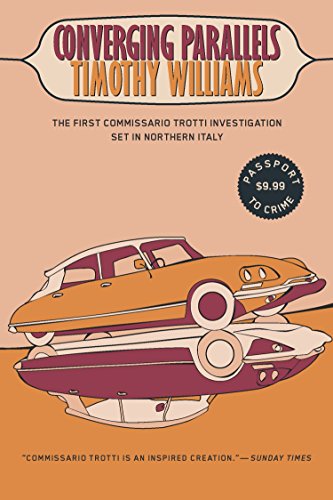
Inhaltsangabe
A small-town kidnapping presents a major problem for Commissario Trotti—and draws us into CWA Award winner Timothy Williams' debut, set against the rich backdrop of a provincial Italian city.
Northern Italy, 1978: Commissario Piero Trotti, trusted senior police investigator in an anonymous provincial city off the River Po, has two difficult cases to solve. A dismembered body has been found in the river, and it’s up to Trotti to figure out who the murder victim is. At the same time, an estranged friend approaches Trotti with a desperate personal plea: his six-year-old daughter—Trotti’s own goddaughter—has been kidnapped. In the wake of the high-profile kidnapping of Aldo Moro, president of Italy’s majority party, faith in law enforcement is at an all-time low, and it’s no surprise the distraught father isn’t willing to take this matter to the police.
Die Inhaltsangabe kann sich auf eine andere Ausgabe dieses Titels beziehen.
Über die Autorin bzw. den Autor
CWA award-winning author Timothy Williams has written six crime novels set in Italy featuring Commissario Piero Trotti as well as two novels set in the French Caribbean, Another Sun and The Honest Folk of Guadeloupe. Born in London and educated at St. Andrews, Williams has taught at the universities of Poitiers in France, Bari and Pavia in Italy, at Jassy in Romania, and most recently in the French West Indies. The Observer placed him among the ten best modern European crime novelists.
Auszug. © Genehmigter Nachdruck. Alle Rechte vorbehalten.
Chapter 1
Trotti sat at his desk and for a moment stared out of the window.
The sky was dark with future rain and the tiles of the neighboring rooftops had lost their terracotta glow. A swallow dropped through the air. The cooing of the pigeons had ceased.
He felt depressed, slightly sick. After a week of hot summer days—and this at the end of April—dark cloudbanks had formed to the north and had come up over the Alps, bringing a chill air. His ankles were cold in the short white socks. At the same time, he felt sticky and uncomfortable.
“Magagna!”
Brigadiere Magagna stuck his head through the door. “Dottore?”
“Bring me a coffee. And one for yourself.”
The door closed.
He looked again at the photographs on his desk: a dead piece of flesh. Without meaning, without purpose, photographed in a glossy black and white.
Trotti had seen his first corpse when he was seventeen years old. A couple of partisans, not much older than himself, in shabby clothes, the red scarf still around their necks, had been strung up by the repubblichini and left to bleed to death. At the time he had wondered what had become of the amputated hands. The smell, the dark blood on the cobblestones and the flies—they had been part of his nightmares ever since.
Magagna knocked and entered carrying a small tray; the air of the dingy office filled with the reassuring aroma of coffee.
“Grappa?” Trotti took the bottle from the cupboard of the desk and without waiting for a reply, poured a shot into each cup. Small, plastic cups with vacuum filled walls and screw-on caps.
They drank.
A Vespa went past in the narrow street below; the engine sounded hollow and angry beneath the old brick walls of the Questura. Several birds darted upwards, touched at the gutter of the roof opposite and then flew away.
Magagna drank noisily, the froth of the coffee tinting the ends of his moustache. “Good.” He always said that. He placed the cup back on the tray. “Thank you, Commissario.” He wiped his moustache with the back of his hand.
“Sit down, Magagna. I want to speak to you.”
Magagna took the green canvas armchair; the cloth was worn and in need of sewing. He was a good-looking man, with a broad forehead and dark black hair. From Pescara. He had the healthy complexion of a peasant. Wide shoulders filled the uniform shirt, neatly washed and creased. A pair of American sunglasses; the thin arms ran parallel to the line demarking his hair and his well shaven cheeks. He smiled readily, showing even teeth.
“I’d be grateful if you dealt with this matter.” He pushed the photograph across the desk. “I’m busy at the moment. It’s nearly seven weeks since they kidnapped the most important man in Italian politics and nobody is any closer to catching the criminals. Or saving Moro’s life. It’s nothing to do with us here but Leonardelli seems to think differently. And in ten days’ time, we’ve got the municipal elections.”
Trotti laughed without humor. “Leonardelli could put us all on traffic duty and say it was a national emergency. ‘In this moment of crisis and political tension, the state knows that it can count upon the loyalty of all the forces of order and in particular upon the Pubblica Sicurezza, who acting upon the instructions of a democratically elected government . . .’” Trotti had raised his hands; he now let them drop back on the desk. There was a packet of sweets by the telephone. He unwrapped one—rhubarb flavor—and placed it in his mouth. “He’s a politician.”
“What do you want me to do, Dottore?”
“Everything. Get a report from Medicina Legale. It looks like a woman. Put out a check on lost persons. Try the Carabinieri and the Pubblica Sicurezza of the up-river urban centers. And try Milan. See if you can . . .”
“Commissario!”
There was a hatch door in the wall; from the other side Gino was banging against the thin panels. “Line three, Commissario, for you. It’s a private call.”
“Excuse me.” Trotti leaned forward and picked up the phone.
“Pronto.”
It was not Agnese. The voice was male and hoarse. “Commissario Trotti?”
“Speaking.”
There was a pause. The faint bell of a cash register tinkled; muted voices speaking in the background.
Silence.
“This is Commissario Trotti speaking.”
“I must speak with you.”
“You are speaking with me.”
“In private.”
“Who is that, please?”
The deadened scraping of fingers against the plastic mouthpiece. “I am a friend, Commissario. You know me.”
“I am here in my office. The Questura, third floor. I shall be here for another couple of hours. You can speak with me here.”
A click of exasperation; air being sucked in. The voice was now louder, a hint of anger. “That is not possible. I must see you alone. You understand—away from your office.”
“I am a busy man.”
“You have a daughter, Commissario.”
The first fat drops of rain fell with sudden ease onto the sill of the window; dark blotches multiplied like the plague on the concrete ledge. Magagna stood up to close the windows; he stepped over a pile of beige dossiers.
“I imagine you care for your daughter.”
“Pioppi?” Trotti’s knuckles had whitened. “Where is she?”
“I must see you. Now.”
“Where is Pioppi?”
“In fifteen minutes; by the old stables near the river.”
“Where is she?”
“Come alone.” The man hesitated. “Please.”
Then...
„Über diesen Titel“ kann sich auf eine andere Ausgabe dieses Titels beziehen.
Suchergebnisse für Converging Parallels (Inspector Trotti, Band 1)

Beispielbild für diese ISBN
Converging Parallels Commissar
Anbieter: World of Books (was SecondSale), Montgomery, IL, USA
Verkäuferbewertung 5 von 5 Sternen

Zustand: Very Good. Item in very good condition! Textbooks may not include supplemental items i.e. CDs, access codes etc. Artikel-Nr. 00104705930
Gebraucht kaufen
EUR 4,50
Versand gratis
Versand innerhalb von USA
Versand innerhalb von USA
Anzahl: 1 verfügbar
Beispielbild für diese ISBN
Converging Parallels Commissar
Anbieter: World of Books (was SecondSale), Montgomery, IL, USA
Verkäuferbewertung 5 von 5 Sternen
Zustand: Good. Item in good condition. Textbooks may not include supplemental items i.e. CDs, access codes etc. Artikel-Nr. 00103246469
Gebraucht kaufen
EUR 4,50
Versand gratis
Versand innerhalb von USA
Versand innerhalb von USA
Anzahl: 2 verfügbar
Beispielbild für diese ISBN
Converging Parallels (Inspector Trotti)
Verlag:
Soho Crime (edition Reprint), 2014
ISBN 10: 1616954604
ISBN 13: 9781616954604
Gebraucht
Paperback
Anbieter: BooksRun, Philadelphia, PA, USA
Verkäuferbewertung 5 von 5 Sternen
Paperback. Zustand: Very Good. Reprint. It's a well-cared-for item that has seen limited use. The item may show minor signs of wear. All the text is legible, with all pages included. It may have slight markings and/or highlighting. Artikel-Nr. 1616954604-11-1
Gebraucht kaufen
EUR 4,53
Versand gratis
Versand innerhalb von USA
Versand innerhalb von USA
Anzahl: 1 verfügbar
Beispielbild für diese ISBN
Converging Parallels
Anbieter: ThriftBooks-Dallas, Dallas, TX, USA
Verkäuferbewertung 5 von 5 Sternen
Paperback. Zustand: Good. No Jacket. Pages can have notes/highlighting. Spine may show signs of wear. ~ ThriftBooks: Read More, Spend Less. Artikel-Nr. G1616954604I3N00
Gebraucht kaufen
EUR 5,91
Versand gratis
Versand innerhalb von USA
Versand innerhalb von USA
Anzahl: 1 verfügbar
Foto des Verkäufers
Converging Parallels (Commissario Trotti #1) (Commissario Trotti Novel)
Anbieter: WeBuyBooks, Rossendale, LANCS, Vereinigtes Königreich
Verkäuferbewertung 5 von 5 Sternen
paperback. Zustand: Good. Most items will be dispatched the same or the next working day. A copy that has been read but remains in clean condition. All of the pages are intact and the cover is intact and the spine may show signs of wear. The book may have minor markings which are not specifically mentioned. Ex library copy with usual stamps & stickers. Artikel-Nr. rev3387935244
Gebraucht kaufen
EUR 1,37
EUR 6,11 Versand
Versand von Vereinigtes Königreich nach USA
Versand von Vereinigtes Königreich nach USA
Anzahl: 1 verfügbar
Beispielbild für diese ISBN
Converging Parallels
Verlag:
Soho Press, Incorporated, 2014
ISBN 10: 1616954604
ISBN 13: 9781616954604
Gebraucht
Softcover
Anbieter: Better World Books, Mishawaka, IN, USA
Verkäuferbewertung 5 von 5 Sternen
Zustand: Good. Reprint. Former library copy. Pages intact with minimal writing/highlighting. The binding may be loose and creased. Dust jackets/supplements are not included. Includes library markings. Stock photo provided. Product includes identifying sticker. Better World Books: Buy Books. Do Good. Artikel-Nr. GRP102675003
Gebraucht kaufen
EUR 8,21
Versand gratis
Versand innerhalb von USA
Versand innerhalb von USA
Anzahl: 1 verfügbar
Beispielbild für diese ISBN
Converging Parallels
Verlag:
Soho Press, Incorporated, 2014
ISBN 10: 1616954604
ISBN 13: 9781616954604
Gebraucht
Softcover
Anbieter: Better World Books, Mishawaka, IN, USA
Verkäuferbewertung 5 von 5 Sternen
Zustand: Very Good. Reprint. Pages intact with possible writing/highlighting. Binding strong with minor wear. Dust jackets/supplements may not be included. Stock photo provided. Product includes identifying sticker. Better World Books: Buy Books. Do Good. Artikel-Nr. 8848022-6
Gebraucht kaufen
EUR 8,21
Versand gratis
Versand innerhalb von USA
Versand innerhalb von USA
Anzahl: 1 verfügbar
Beispielbild für diese ISBN
Converging Parallels (Commissario Trotti #1) (Commissario Trotti Novel) (Inspector Trotti)
Anbieter: AwesomeBooks, Wallingford, Vereinigtes Königreich
Verkäuferbewertung 5 von 5 Sternen
Paperback. Zustand: Very Good. Converging Parallels (Commissario Trotti #1) (Commissario Trotti Novel) (Inspector Trotti) This book is in very good condition and will be shipped within 24 hours of ordering. The cover may have some limited signs of wear but the pages are clean, intact and the spine remains undamaged. This book has clearly been well maintained and looked after thus far. Money back guarantee if you are not satisfied. See all our books here, order more than 1 book and get discounted shipping. Artikel-Nr. 7719-9781616954604
Gebraucht kaufen
EUR 3,70
EUR 4,79 Versand
Versand von Vereinigtes Königreich nach USA
Versand von Vereinigtes Königreich nach USA
Anzahl: 2 verfügbar
Foto des Verkäufers
Converging Parallels (Commissario Trotti #1) (Commissario Trotti Novel)
Anbieter: WeBuyBooks, Rossendale, LANCS, Vereinigtes Königreich
Verkäuferbewertung 5 von 5 Sternen
paperback. Zustand: Very Good. Most items will be dispatched the same or the next working day. A copy that has been read, but is in excellent condition. Pages are intact and not marred by notes or highlighting. The spine remains undamaged. Artikel-Nr. rev8880338577
Gebraucht kaufen
EUR 2,44
EUR 6,11 Versand
Versand von Vereinigtes Königreich nach USA
Versand von Vereinigtes Königreich nach USA
Anzahl: 1 verfügbar
Beispielbild für diese ISBN
Converging Parallels
Verlag:
Soho Press, Incorporated, 2014
ISBN 10: 1616954604
ISBN 13: 9781616954604
Gebraucht
Softcover
Anbieter: Better World Books Ltd, Dunfermline, Vereinigtes Königreich
Verkäuferbewertung 5 von 5 Sternen
Zustand: Good. Reprint. Former library copy. Pages intact with minimal writing/highlighting. The binding may be loose and creased. Dust jackets/supplements are not included. Includes library markings. Stock photo provided. Product includes identifying sticker. Better World Books: Buy Books. Do Good. Artikel-Nr. GRP102675003
Gebraucht kaufen
EUR 5,66
EUR 5,82 Versand
Versand von Vereinigtes Königreich nach USA
Versand von Vereinigtes Königreich nach USA
Anzahl: 2 verfügbar