
Verwandte Artikel zu Forensic Songs
Inhaltsangabe
Mike McCormack's new novel Solar Bones is longlisted for the 2017 Man Booker Prize.
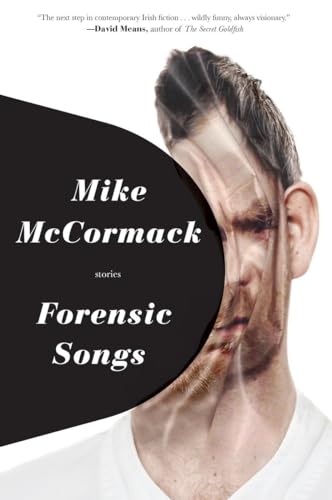
In his second collection of short stories, Mike McCormack joins head and heart in a series of tales which weave a fluid vision of a world morphing between the real and the hyperreal.
Amid much hollow laughter a prisoner is drawn from his cell in the middle of the night to play a video game; two rural guards ponder the security threat posed by the only man in Ireland not to have written his memoirs; a child tries to offset his destiny as a serial killer by petitioning his father for a beating; a late night American cop show becomes a savage analysis of a faltering marriage in the west of Ireland; two men turn up at the door of a slacker to give him news of his death and recruit him to some mysterious surveillance mission; an older brother worries about the health of his younger sibling; the prodigal son returns to reveal the fear and hypocrisy which lies at the heart of his brothers life.
In twelve stories McCormack’s characters find themselves trying to hold onto their identities in a world where love is too often and too easily obscured.
Die Inhaltsangabe kann sich auf eine andere Ausgabe dieses Titels beziehen.
Über die Autorin bzw. den Autor
Mike McCormack has published the short story collection Getting It in the Head and two novels, Notes from a Coma and Crowe's Requiem. In 1996, McCormack was awarded the Rooney Prize for Irish Literature. In 1998, Getting It in the Head was voted a New York Times Notable Book of the Year.
Auszug. © Genehmigter Nachdruck. Alle Rechte vorbehalten.
The Last Thing We Need
Using the edge of his hand, the sergeant swept to one side the little bits and pieces that littered the top of his desk—a spool of thread, a little coil of silver wire, a neat little pliers and what looked at first glance like a small mound of hair and feathers. With a large space cleared in the centre of the desk, he laid down a sheet of blotting paper and placed an unusually hairy-looking insect in its centre. Only then, stark against the white background, was the hook concealed within the coloured hair and feathers visible.
“The Olive Gold Invicta,” the sergeant announced happily. “What think ye of it?”
The question fell to the young guard who stood on the other side of the desk. He looked nervous, giving the giddy impression that he might bolt from the room at any moment. After a long pause and with the cautious tone of a man taking a considerable
gamble he said, “It’s lovely.”
The sergeant smiled indulgently. “It’s more than lovely, young fella, it’s downright irresistible.” He turned the fly over so that now it presented an iridescent green belly to the light. “You’re not looking at it properly. If you were a brown trout, about two and a
half to three pounds, say, and this lad lit on the surface over your head, you’d be beside yourself with happiness. One lep out of you and you’d have him.” He looked up brightly. “Of course then I’d have you and that’s when we’d have some sport.”
And for a few moments the sergeant was lost in such a happy, heedless reverie that the young guard thought it best to remain silent. When he came back to the present the sergeant’s tone was fond. “I started tying flies shortly after I came here—learned it from a man by the name of Billy Phelan. You wouldn’t know him—he’s dead now this good while. Billy would come into town every Tuesday to draw his pension. He’d buy two plugs of tobacco and that would do him till after second Mass on Sunday. But he’d break your heart, the same Billy. Trying to get him into a hackney at night to take him out home . . . many’s the night he slept in one of the cells. But for all his faults there was no one to tie flies like him.” And with that the sergeant sat back and looked up at the young guard. “So tell me, what do you have?”
Startled by the sudden change of subject, the young guard’s head jerked from side to side. “Nothing,” he blurted, “not a thing.”
The sergeant squinted at him. “There can’t be nothing, there has to be something.”
The young guard looked down at the fly on the desk and repeated, “There’s nothing, we’ve looked everywhere.”
“There must be something, some few pages, a document of some sort or other.”
The young guard swallowed thickly.
“There must be some sort of a sketchy outline or a synopsis of some sort.”
The young guard remained silent. The sergeant leaned forward onto the desk.
“What about all the obvious stuff—a short account of his inability to get on with a silent and sullen father?”
“None whatsoever.”
“No tender account of loving regard for his sainted mother?”
“No.”
“A disturbing account of clerical abuse?”
The young guard shook his head, his misery now deepening as the note of incredulity thickened in the sergeant’s voice.
“We hadn’t much but what we had was clean—something along those lines?”
“No.”
“Any description of him wearing a sleeveless geansaí or of his head hopping with lice?”
“No.”
“Short trousers?”
“No.”
“No account of him going shoeless through the fields and developing a thick, protective callus on the soles of his feet?”
“No.”
“A harrowing account of his struggle with the Modh Coinníollach?”
“No.”
“Any character sketch of him looking up with fright and bemusement at the adult world, an account possibly offset in the third person?”
“No.”
The sergeant considered a moment. His face was furrowed with anxiety. “A small parish publication, it’d be easy to miss?” he ventured quietly.
“None.”
“A vanity publication, badly edited on poor-quality paper, loads of typos?”
“No.”
“No sign of a tattered manuscript anywhere? Possibly in a small box that might have fallen down the back of the dresser?”
“Nothing, we did a full search, the house and outhouses, all clean.”
“The fridge, did you check the icebox?”
“A block of ice cream, nothing else.”
“Suffering Christ,” the sergeant breathed, visibly awed and beyond caring who saw it. “And how did he account for himself?”
“He shrugged his shoulders.”
“He shrugged his shoulders?”
“He shrugged his shoulders and produced a birth certificate from a coarse bag under the bed; that’s all.”
The sergeant finally snapped and surged to his feet. He threw his hands wide. “Fuck the birth certificate,” he roared, “where’s his ISBN?”
Had he taken the moment to look, he would have seen that the young guard was trembling on the verge of tears.
“It’s no one’s fault,” the sergeant amended an hour later, his fit of temper behind him. “He might be one of those anomalies the system throws up from time to time. He might be, but I doubt it. I have a feeling . . . Either way, the thing is, what are we going to do about it? Tell me again what we know about him.”
The young guard turned a page of his notebook hurriedly, relieved to finally contribute something positive. “We have his name, date of birth, educational records, and invoices from his place of work.”
“Which is?”
“He owns a...
„Über diesen Titel“ kann sich auf eine andere Ausgabe dieses Titels beziehen.
Suchergebnisse für Forensic Songs

Beispielbild für diese ISBN
Forensic Songs
Anbieter: World of Books (was SecondSale), Montgomery, IL, USA
Verkäuferbewertung 5 von 5 Sternen

Zustand: Very Good. Item in very good condition! Textbooks may not include supplemental items i.e. CDs, access codes etc. Artikel-Nr. 00075376851
Gebraucht kaufen
EUR 3,21
Versand gratis
Versand innerhalb von USA
Versand innerhalb von USA
Anzahl: 1 verfügbar
Beispielbild für diese ISBN
Forensic Songs
Verlag:
Soho Press, Incorporated, 2014
ISBN 10: 1616954140
ISBN 13: 9781616954147
Gebraucht
Softcover
Anbieter: Better World Books, Mishawaka, IN, USA
Verkäuferbewertung 5 von 5 Sternen
Zustand: Good. Former library copy. Pages intact with minimal writing/highlighting. The binding may be loose and creased. Dust jackets/supplements are not included. Includes library markings. Stock photo provided. Product includes identifying sticker. Better World Books: Buy Books. Do Good. Artikel-Nr. 5903918-6
Gebraucht kaufen
EUR 6,16
Versand gratis
Versand innerhalb von USA
Versand innerhalb von USA
Anzahl: 3 verfügbar
Beispielbild für diese ISBN
Forensic Songs
Anbieter: Robinson Street Books, IOBA, Binghamton, NY, USA
Verkäuferbewertung 4 von 5 Sternen

Trade Paperbac. Zustand: Used: Good. Prompt Shipment, shipped in Boxes, Tracking PROVIDEDContemporary Fiction: Good or better trade paperback. Ex-library book with stamps and/or pocket and notations. Artikel-Nr. Ware772JW008
Gebraucht kaufen
EUR 12,37
EUR 8,45 Versand
Versand innerhalb von USA
Versand innerhalb von USA
Anzahl: 1 verfügbar
Foto des Verkäufers
Forensic Songs
Anbieter: WeBuyBooks, Rossendale, LANCS, Vereinigtes Königreich
Verkäuferbewertung 5 von 5 Sternen
paperback. Zustand: Good. Most items will be dispatched the same or the next working day. A copy that has been read but remains in clean condition. All of the pages are intact and the cover is intact and the spine may show signs of wear. The book may have minor markings which are not specifically mentioned. Artikel-Nr. rev3251077218
Gebraucht kaufen
EUR 14,40
EUR 6,44 Versand
Versand von Vereinigtes Königreich nach USA
Versand von Vereinigtes Königreich nach USA
Anzahl: 1 verfügbar
Beispielbild für diese ISBN
Forensic Songs
Anbieter: Kennys Bookstore, Olney, MD, USA
Verkäuferbewertung 5 von 5 Sternen
Zustand: New. Artikel-Nr. V9781616954147
Neu kaufen
EUR 24,88
EUR 9,33 Versand
Versand innerhalb von USA
Versand innerhalb von USA
Anzahl: 15 verfügbar