
Verwandte Artikel zu God and the Multiverse: Humanity's Expanding View...
Inhaltsangabe
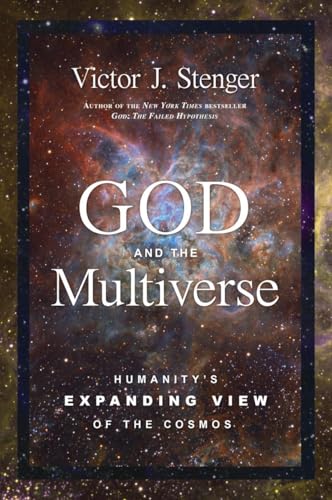
Cosmologists have reasons to believe that the vast universe in which we live is just one of an endless number of other universes within a multiverse—a mind-boggling array that may extend indefinitely in space and endlessly in both the past and the future. Victor Stenger reviews the key developments in the history of science that led to the current consensus view of astrophysicists, taking pains to explain essential concepts and discoveries in accessible terminology. The author shows that science’s emerging understanding of the multiverse—consisting of trillions upon trillions of galaxies—is fully explicable in naturalistic terms with no need for supernatural forces to explain its origin or ongoing existence.
How can conceptions of God, traditional or otherwise, be squared with this new worldview? The author shows how long-held beliefs will need to undergo major revision or otherwise face eventual extinction.
Die Inhaltsangabe kann sich auf eine andere Ausgabe dieses Titels beziehen.
Über die Autorin bzw. den Autor
Victor J. Stenger (1935 - 2014) was an adjunct professor of philosophy at the University of Colorado and emeritus professor of physics and astronomy at the University of Hawaii. He was the author of the New York Times bestseller God: The Failed Hypothesis, God and the Atom, God and the Folly of Faith, The Comprehensible Cosmos, and many other books.
Auszug. © Genehmigter Nachdruck. Alle Rechte vorbehalten.
God and the Multiverse
Humanity's Expanding View of the Cosmos
By Victor J. StengerPrometheus Books
Copyright © 2014 Victor J. Stenger
All rights reserved.
ISBN: 978-1-61614-970-3All rights reserved.
Contents
Acknowledgments, 15,
Prologue, 17,
Preface, 19,
1. From Myth to Science, 29,
2. Toward the New Cosmos, 55,
3. Beyond Unaided Human Vision, 81,
4. Glimpses of the Unimagined, 87,
5. Heat, Light, and the Atom, 101,
6. The Second Physics Revolution, 115,
7. Island Universes, 139,
8. A Dynamic Cosmos, 149,
9. Nuclear Cosmology, 169,
10. Relics of the Big Bang, 183,
11. Particles and the Cosmos, 205,
12. Inflation, 239,
13. Falling Up, 263,
14. Modeling the Universe, 289,
15. The Eternal Multiverse, 309,
16. Life and God, 347,
Notes, 379,
Bibliography, 409,
About, the Author,
Index, 435,
CHAPTER 1
FROM MYTH TO SCIENCE
THE WORD
Upper Paleolithic cave art in Europe demonstrates that humans of forty thousand years ago were already thinking abstractly and expressing creativity by projecting their mental images of animals onto the rock environment. During the Neolithic era, stone megaliths sprang up across Europe, most famously Stonehenge, which was erected in 2,300 BCE and was used for royal burials as well as charting the course of the sun and hosting solstice festivals for pilgrims. This suggests that humans had begun relating to their outside environment in an entirely new way — a way that has been exclusive to Homo sapiens ever since.
Earlier, around 3,500 BCE, writing, called cuneiform, had been invented in Mesopotamia in the form of wedge-shaped characters carved into clay, and for the first time information could be accurately preserved and transferred without depending on the memory of a human messenger. When the ancient Sumerians first took wedge to clay tablet, they couldn't have known that they were writing the first chapter of humankind's journal. But they were. And that story begins roughly six thousand years ago, which is why some still cling to the belief that planet Earth is only six thousand years old — despite conclusive scientific evidence that it is 4.5 billion years old and that our universe goes back 13.8 billion years.
Indeed, our world is six thousand years old. Our Story began when we started to write about it, 3000–4000 BCE. Everything that happened before then we call "prehistory." In a way, it is a prologue because we don't know the names of any Neolithic people. They speak to us only in images, structures, and artifacts. In the early Bronze Age, humans start using words and so that's when individuals emerge and Our Story begins. "In the beginning was the Word."
With the development of civilized culture and writing, we have on record the fact that Bronze Age humans thought in terms of myths (from Greek muthos, meaning "story"), sacred tales that served as explanations for what they observed in the world around them. And the words that they used to describe these myths had power, which gave them a magical quality. Written cosmologies were more systematic than prehistoric, animistic attempts to describe the world, but the supernatural was still a major component.
In Egypt, cosmological myths were woven into the religion with the heavenly bodies being associated with gods. Creation stories with differing details depending on city have been deciphered from various texts and tomb-wall decorations; I will just mention their common elements.
In most Egyptian creation myths, the world arose out of a watery chaos called Nu, an obvious allusion to the river Nile so central to Egyptian life. A pyramid-shaped mound emerged from the waters. The sun god Ra, or in some cases Khephri, appeared out of the mound — a self-created god who then created other gods and eventually humans.
Since it was imperative that priests could anticipate the appearance of gods in the sky and, more important, predict the Nile flood, they developed a calendar with twelve thirty-day months within a year of 365 days based on astronomical observations. And so ancient astronomy made the first step toward applied science.
Science involves two activities, which are today largely carried out by separate groups of professionals — observers or experimentalists who gather the data and theorists who develop models, usually mathematical, to describe what is observed. While the observational side of ancient astronomy was remarkably accomplished, the theory side remained heavily magical and mythological.
The Egyptian theory of creation is an example. According to the most common Egyptian creation myth, the sky goddess Nut gives birth to the sun god Ra once a year, thus describing a universe that is self-creating and eternal.
The Egyptian cosmos was composed of a flat, rectangular Earth with the Nile at its center. In the south, in the sky supported by mountains, there was a river, and on this river the sun god made his daily trip. The sky was a roof placed over the world, supported by columns placed at the four cardinal points. The stars were suspended from the heavens by strong cables, but no apparent explanation was given for their movements.
The civilizations of Mesopotamia and Canaan all had similar concepts of the cosmos and humanity's place in it. Earth was a disk with the firmament, or vault of heaven, resting on its edge. Beneath Earth were the waters of the abyss. Once again, we note the role of water, obviously derived from the fact that the civilization developed along the Tigris and Euphrates Rivers.
Babylonian astronomy was remarkable, with records going back to 800 BCE that are the oldest scientific documents in existence. Babylonian astronomers discovered the 18.6-year cycle of the rising and setting of the moon. They made the earliest recorded sighting of Halley's Comet in 164 BCE, making possible accurate calculations of its orbit by Halley and other astronomers centuries later. Babylonians produced the first almanacs of the movements of the sun, moon, and planets. Although primarily intended for astrological forecasting, the techniques they developed enabled accurate predictions of planetary motion and eclipses.
Curiously, Babylonian scientific astronomy did not lead them to a scientific cosmology; their cosmology remained highly mythological. However, the Greeks would utilize Babylonian astronomy to produce the first cosmology that could be clearly identified as natural rather than magical or mythological.
As in Egypt, Mesopotamian cosmology was integrated into religious belief and a cosmogony, a myth of creation. That myth is described in a poem known as the Enuma Elish dating from a little before 1000 BCE. It describes a clash among the gods in which Marduk (or Assur) defeats the ocean goddess Tiamat and rips her body into two halves that become the heavens and earth. He then organizes the sun, moon, stars, planets, and the weather. He creates humans from the blood of Tiamat's husband, Kingu, so they can do the work of the gods.
The Christian faith, the biggest in the world today, emerged two thousand years ago out of the older faith of a tiny tribe of desert dwellers in Canaan called the Hebrews. The Hebrews divided the universe up into heaven, earth, sea, and the underworld, as shown in figure 1.1. Earth is a more-or-less flat disk floating on water with the vault of heaven resting on foundations on the edge of the sea. Beneath earth were the waters of the abyss....
„Über diesen Titel“ kann sich auf eine andere Ausgabe dieses Titels beziehen.
Suchergebnisse für God and the Multiverse: Humanity's Expanding View...

Beispielbild für diese ISBN
God and the Multiverse: Humanity's Expanding View of the Cosmos
Anbieter: World of Books (was SecondSale), Montgomery, IL, USA
Verkäuferbewertung 5 von 5 Sternen

Hardback. Zustand: Good. Cosmologists have reasons to believe that the vast universe in which we live is just one of an endless number of other universes within a multiverse--a mind-boggling array that may extend indefinitely in space and endlessly in both the past and the future. Victor Stenger reviews the key developments in the history of science that led to the current consensus view of astrophysicists, taking pains to explain essential concepts and discoveries in accessible terminology. The author shows that science's emerging understanding of the multiverse--consisting of trillions upon trillions of galaxies--is fully explicable in naturalistic terms with no need for supernatural forces to explain its origin or ongoing existence. How can conceptions of God, traditional or otherwise, be squared with this new worldview? The author shows how long-held beliefs will need to undergo major revision or otherwise face eventual extinction. Artikel-Nr. CIN1616149701G
Gebraucht kaufen
EUR 6,40
Versand gratis
Versand innerhalb von USA
Versand innerhalb von USA
Anzahl: 1 verfügbar
Beispielbild für diese ISBN
God and the Multiverse : Humanity's Expanding View of the Cosmos
Verlag:
Prometheus Books, Publishers, 2014
ISBN 10: 1616149701
ISBN 13: 9781616149703
Gebraucht
Hardcover
Anbieter: Better World Books, Mishawaka, IN, USA
Verkäuferbewertung 5 von 5 Sternen
Zustand: Very Good. Pages intact with possible writing/highlighting. Binding strong with minor wear. Dust jackets/supplements may not be included. Stock photo provided. Product includes identifying sticker. Better World Books: Buy Books. Do Good. Artikel-Nr. 4553201-6
Gebraucht kaufen
EUR 6,92
Versand gratis
Versand innerhalb von USA
Versand innerhalb von USA
Anzahl: 2 verfügbar
Beispielbild für diese ISBN
God and the Multiverse : Humanity's Expanding View of the Cosmos
Verlag:
Prometheus Books, Publishers, 2014
ISBN 10: 1616149701
ISBN 13: 9781616149703
Gebraucht
Hardcover
Anbieter: Better World Books: West, Reno, NV, USA
Verkäuferbewertung 5 von 5 Sternen
Zustand: Fine. Used book that is in almost brand-new condition. May contain a remainder mark. Better World Books: Buy Books. Do Good. Artikel-Nr. GRP95535546
Gebraucht kaufen
EUR 6,92
Versand gratis
Versand innerhalb von USA
Versand innerhalb von USA
Anzahl: 1 verfügbar
Beispielbild für diese ISBN
God and the Multiverse: Humanity's Expanding View of the Cosmos
Anbieter: ThriftBooks-Atlanta, AUSTELL, GA, USA
Verkäuferbewertung 5 von 5 Sternen
Hardcover. Zustand: Very Good. No Jacket. May have limited writing in cover pages. Pages are unmarked. ~ ThriftBooks: Read More, Spend Less. Artikel-Nr. G1616149701I4N00
Gebraucht kaufen
EUR 7,10
Versand gratis
Versand innerhalb von USA
Versand innerhalb von USA
Anzahl: 1 verfügbar
Beispielbild für diese ISBN
God and the Multiverse: Humanity's Expanding View of the Cosmos
Anbieter: ThriftBooks-Atlanta, AUSTELL, GA, USA
Verkäuferbewertung 5 von 5 Sternen
Hardcover. Zustand: Very Good. No Jacket. Missing dust jacket; May have limited writing in cover pages. Pages are unmarked. ~ ThriftBooks: Read More, Spend Less. Artikel-Nr. G1616149701I4N01
Gebraucht kaufen
EUR 7,10
Versand gratis
Versand innerhalb von USA
Versand innerhalb von USA
Anzahl: 1 verfügbar
Beispielbild für diese ISBN
God and the Multiverse: Humanity's Expanding View of the Cosmos
Anbieter: ThriftBooks-Dallas, Dallas, TX, USA
Verkäuferbewertung 5 von 5 Sternen
Hardcover. Zustand: Good. No Jacket. Former library book; Pages can have notes/highlighting. Spine may show signs of wear. ~ ThriftBooks: Read More, Spend Less. Artikel-Nr. G1616149701I3N10
Gebraucht kaufen
EUR 7,10
Versand gratis
Versand innerhalb von USA
Versand innerhalb von USA
Anzahl: 1 verfügbar
Beispielbild für diese ISBN
God and the Multiverse: Humanity's Expanding View of the Cosmos
Anbieter: ThriftBooks-Phoenix, Phoenix, AZ, USA
Verkäuferbewertung 5 von 5 Sternen
Hardcover. Zustand: Fair. No Jacket. Missing dust jacket; Readable copy. Pages may have considerable notes/highlighting. ~ ThriftBooks: Read More, Spend Less. Artikel-Nr. G1616149701I5N01
Gebraucht kaufen
EUR 7,10
Versand gratis
Versand innerhalb von USA
Versand innerhalb von USA
Anzahl: 1 verfügbar
Beispielbild für diese ISBN
God and the Multiverse: Humanity's Expanding View of the Cosmos
Anbieter: ThriftBooks-Dallas, Dallas, TX, USA
Verkäuferbewertung 5 von 5 Sternen
Hardcover. Zustand: Fair. No Jacket. Missing dust jacket; Readable copy. Pages may have considerable notes/highlighting. ~ ThriftBooks: Read More, Spend Less. Artikel-Nr. G1616149701I5N01
Gebraucht kaufen
EUR 7,10
Versand gratis
Versand innerhalb von USA
Versand innerhalb von USA
Anzahl: 1 verfügbar
Beispielbild für diese ISBN
God and the Multiverse: Humanity's Expanding View of the Cosmos
Anbieter: ThriftBooks-Dallas, Dallas, TX, USA
Verkäuferbewertung 5 von 5 Sternen
Hardcover. Zustand: Good. No Jacket. Pages can have notes/highlighting. Spine may show signs of wear. ~ ThriftBooks: Read More, Spend Less. Artikel-Nr. G1616149701I3N00
Gebraucht kaufen
EUR 7,10
Versand gratis
Versand innerhalb von USA
Versand innerhalb von USA
Anzahl: 1 verfügbar
Beispielbild für diese ISBN
God and the Multiverse
Anbieter: PBShop.store US, Wood Dale, IL, USA
Verkäuferbewertung 5 von 5 Sternen
HRD. Zustand: New. New Book. Shipped from UK. Established seller since 2000. Artikel-Nr. CX-9781616149703