
Verwandte Artikel zu Taking Liberties: Why Religious Freedom Doesn't...
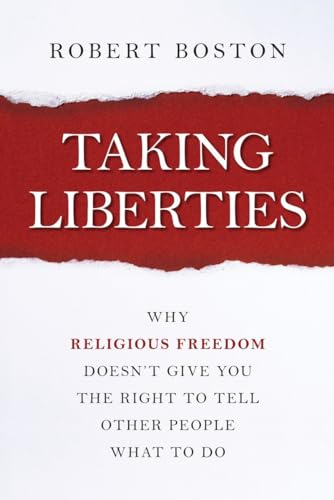
Taking Liberties: Why Religious Freedom Doesn't Give You the Right to Tell Other People What to Do - Softcover
Inhaltsangabe
A concise and lucid explanation of what religious freedom is and isn't.
Increasingly, conservative religious groups are using religious liberty as a sword to lash out at others. In this forcefully argued defense of the separation of church and state, Robert Boston makes it clear that the religious freedom guaranteed in the First Amendment is an individual right, the right of personal conscience, not a license allowing religious organizations to discriminate against and control others. The book examines the controversy over birth control, same-sex marriage, religion in public schools, the intersection of faith and politics, and the "war on Christmas," among other topics.
Boston concludes with a series of recommendations for resolving clashes between religious liberty claims and individual rights.
Die Inhaltsangabe kann sich auf eine andere Ausgabe dieses Titels beziehen.
Über die Autorin bzw. den Autor
Robert Boston is the director of communications for Americans United for Separation of Church and State and the editor of Church & State magazine. He is the author of Why the Religious Right Is Wrong about Separation of Church and State, Close Encounters with the Religious Right, and The Most Dangerous Man in America? Pat Robertson and the Rise of the Christian Coalition. He is also a frequent contributor to The Humanist, and his articles have appeared in Free Inquiry, The Skeptical Inquirer, Conscience, and other publications.
Auszug. © Genehmigter Nachdruck. Alle Rechte vorbehalten.
TAKING LIBERTIES
WHY RELIGIOUS FREEDOM DOESN'T GIVE YOU THE RIGHT TO TELL OTHER PEOPLE WHAT TO DO
By ROBERT BOSTONPrometheus Books
Copyright © 2014 Robert Boston
All rights reserved.
ISBN: 978-1-61614-911-6All rights reserved.
Contents
Acknowledgments, 9,
Introduction, 13,
Chapter 1: History, 25,
Chapter 2: Religion, 43,
Chapter 3: Sex, 61,
Chapter 4: Education, 83,
Chapter 5: Politics, 105,
Chapter 6: Culture, 129,
Chapter 7: Persecution, 153,
Conclusion: Run Your Own Life, Not Mine, 171,
Notes, 183,
Select Bibliography, 191,
Index, 193,
CHAPTER 1
HISTORY
A lot of countries don't have religious freedom. In manynations, the government presumes to tell people whatto believe and how to behave when it comes to religion.Saudi Arabia, where faiths outside Wahhabi Islam are illegal, is anextreme example.
But even some generally tolerant Western nations regulate (orattempt to regulate) the religious behaviors of their citizens. The practiceof Scientology is illegal in Germany, and some states there stillattempt to place restrictions on the faith of Jehovah's Witnesses.
The United States took a different path. Why?
The short answer is that we have religious freedom in Americabecause there was a time when we didn't, and we learned fromthat. This period of restrictions on religious liberty was not anabstraction to key founders. They lived through it; they observed itfirsthand. Having seen the results of colonies where there was nomeaningful religious freedom, they sought to protect its practice.
I have discussed the history of this period in one of my previousbooks, Why the Religious Right Is Wrong about Separation of Churchand State. It's not my intention to revisit all of that again here, butit is important to take a quick look at the development of religiousfreedom in the United States. As is often the case, a glance backwardtells us how we got to where we are.
This is important because the use (or misuse) of history is fundamentalto the strategy of those who would redefine religiousfreedom. They have constructed a narrative—one that does notnecessarily jibe with the facts—to buttress this redefinition.
One of the things they have sought to do is decouple religiousfreedom from the concept of the separation of church andstate. These two concepts—religious liberty and church-state separation—havebeen portrayed as enemies and have been made tofight. The implication here is that the American people will have tochoose: Do they want separation or religious liberty? We are toldthat our nation can't have both.
Actually, we can. In fact, we have. Indeed, we must. Religiousfreedom is not the enemy of separation of church and state. Thesetwo concepts are partners. More than that, they're like mutualisticorganisms. They need one another to survive. The founders knewthis; that's why the First Amendment says what it does.
Prior to the founders, early religious-liberty pioneers alsounderstood this. Roger Williams, an iconoclastic minister and thefounder of Rhode Island, challenged the Puritan establishmentof Massachusetts with a bold demand for "soul liberty." Williamsmaintained that the state had no business dictating orthodoxy toanyone. His preferred method of making certain that the governmentdid not do this was the separation of church and state.
Williams's separation was not merely the end of establishedchurches, although he certainly favored that. He insisted that thegovernment had no right to compel anyone to recite a religiousoath, and he blasted attempts by the state to define which religionswere pleasing to God. Such attempts inevitably led to persecution,Williams maintained. And compulsory religion, he argued, "stinksin the nostrils of God."
Williams's ideas were heretical at the time. Indeed, Massachusetts'sruling Puritans found him tiresome and had plans to forciblyship him back to England. Williams escaped and fled into the wilderness.He purchased (rather than simply seized) land from the nativesand founded his own colony—Providence.
Meaningful religious liberty, Williams believed, encompassesthe right to be wrong from someone else's perspective. And thiswasn't just talk on his part; Williams put it into practice. Williamswas not fond of Quakers and found their theology strange. YetQuakers worshipped unmolested in Providence. If Quakers werewrong, Williams believed, God would have an opportunity toexplain that to them at some point. It was not the magistrate's job.
In a famous metaphor, Williams spoke of a "wall of separationbetween the garden of the church and the wilderness of the world."The phrase is interesting because it anticipates something ThomasJefferson said many years later—although there is no evidence thatJefferson knew of it.
We get the impression here that Williams is advocating for thepurity of the church in the face of state encroachments. RandallBalmer, a highly respected scholar of American religion, has pointedout that the word wilderness had great meaning for the men and womenof Williams's day. It's likely Williams chose it with great care.
Balmer notes that the Puritans viewed the wilderness as a frighteningplace, untamed and full of dangers. To mix the church withthe wilderness, then, was a great threat to the church. Williams'sseparation was in no way designed to lessen the power or purity ofbelief. In fact, this wall was a protector, not a destroyer.
As European settlements grew along the East Coast, coloniesadopted various rules relating to religious freedom. Some had establishedchurches, while others were more liberal in their attitude.
In those colonies with official state churches, dissenting clergymembers were the first to raise the argument for separation ofchurch and state. A distance between the two institutions, theyargued, was the only way to ensure freedom of belief for all.
Some pastors framed their argument in explicitly theologicalterms. Official establishments, they argued, served the interests ofneither church nor state.
Isaac Backus, a colonial-era Baptist preacher in New England,argued the former, asserting, "Religious matters are to be separatedfrom the jurisdiction of the state, not because they are beneath theinterests of the state but, quite to the contrary, because they are toohigh and holy and thus are beyond the competence of the state."
John Leland, an especially fiery Baptist cleric, worked his entirelife to end established churches and any government interferencein soul liberty. Leland argued that mere toleration was not enough.The government had to get out of the religion business entirely.
"The liberty I contend for is more than toleration," Lelandwrote in 1820. "The very idea of toleration is despicable; it supposesthat some have a pre-eminence above the rest to grant indulgence;whereas all should be equally free, Jews, Turks [Muslims], Pagansand Christians. Test oaths and established creeds should be avoidedas the worst of evils."
Leland holds an unusual distinction in American politicalhistory: he helped end state-established churches in three states. Heis perhaps best known for providing a theological voice to the effortsof Thomas Jefferson and James Madison to free Virginia from theAnglican establishment. Less well-known are his efforts in his homestate of Massachusetts. The Bay State was the last to surrender itsestablished church, finally cutting it loose in 1833. Leland, who diedin 1841, helped lead the charge for disestablishment. While...
„Über diesen Titel“ kann sich auf eine andere Ausgabe dieses Titels beziehen.
Suchergebnisse für Taking Liberties: Why Religious Freedom Doesn't...

Beispielbild für diese ISBN
Taking Liberties: Why Religious Freedom Doesn't Give You the Right to Tell Other People What to Do
Anbieter: World of Books (was SecondSale), Montgomery, IL, USA
Verkäuferbewertung 5 von 5 Sternen

Paperback. Zustand: Very Good. A concise and lucid explanation of what religious freedom is and isn't. Increasingly, conservative religious groups are using religious liberty as a sword to lash out at others. In this forcefully argued defense of the separation of church and state, Robert Boston makes it clear that the religious freedom guaranteed in the First Amendment is an individual right, the right of personal conscience, not a license allowing religious organizations to discriminate against and control others. The book examines the controversy over birth control, same-sex marriage, religion in public schools, the intersection of faith and politics, and the war on Christmas, among other topics. Boston concludes with a series of recommendations for resolving clashes between religious liberty claims and individual rights. Artikel-Nr. 00104174238
Gebraucht kaufen
EUR 4,48
Versand gratis
Versand innerhalb von USA
Versand innerhalb von USA
Anzahl: 2 verfügbar
Beispielbild für diese ISBN
Taking Liberties: Why Religious Freedom Doesn't Give You the Right to Tell Other People What to Do
Anbieter: World of Books (was SecondSale), Montgomery, IL, USA
Verkäuferbewertung 5 von 5 Sternen
Paperback. Zustand: Good. A concise and lucid explanation of what religious freedom is and isn't. Increasingly, conservative religious groups are using religious liberty as a sword to lash out at others. In this forcefully argued defense of the separation of church and state, Robert Boston makes it clear that the religious freedom guaranteed in the First Amendment is an individual right, the right of personal conscience, not a license allowing religious organizations to discriminate against and control others. The book examines the controversy over birth control, same-sex marriage, religion in public schools, the intersection of faith and politics, and the war on Christmas, among other topics. Boston concludes with a series of recommendations for resolving clashes between religious liberty claims and individual rights. Artikel-Nr. 00106282573
Gebraucht kaufen
EUR 4,48
Versand gratis
Versand innerhalb von USA
Versand innerhalb von USA
Anzahl: 1 verfügbar
Beispielbild für diese ISBN
Taking Liberties
Verlag:
G38-Prometheus (edition ), 2014
ISBN 10: 1616149116
ISBN 13: 9781616149116
Gebraucht
Paperback
Anbieter: BooksRun, Philadelphia, PA, USA
Verkäuferbewertung 5 von 5 Sternen
Paperback. Zustand: Very Good. It's a well-cared-for item that has seen limited use. The item may show minor signs of wear. All the text is legible, with all pages included. It may have slight markings and/or highlighting. Artikel-Nr. 1616149116-11-1
Gebraucht kaufen
EUR 4,49
Versand gratis
Versand innerhalb von USA
Versand innerhalb von USA
Anzahl: 1 verfügbar
Beispielbild für diese ISBN
Taking Liberties: Why Religious Freedom Doesn't Give You the Right to Tell Other People What to Do
Anbieter: Wonder Book, Frederick, MD, USA
Verkäuferbewertung 5 von 5 Sternen
Zustand: Good. Good condition. A copy that has been read but remains intact. May contain markings such as bookplates, stamps, limited notes and highlighting, or a few light stains. Artikel-Nr. M09A-03410
Gebraucht kaufen
EUR 6,43
Versand gratis
Versand innerhalb von USA
Versand innerhalb von USA
Anzahl: 2 verfügbar
Beispielbild für diese ISBN
Taking Liberties: Why Religious Freedom Doesn't Give You the Right to Tell Other People What to Do
Anbieter: ThriftBooks-Reno, Reno, NV, USA
Verkäuferbewertung 5 von 5 Sternen
Paperback. Zustand: Very Good. No Jacket. May have limited writing in cover pages. Pages are unmarked. ~ ThriftBooks: Read More, Spend Less. Artikel-Nr. G1616149116I4N00
Gebraucht kaufen
EUR 6,48
Versand gratis
Versand innerhalb von USA
Versand innerhalb von USA
Anzahl: 1 verfügbar
Beispielbild für diese ISBN
Taking Liberties: Why Religious Freedom Doesn't Give You the Right to Tell Other People What to Do
Anbieter: ThriftBooks-Dallas, Dallas, TX, USA
Verkäuferbewertung 5 von 5 Sternen
Paperback. Zustand: Very Good. No Jacket. May have limited writing in cover pages. Pages are unmarked. ~ ThriftBooks: Read More, Spend Less. Artikel-Nr. G1616149116I4N00
Gebraucht kaufen
EUR 6,48
Versand gratis
Versand innerhalb von USA
Versand innerhalb von USA
Anzahl: 1 verfügbar
Beispielbild für diese ISBN
Taking Liberties: Why Religious Freedom Doesn't Give You the Right to Tell Other People What to Do
Anbieter: ThriftBooks-Atlanta, AUSTELL, GA, USA
Verkäuferbewertung 5 von 5 Sternen
Paperback. Zustand: Very Good. No Jacket. May have limited writing in cover pages. Pages are unmarked. ~ ThriftBooks: Read More, Spend Less. Artikel-Nr. G1616149116I4N00
Gebraucht kaufen
EUR 6,48
Versand gratis
Versand innerhalb von USA
Versand innerhalb von USA
Anzahl: 1 verfügbar
Beispielbild für diese ISBN
Taking Liberties: Why Religious Freedom Doesn't Give You the Right to Tell Other People What to Do
Anbieter: ThriftBooks-Phoenix, Phoenix, AZ, USA
Verkäuferbewertung 5 von 5 Sternen
Paperback. Zustand: Very Good. No Jacket. May have limited writing in cover pages. Pages are unmarked. ~ ThriftBooks: Read More, Spend Less. Artikel-Nr. G1616149116I4N00
Gebraucht kaufen
EUR 6,48
Versand gratis
Versand innerhalb von USA
Versand innerhalb von USA
Anzahl: 1 verfügbar
Beispielbild für diese ISBN
Taking Liberties : Why Religious Freedom Doesn't Give You the Right to Tell Other People What to Do
Verlag:
Prometheus Books, Publishers, 2014
ISBN 10: 1616149116
ISBN 13: 9781616149116
Gebraucht
Softcover
Anbieter: Better World Books, Mishawaka, IN, USA
Verkäuferbewertung 5 von 5 Sternen
Zustand: Good. Pages intact with minimal writing/highlighting. The binding may be loose and creased. Dust jackets/supplements are not included. Stock photo provided. Product includes identifying sticker. Better World Books: Buy Books. Do Good. Artikel-Nr. 5368336-6
Gebraucht kaufen
EUR 8,35
Versand gratis
Versand innerhalb von USA
Versand innerhalb von USA
Anzahl: 2 verfügbar
Beispielbild für diese ISBN
Taking Liberties : Why Religious Freedom Doesn't Give You the Right to Tell Other People What to Do
Verlag:
Prometheus Books, Publishers, 2014
ISBN 10: 1616149116
ISBN 13: 9781616149116
Gebraucht
Softcover
Anbieter: Better World Books, Mishawaka, IN, USA
Verkäuferbewertung 5 von 5 Sternen
Zustand: Very Good. Former library copy. Pages intact with possible writing/highlighting. Binding strong with minor wear. Dust jackets/supplements may not be included. Includes library markings. Stock photo provided. Product includes identifying sticker. Better World Books: Buy Books. Do Good. Artikel-Nr. 1547907-75
Gebraucht kaufen
EUR 8,35
Versand gratis
Versand innerhalb von USA
Versand innerhalb von USA
Anzahl: 1 verfügbar