
Verwandte Artikel zu The Measure of a Nation: How to Regain America's...
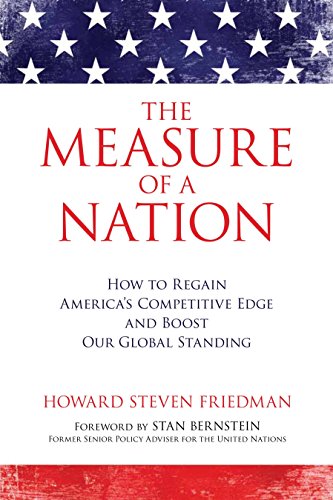
The Measure of a Nation: How to Regain America's Competitive Edge and Boost Our Global Standing (Contemporary Issues) - Softcover
Inhaltsangabe
If America were a corporation, how would an independent analyst judge its ability to compete against other corporate giants? According to the author, that hypothetical analyst would label America a corporate dinosaur and recommend that the nation either change or face extinction.
This book focuses on how to improve America by first comparing its performance with thirteen competitive industrial nations, then identifying the best practices found throughout the world that can be adopted here in the United States. The author lays out some disturbing facts about America’s lack of competitiveness in five key areas: health, education, safety, equality, and even democracy. Taking the approach that "data doesn’t lie," the author notes alarming statistics, for example:
-Americans have the lowest life expectancy among all competitor nations.
-Americans are at least two times more likely to be murdered and four times more likely to be incarcerated than any other competitor country, including Japan, France, and the United Kingdom.
-America shows the sharpest disparity between rich and poor among all nations on its competitor list.
Using charts that clearly illustrate the unbiased, party-neutral data, the author uncovers the major problem areas that the nation must address to become a leader again. Homing in on best practices from other countries than can be adapted to the United States, the author plots a course to transform America from a corporate behemoth burdened by internal issues and poor performance to a thriving business with an exciting portfolio of solutions.
Die Inhaltsangabe kann sich auf eine andere Ausgabe dieses Titels beziehen.
Über die Autorin bzw. den Autor
Howard Steven Friedman is a leading statistician and health economist for the United Nations. He has worked with major organizations including UNICEF, the World Bank, the World Health Organization, UNFPA, UNAIDS, UNDP, and UNESCO. He is also an adjunct professor at Columbia University’s School of International and Public Affairs, and he formerly directed data analysis teams in the corporate world. He is the author of more than thirty-five scientific articles and book chapters in areas of applied statistics and health economics.
Auszug. © Genehmigter Nachdruck. Alle Rechte vorbehalten.
THE MEASURE OF A NATION
How to Regain America's Competitive Edge and Boost Our Global StandingBy HOWARD STEVEN FRIEDMANPrometheus Books
Copyright © 2012 Howard Steven FriedmanAll right reserved.
ISBN: 978-1-61614-569-9
Contents
Foreword by Stan Bernstein.............................................11Introduction: Competitive Intelligence for America.....................17Chapter 1. The Nation's Heartbeat: Health..............................29Chapter 2. Locking Our Doors: Safety...................................71Chapter 3. The Right to the Three Rs: Education........................99Chapter 4. We the People: Democracy....................................131Chapter 5. A Balancing Act: Equality...................................167Chapter 6. What the Data Have Shown Us.................................207Acknowledgments........................................................225Notes..................................................................227Index..................................................................263
Chapter One
The Nation's Heartbeat: HealthHealth is at the heart of human progress. It determines whether parents can work to support their families, children can attend school, women can survive childbirth, and infants can grow and thrive. Where health services are strong and accessible, families and communities flourish. Where health services are inaccessible, weak, or nonexistent, families suffer, adults die prematurely, and communities unravel. —from the US Government Global Health Initiative Strategy, available online at http://www.ghi.gov/resources/stragegies/.
Nothing else about our lives as Americans matters at all if we don't have a reasonable expectation of a healthy life. Basic safety, the enrichment of education, our entire democratic process, our own individual chance at social mobility: none of these things has any importance or interest if we cannot take advantage of them. And without health, we can't.
Maybe that's why our Declaration of Independence places life first in the list of "unalienable" rights with which we are naturally endowed. We all get just the one life, and living it in health and for as long as possible is basic to everything else that we do and everything else that affects us. So it makes sense that health should be the first comparison we look at, for it underlies all the other assessments this book explores.
But how do we measure health? So many factors determine and affect it. We have no control over many of them—gender, for example, or genes, or even the culture in which we grow up. The air we breathe, the water we drink, and other environmental realities affect our health, but these are realities we can only change immediately by moving our location. We have limited control over where we work and how much income we earn, our social status, and our education, yet all of these impact our health, as do lifestyle choices such as diet, exercise, and personal habits like smoking, use of alcohol and drugs, health practices, and coping mechanisms.
Health is a subject with which we seem to be obsessed. Wonder drugs, diet fads, and superfoods buzz around American pop culture and are regular topics on radio and television talk shows. Feats of medical practice that seem miraculous routinely lead the headlines. There isn't a newspaper or news broadcast that isn't staffed with a health columnist or physician interpreting the latest medical research results and advising us all on lifestyle choices. We thrill to the story of the child from a distant land, born with a rare ailment, who is flown here to undergo a special life-saving procedure available only in America. We read regularly about world leaders arriving in private jets for cutting-edge treatments developed by American researchers in American laboratories.
Essential to it all is our health system, the totality of medical and healthcare products, systems, services, people and resources, and physical facilities that affect us throughout our lifetime. In fact, the healthcare system starts to affect us even before our lifetime. From the moment our mothers initiate prenatal care to the debilitations of old age, and for every bruise, break, sickness, and stress in between, our healthcare system is where we go for a healthier life and more of it. So, how the system responds is central to measuring the health of our nation as a whole.
The cliché dutifully repeated by so many politicians, perhaps buoyed by the stories of those outstanding medical accomplishments, is that the United States enjoys "the best healthcare in the world." It's an oft-used phrase, its frequency of use matched only by its inaccuracy, as we will discover in separating the fiction from the facts about how the United States's healthcare stacks up against the competition.
The simplest and most compelling metric for assessing health and comparing health outcomes is life expectancy, the average number of years an individual can expect to live. On that measure, the United States does very badly indeed, registering the lowest life expectancy in our group. Stunningly, that low life expectancy includes both the highest infant mortality rate and maternal mortality ratio in the group. Moreover, we spend per person nearly twice as much as all the other nations in our competitor group and in some cases as much as four times more. More money for the worst outcome. You don't have to be on the board of directors to know a bad return on investment when you see one.
Bottom line: as a competitor in healthcare, the United States is clearly ailing—and we the people are not getting our money's worth.
Why? How is it we can spend so much more for healthcare than our competitor nations and yet have one of the lowest life expectancies in our sector? Why are we losing so many infants and mothers in childbirth when we are supposed to be the health market leader? How have we cut our smoking rate dramatically yet seen a striking increase in obesity, a major health risk factor? How, with our world-renowned hospitals and research centers, are the vital statistics on our national health so poor?
Let's look at the data.
WEALTH MAKES HEALTH?
The inherited factors of genes and gender as well as the influences of such things as where we live, the kind of work we do, and, of course, our own behavior all affect health and, therefore, life expectancy. A positive change in behavior—for example, improving diet or exercising more—will have a positive effect on our health and can extend our lifespan. And vice versa; negative behavior can have a negative effect.
Other factors also affect life expectancy: the rate of disease at a particular time in a particular place, an individual's mental health, even the rates of crime and safety. Advances in healthcare knowledge and technology, for example, from the development of the polio vaccine to breakthroughs in cancer treatment, can increase life expectancy, while the sudden arrival of new epidemics, like HIV/AIDS and the rampant use of crack cocaine in the 1980s, can cause it to plummet.
One of the more definitive factors affecting a nation's life expectancy is wealth. The numbers demonstrate that, globally, life expectancy generally increases as a function of a country's wealth—that is, up to a certain level of wealth. In fact, looking at life expectancy data is a little like taking the rough economic pulse of a country.
The reason is simple: In poorer countries, the chances of survival are dominated by the rates of infectious...
„Über diesen Titel“ kann sich auf eine andere Ausgabe dieses Titels beziehen.
Suchergebnisse für The Measure of a Nation: How to Regain America's...

Beispielbild für diese ISBN
Measure of a Nation : How to Regain America's Competitive Edge and Boost Our Global Standing
Verlag:
Prometheus Books, Publishers, 2012
ISBN 10: 1616145692
ISBN 13: 9781616145699
Gebraucht
Softcover
Erstausgabe
Anbieter: Better World Books, Mishawaka, IN, USA
Verkäuferbewertung 5 von 5 Sternen

Zustand: Good. First Edition. Pages intact with minimal writing/highlighting. The binding may be loose and creased. Dust jackets/supplements are not included. Stock photo provided. Product includes identifying sticker. Better World Books: Buy Books. Do Good. Artikel-Nr. 2734209-6
Gebraucht kaufen
EUR 6,95
Versand gratis
Versand innerhalb von USA
Versand innerhalb von USA
Anzahl: 1 verfügbar
Beispielbild für diese ISBN
Measure of a Nation : How to Regain America's Competitive Edge and Boost Our Global Standing
Verlag:
Prometheus Books, Publishers, 2012
ISBN 10: 1616145692
ISBN 13: 9781616145699
Gebraucht
Softcover
Erstausgabe
Anbieter: Better World Books: West, Reno, NV, USA
Verkäuferbewertung 5 von 5 Sternen
Zustand: Good. First Edition. Former library copy. Pages intact with minimal writing/highlighting. The binding may be loose and creased. Dust jackets/supplements are not included. Includes library markings. Stock photo provided. Product includes identifying sticker. Better World Books: Buy Books. Do Good. Artikel-Nr. 7113417-6
Gebraucht kaufen
EUR 6,95
Versand gratis
Versand innerhalb von USA
Versand innerhalb von USA
Anzahl: 1 verfügbar
Beispielbild für diese ISBN
Measure of a Nation: How to Regain America's Competitive Edge and Boost Our Global Standing
Anbieter: ThriftBooks-Atlanta, AUSTELL, GA, USA
Verkäuferbewertung 5 von 5 Sternen
Paperback. Zustand: Fair. No Jacket. Readable copy. Pages may have considerable notes/highlighting. ~ ThriftBooks: Read More, Spend Less. Artikel-Nr. G1616145692I5N00
Gebraucht kaufen
EUR 7,76
Versand gratis
Versand innerhalb von USA
Versand innerhalb von USA
Anzahl: 1 verfügbar
Beispielbild für diese ISBN
The Measure of a Nation: How to Regain America's Competitive Edge and Boost Our Global Standing
Anbieter: Revaluation Books, Exeter, Vereinigtes Königreich
Verkäuferbewertung 5 von 5 Sternen
Paperback. Zustand: Brand New. 269 pages. 9.00x6.00x0.75 inches. In Stock. Artikel-Nr. 1616145692
Neu kaufen
EUR 34,16
EUR 11,92 Versand
Versand von Vereinigtes Königreich nach USA
Versand von Vereinigtes Königreich nach USA
Anzahl: 1 verfügbar