
Verwandte Artikel zu Fit to Serve: Reflections on a Secret Life, Private...
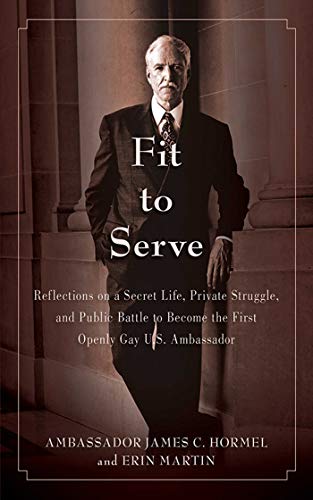
Fit to Serve: Reflections on a Secret Life, Private Struggle, and Public Battle to Become the First Openly Gay U.S. Ambassador - Hardcover
Inhaltsangabe
This is the memoir of James C. Hormel—a man who grew up feeling different not only because his family owned the Hormel “empire” and lived in a twenty-six-bedroom house in a small Midwest town, but because he was gay at a time when homosexuality was not discussed or accepted. Outwardly he tried to live up to the life his father wanted for him—he was a successful professional, had married a lovely woman, and had children—but as vola-tile changes in the late 1960s impeded on the American psyche, Hormel realized that he could not hide his true self forever.
Hormel moved to New York City, became an antiwar activist, battled homophobia, lost dear friends to AIDS, and set out to become America’s first openly gay ambassador, a position he finally won during the Clinton administration. Today, Hormel continues to fight for LGBT equality and gay marriage rights. This is a passionate and inspiring true story of the determination for human equality and for attaining your own version of the American Dream—life, liberty, and the pursuit of happiness without exception.
Die Inhaltsangabe kann sich auf eine andere Ausgabe dieses Titels beziehen.
Über die Autorin bzw. den Autor
Ambassador James C. Hormel was born in Austin, Minnesota, in 1933. He has a law degree and worked as Assistant Dean and Dean of Students at the University of Chicago Law School. In 1995 he served as a U.S. delegate to the UN Commission on Human Rights and the UN General Assembly in 1996. He served as U.S. Ambassador to Luxembourg from 1999-2000. He also established the James C. Hormel Gay and Lesbian Center at the San Francisco Public Library. He currently works at an investment firm called Equidex and devotes most of his time to philanthropy and Democratic politics. He currently resides in San Francisco, California. Erin Martin is a former journalist for The Hartford Courange and also worked for U.S. Senator Christopher J. Dodd of Connecticut as a press secretary and speechwriter. She's worked on political development programs in post-Apartheid South Africa and Namibia, for The September 11th Fund, and currently works for a Madison Avenue communications consultancy. She lives in New York City.
Auszug. © Genehmigter Nachdruck. Alle Rechte vorbehalten.
Fit To Serve
Reflections on a Secret Life, Private Struggle, and Public Battle to Become America's First Openly Gay U.S. Ambassador
By James C. Hormel, Erin MartinSkyhorse Publishing
Copyright © 2011 James C. Hormel and Erin Martin
All rights reserved.
ISBN: 978-1-61608-398-4All rights reserved.
Contents
Chapter 1: They Will Eat You Alive,
Chapter 2: Cockeyed World,
Chapter 3: War Years,
Chapter 4: Rhymes with Normal,
Chapter 5: Dismal Failure,
Chapter 6: A Rough Senior Year,
Chapter 7: Fear of Discovery,
Chapter 8: Stepping Out,
Chapter 9: Influences of the Day,
Chapter 10: Political Tourist,
Chapter 11: A New Life,
Chapter 12: Death and Birth,
Chapter 13: Fit to Serve,
Chapter 14: Working on My Résumé,
Chapter 15: The Smearing,
Chapter 16: The Dangers of Coloring Books,
Chapter 17: Not Dead Yet,
Chapter 18: Luxembourg,
Chapter 19: The Value of Activism,
About the Authors,
Acknowledgments,
Sources,
Index,
CHAPTER 1
They Will Eat You Alive
As soon as the bicycle courier arrived with the package, my office manager, Marcus, brought it to me, wished me luck, and then left me alone. I took the yellow padded envelope in my hands, knowing what it contained: a videotape — and an accusation.
Seated at my cluttered desk, just two stories above the loud racket of Market Street's trolleys, I heard nothing apart from the thump of my heart. My hands shook; they often do — owing to a hereditary muscle tremor common to the men in my family — but my anger made the shaking worse. California Senator Dianne Feinstein's mother-knows-best voice played in my mind: "Oh Jim, they will try to eat you alive," she had warned.
I freed the tape from the mailer and read the chicken scratch on its label: Pat Robertson.
I must have something better to do than watch this tape, I thought.
A little after eight o'clock that morning, in the bathroom splashing water on my face, I realized that it was April 2, my oldest daughter Alison's forty-second birthday. She lived in Charlottesville, with her husband Bernie, and was on a daunting mission of her own: founding a school for autistic children. She wanted her kids Harry and Georgia, and others like them, to get the attention not available to them in conventional schools.
The phone rang. I answered the cordless by my bed and immediately noted a hint of agitation in the smooth voice of Ray Mulliner. A refugee of Salt Lake City, excommunicated by the Mormon Church for being gay, he had helped me manage my philanthropic and political work for more than a dozen years.
"Hey, Jim. I am really sorry to bother you, but I just got a call from the White House that you need to know about," he said, pausing so that we both could take a breath.
"Oh really?" I responded, still a bit groggy.
"Yeah. Pat Robertson did a piece on your nomination on his show this morning. It was quite ugly, apparently."
Anxiety spread inside me like spilled paint. "What did he say?" I asked.
"Well, there was a tiny protest in front of the Capitol yesterday; I mean, tiny, as in eight to ten people, and they blew it up into a big story," Ray said. "They made all kinds of accusations about pedophilia."
"Pedophilia?" I yelled. "What? Are these people out of their minds?" "I know, I know. It's becoming very clear that they will stop at nothing," Ray said. "I already have a call in to KPIX to see whether we can get a tape."
"I'll be in as soon as I can," I said.
"Be prepared — the phones are ringing already," he said, hanging up.
I sat in silence, taking shallow breaths. I looked back toward my bed and contemplated diving under the covers.
After a quick shave and fast shower, I threw on a casual shirt and comfortable khaki pants — it was going to be a long day. I grabbed a banana and rushed to the office, so fixated on what had been said about me that I forgot to call Alison to wish her well.
Alone in my office, I put my dread aside, pushed the tape into the slot, and took a seat on the nearby sofa. The blue logo of The 700 Club filled the screen and a voice announced Robertson and his co-host Terry Meeuwsen.
The duo stood in front of a set that looked like a living room, as if all of America was being invited into their home. They stood shoulder to shoulder: Robertson, gray-haired and paternal in a tan jacket, blue shirt, and dark tie; Meeuwsen, blond and just short of fifty, perched next to him. They looked deeply into the camera, into the homes of nearly 1 million viewers. Robertson wrinkled his forehead and squinted for emphasis as he announced news on Paula Jones's sexual harassment lawsuit against President Clinton, which had been dismissed the day before. My heart quickened as they moved on to me.
"A wealthy tycoon with ties to homosexual groups that promote sex with children may soon be a United States ambassador, without approval of the United States Senate," Meeuwsen intoned, slowing at the words sex with children. "Are sexual politics and money driving this behind-the-scenes deal? CBN News investigates."
To me, the show had the atmospherics of children's theater, and I half-expected to see Bert, Ernie, or Big Bird sitting in the anchor's chair. Instead, the camera focused on a precisely coiffed gentleman named Lee Webb to introduce the report. Behind him, across a giant screen, was a grainy image of me. It was plucked from a year-old television interview conducted during San Francisco's 1996 Lesbian, Gay, Bisexual, and Transgender Pride Parade. I wore a white Coming Out Day T-shirt, appropriate for the sunny weather and the event but not flattering for television. Bulky headphones and a microphone stood out against my cropped white hair. I looked more like an amateur helicopter pilot than an ambassadorial nominee. The words CONTROVERSIAL APPOINTEE hovered in bold letters above my head, with smaller, fading subtitles in rows below: HORMEL, HORMEL.
Next, a written warning appeared on the screen as the pseudo-anchor tipped his head toward the camera: "A word of warning about our next story. This story may contain graphic images that you will not want your children to see."
Oh please, I thought. How utterly ridiculous.
Describing me as a "radical homosexual activist," Webb explained that I was President Clinton's nominee as ambassador to Luxembourg, and that to overcome objections in the Senate, Clinton might use special powers to bypass a confirmation vote and give me a recess appointment. Next, a reporter from The 700 Club's very own Christian Broadcasting Network appeared on the screen.
Video rolled of a press conference in front of the U.S. Capitol, in which a group of nine protesters, identified as "a mix of ex-homosexuals and Christians," chanted: "Can Hormel! Can Hormel!" They carried signs, some of which read: Pedophiles Go to Jail, not Luxembourg. Speakers claimed that I had given financial support to NAMBLA (the North American Man-Boy Love Association), an organization founded in the 1970s to advocate relationships between men and boys. In his voice-over, the CBN reporter told viewers that my philanthropic work had "helped popularize homosexuality and child sex abuse."
My blood boiled. I should have known it would come to this, I thought.
The seemingly interminable story moved on to an interview with a Christian activist who eventually became my most...
„Über diesen Titel“ kann sich auf eine andere Ausgabe dieses Titels beziehen.
Suchergebnisse für Fit to Serve: Reflections on a Secret Life, Private...

Beispielbild für diese ISBN
Fit to Serve: Reflections on a Secret Life, Private Struggle, and Public Battle to Become the First Openly Gay U.S. Ambassador
Anbieter: World of Books (was SecondSale), Montgomery, IL, USA
Verkäuferbewertung 5 von 5 Sternen

Zustand: Good. Item in good condition. Textbooks may not include supplemental items i.e. CDs, access codes etc. Artikel-Nr. 00110010210
Gebraucht kaufen
EUR 4,89
Versand gratis
Versand innerhalb von USA
Versand innerhalb von USA
Anzahl: 1 verfügbar
Beispielbild für diese ISBN
Fit to Serve: Reflections on a Secret Life, Private Struggle, and Public Battle to Become the First Openly Gay U.S. Ambassador
Anbieter: World of Books (was SecondSale), Montgomery, IL, USA
Verkäuferbewertung 5 von 5 Sternen
Zustand: Very Good. Item in very good condition! Textbooks may not include supplemental items i.e. CDs, access codes etc. Artikel-Nr. 00110010171
Gebraucht kaufen
EUR 4,89
Versand gratis
Versand innerhalb von USA
Versand innerhalb von USA
Anzahl: 9 verfügbar
Beispielbild für diese ISBN
Fit to Serve: Reflections on a Secret Life, Private Struggle, and Public Battle to Become the First Openly Gay U.S. Ambassador
Anbieter: BooksRun, Philadelphia, PA, USA
Verkäuferbewertung 5 von 5 Sternen
Hardcover. Zustand: Very Good. 1. With dust jacket. It's a well-cared-for item that has seen limited use. The item may show minor signs of wear. All the text is legible, with all pages included. It may have slight markings and/or highlighting. Artikel-Nr. 1616083980-11-1-29
Gebraucht kaufen
EUR 7,96
Versand gratis
Versand innerhalb von USA
Versand innerhalb von USA
Anzahl: 1 verfügbar
Beispielbild für diese ISBN
Fit to Serve: Reflections on a Secret Life, Private Struggle, and Public Battle to Become the First Openly Gay U.S. Ambassador
Anbieter: ThriftBooks-Dallas, Dallas, TX, USA
Verkäuferbewertung 5 von 5 Sternen
Hardcover. Zustand: Good. No Jacket. Former library book; Pages can have notes/highlighting. Spine may show signs of wear. ~ ThriftBooks: Read More, Spend Less. Artikel-Nr. G1616083980I3N10
Gebraucht kaufen
EUR 8,48
Versand gratis
Versand innerhalb von USA
Versand innerhalb von USA
Anzahl: 1 verfügbar
Beispielbild für diese ISBN
Fit to Serve: Reflections on a Secret Life, Private Struggle, and Public Battle to Become the First Openly Gay U.S. Ambassador
Anbieter: ThriftBooks-Dallas, Dallas, TX, USA
Verkäuferbewertung 5 von 5 Sternen
Hardcover. Zustand: Very Good. No Jacket. May have limited writing in cover pages. Pages are unmarked. ~ ThriftBooks: Read More, Spend Less. Artikel-Nr. G1616083980I4N00
Gebraucht kaufen
EUR 8,48
Versand gratis
Versand innerhalb von USA
Versand innerhalb von USA
Anzahl: 1 verfügbar