
Verwandte Artikel zu Life Lessons from a Ranch Horse: With a New Afterword...
Inhaltsangabe
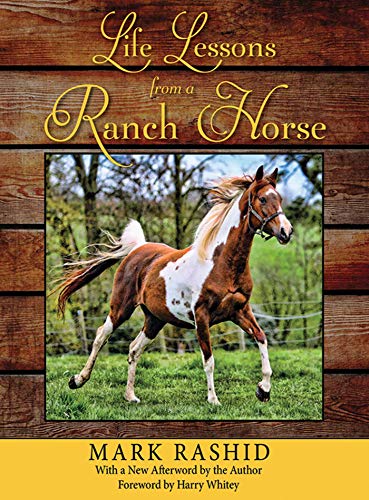
In this heartwarming and instructive book of horsemanship, highly-respected horse trainer Mark Rashid shares what he learned from a very special, and very challenging, horse. Through a lot of hard work, Mark comes to understand the potential for powerful communication that exists when two beings take the time to understand each other. Although his realizations are inspired by work with horses, readers will discover that Rashid’s six guidelines for interaction can improve our relationships with the people in our lives as well.
In this second edition of the beloved title, with a new brand-new afterword, Rashid invites us to enjoy his all-new reflections on the lessons learned from a life spent with horses.
Die Inhaltsangabe kann sich auf eine andere Ausgabe dieses Titels beziehen.
Über die Autorin bzw. den Autor
Mark Rashid is an author and horse trainer. His books, such as Considering the Horse and Whole Heart, Whole Horse, follow his training philosophy, which is to find training solutions by considering the horse's point of view. The author of seven books, Rashid was featured on the PBS Nature series.
Auszug. © Genehmigter Nachdruck. Alle Rechte vorbehalten.
Life Lessons from a Ranch Horse
By Mark RashidSkyhorse Publishing
Copyright © 2011 Mark Rashid
All rights reserved.
ISBN: 978-1-61608-340-3All rights reserved.
Contents
Foreword by Harry Whitney,
Preface,
Introduction,
PART ONE: LESSONS,
School Starts,
The Teacher Speaks,
Recognizing the Problem,
Lesson One: Non-Confrontation,
Lesson Two: Planning Ahead,
Lesson Three: Patience,
Lesson Four: Persistence,
Lesson Five: Consistency,
Lesson Six: Fix It and Move On,
PART TWO: DAY WORK,
Working Together,
The Path,
Positive Conflicts,
Blending,
Balance,
Communication,
Practice,
The Beginner,
PART THREE: BUCK'S LEGACY,
One Last Ride,
Afterword,
CHAPTER 1
School Starts
I had just fed our four horses, three in the corral and one in the barn, and the one in the barn wasn't eating. A horse not eating at feeding time is almost always something to be concerned about, and if it were any other horse, I might have been alarmed.
The other horses were already pinning their ears, squealing, and running each other off the three piles of hay, one for each horse. As was their ritual, for the next five minutes or so they'd play a sort of musical chairs with the piles, moving each time the smallest one of the bunch — a little 14.2-hand, line-back dun gelding named Tuff — decided he needed some hay from a different pile. With ears pinned, he would head over to the closest pile and chase off Red, a 16-hand sorrel gelding that dwarfed Tuff. Red would, in turn, pin his ears at Quincy, a 15-hand gelding eating quietly at the third pile, sending him over to the pile Tuff had abandoned at the beginning. They'd all settle back down until Tuff decided to move to the next pile, starting the whole thing over.
While it was fun watching those three sort out their eating arrangements for the evening meal, it was the gelding in the barn that had my attention. He was an old horse, Buck. At twenty-three years old, he was beginning to show his age. Only a few months earlier, I had retired him from ranch work and given him to my youngest son, Aaron.
I'd recently taken Buck off the winter pasture, because he wasn't faring as well as I liked. Although he wasn't really thin, it was obvious that he wasn't doing as well as the others on the pasture. He was a hard-keeper to begin with, and any time he started to lose weight it raised a red flag for me. I brought Buck home so I could supplement his diet and maybe get him to put on a few pounds.
Buck stood in his run just outside the barn and stared at me. He watched my every move, occasionally shifting his weight from one hind leg to the other. Even though I'd just put his nightly share of pellets in his stall, he completely ignored them, a behavior that would worry most folks. A horse not eating, especially his extra feed, usually meant something serious was going on, colic maybe. But I could tell that Buck wasn't sick. He was just trying to tell me something.
I was pretty busy at the time and tried to ignore him as I went about my chores. But after all the years we'd been together, I knew when he got this way, it would be impossible to ignore him for long. I turned and looked at him.
"What?" I asked.
As if answering, he nonchalantly turned his head and looked into his stall. I walked over to the run, reached through the panels, and stroked his neck. He kept his head turned, and even though I could barely see his left eye, the one closest to me, I saw that he was looking at me.
Fine. At least I knew that whatever it was he wanted must be in his stall. Probably something with his pellets, I thought. I put my rake down, walked around the corner and into the barn, opened the metal sliding door to his stall, and went in. Buck met me in the stall. I checked the pellets for foreign objects; there weren't any. I picked them up, smelled them, and even tasted them to see if they were okay; they were. I checked to make sure he had plenty of clean water; he did.
He stood looking at me. I looked around in the stall but couldn't see anything out of the ordinary, so I petted him on his head and left the stall. He snorted loudly and shook his head. I returned and looked at him through the door. He quietly turned and looked out at the horses in the corral playing musical hay piles. Again, even with his head turned, I could see that he was looking at me.
Okay, so now I knew that he wanted something he didn't have, but the others did, and it had something to do with his stall. Whatever it was, it was more important to him that the two scoops of pellets in his feeder. I knew this because, over our years together, in thousands of situations, Buck had spent a great deal of time trying to train me to listen to what he had to say. With the patience of a saint, he had presented ideas that I'd never have thought possible for any animal other than a human to have.
The first time Buck tried to get me to listen to him, it was to help me understand how horses do things. It happened about a year after we started working together. He was seven years old at that time.
We were working a roundup I'd helped with for many years. Like usual, we were helping a friend gather his herd of about 120 horses from twenty-five hundred acres of land. Buck and I were alone when we'd come upon thirty head up in the rocks above a small mountain valley. We successfully worked them down into the valley, and our next moves were to bring them down a draw, across a meadow about a mile in length, through a tunnel that ran under the highway, and finally into the large catch pen.
The only problem was that Buck and I ended up between the horses and the draw on the south end of the valley we needed them to go down. We would have to get around them to the north in order to drive them to the draw. This was a precarious situation, because one wrong move on my part and I could end up scattering the herd to the far ends of the pasture. On top of that, just out of sight in the trees at the north end of the valley, there was an open gate that led to another five hundred acres — and I definitely did not want them getting to that five hundred.
Buck and I slowly started to make our way around the herd, giving them a wide berth, so as not to alarm them. We were nearly all the way past the herd, and everything was going well, when I noticed the horses begin to watch us pretty carefully. Even though we were moving slowly, they started to mill around. A few of them even turned and headed toward the line of trees to the north, right where the open gate was. They weren't moving all that fast, but in my mind's eye I could see them breaking into a lope and taking the rest of the herd with them.
Wanting to get out ahead of them and stay ahead of them, I urged Buck to pick up a little jog trot. Much to my surprise, he refused. As far as I could remember, this was the first time he had refused to do anything I asked of him. I asked again, and again he refused, maintaining his slow, steady walk.
With a quick glance at the herd, I could see that a couple more horses had joined the ones already on the move. I quickly began trying to figure out why Buck's wasn't responding. We hadn't been working that long, only about an hour, and he'd been walking the majority of that time, so I knew he couldn't be tired. I turned around in the saddle and glanced back at Buck's tail to see if he needed — how can I say this delicately? — a rest stop. But that wasn't it, either.
Nope, for some...
„Über diesen Titel“ kann sich auf eine andere Ausgabe dieses Titels beziehen.
Suchergebnisse für Life Lessons from a Ranch Horse: With a New Afterword...

Beispielbild für diese ISBN
Life Lessons from a Ranch Horse: With a New Afterword by the Author
Anbieter: World of Books (was SecondSale), Montgomery, IL, USA
Verkäuferbewertung 5 von 5 Sternen

Hardback. Zustand: Good. In this heartwarming and instructive book of horsemanship, highly-respected horse trainer Mark Rashid shares what he learned from a very special, and very challenging, horse. Artikel-Nr. 00099052978
Gebraucht kaufen
EUR 5,61
Versand gratis
Versand innerhalb von USA
Versand innerhalb von USA
Anzahl: 2 verfügbar
Foto des Verkäufers
Life Lessons from a Ranch Horse: With a New Afterword by the Author
Anbieter: Dream Books Co., Denver, CO, USA
Verkäuferbewertung 5 von 5 Sternen
Zustand: very_good. Pages are clean with no markings. May show minor signs of wear or cosmetic defects marks, cuts, bends, or scuffs on the cover, spine, pages, or dust jacket. May have remainder marks on edges. Artikel-Nr. DBV.1616083409.VG
Gebraucht kaufen
EUR 7,41
Versand gratis
Versand innerhalb von USA
Versand innerhalb von USA
Anzahl: 1 verfügbar
Beispielbild für diese ISBN
Life Lessons from a Ranch Horse : With a New Afterword by the Author
Verlag:
Skyhorse Publishing Company, Incorporated, 2011
ISBN 10: 1616083409
ISBN 13: 9781616083403
Gebraucht
Hardcover
Anbieter: Better World Books: West, Reno, NV, USA
Verkäuferbewertung 5 von 5 Sternen
Zustand: Very Good. Pages intact with possible writing/highlighting. Binding strong with minor wear. Dust jackets/supplements may not be included. Stock photo provided. Product includes identifying sticker. Better World Books: Buy Books. Do Good. Artikel-Nr. 17330993-6
Gebraucht kaufen
EUR 8,79
Versand gratis
Versand innerhalb von USA
Versand innerhalb von USA
Anzahl: 1 verfügbar
Beispielbild für diese ISBN
Life Lessons from a Ranch Horse : With a New Afterword by the Author
Verlag:
Skyhorse Publishing Company, Incorporated, 2011
ISBN 10: 1616083409
ISBN 13: 9781616083403
Gebraucht
Hardcover
Anbieter: Better World Books, Mishawaka, IN, USA
Verkäuferbewertung 5 von 5 Sternen
Zustand: Good. Pages intact with minimal writing/highlighting. The binding may be loose and creased. Dust jackets/supplements are not included. Stock photo provided. Product includes identifying sticker. Better World Books: Buy Books. Do Good. Artikel-Nr. 11313622-6
Gebraucht kaufen
EUR 8,79
Versand gratis
Versand innerhalb von USA
Versand innerhalb von USA
Anzahl: 1 verfügbar