
Verwandte Artikel zu The Many Faces of Posttraumatic Stress Disorder: Does...
The Many Faces of Posttraumatic Stress Disorder: Does Post Traumatic Stress Disorder Have a Grip on Your Life? - Softcover
Inhaltsangabe
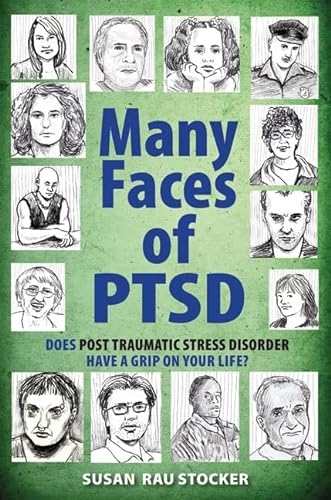
Person-centered instead of theory-centered, this resource provides a basic context for understanding how post-traumatic stress disorder (PTSD) affects people and those around them. Compassionate, firsthand knowledge of the different ways in which PTSD manifests itself are described throughout the 12 case studies examined in this guide. Bringing this mental health issue to light for sufferers, families, and friends, these stories illuminate the confusion that often surrounds the behaviors and reactions associated with PTSD and can increase understanding, patience, and awareness. A piece of reflective foil covers the middle of the front cover of this book, so that readers view themselves when looking upon it.
Die Inhaltsangabe kann sich auf eine andere Ausgabe dieses Titels beziehen.
Über die Autorin bzw. den Autor
Susan Rau Stocker is a marriage and family therapist, a teacher, and a writer. She lives in Akron, Ohio.
Auszug. © Genehmigter Nachdruck. Alle Rechte vorbehalten.
The Many Faces of PTSD
By Susan Rau Stocker, Alice J. MacDonald, Malvina T. RauHoly Macro! Books
Copyright © 2010 Susan Stocker
All rights reserved.
ISBN: 978-1-61547-002-0All rights reserved.
Contents
Introduction,
Case Studies,
Brenda--Domestic Violence,
Mary--Exposure and Vulnerability,
Vicky--Ritualistic Abuse and Incest,
Alan--Sibling Abuse, Parental Neglect, and Abandonment,
Roger--Critical, Narcissistic Parenting,
Olivia--Physical Abuse and Domestic Violence,
Ted--Combat in Viet Nam,
Maggie--Incest and Maternal Hatred,
William--Adoption, Mixed Race, and Iraq War Veteran,
Joy--Vulnerability, Neglect, and Abuse of Unknown Origin,
Carrie--Rape,
Susan--Secondary PTSD,
List of Possible PTSD Indicators,
Notes to Therapists,
About the Author,
CHAPTER 1
Brenda
Her Story
She came into the Victim Assistance office early one morning with a four year old in tow. She had gotten the older child to school and somehow found her way to us. When she and the child came into my office, and we shut the door, she started sobbing uncontrollably.
She was a battered and abused wife, and she looked the part. Her thin face was without color, her blondish hair without style, her clothes without form. The child looked terrified. He buried his head in his mother's lap and cried along. I felt like crying, too.
Her fear was for the boys, especially the one in fourth grade whom her husband had recently started to abuse. She could take it; she even thought she herself deserved it. After all, he did everything. The translation of "everything" turned out to be that he provided all the money. She couldn't even get the house straightened up or get a good meal on the table.
I was as new to the business of being a therapist as she was to the business of being a client. We muddled along together as her story told itself. She was not a woman you could warm up to. She was devoid of the social niceties: no manners, no appreciation, no interest in anyone other than herself and her children. In fact, she felt to me like a bottomless pit. What could ever be enough to fill this woman's heart and give her some hope?
Within six weeks I thought we were doing extraordinarily well. She was out of the house and living in a battered women's shelter. She had gotten a haircut, some clothes that fit, and she reported that her school -aged child was happy at the shelter. The four year old looked like he had gained some weight. He had some color in his cheeks as well as a little bag of toys he carried with him now. Brenda was enrolled in a program to retrain housewives. When she finished that program, they would help her find an apartment and a job. Legal aid would enable her to sever her abusive relationship and hopefully get some child support.
Clearly her self-esteem was that of a battered person under the control of an abuser. She had no car of her own, no independence, no family in the area, and no money she could access. Her husband, a long-distance truck driver, would take her to the grocery store so he could oversee her purchases. When he left on a trip, he'd leave behind the car with an empty gas tank and a twenty for her week's spending. That, though, was preferable to the irritable iron fist he wielded when he was home. He'd recently beaten the ten year old with his shoe because the boy had given him a disrespectful look. Then he took the four year old out for ice cream.
Brenda had a lot of bruises and breaks, too. She made up stories about the causes of her injuries, as well as the reasons for the older boy's broken arm. She knew the ER doctors didn't believe her, but they let her tell her tales. Her last ER visit was for a dislocated shoulder and a broken nose. Quite a fall.
She knew she needed to leave him. She even wanted to leave. She absolutely astonished me when she actually did. We had worked together to find the resources, but only she could take the action. She was terrified, but she did it. I'm sure my explanation of how Children's Services Board (CSB) would have to be involved if either boy was harmed again helped her find the strength. She didn't want to be home with her husband when CSB came knocking on the door. That would have been hard on everyone's bones.
For ten weeks, she never missed a therapy appointment. Then she disappeared. I was scared for her. She finally checked in a couple weeks later to tell me that she had called her husband so he could talk to the boys. She thought it was "only fair." So her husband came and got her and the boys and apologized, and now they were all back home together and everything was wonderful. This part of the cycle, I was to learn later, is called "the honeymoon phase."
Her Signs
Domestic violence can be one of the ways that PTSD presents itself. Typically, the abuser will be a man who has been the victim of childhood abuse, and the abused will be a woman who has been the victim of childhood abuse. These childhood traumas may have been sexual, physical, emotional, and/or psychological and may have been abusive or neglectful.
We are not talking about discipline. We are talking about abuse. When children are disciplined, they know what they did. The discipline may be extraordinarily harsh, but the children seem to understand. "I ... (did thus or so) and the old man beat me with a board. I couldn't sit for days." This is discipline. Harsh discipline, but still discipline. This story is frequently told with a laugh. Abuse, on the other hand, comes out of left field. The abusive story usually begins with the action of the abuser: "He slammed me up against the wall because I didn't give him a morning hug!" This story is told with disbelief and disdain. Discipline is frequently tied to something a child did do. Abuse is frequently tied to something a child didn't do.
The domestic violence abuser will usually, but not always, be a man. The abused will usually be a woman. Men tend to act out, and women tend to internalize. Please understand that these are generalizations and stereotypes. (All we need to do is look at same sex relationships to see the exceptions.) However, generalizations and stereotypes don't make themselves up. They evolve from repeated examples.
So, Brenda, a victim of domestic violence, was most likely a victim of childhood sexual abuse who married another victim of childhood abuse, and he took the role of the perpetrator and she took the role of the victim. Logically, you can't have a perpetrator without a victim or a victim without a perpetrator.
And then there is the third role: that of the witness. Sometimes the witnesses are innocent, as in the case of Brenda's children. Sometimes the witnesses are complicit, as in the case of an adult family member. More likely than not, this family member/witness is the wife of the perpetrator or the mother of the perpetrator. Imagine the mother of the perpetrator, the perpetrator being perhaps the older brother, being also the mother of the victim, who, let's say, was the younger daughter. This is a scenario which is not infrequent. An all-too -common reaction for a complicit wife, mother, sibling, etc., is silence. And innocence. And lack of knowledge. This is actually understandable because some things are too horrible to know or accept. But it is intolerable and immoral. We cannot not know what we know, no matter how much we want to.
All of this said, we must then conclude that in the cases of PTSD rooted in childhood abuse and neglect, we are dealing with a cycle. This cycle is often intergenerational and...
„Über diesen Titel“ kann sich auf eine andere Ausgabe dieses Titels beziehen.
Suchergebnisse für The Many Faces of Posttraumatic Stress Disorder: Does...

Beispielbild für diese ISBN
Many Faces of PTSD: Does Post Traumatic Stress Disorder Have a Grip On Your Life?
Anbieter: World of Books (was SecondSale), Montgomery, IL, USA
Verkäuferbewertung 5 von 5 Sternen

Zustand: Good. Item in good condition and has highlighting/writing on text. Used texts may not contain supplemental items such as CDs, info-trac etc. Artikel-Nr. 00095142894
Gebraucht kaufen
EUR 4,76
Versand gratis
Versand innerhalb von USA
Versand innerhalb von USA
Anzahl: 1 verfügbar
Beispielbild für diese ISBN
Many Faces of PTSD: Does Post Traumatic Stress Disorder Have a Grip On Your Life?
Verlag:
Holy Macro! Books (edition ), 2010
ISBN 10: 1615470026
ISBN 13: 9781615470020
Gebraucht
Paperback
Anbieter: BooksRun, Philadelphia, PA, USA
Verkäuferbewertung 5 von 5 Sternen
Paperback. Zustand: Very Good. It's a well-cared-for item that has seen limited use. The item may show minor signs of wear. All the text is legible, with all pages included. It may have slight markings and/or highlighting. Artikel-Nr. 1615470026-11-1
Gebraucht kaufen
EUR 4,77
Versand gratis
Versand innerhalb von USA
Versand innerhalb von USA
Anzahl: 1 verfügbar