
Verwandte Artikel zu Nothing: Surprising Insights Everywhere from Zero to...
Inhaltsangabe
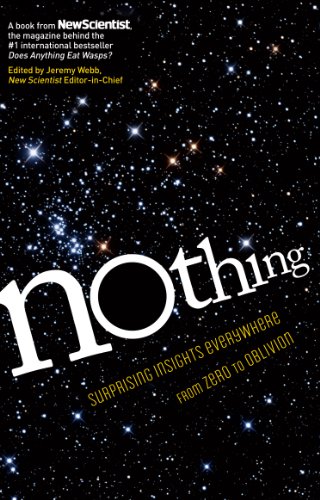
Incredible discoveries from the fringes of the universe to the inner workings of our minds—all from nothing!
It turns out that almost nothing is as curious—or as enlightening—as, well, nothing. What is nothingness? Where can it be found? The writers of the world's top-selling science magazine investigate—from the big bang, dark energy, and the void to superconductors, vestigial organs, hypnosis, and the placebo effect—and discover that understanding nothing may be the key to understanding everything:
What came before the big bang, and will our universe end?
How might cooling matter down almost to absolute zero help solve our energy crisis?
How can someone suffer from a false diagnosis as though it were true?
Does nothingness even exist? Recent experiments suggest that squeezing a perfect vacuum somehow creates light.
Why is it unfair to accuse sloths—animals who do nothing—of being lazy? And more!
Contributors Paul Davies, Jo Marchant, and Ian Stewart, along with two former editors of Nature and 16 other leading writers and scientists, marshal up-to-the-minute research to make one of the most perplexing realms in science dazzlingly clear. Prepare to be amazed at how much more there is to nothing than you ever realized.
It turns out that almost nothing is as curious—or as enlightening—as, well, nothing. What is nothingness? Where can it be found? The writers of the world's top-selling science magazine investigate—from the big bang, dark energy, and the void to superconductors, vestigial organs, hypnosis, and the placebo effect—and discover that understanding nothing may be the key to understanding everything:
What came before the big bang, and will our universe end?
How might cooling matter down almost to absolute zero help solve our energy crisis?
How can someone suffer from a false diagnosis as though it were true?
Does nothingness even exist? Recent experiments suggest that squeezing a perfect vacuum somehow creates light.
Why is it unfair to accuse sloths—animals who do nothing—of being lazy? And more!
Contributors Paul Davies, Jo Marchant, and Ian Stewart, along with two former editors of Nature and 16 other leading writers and scientists, marshal up-to-the-minute research to make one of the most perplexing realms in science dazzlingly clear. Prepare to be amazed at how much more there is to nothing than you ever realized.
Die Inhaltsangabe kann sich auf eine andere Ausgabe dieses Titels beziehen.
Über die Autorin bzw. den Autor
Established in 1956, New Scientist is the fastest-growing and bestselling science magazine in the world, reaching over 3 million readers through its print and digital channels. Its series of accessible popular science books, which debuted in 2005, has sold well over 2 million copies worldwide. Jeremy Webb, who has worked at New Scientist for over twenty-three years, is editor-in-chief.
Auszug. © Genehmigter Nachdruck. Alle Rechte vorbehalten.
Nothing: Surprising Insight Everywhere from Zero to Oblivion
By Jeremy WeberThe Experiment
Copyright © 2014 Jeremy Weber
All rights reserved.
ISBN: 978-1-61519-205-2All rights reserved.
CHAPTER 1
Beginnings
"Astronomy leads us to a unique event, a universe which was created out of nothing," said Arno Penzias, the American physicist and Nobel laureate. He was talking about the mother of all beginnings, the big bang. It's the obvious place for us to start. To add some variety, we'll bounce you to ancient Babylon and then to the most modern of brain-scanning laboratories. You'll find out about the birth of a symbol that you almost certainly take for granted and discover that your head is home to an organ you've probably never heard of. Along the way, we'll look at the fruits of an infant scientific field—the mind's power to heal the body.
The big bang
Our universe began in an explosion of sorts, what's called the big bang. The $64,000 question is how the cosmos emerged out of nothing. But before we tackle that, we need to understand what the big bang entailed. Here's Marcus Chown.
In the beginning was nothing. Then the universe was born in a searing hot fireball called the big bang. But what was the big bang? Where did it happen? And how have astronomers come to believe such a ridiculous thing?
About 13.82 billion years ago, the universe that we inhabit erupted, literally, out of nothing. It exploded in a titanic fireball called the big bang. Everything—all matter, energy, even space and time—came into being at that instant.
In the earliest moments of the big bang, the stuff of the universe occupied an extraordinarily small volume and was unimaginably hot. It was a seething cauldron of electromagnetic radiation mixed with microscopic particles of matter unlike any found in today's universe. As the fireball expanded, it cooled, and more and more structure began to "freeze out."
Step by step, the fundamental particles we know today, the building blocks of all ordinary matter, acquired their present identities. The particles condensed into atoms and galaxies began to grow, then fragment into stars such as our sun. About 4.55 billion years ago, Earth formed. The rest, as they say, is history.
It is an extraordinarily grand picture of creation. Yet astronomers and physicists, armed with a growing mass of evidence to back their theories, are so confident of the scenario that they believe they can work out the detailed conditions in the early universe as it evolved, instant by instant.
That's not to say we can go back to the moment of creation. The best that physics can do is to attempt to describe what was happening when the universe was already about 10-35 seconds old—a length of time that can also be written as a decimal point followed by 34 zeroes and a I.
This is an exceedingly small interval of time, but you would be wrong if you thought it was so close to the moment of creation as to make no difference. Although the structure of the universe no longer changes much in even a million years, when the universe was young, things changed much more rapidly.
For example, physicists think that as many important events happened between the end of the first tenth of a second and the end of the first second as in the interval from the first hundredth of a second to the first tenth of a second, and so on, logarithmically, back to the very beginning. As they run the history of the universe backward, like a movie in reverse, space is filled with ever more frenzied activity.
This is because the early universe was dominated by electromagnetic radiation-in the form of little packets of energy called photons-and the higher the temperature, the more energetic the photons. Now, high-energy photons can change into particles of matter because one form of energy can be converted into another, and, as Einstein revealed, mass (m) is simply a form of energy (E), hence his famous equation E=mc2, where c is the speed of light.
What Einstein's equation says is that particles of a particular mass, m, can be created if the packets of radiation, the photons, have an energy of at least mc2. Put another way, there is a temperature above which the photons are energetic enough to produce a particle of mass, m, and below which they cannot create that particle.
If we look far enough back, we come to a time when the temperature was so high, and the photons so energetic, that colliding photons could produce particles out of radiant energy. What those particles were before the universe was 10-35 seconds old, we do not know. All we can say is that they were very much more massive than the particles we are familiar with today, such as the electron and top quark.
As time progressed and temperature fell, so the mix of particles in the universe changed to a soup of less and less massive particles. Each particle was "king for a day," or at least for a split second. For the reverse process was also going on-matter was being converted back to radiant energy as particles collided to produce photons.
What do physicists think the universe was like a mere 10-35 seconds after the big bang?
Well, the volume of space that was destined to become the "observable universe," which today is 84 billion light years across, was contained in a volume roughly the size of a pea. And the temperature of this superdense material was an unimaginable 1028 ºC.
At this temperature, physicists predict, colliding photons had just the right amount of energy to produce a particle called the X-boson that was a million billion times more massive than the proton. No one has yet observed an X-boson, because to do so we would have to recreate, in an Earth-bound laboratory, the extreme conditions that existed just 10-35 seconds after the big bang.
How far back can physicists probe in their laboratories?
The answer is to a time when the universe was about one-trillionth (10-12) of a second old. By then, it had cooled down to about 100 million billion degrees—still 10 billion times hotter than the center of the sun. In 2012, physicists at CERN, the European center for particle physics in Geneva, recreated these conditions in the giant particle accelerator called the Large Hadron Collider. They conjured into being a particle that resembles the Higgs boson, a particle that vanished from the universe a trillionth of a second after the big bang.
The gulf between 10-35 seconds and a trillionth of a second is gigantic. We know that for most of this period, matter was squeezed together more tightly than the most compressed matter we know of—that inside the nuclei of atoms. And, as the temperature fell, so the energy level of photons declined, creating particles of lower and lower masses.
At some point, the hypothetical building blocks of the neutron and proton—known as quarks—came into being. And by the time the universe was about one-hundredth of a second old, it had cooled sufficiently to be dominated by particles that are familiar to us today: photons, electrons, positrons and neutrinos. Neutrons and protons were around, but there weren't many of them. In fact, they were a very small contaminant in the universe.
About one second into the life of the universe, the temperature had fallen to about 10 billion ºC, and photons had too little energy to produce particles easily. Electrons and their positively charged "antimatter" opposites, called positrons, were colliding and annihilating each other to create photons. However, because of a slight and, to this day, mysterious lopsidedness in the laws of physics, there were...
„Über diesen Titel“ kann sich auf eine andere Ausgabe dieses Titels beziehen.
Suchergebnisse für Nothing: Surprising Insights Everywhere from Zero to...

Beispielbild für diese ISBN
Nothing: Surprising Insights Everywhere from Zero to Oblivion
Anbieter: World of Books (was SecondSale), Montgomery, IL, USA
Verkäuferbewertung 5 von 5 Sternen

Zustand: Very Good. Item in very good condition! Textbooks may not include supplemental items i.e. CDs, access codes etc. Artikel-Nr. 00082670992
Gebraucht kaufen
EUR 3,71
Versand gratis
Versand innerhalb von USA
Versand innerhalb von USA
Anzahl: 2 verfügbar
Beispielbild für diese ISBN
Nothing: Surprising Insights Everywhere from Zero to Oblivion
Anbieter: World of Books (was SecondSale), Montgomery, IL, USA
Verkäuferbewertung 5 von 5 Sternen
Zustand: Good. Item in good condition. Textbooks may not include supplemental items i.e. CDs, access codes etc. Artikel-Nr. 00106172032
Gebraucht kaufen
EUR 3,71
Versand gratis
Versand innerhalb von USA
Versand innerhalb von USA
Anzahl: 3 verfügbar
Beispielbild für diese ISBN
Nothing: Surprising Insights Everywhere from Zero to Oblivion
Verlag:
The Experiment (edition First Edition), 2014
ISBN 10: 1615192050
ISBN 13: 9781615192052
Gebraucht
Paperback
Erstausgabe
Anbieter: BooksRun, Philadelphia, PA, USA
Verkäuferbewertung 5 von 5 Sternen
Paperback. Zustand: Very Good. First Edition. It's a well-cared-for item that has seen limited use. The item may show minor signs of wear. All the text is legible, with all pages included. It may have slight markings and/or highlighting. Artikel-Nr. 1615192050-8-1
Gebraucht kaufen
EUR 4,72
Versand gratis
Versand innerhalb von USA
Versand innerhalb von USA
Anzahl: 1 verfügbar
Beispielbild für diese ISBN
Nothing: Surprising Insights Everywhere from Zero to Oblivion
Anbieter: ThriftBooks-Atlanta, AUSTELL, GA, USA
Verkäuferbewertung 5 von 5 Sternen
Paperback. Zustand: Very Good. No Jacket. May have limited writing in cover pages. Pages are unmarked. ~ ThriftBooks: Read More, Spend Less. Artikel-Nr. G1615192050I4N00
Gebraucht kaufen
EUR 6,71
Versand gratis
Versand innerhalb von USA
Versand innerhalb von USA
Anzahl: 1 verfügbar
Beispielbild für diese ISBN
Nothing : Surprising Insights Everywhere from Zero to Oblivion
Anbieter: Better World Books, Mishawaka, IN, USA
Verkäuferbewertung 5 von 5 Sternen
Zustand: Good. Former library copy. Pages intact with minimal writing/highlighting. The binding may be loose and creased. Dust jackets/supplements are not included. Includes library markings. Stock photo provided. Product includes identifying sticker. Better World Books: Buy Books. Do Good. Artikel-Nr. 15240384-6
Gebraucht kaufen
EUR 6,98
Versand gratis
Versand innerhalb von USA
Versand innerhalb von USA
Anzahl: 1 verfügbar
Beispielbild für diese ISBN
Nothing : Surprising Insights Everywhere from Zero to Oblivion
Anbieter: Better World Books, Mishawaka, IN, USA
Verkäuferbewertung 5 von 5 Sternen
Zustand: Good. Pages intact with minimal writing/highlighting. The binding may be loose and creased. Dust jackets/supplements are not included. Stock photo provided. Product includes identifying sticker. Better World Books: Buy Books. Do Good. Artikel-Nr. 9363164-6
Gebraucht kaufen
EUR 6,98
Versand gratis
Versand innerhalb von USA
Versand innerhalb von USA
Anzahl: 1 verfügbar
Beispielbild für diese ISBN
Nothing: Surprising Insights Everywhere from Zero to Oblivion
Anbieter: Night Heron Books, Laramie, WY, USA
Verkäuferbewertung 5 von 5 Sternen
paperback. Zustand: Good. Paperback. Minor wear to page edges and corners. No writing, highlighting, or marks in text. Cover a bit worn and rubbed. Artikel-Nr. 765879
Gebraucht kaufen
EUR 7,32
EUR 3,78 Versand
Versand innerhalb von USA
Versand innerhalb von USA
Anzahl: 1 verfügbar
Beispielbild für diese ISBN
Nothing: Surprising Insights Everywhere from Zero to Oblivion
Anbieter: WorldofBooks, Goring-By-Sea, WS, Vereinigtes Königreich
Verkäuferbewertung 5 von 5 Sternen
Paperback. Zustand: Very Good. The book has been read, but is in excellent condition. Pages are intact and not marred by notes or highlighting. The spine remains undamaged. Artikel-Nr. GOR006925015
Gebraucht kaufen
EUR 4,69
EUR 6,60 Versand
Versand von Vereinigtes Königreich nach USA
Versand von Vereinigtes Königreich nach USA
Anzahl: 2 verfügbar
Beispielbild für diese ISBN
Nothing: Surprising Insights Everywhere from Zero to Oblivion
Anbieter: AwesomeBooks, Wallingford, Vereinigtes Königreich
Verkäuferbewertung 5 von 5 Sternen
Paperback. Zustand: Very Good. Nothing: Surprising Insights Everywhere from Zero to Oblivion This book is in very good condition and will be shipped within 24 hours of ordering. The cover may have some limited signs of wear but the pages are clean, intact and the spine remains undamaged. This book has clearly been well maintained and looked after thus far. Money back guarantee if you are not satisfied. See all our books here, order more than 1 book and get discounted shipping. Artikel-Nr. 7719-9781615192052
Gebraucht kaufen
EUR 7,60
EUR 4,86 Versand
Versand von Vereinigtes Königreich nach USA
Versand von Vereinigtes Königreich nach USA
Anzahl: 2 verfügbar
Beispielbild für diese ISBN
Nothing: Surprising Insights Everywhere from Zero to Oblivion
Anbieter: Phatpocket Limited, Waltham Abbey, HERTS, Vereinigtes Königreich
Verkäuferbewertung 5 von 5 Sternen
Zustand: Good. Your purchase helps support Sri Lankan Children's Charity 'The Rainbow Centre'. Shows some signs of wear but in good overall condition. Our donations to The Rainbow Centre have helped provide an education and a safe haven to hundreds of children who live in appalling conditions. Artikel-Nr. Z1-K-024-02071
Gebraucht kaufen
EUR 3,28
EUR 12,54 Versand
Versand von Vereinigtes Königreich nach USA
Versand von Vereinigtes Königreich nach USA
Anzahl: 1 verfügbar