
Verwandte Artikel zu Entangling Vines: A Classic Collection of Zen Koans
Inhaltsangabe
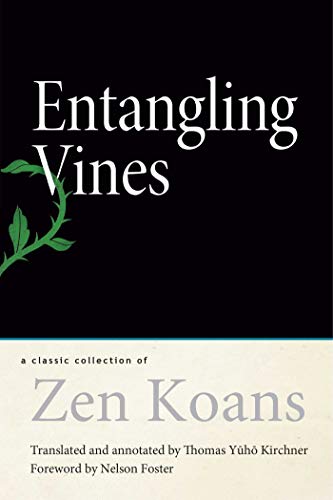
Entangling Vines, a translation of the Shumon kattoshu, is one of the few major koan texts to have been compiled in Japan rather than China. Indeed, Kajitani Sonin (1914 - 95), former chief abbot of Shokoku-ji and author of an annotated, modern-Japanese translation of the Kattoshu, commented that "herein are compiled the basic Dharma materials of the koan system." Most of the central koans of the contemporary Rinzai koan curriculum are contained in this work.
A distinctive feature of Entangling Vines is that, unlike The Gateless Gate and Blue Cliff Record, it presents the koans "bare," with no introductions, commentaries, or verses. Its straightforward structure lends the koans added force and immediacy, emphasizing the Great Matter, the essential point to be interrogated, and providing ample material for the rigors of examining and refining Zen experience.
Containing 272 cases and extensive note material, the collection is indispensable for serious koan training and will also be of interest for anyone drawn to Zen literature. The present translation had its origins in the discussions between three forward-looking modern Japanese Zen masters and Thomas Kirchner, an experienced Zen monk from America. And Kirchner's careful annotation of each koan makes this a brilliant introduction to Buddhist philosophy.
Die Inhaltsangabe kann sich auf eine andere Ausgabe dieses Titels beziehen.
Über die Autorin bzw. den Autor
Ueda Shizuteru, Professor Emeritus at Kyoto University, specializes in the philosophy of religion. His areas of interest include Christian mysticism, Buddhist thought, and Kyoto School philosophy. He is a longtime practitioner of Zen meditation.
Auszug. © Genehmigter Nachdruck. Alle Rechte vorbehalten.
Entangling Vines
A Classic Collection of Zen KoansBy Translated by Thomas Yuho Kirchner Foreword by Nelson FosterWisdom Publications
Copyright © 2013 Translated by Thomas Yuho Kirchner Foreword by Nelson FosterAll right reserved.
ISBN: 9781614290773
From the foreword by Nelson Foster
This book offers “entangling vines,” but who would want them and what for? The phrase suggests tough, jungly vegetation that will trip you up, snag you in its rope-like sinews, and hold you captive. As a title, it seems calculated to put off all but the boldest or most foolhardy readers, signaling that exploration of these pages will be a struggle—arduous, exhausting, possibly futile altogether. It invites risk-takers, curiosity seekers, and especially, perhaps, people driven to get to the bottom of life’s biggest questions. Shall we count you in?
As the subtitle makes clear, the vines threatening to tie us up here are koans, the famously enigmatic little stories of Zen tradition. The liveliness and strangeness of koans—the humor and inscrutability of their repartee, their unorthodox treatment of Buddhist doctrine, the indifference they exhibit to logic or social convention, their frequent eruption into hitting and hollering, their broad expressive range, from crudeness to banality to poetry of great subtlety and beauty—have made them intriguing to people of diverse cultures ever since they emerged as a feature of Zen’s Chinese precursor, Chan, some nine centuries ago.
Understanding has lagged far behind interest, unfortunately. In attempting to characterize koans, popular writers commonly resort to the words puzzles and riddles, which are so inaccurate as to be positively misleading. Academic specialists fare little better with such arid definitions as “pedagogical tools for religious training.” Zen masters, who seem supremely qualified to explain the nature and working of koans, typically deflect requests for such information, declaring words inadequate to do justice to the phenomenon. Try a koan and see for yourself, they say.
Which brings us back to the entanglement under consideration—yours. Entanglement in koans takes two basic forms, one of them praised in Chan and Zen tradition, the other deplored, even ridiculed. The latter is a fascination with koans that remains merely literary or intellectual. The tradition doesn’t reject such pursuits wholesale; indeed, it possesses an extraordinarily rich literature, and many of its great figures have demonstrated nimbleness and delight in the life of the mind. Zen has always insisted, however, that other interests be subordinated to practice and awakening, and it deploys a set of vivid metaphors to emphasize the absurdity and fruitlessness of a Zen student entering the thickets of analysis and interpretation before experiencing insight: heading east when you want to go west, scratching your shoe when your foot itches, beating the cart instead of the horse.
The approved form of entanglement with koans involves thorough, sustained absorption in one koan at a time, in the hope that it will eventually resolve in a deeply liberating realization. Before the process runs its course, however, engaging a koan in this fashion often feels tedious or even torturous—every bit as constricting and exasperating as the title metaphor implies—and the bonds grow still tighter if one thrashes around mentally in the effort to get loose. So whoever originally applied the phrase “entangling vines” to koans undoubtedly deserves a prize for Truth in Advertising (Medieval Chinese Division). It wasn’t a private effort, though; institutionally, for centuries Chan and Zen have stressed the hardship of working with koans, promoting images of the process even more painful to contemplate than getting snarled in a web of creepers. The most cringe-inducing of these liken koan study to nightmares at the dining table—gnawing on an iron bun, eating the putrid mash left after the fermentation of alcohol, lapping up the shit and piss of bygone sages, swallowing a red-hot iron ball that can’t be disgorged.
Despite such repulsive warnings, generations of Zen practitioners—male and female, lay and monastic, dauntless or terrified—have undertaken koan work and survived to verify its joys and lasting benefits as well as its intermittent miseries. Most descriptions of the process attribute the difficulty of koans to their deliberate thwarting of rationality. By this account, koans function as efficient traps for logical thought because the masters of old designed them expressly for that purpose. While it’s true that logic rarely produces significant insight into a koan, the notion that koans are explicitly intended to impede logic doesn’t hold up.
Centuries ago, the annals of Chan tell us, a monk questioned his distinguished master about the sayings of his predecessors, asking, “Did the buddhas and ancestral teachers have the intention of tricking people or not?” The master’s reply holds for Buddhist texts of all kinds but fits koans particularly well:
Tell me, do rivers and lakes have any intention of obstructing people? Although rivers and lakes have no intention of obstructing people, still people can’t cross them, so they become barriers from a human standpoint. Although ancestral teachers and buddhas had no intention of tricking people, right now people can’t go beyond them, so ancestral teachers and buddhas trick people after all.
Rather than presuming that koans were created to confound us, we would do well to take them at face value, as good-faith attempts to present the Dharma, the wisdom of the Buddha, in a straightforward, perhaps striking, manner. Many events in everyday life surprise and confuse us, after all, though no one intends them to; we simply don’t understand them or even know how to understand them. From this perspective, it seems utterly unremarkable that a koan—a few words cherished for illuminating reality in a profound way—would go over our heads on first encounter (and maybe for quite a while afterward). Koans often perplex the monastics and lay people who appear in them, and evidence abounds that they’ve perplexed innumerable monks, nuns, and lay people who’ve pondered them as well. You’re baffled by them? Big deal. Join the crowd.
Beyond the qualities that have made koans a challenge in any age lie obstacles of a more mundane sort. Readers of this book can’t help being hampered by the fact that an enormous gulf of time, language, history, and worldview separates us from the original parties to its content—both the people who speak and act in its koans and those who later transcribed, edited, compiled, and published them. While the latter surely had posterity in mind as they went about their tasks, they had to speak to their culture in its own terms. Even if they could have imagined readers like you and me, they couldn’t possibly have tailored their texts to suit modern minds.
Judging it infeasible to bridge this culture gap, some Asian teachers whose own training centered on traditional koans have chosen to set them aside when instructing Westerners, instead improvising koans free of exotic references. Other masters, determined to transmit the legacy of koan study intact, have strived to help non-Asian practitioners cross the cultural gulf. This effort has sometimes led them to minimize cultural differences and assert dubiously universal human qualities and...
„Über diesen Titel“ kann sich auf eine andere Ausgabe dieses Titels beziehen.
Suchergebnisse für Entangling Vines: A Classic Collection of Zen Koans

Beispielbild für diese ISBN
Entangling Vines: A Classic Collection of Zen Koans
Anbieter: GridFreed, San Diego, CA, USA
Verkäuferbewertung 5 von 5 Sternen

hardcover. Zustand: New. In shrink wrap. Looks like an interesting title! Artikel-Nr. 200-06154
Neu kaufen
EUR 17,53
EUR 6,14 Versand
Versand innerhalb von USA
Versand innerhalb von USA
Anzahl: 1 verfügbar
Beispielbild für diese ISBN
Entangling Vines: A Classic Collection of ZEN Koans
Verlag:
Wisdom Publications,U.S., 2013
ISBN 10: 1614290776
ISBN 13: 9781614290773
Gebraucht
Hardcover
Anbieter: Reuseabook, Gloucester, GLOS, Vereinigtes Königreich
Verkäuferbewertung 5 von 5 Sternen
hardcover. Zustand: Used; Good. Dispatched, from the UK, within 48 hours of ordering. This book is in good condition but will show signs of previous ownership. Please expect some creasing to the spine and/or minor damage to the cover. Artikel-Nr. CHL10919620
Gebraucht kaufen
EUR 31,75
EUR 8,20 Versand
Versand von Vereinigtes Königreich nach USA
Versand von Vereinigtes Königreich nach USA
Anzahl: 1 verfügbar
Beispielbild für diese ISBN
Entangling Vines
Anbieter: Majestic Books, Hounslow, Vereinigtes Königreich
Verkäuferbewertung 4 von 5 Sternen

Zustand: New. pp. 352. Artikel-Nr. 58104758
Neu kaufen
EUR 38,79
EUR 7,61 Versand
Versand von Vereinigtes Königreich nach USA
Versand von Vereinigtes Königreich nach USA
Anzahl: 1 verfügbar