
Verwandte Artikel zu Wouldn't It Be Nice: Brian Wilson and the Making...
Inhaltsangabe
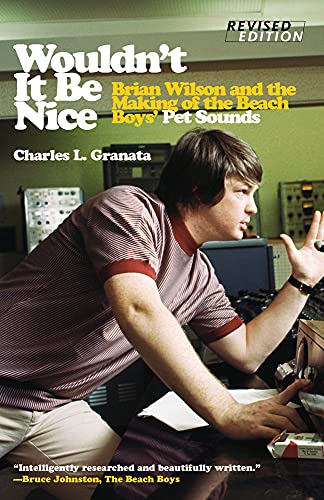
When he first started working on Pet Sounds, Brian Wilson said that he was going to write "the greatest rock album ever made." That album, released in 1966, fifty years ago, changed the face of popular music.
From conception and composition to arrangement and production, Pet Sounds was the work of one extraordinary man. Turning his back on the protest songs and folk rock of his contemporaries and even on the bright surf sound of his own creation, Brian Wilson reached deep within himself to make music that struck an emotional chord and touched people's souls. Embracing the rapidly advancing recording technology of the time, he expertly created an original studio sound that would inspire generations of listeners and musicians.
Featuring a detailed track-by-track analysis of the songs and extensive interviews with key personalities, Wouldn't It Be Nice reveals the influences--musical, personal, and professional--that together created this groundbreaking album. Now revised to include new information and recent developments, this is the definitive book on one of the greatest albums ever made.
Die Inhaltsangabe kann sich auf eine andere Ausgabe dieses Titels beziehen.
Über die Autorin bzw. den Autor
Charles L. Granata is a record and radio producer, music historian, and author of the award-winning Sessions with Sinatra as well as numerous essays on popular music and the history of sound recording. He divides his time between Los Angeles and Livingston, New Jersey. Tony Asher is a lyricist who collaborated with Brian Wilson on Pet Sounds. He lives in Los Angeles.
Auszug. © Genehmigter Nachdruck. Alle Rechte vorbehalten.
Wouldn't It Be Nice
Brian Wilson and the Making of the Beach Boys' Pet Sounds
By Charles L. GranataChicago Review Press Incorporated
Copyright © 2017 Charles L. Granata
All rights reserved.
ISBN: 978-1-61373-837-5All rights reserved.
Contents
Introduction to the Revised Edition,
Foreword - by Tony Asher,
Preface,
Early History,
Fresh Sounds,
Turning Points,
Writing the Album,
The Making of Pet Sounds,
Pet Sounds Arrives,
Brian's in-Between Years (1967–1990),
Small Steps (the 1990s),
Pet Sounds Revisited (1990–2002),
The Legend Lives On,
Epilogue,
An Interview with Mark Linett,
Acknowledgments,
Selected Bibliography,
Lyric Credits and Permissions,
Index,
CHAPTER 1
early history
As far back as I can remember, there's been music in my life.
— Brian Wilson
Without Brian, there wouldn't have been any Beach Boys.
— Recording engineer Chuck Britz
Some people would say that the Beach Boys were born on Labor Day weekend, 1961, when three brothers, one cousin, and a friend rented the equipment required to make their first demo recording. Others might contend that the group didn't emerge until "Surfin' USA" — their first big hit — entered the number three spot on the Billboard charts in 1963. Then again, a convincing argument could be made that the fate of the band was sealed with the birth of Brian Douglas Wilson on Saturday, June 20, 1942.
In reality, it all began with a radio.
"In junior high school Brian would eat dinner, and he'd go into his room and that radio would be on constantly," his mother Audree explained. "I remember [Brian's father] Murry once saying to me, 'Do you think we should worry about him?' I said, 'No. He's just loving the music.'"
Music — and the tiny transistor radio he kept hidden under his pillow at night — became Brian's constant companions, exposing the boy to a wide variety of genres and styles. "My favorite [station] was KFWB in Hollywood," Brian said. "Every record had something you would listen to; every record had some kind of twist in it that gave you that feelin', and you'd say, 'Oh, man.' You'd go to the piano and say, 'Now, how did they do that?' You'd start learning about it — it's an education. Anybody with a good ear [was] gonna pick up on those records."
Brian's passion delighted his parents, and it was a rare day that Murry — an aspiring songwriter — didn't hammer out his latest creation on the family's piano for Brian's entertainment. For her part, Audree shared her small record collection with her son, beaming when he begged to hear Glenn Miller's big band rendition of "Rhapsody in Blue."
The Wilson Family
In the early 1940s, the Wilsons lived in a small house at 3701 West 119th Street in Hawthorne, California, an inland town off the Pacific coast area known as South Bay. Hawthorne was a blue-collar town, and Murry tried hard to provide a comfortable life for his family, who also benefited from the support of various relatives scattered throughout the area. Brian forged a special relationship with Audree's father, who, until his death in 1948, would take the boy on explorative flights in his single-engine prop plane. The family was also close to Audree's sister Glee Love, who lived in nearby View Park with her husband Milton and their six children: Michael, Stanley, Stephen, Maureen, Marjorie, and Stephanie.
By the end of 1946, the Wilson family included two more children: Dennis (born on December 4, 1944) and Carl (born on December 21, 1946). All three of the Wilson boys were gregarious and athletic, and they engaged in the harmless pranks typical of boys their age. From a distance, the Wilsons appeared to be a happy family who enjoyed the idyllic environs that southern California had to offer. In reality, relations within the family unit were neither healthy nor respectful.
As a father, Murry Wilson was an inscrutable failure. While he appeared to be a strict disciplinarian who wanted the best for his children, he was a ruthless egomaniac whose parenting philosophy was skewed by his own experience as the child of an abusive, alcoholic father. Life in the Wilson house wasn't easy, and each of the boys dealt with the dysfunction differently.
Carl, who died of lung cancer at age fifty-one on February 6, 1998, was the least affected by his father's misdeeds, and emerged as the family mediator.
Dennis, the rebellious middle child, endured the most punishment. As a youngster he was beaten frequently, and he responded to provocation with a quick temper and fists. Throughout his life, Dennis seethed with anger, and the physical confrontations between father and son lasted well into adulthood. Dennis was the first of the brothers to experiment with alcohol and other drugs; after two decades of reckless behavior exacerbated by chronic substance abuse, he drowned in a drunken stupor on December 28, 1983, in Marina del Rey, California. He was thirty-nine.
Brian suffered, too. While his wounds were more psychological than physical, Murry didn't refrain from hitting him. One of Brian's most vivid childhood memories is of his father slapping the side of his head — a punishment that he once blamed for the deafness in his right ear.
Music in the Air
To compensate for his lack of emotional intelligence, Murry indulged his boys with music: pianos, a Hammond organ for the family room, and lessons all around. When the Four Freshmen performed at the Crescendo, the man who mercilessly belittled his children struggled to find the money to buy tickets so Brian could attend.
Murry was difficult, but listening to and writing music was one of the few things that tempered his coarseness. He was particularly proud when pop arranger Jimmy Haskell recorded two of his songs, "Fiesta Day Polka" and "Hide My Tears," in the early 1950s. Later, the Bachelors recorded his inane "Two-Step Side-Step," which was subsequently featured by Lawrence Welk and his orchestra on a radio program originating from Santa Monica's Aragon Ballroom. But as hard as he tried, his songs were just too schmaltzy for the rapidly evolving pop market, and except for a few tunes issued as 78-rpm singles, Murry's music went unnoticed.
At home, music became Murry's sole emotional connection to his children — a rare gift bestowed with unrestricted love. "I remember that music was always present," Carl told journalist Geoffrey Himes in 1983. "We always had a couple of pianos and a jukebox in the house. We had a garage that my dad fixed up into a den. We'd all get around the piano; my mom would play, and later Brian started to play. By age 10, he was already playing great boogie-woogie piano!"
Brian also sang in the choir at Inglewood Covenant Church, where the director discovered that, even with his hearing loss, the boy had perfect pitch. He blended nicely with the main choir, and his clear soprano voice projected beautifully when he sang solo. While it was apparent that he was the one blessed with an ear for music, Brian encouraged Dennis and Carl to join him in singing hymns. "The three brothers used to harmonize in bed," Brian remembered. "We'd all sleep in the same room. We used to sing this song, 'Come Down, Come Down from the Ivory Tower.' We developed a little blend, which aided us when we started getting into the Beach Boys stuff."
Music became Brian's escape. He mastered and outgrew his child-sized accordion, and...
„Über diesen Titel“ kann sich auf eine andere Ausgabe dieses Titels beziehen.
Suchergebnisse für Wouldn't It Be Nice: Brian Wilson and the Making...

Foto des Verkäufers
Wouldn't It Be Nice
Anbieter: WeBuyBooks, Rossendale, LANCS, Vereinigtes Königreich
Verkäuferbewertung 5 von 5 Sternen

paperback. Zustand: Like New. Most items will be dispatched the same or the next working day. An apparently unread copy in perfect condition. Dust cover is intact with no nicks or tears. Spine has no signs of creasing. Pages are clean and not marred by notes or folds of any kind. Artikel-Nr. rev2716721946
Gebraucht kaufen
EUR 9,29
EUR 6,82 Versand
Versand von Vereinigtes Königreich nach USA
Versand von Vereinigtes Königreich nach USA
Anzahl: 1 verfügbar
Beispielbild für diese ISBN
Wouldn't It Be Nice: Brian Wilson and the Making of the Beach Boys' Pet Sounds
Anbieter: Revaluation Books, Exeter, Vereinigtes Königreich
Verkäuferbewertung 5 von 5 Sternen
Paperback. Zustand: Brand New. revised edition. 264 pages. 8.50x5.50x0.25 inches. In Stock. Artikel-Nr. x-1613738374
Neu kaufen
EUR 21,15
EUR 11,67 Versand
Versand von Vereinigtes Königreich nach USA
Versand von Vereinigtes Königreich nach USA
Anzahl: 2 verfügbar
Beispielbild für diese ISBN
Wouldn t It be Nice
Anbieter: Kennys Bookstore, Olney, MD, USA
Verkäuferbewertung 5 von 5 Sternen
Zustand: New. Num Pages: 272 pages. BIC Classification: 1KBB; 3JJP; AVGP; AVH; AVX; BGF. Category: (G) General (US: Trade). Dimension: 142 x 216 x 19. Weight in Grams: 350. . 2016. Revised edition. Paperback. . . . . Books ship from the US and Ireland. Artikel-Nr. V9781613738375
Neu kaufen
EUR 26,22
EUR 9,26 Versand
Versand innerhalb von USA
Versand innerhalb von USA
Anzahl: Mehr als 20 verfügbar
Foto des Verkäufers
WOULDNT IT BE NICE REV/E
Anbieter: moluna, Greven, Deutschland
Verkäuferbewertung 5 von 5 Sternen
Zustand: New. KlappentextrnrnWhen he first started working on Pet Sounds , Brian Wilson said that he was going to write "the greatest rock album ever made." That album, released in 1966, fifty years ago, changed the face of popular music. From conce. Artikel-Nr. 639213217
Neu kaufen
EUR 19,27
EUR 48,99 Versand
Versand von Deutschland nach USA
Versand von Deutschland nach USA
Anzahl: Mehr als 20 verfügbar