
Verwandte Artikel zu The Curious Case of Kiryas Joel: The Rise of a Village...
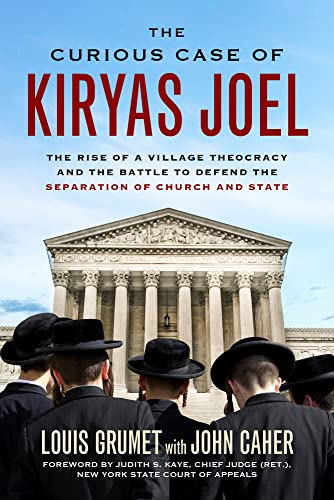
The Curious Case of Kiryas Joel: The Rise of a Village Theocracy and the Battle to Defend the Separation of Church and State - Hardcover
Inhaltsangabe
Twenty years ago, in the middle of the night and on the last day of the legislative session, the New York State Legislature created a publicly funded school district to cater to the interests of a religious sect called the Satmar, an insular group of Hasidic Jews that objects to, among other things, female school bus drivers. The rapidly growing sect had bought land in rural Upstate New York, populated it solely with members of its faction, and created a village called Kiryas Joel that exerted extraordinary political pressure over both political parties. Marking the first time in American history that a governmental unit was established for a religious group, the legislature’s action prompted years of litigation that eventually went to the US Supreme Court.
As today’s Supreme Court signals its willingness to view a religious viewpoint like any other speech and accord it equal protection, the 1994 case, Board of Education of Kiryas Joel Village School District v. Grumet, stands as the most important legal precedent in the fight to uphold the separation of church and state. In The Curious Case of Kiryas Joel, plaintiff Louis Grumet opens a window onto the Satmar Hasidic community, where language, customs, and dress have led to estrangement from and clashes with neighboring communities, and details the inside story of his fight for the First Amendment and against New York’s most powerful politicians.
Informed by numerous interviews with key figures such as Governor George Pataki, media accounts, court transcripts, and more, The Curious Case of Kiryas Joel not only tantalizes with a peek at cynical power politics driven by votes and Supreme Court justice squabbling and negotiation; it also provides an important demonstration of how a small, insular, and politically savvy religious group can grasp legal and political power. This story—a blend of politics, religion, cultural clashes, and constitutional tension—is an object lesson in the ongoing debate over freedom of versus freedom from religion.
As today’s Supreme Court signals its willingness to view a religious viewpoint like any other speech and accord it equal protection, the 1994 case, Board of Education of Kiryas Joel Village School District v. Grumet, stands as the most important legal precedent in the fight to uphold the separation of church and state. In The Curious Case of Kiryas Joel, plaintiff Louis Grumet opens a window onto the Satmar Hasidic community, where language, customs, and dress have led to estrangement from and clashes with neighboring communities, and details the inside story of his fight for the First Amendment and against New York’s most powerful politicians.
Informed by numerous interviews with key figures such as Governor George Pataki, media accounts, court transcripts, and more, The Curious Case of Kiryas Joel not only tantalizes with a peek at cynical power politics driven by votes and Supreme Court justice squabbling and negotiation; it also provides an important demonstration of how a small, insular, and politically savvy religious group can grasp legal and political power. This story—a blend of politics, religion, cultural clashes, and constitutional tension—is an object lesson in the ongoing debate over freedom of versus freedom from religion.
Die Inhaltsangabe kann sich auf eine andere Ausgabe dieses Titels beziehen.
Über die Autorinnen und Autoren
Louis Grumet is the former executive director of the New York State School Boards Association. He has previously held various positions including special assistant to then New York Secretary of State Mario Cuomo. John Caher, Senior Advisor for Strategic Communications with the New York State Unified Court System, is a former senior reporter with the New York Law Journal, State Editor of the Albany Times Union and the author or coauthor of five books including King of the Mountain and A Time for Reflection. Judith S. Kaye was the first woman to serve on New York’s highest court, the state’s chief judge for 15 years, and, at the time of her death in January 2016, of counsel to the Manhattan law firm of Skadden, Arps, Slate, Leagher and Flom
Louis Grumet is the former executive director of the New York State School Boards Association. He has previously held various positions including special assistant to then New York Secretary of State Mario Cuomo. John Caher, Senior Advisor for Strategic Communications with the New York State Unified Court System, is a former senior reporter with the New York Law Journal, State Editor of the Albany Times Union and the author or coauthor of five books including King of the Mountain and A Time for Reflection. Judith S. Kaye was the first woman to serve on New York's highest court, the state's chief judge for 15 years, and, at the time of her death in January 2016, of counsel to the Manhattan law firm of Skadden, Arps, Slate, Leagher and Flom
Auszug. © Genehmigter Nachdruck. Alle Rechte vorbehalten.
The Curious Case of Kiryas Joel
The Rise of a Village Theocracy and the Battle to Defend the Separation of Church and State
By Louis Grumet, John Caher, Rick KopsteinChicago Review Press Incorporated
Copyright © 2016 Louis Grumet and John M. Caher
All rights reserved.
ISBN: 978-1-61373-500-8All rights reserved.
Contents
Foreword by Judith S. Kaye, Former Chief Judge, New York State Court of Appeals,
A Note on Sources,
Prologue: "Curious" Joel,
1 A New Homeland,
2 Who Moves In?,
3 Who Governs?,
4 Who Educates?,
5 Who Is Worshipped?,
6 Who Litigates?,
7 Who Is Our Adversary?,
8 Here Comes the Judge,
9 Establishment,
10 Reviewing the Decision,
11 Does It Pass the Test?,
12 Would the Supreme Court Care?,
13 The Supreme Court Opens the Door,
14 Strange Bedfellows,
15 May It Please the Court,
16 Judicial Deliberations,
17 Supremely Decided,
18 Déjà Vu,
Epilogue,
Acknowledgments,
Chronology,
Notes,
Index,
CHAPTER 1
A NEW HOMELAND
* * *
The United States of America should have a foundation free from the influence of the clergy.
— George Washington
WHEN ANN KRAWET and her husband, Dave, moved from New York City to Monroe, New York, in 1968, they weren't looking for anything unusual — just a nice, safe home and a smaller, more manageable community. Ann and Dave, a Reform Jewish couple expecting their third child, had been living in a one-and-a-half-bedroom walk-up apartment in Brooklyn and were desperate for more space.
Upstate in Orange County, they found a classic cedar-shingle home in a little subdivision that had been neatly cut into a tree-covered hill so that all of the homes remained surrounded by woods. Ann thought the small round windows on the second level — just under the eaves — were "darling." A living room at the far end of the house had huge sixteen-pane windows that looked over a large lawn bordered by trees. They had found their paradise in a town named in honor of our fifth president, James Monroe, officially a Virginia Episcopalian but more likely a deist.
Monroe, an old colonial town west of the Hudson and about an hour northwest of the Bronx, had approved several subdivisions in the 1960s, including the one where Ann and Dave found their home. They had been attracted to Monroe for a few reasons. First, it was about equidistant between Dave's job at the old US Custom House in lower Manhattan (a two-hour commute) and Ann's parents' home in Sullivan County (west of Orange County, on the border between New York and Pennsylvania); second, since Monroe necessitated a long commute to Manhattan, the prices were cheaper than in closer suburbs (Ann and Dave were able to buy in a subdivision with two-acre lots); finally, the presence of the old town of Monroe added a touch of authentic "small-town" feel to the benefits of good public schools and bucolic splendor offered by such bedroom communities.
Orange County was named after the Dutchman William of Orange, who took over England at the end of the seventeenth century. Originally owned by the Dutch, New York was called New Netherland until the British kicked them out and, in keeping with the reign of King Charles II and his family, renamed it after the Duke of York, brother of the king. About fifteen years after taking over New Netherland from the Dutch, Charles's family lost control of England to the Dutch leader, William. This occurred as part of the "glorious revolution of 1688," when the Protestants took England back from the Catholics one more time. William was married to Mary, daughter of the English king, and invaded successfully. Religious disputes have always weighed heavily in the area. Although William didn't change the name back to New Netherland, he didn't protest when some appreciative Dutch colonists named the southwest area of the Hudson Valley "Orange County."
When the town of Monroe was chartered in the early eighteenth century by Queen Anne, the area of mostly high, rocky hills and swampy valleys was sparsely populated, and the situation wasn't much different eighty years later when the American Revolution was sweeping the colonies. The region saw a fair amount of action during the wars at the end of the eighteenth century. Along with the Mohawk's great chief Joseph Brant, Claudius Smith and his "cowboys" were particularly active in the area around present-day Monroe, defending loyal British from the "American" paramilitary operations. In fact, during his retreat toward Pennsylvania after the disastrous Battle of Brooklyn, George Washington stayed in a farmhouse in Orange County. With its tactical advantages and commanding plateau overseeing the Hudson River, Orange County has been home to the US Military Academy at West Point since 1802.
Monroe was built on a relatively level raised plain in a region of marshy farmland that few farmed because nobody knew how, until some Poles and Volga Germans showed up at the turn of the twentieth century, found it familiar terrain, and immediately began to grow onions. Before the arrival of these hardy farmers, this part of Upstate New York had clung to a way of life that would have been recognizable to Diedrich Knickerbocker. These days, bridges have replaced ferries, bringing the west bank of the Hudson within easy reach of Manhattan; the empire of the automobile bought out the onion farms, and the landscape has become a patchwork of suburbs and outlet malls, interspersed with the few remaining colonial towns and a large regional airport.
When Ann and Dave Krawet arrived in the late 1960s, agriculture still dominated a landscape that was ever so slowly evolving into rural suburbia. Cow crossings continued to bring traffic to a standstill on Highway 17, the major east-west corridor, as the cattle were ushered to the milking barns where Velveeta cheese, the 1917 invention of a Swiss immigrant who had settled in Monroe, was still made. The Krawets loved the charm of the area. It seemed they had arrived just at the right time.
Ann resigned her job as a social studies teacher to concentrate on raising the family's three children but soon found she had time on her hands. She started volunteering for a variety of activities at Temple Beth-El, the local Reform synagogue. The temple had been founded during the days when Monroe was just a vacation rental area for people on their way to the big resorts in the Catskills (known as the Borscht Belt because of the primarily Eastern European, Jewish clientele). It was during those first few years volunteering at the temple and for school activities that Ann made lasting friendships in town and was introduced to the whole panoply of local government and community issues with which any vibrant town buzzes. Things were going great: the older kids loved the schools, Ann felt at home in the community, and Dave, despite the long commute, was proud that he could provide his family a lifestyle that, in comparison to the postwar Brooklyn where he had grown up, was one of pastoral luxury.
Then one day a mysterious real estate developer from Montreal purchased about three hundred acres of a recently cleared wasteland north of Highway 17, in Monroe Township. The land near Stewart Air Force Base had been deemed suitable for industrial use. When those plans collapsed, the land was on the market, and relatively cheap. Rumors spread, one of the more accurate beginning at the local Lions Club, where a member who was a state trooper let it be known that he had...
„Über diesen Titel“ kann sich auf eine andere Ausgabe dieses Titels beziehen.
Suchergebnisse für The Curious Case of Kiryas Joel: The Rise of a Village...

Beispielbild für diese ISBN
The Curious Case of Kiryas Joel : The Rise of a Village Theocracy and the Battle to Defend the Separation of Church and State
Verlag:
Chicago Review Press, Incorporated, 2016
ISBN 10: 1613735006
ISBN 13: 9781613735008
Gebraucht
Hardcover
Anbieter: Better World Books, Mishawaka, IN, USA
Verkäuferbewertung 5 von 5 Sternen

Zustand: Very Good. Former library copy. Pages intact with possible writing/highlighting. Binding strong with minor wear. Dust jackets/supplements may not be included. Includes library markings. Stock photo provided. Product includes identifying sticker. Better World Books: Buy Books. Do Good. Artikel-Nr. 15638680-6
Gebraucht kaufen
EUR 13,89
Versand gratis
Versand innerhalb von USA
Versand innerhalb von USA
Anzahl: 1 verfügbar
Beispielbild für diese ISBN
The Curious Case of Kiryas Joel : The Rise of a Village Theocracy and the Battle to Defend the Separation of Church and State
Verlag:
Chicago Review Press, Incorporated, 2016
ISBN 10: 1613735006
ISBN 13: 9781613735008
Gebraucht
Hardcover
Anbieter: Better World Books, Mishawaka, IN, USA
Verkäuferbewertung 5 von 5 Sternen
Zustand: Good. Pages intact with minimal writing/highlighting. The binding may be loose and creased. Dust jackets/supplements are not included. Stock photo provided. Product includes identifying sticker. Better World Books: Buy Books. Do Good. Artikel-Nr. 18315401-6
Gebraucht kaufen
EUR 13,89
Versand gratis
Versand innerhalb von USA
Versand innerhalb von USA
Anzahl: 1 verfügbar
Beispielbild für diese ISBN
The Curious Case of Kiryas Joel : The Rise of a Village Theocracy and the Battle to Defend the Separation of Church and State
Verlag:
Chicago Review Press, Incorporated, 2016
ISBN 10: 1613735006
ISBN 13: 9781613735008
Gebraucht
Hardcover
Anbieter: Better World Books, Mishawaka, IN, USA
Verkäuferbewertung 5 von 5 Sternen
Zustand: Very Good. Pages intact with possible writing/highlighting. Binding strong with minor wear. Dust jackets/supplements may not be included. Stock photo provided. Product includes identifying sticker. Better World Books: Buy Books. Do Good. Artikel-Nr. 10099783-6
Gebraucht kaufen
EUR 13,89
Versand gratis
Versand innerhalb von USA
Versand innerhalb von USA
Anzahl: 3 verfügbar