
Verwandte Artikel zu Writing to God, Kids' Edition
Inhaltsangabe
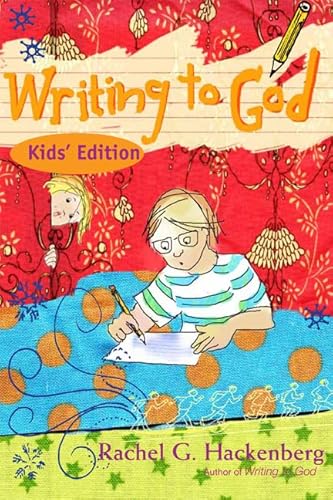
Writing to God – Kid’s’ Edition offers guidance to kids that parents can also appreciate: It invites them to speak to God creatively through their pens (or pencils, or crayons).
In 35 days, kids are invited to pray to God using their senses, reflecting on their feelings, in light of Bible verses, looking at nature, to understand the ordinary events of life, to use new words and pictures for God, and as a way to say “thank you.”
“Hackenberg’s book gives children permission to experience prayer as daily conversation with God. The freshness and honesty of her own prayers and her helpful prompts invite them to find and value their own words as offerings to a God who wants to be in relationship with them.” –Anabel Proffitt, Associate Professor of Educational Ministries, Lancaster Theological Seminary
In 35 days, kids are invited to pray to God using their senses, reflecting on their feelings, in light of Bible verses, looking at nature, to understand the ordinary events of life, to use new words and pictures for God, and as a way to say “thank you.”
“Hackenberg’s book gives children permission to experience prayer as daily conversation with God. The freshness and honesty of her own prayers and her helpful prompts invite them to find and value their own words as offerings to a God who wants to be in relationship with them.” –Anabel Proffitt, Associate Professor of Educational Ministries, Lancaster Theological Seminary
Die Inhaltsangabe kann sich auf eine andere Ausgabe dieses Titels beziehen.
Über die Autorin bzw. den Autor
Rev. Rachel G. Hackenberg is a graduate of Princeton Theological Seminary, serves as the pastor of Grace United Church of Christ in Lancaster, PA, and is also the author of a popular book for adults, Writing to God.
Von der hinteren Coverseite
Try talking to God with a pencil, pen, marker, or box of crayons!
Writing to God: Kids' Edition shows kids how their prayers:
- Don't have to be perfect to reach God.
- Don't have to use big or fancy words.
- May tell a story using words or pictures.
- Can be happy or sad.
- May have misspelled and crossed-out words. (God understands when we make mistakes.)
"Rachel Hackenberg has an amazing ability to transform the most ordinary elements in a child's life. She invites kids to be themselves but also to see their world through God's eyes." --Trish Heidebrecht, Christian Educator, Chippawa Presbyterian Church
"Rachel Hackenberg's book introduces us to a practical method that should work for just about everyone. All that is needed is a simple writing tool, some paper, and the imagination that often comes from being a kid." -- Rev. Ricky Manalo, CSP, is a liturgical composer, author, and member of the Paulist Fathers Community.
Writing to God: Kids' Edition shows kids how their prayers:
- Don't have to be perfect to reach God.
- Don't have to use big or fancy words.
- May tell a story using words or pictures.
- Can be happy or sad.
- May have misspelled and crossed-out words. (God understands when we make mistakes.)
"Rachel Hackenberg has an amazing ability to transform the most ordinary elements in a child's life. She invites kids to be themselves but also to see their world through God's eyes." --Trish Heidebrecht, Christian Educator, Chippawa Presbyterian Church
"Rachel Hackenberg's book introduces us to a practical method that should work for just about everyone. All that is needed is a simple writing tool, some paper, and the imagination that often comes from being a kid." -- Rev. Ricky Manalo, CSP, is a liturgical composer, author, and member of the Paulist Fathers Community.
Auszug. © Genehmigter Nachdruck. Alle Rechte vorbehalten.
Writing to God
By Rachel G. HackenbergPARACLETE PRESS
Copyright © 2012 Rachel HackenbergAll right reserved.
ISBN: 978-1-61261-107-5
Chapter One
Hi! My name is Rachel.When I was a girl, I wasn't sure how to pray. Should I use fancy church words?
Holy Thee THOU Blessed Trinity Amen
Should I put my hands together and close my eyes? (Closing my eyes usually put me to sleep.) Should I pray for the whole entire world? And how could I pray for the whole entire world if I didn't know the name of every person ... Laboni, Dae, Aram, Vahe, Elizabeth, Paavo, Ianthe, José ... or the name of every place and every plant and every animal?
Most of the time, adults did the praying for me. My dad prayed at dinner. My pastor prayed during church. My teachers prayed in Sunday school. Adults wrote the books of prayer that I read in the morning before school. Adults wrote the prayers that we said aloud in church (including Jesus, who gave us the "Our Father" prayer).
So I never learned how to pray using my own words.
I just guessed.
Um ... HI GOD.
I felt pretty certain that my made-up prayers weren't very good and didn't really work.
... Can you hear me?
But I kept trying. I really wanted to say prayers to God using my own words, sharing my own feelings, asking my own questions.
One day—much later, when I had grown up—I was watching my baby son as he slept in his crib, and I wanted to say a special prayer that was just for him. I wanted to ask God to wrap love around him like a blanket. I decided to write down my prayer so that I could keep it and keep praying it as my son grew up.
I wrote:
May the angels guide you. May the LORD hold you and be with you for your whole life.
When he was a few years older, I wrote this: God, walk beside him through the hallways at school. Sit with him in classes and in the cafeteria. Laugh with him, teach him, and bring him safely home after school.
As I looked at the words I had written, it was like all the puzzle pieces of prayer finally fit together! When I wrote down these prayers, I finally realized that I actually could pray....
... and I haven't stopped writing my prayers ever since! I like to call this prayer-writing, and I use prayer-writing everywhere! I carry a pencil or pen and paper with me so that I can write prayers anytime and anywhere: at the kitchen table, in my car, just before bedtime, at my church, in the coffee shop, at a friend's house, on the beach, at the computer. Anywhere!
Today, after all these years, I can say that I love praying. I think if I had discovered prayer-writing when I was a kid, I might not have felt for such a long time that it was hard to pray.
If you feel like you don't know how to pray (like I felt when I was your age), maybe I can help! You might enjoy prayer-writing as a way to talk to God.
This book has ideas to show you how to write prayers in your own words. You can read through the whole book and try all of the ideas together, or you can try one new idea every day. You can use these ideas to write prayers with your family, or you can write prayers that are just between you and God.
Your prayers don't have to be perfect to reach God. You don't have to use big or fancy words. Your prayers can be long or short. Your prayers may even tell a story using words or pictures. Your prayers can be happy or sad or grumpy. Your prayers can have misspelled words and crossed-out words. (God understands when we make mistakes.)
Just be honest with God. Use words that make sense to you. Write about what you're feeling. Tell God when things are really great ... and when they're not. Have fun using prayer-writing as a chance to talk to God.
And—no matter what your prayer looks like on paper—please know that God is enjoying this conversation with you!
from Rachel
Idea #1 Writing prayers that use your five senses.
Let's start with the sense of sight. What are three things that you can see, right now, where you are? Write to God and tell God something about each of these three things.
For example, I see flowers and a mirror and a pen. So I tell God:
The yellow and white flowers are beautiful.
The next time I look in that mirror, I want to remember that God loves me. I like to write with my favorite blue pen.
I know that those sentences don't start with "Dear God" or end with "Amen," but each sentence is a prayer—a short conversation with God!
Idea #1 Writing prayers that use your five senses.
Let's use the sense of touch next for praying. Think about holding a rock in your hand. Does it feel smooth or bumpy? Is it hard, or does it crumble easily? Is it heavy? What can you do with rocks? Write "Thank you for rocks" and then make a list of cool ways that we use rocks.
Here's my example:
Thank you for rocks that make roads and become buildings. Thank you for rocks that I can skip across the river.
Logan (age 5) prays:
Dear God, Thank you for rocks. They are cool because ... they're hard you can collect rocks some rocks can draw they make shapes they can line up in a row.
Idea # 1 Writing prayers that use your five senses.
How about the sense of hearing? Do you ever hear bad news? Sometimes we hear something sad or scary or mean when we're listening to people talk around us, listening to the radio or television. Tell God about some bad news that you've heard.
I want to tell God:
I'm so sad to hear that my grandfather is sick. I'm worried because he is in the hospital. Would you please take care of him, and take care of my grandmother, and of me too?
Emily (age 12) prays:
Dear Lord, I woke up this morning full of life, and five seconds later my world went up in smoke. I couldn't bear the words I was hearing. My sister is moving! Pull me through this, Lord. Let me know I am loved ...
Idea # 1 Writing prayers that use your five senses.
Now the sense of taste! You can probably think quickly of foods that you love to taste. Did you know that there's a Bible verse that says, "Taste and see that the Lord is good!" (Psalm 34:8, NRSV)? This verse tells us that we can use all of our senses—even taste—to get to know God. How awesome that even the food we eat can remind us of God! Write or draw pictures of food that you like (and food that you don't like!) to thank God for the different kinds of food in the world.
I thank God for:
warm tomato soup on a chilly day lima beans (even though I think they are really gross) corn-on-the-cob with butter apples (God, it's amazing that you can make one little apple seed grow into a whole apple tree with new apples!)
Idea # 1 Writing prayers that use your five senses.
Finally, the sense of smell. I wonder how our noses and brains decide if things smell good or nasty. Or why some people like a smell that other people dislike. God is amazing for creating so many scents! Write to God about the things you smell.
These are some of the things that I am thankful for smelling, God:
chocolate cookies baking in the oven a hamster cage that needs to be cleaned the kind-of-good, kind-of-stinky smell of mud after rain smoke from a campfire
This list doesn't look like a prayer, but I thank God for the sense of smell to experience the odors of life!
Idea # 2 Writing to god about your...
„Über diesen Titel“ kann sich auf eine andere Ausgabe dieses Titels beziehen.
Suchergebnisse für Writing to God, Kids' Edition

Beispielbild für diese ISBN
Writing to God, Kids' Edition
Anbieter: ThriftBooks-Atlanta, AUSTELL, GA, USA
Verkäuferbewertung 5 von 5 Sternen

Paperback. Zustand: Good. No Jacket. Pages can have notes/highlighting. Spine may show signs of wear. ~ ThriftBooks: Read More, Spend Less. Artikel-Nr. G1612611079I3N00
Gebraucht kaufen
EUR 5,87
Versand gratis
Versand innerhalb von USA
Versand innerhalb von USA
Anzahl: 1 verfügbar
Beispielbild für diese ISBN
Writing to God, Kids' Edition
Anbieter: ThriftBooks-Reno, Reno, NV, USA
Verkäuferbewertung 5 von 5 Sternen
Paperback. Zustand: Very Good. No Jacket. May have limited writing in cover pages. Pages are unmarked. ~ ThriftBooks: Read More, Spend Less. Artikel-Nr. G1612611079I4N00
Gebraucht kaufen
EUR 5,87
Versand gratis
Versand innerhalb von USA
Versand innerhalb von USA
Anzahl: 1 verfügbar
Beispielbild für diese ISBN
Writing to God, Kids' Edition
Anbieter: ThriftBooks-Atlanta, AUSTELL, GA, USA
Verkäuferbewertung 5 von 5 Sternen
Paperback. Zustand: Very Good. No Jacket. May have limited writing in cover pages. Pages are unmarked. ~ ThriftBooks: Read More, Spend Less. Artikel-Nr. G1612611079I4N00
Gebraucht kaufen
EUR 5,87
Versand gratis
Versand innerhalb von USA
Versand innerhalb von USA
Anzahl: 1 verfügbar
Beispielbild für diese ISBN
Writing to God, Kids' Edition
Anbieter: ThriftBooks-Dallas, Dallas, TX, USA
Verkäuferbewertung 5 von 5 Sternen
Paperback. Zustand: Very Good. No Jacket. May have limited writing in cover pages. Pages are unmarked. ~ ThriftBooks: Read More, Spend Less. Artikel-Nr. G1612611079I4N00
Gebraucht kaufen
EUR 5,87
Versand gratis
Versand innerhalb von USA
Versand innerhalb von USA
Anzahl: 1 verfügbar
Beispielbild für diese ISBN
Writing to God
Verlag:
Paraclete Press, Incorporated, 2012
ISBN 10: 1612611079
ISBN 13: 9781612611075
Gebraucht
Softcover
Anbieter: Better World Books, Mishawaka, IN, USA
Verkäuferbewertung 5 von 5 Sternen
Zustand: Good. Pages intact with minimal writing/highlighting. The binding may be loose and creased. Dust jackets/supplements are not included. Stock photo provided. Product includes identifying sticker. Better World Books: Buy Books. Do Good. Artikel-Nr. 8369625-6
Gebraucht kaufen
EUR 6,47
Versand gratis
Versand innerhalb von USA
Versand innerhalb von USA
Anzahl: 1 verfügbar