
Verwandte Artikel zu Money From Nothing: Or, Why We Should Stop Worrying...
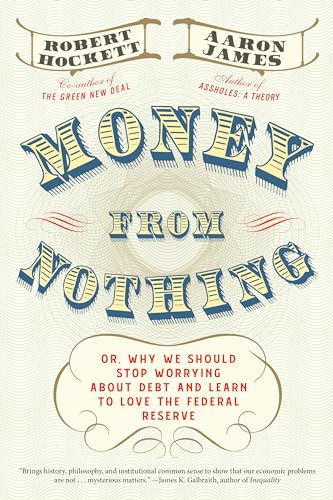
Money From Nothing: Or, Why We Should Stop Worrying About Debt and Learn to Love the Federal Reserve - Hardcover
Inhaltsangabe
A major work of financial theory and practice with immediate relevance to the rebuilding of the economy, and restoring the promise of equality
When the government decides to spend money, it simply creates the necessary funds for itself--as if out of thin air. That's how we pay for interstate highways, post offices, wars, social services, and economic stimulus packages. If it's that easy to make money . . . can't we all get more of it? Absolutely. And we should.
So argue financial regulation expert Robert Hockett and bestselling philosopher Aaron James in this eye-opening, irreverent, and inspiring exploration of what the dollar really is. And better still, they show how we can build an economy that works for everybody without unwanted taxes and added regulations.
In the process, we learn how disingenuous the political rhetoric surrounding inflation can be, how the demonized concept of the deficit is really just another way of tallying our collective national wealth, and how a strong central bank could free us from the abuses of private banking.
With broad historical background and ambitious yet practical institutional proposals, Hockett and James offer a new vision of public finance--people's banking for a people's economy. Armed with this new outlook, we can even stop worrying debt and learn to love a strong, accountable, and transparent Federal Reserve as a cornerstone of our democracy.
Die Inhaltsangabe kann sich auf eine andere Ausgabe dieses Titels beziehen.
Über die Autorin bzw. den Autor
Robert Hockett has first-hand experience working at the International Monetary Fund and the Federal Reserve Bank of New York, and continues to consult for a number of US federal, state and local legislators and regulators. He drafted Rep. Alexandria Ocasio-Cortez's "Green New Deal" resolution for the House of Representatives and officially advises her on economic policy. He is the Edward Cornell Professor of Law and a Professor of Public Policy at Cornell University, Senior Counsel at Westwood Capital (a socially responsible investment bank), and a Fellow of The Century Foundation (a think tank). He's a regular contributor to Forbes magazine, where he covers finance, economics, law and justice. He lives in Ithaca, NY.
Aaron James holds a PhD from Harvard and is professor of philosophy at the University of California, Irvine. He is the author of Fairness in Practice: A Social Contract for a Global Economy, the bestselling Assholes: A Theory, Assholes: A Theory of Donald Trump, Surfing with Sartre and numerous academic articles. He lives in Irvine, CA.
Auszug. © Genehmigter Nachdruck. Alle Rechte vorbehalten.
“You’ve always had the power, my dear, you just had to learn it for yourself.”
—Glinda, the Good Witch of the North, The Wizard of Oz (1939)
You probably saw the movie version of The Wizard of Oz as a kid, as so many of us did. You might even recall the crucial line just quoted, which comes in the story’s culminating scene. Glinda, the Good Witch, is explaining to Dorothy what her long ordeal (being swept away by a great storm from her home in Kansas) could possibly mean.
The big lesson is: You’ve had the power to go back to Kansas all along—by tapping your shoes together. You merely didn’t realize it. So you had to learn it for yourself. But you can empower yourself, now, by understanding what you’re capable of.
That sounds like a message of female empowerment, and it may well have been. But today we often forget that the film, based on a children’s book by L. Frank Baum, is ultimately a parable about money. Baum was not only a one-time actor and the author of numerous tales about the land of Oz, an imagined American utopia, he was also a political activist who once owned a newspaper. The story we think we know so well was responding to the economic crises of his day.
This book is not a parable, but if it has a big thesis, it’s that we still haven’t taken Glinda’s (and Baum’s) lesson to heart, even a hundred years later. The lesson is: Although we Americans have suffered through financial crises, we’ve had the power to take control of our money all along. But we haven’t fully realized how it can help heal our society. Now the time has come to empower ourselves by understanding what we’re capable of.
Really? The Wizard of Oz—a neglected tract of political philosophy, the key to future prosperity and maybe to saving the republic? Yup. Just think back to that famous scene when Dorothy and Co., having followed the yellow brick road, finally arrive at the Emerald City. The great wizard is putting on an awesome spectacle. Suddenly, Toto the dog pulls back the curtain, revealing a coy, bumbling man conjuring with smoke and mirrors. We now use “pulling back the curtain” as a cliché for unveiling or unmasking. We’ve largely forgotten what the original parable was pulling back the curtain on.
When Baum’s book was published in 1900, it was meant to expose the “gold standard” as an illusion. There was no “yellow brick road,” paved in golden rocks, to a green Emerald City of shared prosperity. That was always mythology, so much propaganda.
Just recall the main characters. Who was the bumbling “Wizard of Oz” behind the curtain (“oz.” meaning “ounce,” which is of course the unit of measure for precious metals)? Government officials of the day.
Who were the Wicked Witches of the East and West? The bankers of the East and West Coast cities, who propagated the gold myth for private profit—profit that came at the expense of the great hinterland.
And the Cowardly Lion? The political class and intellectuals that let the bankers have their way.
What about the Tin Man without a heart? The industrial workers in the cities, who never aligned with the farmers.
Who, then, was Dorothy? A daughter of the Midwestern farm families, who suffered under a recession and wave of home foreclosures in the 1890s. The recession was the great cyclone that swept Dorothy from her home in Kansas.
If this isn’t obvious, consider the crises of Baum’s day, the ones he lived through. By 1900, the American economy had been starved of money decade after decade. That was the whole point of the “gold standard,” after all—to limit the supply of money to the scarce supply of certain specific yellow rocks dug up from the ground. So when the gold diggers out west or in Australia or South Africa had a bad year, well, there just wasn’t going to be enough money for a growing economy. That brought what economists call “deflation,” or “too little money chasing too many goods,” and thus economic contraction in the Midwest. Farmers outside of the big cities, in Kansas for example, were hit hardest.
The early American colonies were short on precious metals, so they used book credit, paper called “scrip,” and even tobacco or shell beads as moneys. Then the founders of the post-Revolutionary republic took over and declared a new unit of account, “the dollar,” officially tying it to both gold and silver. But in practice it was often the one or the other, depending on what metal was available. During the Civil War, paper money “greenbacks” were issued with no strict connection to either gold or silver, as Treasury bonds were now deemed to be “good as gold.” To a degree that seems strange to us now, by the mid- to late-nineteenth-century major political movements—the “Greenbackers” and then the “free silver men”—feverishly organized around monetary policy decisions. It was a coinage act later called the “crime of 1873,” which gave us what we now call “the gold standard,” that would eventually draw particular ire. Word had it that London and New York bankers such as the Rothschilds and the Morgans had duped gullible congressmen to “demonetize” silver in last-minute, dead-of-night legislation. And so, during the cycle of depressions that followed, distrust and suspicion only heightened. By 1896, William Jennings Bryan, the loudmouthed “populist” US representative from Nebraska, condemned the exclusive tie to gold in what some regard as the most famous speech in American history. “You shall not press down upon the brow of labor this crown of thorns. You shall not crucify mankind upon a cross of gold,” he thundered.
Bryan was an unsubtle man with a serious proposal, in line with what Americans had done in the past when they turned to shells, scrip, and other forms of currency: if there aren’t enough dollars out there, just issue more of them, now backed by silver alongside gold. Baum, a progressive former journalist and early feminist, well aware of the politics of his era, seemed to agree. In his original story, Dorothy wore a silver slipper, alluding to “bi-metallism,” the use of two metals as a monetary standard. How do you “click the shoes together” and “go back to Kansas”? Officials need only call off the exclusive commitment to gold, in a public announcement. More money in circulation would “re-inflate” the economy for the benefit of farm workers, at that time still a major economic constituency.
***
In this book we argue that the “green menace” of runaway debt and inflation isn’t that different from the “red menace” hysteria Richard Hofstadter and Stanley Kubrick understood and spoofed so well. Indeed, irrational fears have always stood in the way of a sound understanding of money. They drive the popular appeal of films such as Goldfinger (Special Agent James Bond foils a plot to steal gold from Fort Knox), as well as suspicions about whether there still is gold in Fort Knox, and, if not, where it all went. They also drive more consequential developments such as fiscal austerity after the 2008 crash, and the re-emergence of goldbugs like former congressman Ron Paul, who over decades called for investigation into “the Fort Knox issue,” a return to a gold standard, and even the Fed’s outright abolition (“End the Fed”).
The paranoid style of politics explains why money...
„Über diesen Titel“ kann sich auf eine andere Ausgabe dieses Titels beziehen.
Suchergebnisse für Money From Nothing: Or, Why We Should Stop Worrying...

Beispielbild für diese ISBN
Money from Nothing: Or, Why We Should Stop Worrying about Debt and Learn to Love the Federal Reserve
Verlag:
Melville House Publishing, 2020
ISBN 10: 1612198562
ISBN 13: 9781612198569
Gebraucht
Hardcover
Anbieter: ThriftBooks-Atlanta, AUSTELL, GA, USA
Verkäuferbewertung 5 von 5 Sternen

Hardcover. Zustand: Very Good. No Jacket. Former library book; May have limited writing in cover pages. Pages are unmarked. ~ ThriftBooks: Read More, Spend Less. Artikel-Nr. G1612198562I4N10
Gebraucht kaufen
EUR 20,88
Versand gratis
Versand innerhalb von USA
Versand innerhalb von USA
Anzahl: 1 verfügbar
Beispielbild für diese ISBN
Money From Nothing
Verlag:
Melville House Publishing, 2020
ISBN 10: 1612198562
ISBN 13: 9781612198569
Gebraucht
Hardcover
Anbieter: World of Books (was SecondSale), Montgomery, IL, USA
Verkäuferbewertung 5 von 5 Sternen
Hardback. Zustand: Very Good. After fifty years of stagnating wages and the ever-growing gap between the rich and the rest of us, many Americans believe that their government and their society have broken faith with them. Hockett and James aim to repair and renew our fraying social contract by showing how money itself can restore shared prosperity and protect democracy against the rising tide of authoritarianism. To address these problems, MONEY FROM NOTHING lays out a new vision of money and public finance, without the wonky policy arguments that make even the educated reader's eyes glaze over. Most importantly, the bold plan laid out here-which includes the Federal Reserve putting real money directly into the bank account of each and every citizen-avoids the pitfalls of unwanted taxes, added regulation, and increased inflation. Artikel-Nr. 00107343090
Gebraucht kaufen
EUR 20,89
Versand gratis
Versand innerhalb von USA
Versand innerhalb von USA
Anzahl: 1 verfügbar
Beispielbild für diese ISBN
Money From Nothing
Verlag:
Melville House Publishing, 2020
ISBN 10: 1612198562
ISBN 13: 9781612198569
Gebraucht
Hardcover
Anbieter: World of Books (was SecondSale), Montgomery, IL, USA
Verkäuferbewertung 5 von 5 Sternen
Hardback. Zustand: Good. After fifty years of stagnating wages and the ever-growing gap between the rich and the rest of us, many Americans believe that their government and their society have broken faith with them. Hockett and James aim to repair and renew our fraying social contract by showing how money itself can restore shared prosperity and protect democracy against the rising tide of authoritarianism. To address these problems, MONEY FROM NOTHING lays out a new vision of money and public finance, without the wonky policy arguments that make even the educated reader's eyes glaze over. Most importantly, the bold plan laid out here-which includes the Federal Reserve putting real money directly into the bank account of each and every citizen-avoids the pitfalls of unwanted taxes, added regulation, and increased inflation. Artikel-Nr. 00100590409
Gebraucht kaufen
EUR 20,89
Versand gratis
Versand innerhalb von USA
Versand innerhalb von USA
Anzahl: 1 verfügbar
Beispielbild für diese ISBN
Money from Nothing : Or, Why We Should Stop Worrying about Debt and Learn to Love the Federal Reserve
Verlag:
Melville House Publishing, 2020
ISBN 10: 1612198562
ISBN 13: 9781612198569
Gebraucht
Hardcover
Anbieter: Better World Books, Mishawaka, IN, USA
Verkäuferbewertung 5 von 5 Sternen
Zustand: Good. Former library copy. Pages intact with minimal writing/highlighting. The binding may be loose and creased. Dust jackets/supplements are not included. Includes library markings. Stock photo provided. Product includes identifying sticker. Better World Books: Buy Books. Do Good. Artikel-Nr. 42739390-6
Gebraucht kaufen
EUR 22,17
Versand gratis
Versand innerhalb von USA
Versand innerhalb von USA
Anzahl: 2 verfügbar
Beispielbild für diese ISBN
Money From Nothing: Or, Why We Should Stop Worrying About Debt and Learn to Love the Federal Reserve
Anbieter: Books From California, Simi Valley, CA, USA
Verkäuferbewertung 4 von 5 Sternen

hardcover. Zustand: Very Good. Artikel-Nr. mon0004235678
Gebraucht kaufen
EUR 20,80
EUR 4,45 Versand
Versand innerhalb von USA
Versand innerhalb von USA
Anzahl: 1 verfügbar
Beispielbild für diese ISBN
Money From Nothing: Or, Why We Should Stop Worrying About Debt and Learn to Love the Federal Reserve
Anbieter: Majestic Books, Hounslow, Vereinigtes Königreich
Verkäuferbewertung 4 von 5 Sternen
Zustand: New. Artikel-Nr. 369162332
Neu kaufen
EUR 23,83
EUR 7,68 Versand
Versand von Vereinigtes Königreich nach USA
Versand von Vereinigtes Königreich nach USA
Anzahl: 3 verfügbar
Beispielbild für diese ISBN
Money From Nothing
Anbieter: PBShop.store US, Wood Dale, IL, USA
Verkäuferbewertung 5 von 5 Sternen
HRD. Zustand: New. New Book. Shipped from UK. Established seller since 2000. Artikel-Nr. GB-9781612198569
Beispielbild für diese ISBN
Money From Nothing
Anbieter: PBShop.store UK, Fairford, GLOS, Vereinigtes Königreich
Verkäuferbewertung 5 von 5 Sternen
HRD. Zustand: New. New Book. Shipped from UK. Established seller since 2000. Artikel-Nr. GB-9781612198569
Neu kaufen
EUR 33,14
EUR 5,93 Versand
Versand von Vereinigtes Königreich nach USA
Versand von Vereinigtes Königreich nach USA
Anzahl: 7 verfügbar
Beispielbild für diese ISBN
Money From Nothing
Anbieter: Kennys Bookstore, Olney, MD, USA
Verkäuferbewertung 5 von 5 Sternen
Zustand: New. 2020. Hardcover. . . . . . Books ship from the US and Ireland. Artikel-Nr. V9781612198569
Neu kaufen
EUR 43,89
EUR 9,37 Versand
Versand innerhalb von USA
Versand innerhalb von USA
Anzahl: 7 verfügbar
Foto des Verkäufers
Money From Nothing
Verlag:
Melville House Publishing Sep 2020, 2020
ISBN 10: 1612198562
ISBN 13: 9781612198569
Neu
Hardcover
Anbieter: AHA-BUCH GmbH, Einbeck, Deutschland
Verkäuferbewertung 5 von 5 Sternen
Buch. Zustand: Neu. Neuware - A major work of financial theory and practice with immediate relevance to the rebuilding of the economy, and restoring the promise of equalityWhen the government decides to spend money, it simply creates the necessary funds for itself--as if out of thin air. That's how we pay for interstate highways, post offices, wars, social services, and economic stimulus packages. If it's that easy to make money . . . can't we all get more of it Absolutely. And we should. So argue financial regulation expert Robert Hockett and bestselling philosopher Aaron James in this eye-opening, irreverent, and inspiring exploration of what the dollar really is. And better still, they show how we can build an economy that works for everybody without unwanted taxes and added regulations. In the process, we learn how disingenuous the political rhetoric surrounding inflation can be, how the demonized concept of the deficit is really just another way of tallying our collective national wealth, and how a strong central bank could free us from the abuses of private banking. With broad historical background and ambitious yet practical institutional proposals, Hockett and James offer a new vision of public finance--people's banking for a people's economy. Armed with this new outlook, we can even stop worrying debt and learn to love a strong, accountable, and transparent Federal Reserve as a cornerstone of our democracy. Artikel-Nr. 9781612198569
Neu kaufen
EUR 37,07
EUR 35,00 Versand
Versand von Deutschland nach USA
Versand von Deutschland nach USA
Anzahl: 2 verfügbar