
Verwandte Artikel zu The Marginalized Majority: Claiming Our Power in a...
Inhaltsangabe
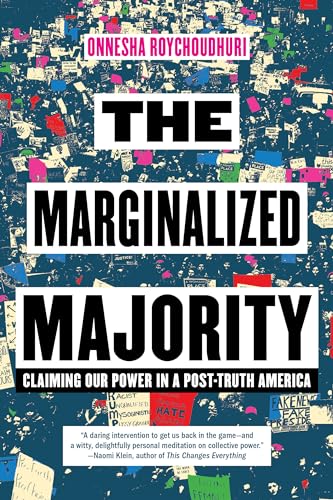
“This book is a daring intervention to get us back in the game—and a witty, delightfully personal meditation on collective power.” —Naomi Klein
The energy on the left has never been higher. But because there are so many issues to tackle, each one more urgent and divisive than the next, some say progressives will once again fail to seize the moment and gain real power. But what if we’re getting the story all wrong?
In The Marginalized Majority, Onnesha Roychoudhuri makes the galvanizing case that our plurality of identities is not only our greatest strength, but is also at the indisputable core of successful progressive change throughout history.
From the civil rights movement to the Women’s March, mainstream media to Saturday Night Live, Roychoudhuri illuminates how historical narratives are written and, by holding the myths about our disenfranchisement up to the light, reveals we have far more power than we’re often led to believe. With both clear-eyed hope and electrifying power, she examines our ideas about what’s possible, and what’s necessary—opening up space for action, new realities, and, ultimately, survival.
Now, Roychoudhuri urges us, is the time to fight like the majority we already are.
Die Inhaltsangabe kann sich auf eine andere Ausgabe dieses Titels beziehen.
Über die Autorin bzw. den Autor
Onnesha Roychoudhuri is a Brooklyn-based writer, editor, and educator. Her work has appeared in publications such as Rolling Stone, n+1, the Virginia Quarterly Review, Boston Review, The Nation, The American Prospect, Salon, and Mother Jones. She is the co-founder of Speech/Act, and organization working at the intersection of storytelling and social justice.
Auszug. © Genehmigter Nachdruck. Alle Rechte vorbehalten.
The Marginalized Majority
INTRODUCTION
We have frequently printed the word Democracy.
Yet I cannot too often repeat that it is a word the real gist of which still sleeps, quite unawaken’d…It is a great word, whose history, I suppose, remains unwritten, because that history has yet to be enacted.
—WALT WHITMAN, DEMOCRATIC VISTAS1
The Marginalized MajorityE PLURIBUS PLURIBUS
DURING A RECENT VISIT WITH my mother, I sat flipping through an old photo album I’d never seen before. Inside were images of our extended family on my mother’s side, stretching back to the time I was about four years old. My mother sat close to me, leaning in to offer captions as I turned the pages. I was laughing at the way I could chart the march of adolescence by my increasingly less amused facial expressions. As my cheeks began to grow more slender, the open smile transformed, offering up a paltry, tight-lipped semblance instead.
Toward the end of the album was an image that startled me: my mother and I sitting around a large table at a restaurant, most of her side of the family arranged in seats, beaming at the camera. My face, the only brown one at the table, stands out for another reason: I’m not even attempting a smile. In fact, I look furious. I noticed that my mother, who had been eagerly narrating the who, what, and where of each image, had gone silent. When I turned to look at her, she said simply, “Oh.” “What?” I asked. My mother looked uncomfortable. “Well,” she said, “if you don’t remember, maybe it’s better that way.” This, of course, only piqued my curiosity. “Tell me,” I said. My mother sighed. The dinner was to celebrate her parents’ wedding anniversary; my uncle had just finished going around the table with his video camera in hand, naming everyone at the table. Except he had skipped over us.
Here was a historical moment I had forgotten until it resurfaced.
Uncle Bill didn’t “believe in mixed marriage.” Growing up, if I ever found myself in the same room or around the same dinner table as him, I could rely on one thing: He would not acknowledge my existence. He did not look at me and he did not speak to me. My general response was to simply ignore Bill the way he ignored me, though it would take me years before I could articulate how there was a power differential at play: He ignored me because my existence challenged his sensibilities. I ignored him because his sensibilities challenged my existence.
In retrospect, I’m grateful for the experience of growing up around my uncle Bill. Encountering racism and its tolerance in my own family gave me a model for what it means to grow up in America.
Of course, I did not have this outlook when I was a child. The situation felt like a private matter. I didn’t tell my friends about the uncle who did not speak to me. I did not ask my mother questions about what it meant. Before I found my way to placing this experience in a broader framework of the institutional racism at the heart of this country’s founding, it was a personal, even shameful, story to hold. I didn’t want to look at it any more closely because I feared that if I scratched the surface, what I would come away with were concrete reasons why I was less worthy of acknowledgment, of acceptance—even of existence—in this country.
—
THESE QUESTIONS OF WHO belongs and who doesn’t, who is a person worth counting and who isn’t, have always preoccupied us in America. There’s the early stuff of our country’s founding—the “handful” of “uncivilized” and “intractable” natives who populated the country before Europeans landed on its shores, offering the gifts of these preposterously off-base adjectives along with smallpox and influenza plagues. When those indigenous people died en masse from those plagues, as well as deliberate slaughter, the African slave trade filled the gap—men, women, and children shackled and shipped over to the New World to provide a new form of free labor to sustain the country’s economy. Then there were the waves of willing immigrants who arrived seeking a better life. With so many cultures and languages colliding on America’s shores, there has always been tension, and the attendant question of whether being American means to scrub yourself of your particularities, or to celebrate them.
We learn about the fractioning of human beings in a section of our high school history textbooks: each slave counting as three-fifths of a person for the purposes of getting slave owners more representation in Congress. We’re encouraged to read these historical narratives as static, safely ensconced in the container of the past, where they ostensibly remain without leaking. We’re encouraged to think of ourselves as outside of that history, too—here to study it rather than participate in the making of it. The narrative, say, of our country overturning Jim Crow, comes to us framed in a tone of inevitability. Of course we had to do away with these unfair laws, the logic of these few glossy pages in our history books implies, it was just a matter of time.
There’s something tricky in the definition of “history” as we commonly use it—the study of past events. Viewed in this way, history ruptures continuity, severing itself from the present and future. Maybe there is a kind of American-hued wish at the heart of this understanding of history—to not be lashed to the past, to invent ourselves anew. But, of course, this severance is impossible.
The word “history” comes from the Greek historia, meaning “knowledge acquired by investigation.” There’s more promise in this etymology—room for engagement and continuity. We are accustomed to thinking of the future as containing unknowns. But the past, too, is full of hidden and lesser-known narratives. What might these narratives tell us about who we are and what’s possible?
How does it change our understanding of the United States, for instance, to acknowledge that contemporary estimates of indigenous peoples in the Americas put the population at roughly 50–100 million people in the late 1400s before they were decimated by European diseases—ten times that of earlier estimates?2 Or that many of these indigenous civilizations were far more advanced in agriculture, architecture, and mathematics than the early British and Spanish empires?3 How does it change our understanding of our country to learn that the US Constitution was modeled on the Iroquois Confederacy? Or that, by 1860, the United States counted 4 million slaves among its population, valued at a worth of $3.5 billion—making them, as historian David Blight points out, the largest financial asset in the US economy, worth more than all railroads and manufacturing combined?4
What do these narratives tell us about whose country this is?
—
WE ARE MANY. WE ARE ONE. The copper two-cent coin was first issued in 1864, and it was conspicuously missing the usual motto: E pluribus unum—“out of many, one.” The Civil War was in its third year, and it seemed impossible to agree on who were the many, and who were the one. Fast forward to 1938, when the House Un-American Activities Committee was created to investigate whether any Americans had communist ties, which, according to the committee’s calculus, would make them un-American. Fast forward even further to 2008, when, just days before the presidential election, Minnesota Republican representative Michele Bachmann accused...
„Über diesen Titel“ kann sich auf eine andere Ausgabe dieses Titels beziehen.
Suchergebnisse für The Marginalized Majority: Claiming Our Power in a...

Beispielbild für diese ISBN
The Marginalized Majority: Claiming Our Power in a Post-Truth America
Anbieter: World of Books (was SecondSale), Montgomery, IL, USA
Verkäuferbewertung 5 von 5 Sternen

Zustand: Good. Item in good condition. Textbooks may not include supplemental items i.e. CDs, access codes etc. Artikel-Nr. 00102648107
Gebraucht kaufen
EUR 3,67
Versand gratis
Versand innerhalb von USA
Versand innerhalb von USA
Anzahl: 3 verfügbar
Beispielbild für diese ISBN
The Marginalized Majority: Claiming Our Power in a Post-Truth America
Verlag:
Melville House (edition ), 2018
ISBN 10: 1612196993
ISBN 13: 9781612196992
Gebraucht
Paperback
Anbieter: BooksRun, Philadelphia, PA, USA
Verkäuferbewertung 5 von 5 Sternen
Paperback. Zustand: Very Good. It's a well-cared-for item that has seen limited use. The item may show minor signs of wear. All the text is legible, with all pages included. It may have slight markings and/or highlighting. Artikel-Nr. 1612196993-11-1
Gebraucht kaufen
EUR 4,61
Versand gratis
Versand innerhalb von USA
Versand innerhalb von USA
Anzahl: 1 verfügbar
Beispielbild für diese ISBN
The Marginalized Majority: Claiming Our Power in a Post-Truth America
Verlag:
Melville House Publishing, 2018
ISBN 10: 1612196993
ISBN 13: 9781612196992
Gebraucht
Paperback
Anbieter: ThriftBooks-Dallas, Dallas, TX, USA
Verkäuferbewertung 5 von 5 Sternen
Paperback. Zustand: Very Good. No Jacket. May have limited writing in cover pages. Pages are unmarked. ~ ThriftBooks: Read More, Spend Less. Artikel-Nr. G1612196993I4N00
Gebraucht kaufen
EUR 5,92
Versand gratis
Versand innerhalb von USA
Versand innerhalb von USA
Anzahl: 1 verfügbar
Beispielbild für diese ISBN
The Marginalized Majority: Claiming Our Power in a Post-Truth America
Verlag:
Melville House Publishing, 2018
ISBN 10: 1612196993
ISBN 13: 9781612196992
Gebraucht
Paperback
Anbieter: ThriftBooks-Atlanta, AUSTELL, GA, USA
Verkäuferbewertung 5 von 5 Sternen
Paperback. Zustand: Good. No Jacket. Former library book; Pages can have notes/highlighting. Spine may show signs of wear. ~ ThriftBooks: Read More, Spend Less. Artikel-Nr. G1612196993I3N10
Gebraucht kaufen
EUR 5,92
Versand gratis
Versand innerhalb von USA
Versand innerhalb von USA
Anzahl: 1 verfügbar
Beispielbild für diese ISBN
The Marginalized Majority: Claiming Our Power in a Post-Truth America
Verlag:
Melville House Publishing, 2018
ISBN 10: 1612196993
ISBN 13: 9781612196992
Gebraucht
Paperback
Anbieter: ThriftBooks-Atlanta, AUSTELL, GA, USA
Verkäuferbewertung 5 von 5 Sternen
Paperback. Zustand: Good. No Jacket. Pages can have notes/highlighting. Spine may show signs of wear. ~ ThriftBooks: Read More, Spend Less. Artikel-Nr. G1612196993I3N00
Gebraucht kaufen
EUR 5,92
Versand gratis
Versand innerhalb von USA
Versand innerhalb von USA
Anzahl: 1 verfügbar
Beispielbild für diese ISBN
The Marginalized Majority: Claiming Our Power in a Post-Truth America
Verlag:
Melville House Publishing, 2018
ISBN 10: 1612196993
ISBN 13: 9781612196992
Gebraucht
Paperback
Anbieter: ThriftBooks-Dallas, Dallas, TX, USA
Verkäuferbewertung 5 von 5 Sternen
Paperback. Zustand: Fair. No Jacket. Former library book; Readable copy. Pages may have considerable notes/highlighting. ~ ThriftBooks: Read More, Spend Less. Artikel-Nr. G1612196993I5N10
Gebraucht kaufen
EUR 5,92
Versand gratis
Versand innerhalb von USA
Versand innerhalb von USA
Anzahl: 1 verfügbar
Beispielbild für diese ISBN
The Marginalized Majority: Claiming Our Power in a Post-Truth America
Verlag:
Melville House Publishing, 2018
ISBN 10: 1612196993
ISBN 13: 9781612196992
Gebraucht
Paperback
Anbieter: ThriftBooks-Atlanta, AUSTELL, GA, USA
Verkäuferbewertung 5 von 5 Sternen
Paperback. Zustand: Very Good. No Jacket. Former library book; May have limited writing in cover pages. Pages are unmarked. ~ ThriftBooks: Read More, Spend Less. Artikel-Nr. G1612196993I4N10
Gebraucht kaufen
EUR 5,92
Versand gratis
Versand innerhalb von USA
Versand innerhalb von USA
Anzahl: 1 verfügbar
Beispielbild für diese ISBN
The Marginalized Majority: Claiming Our Power in a Post-Truth America
Verlag:
Melville House Publishing, 2018
ISBN 10: 1612196993
ISBN 13: 9781612196992
Gebraucht
Paperback
Anbieter: ThriftBooks-Reno, Reno, NV, USA
Verkäuferbewertung 5 von 5 Sternen
Paperback. Zustand: Very Good. No Jacket. May have limited writing in cover pages. Pages are unmarked. ~ ThriftBooks: Read More, Spend Less. Artikel-Nr. G1612196993I4N00
Gebraucht kaufen
EUR 5,92
Versand gratis
Versand innerhalb von USA
Versand innerhalb von USA
Anzahl: 1 verfügbar
Beispielbild für diese ISBN
The Marginalized Majority : Claiming Our Power in a Post-Truth America
Verlag:
Melville House Publishing, 2018
ISBN 10: 1612196993
ISBN 13: 9781612196992
Gebraucht
Softcover
Anbieter: Better World Books, Mishawaka, IN, USA
Verkäuferbewertung 5 von 5 Sternen
Zustand: Very Good. Former library copy. Pages intact with possible writing/highlighting. Binding strong with minor wear. Dust jackets/supplements may not be included. Includes library markings. Stock photo provided. Product includes identifying sticker. Better World Books: Buy Books. Do Good. Artikel-Nr. 15612010-6
Gebraucht kaufen
EUR 6,41
Versand gratis
Versand innerhalb von USA
Versand innerhalb von USA
Anzahl: 1 verfügbar
Beispielbild für diese ISBN
The Marginalized Majority : Claiming Our Power in a Post-Truth America
Verlag:
Melville House Publishing, 2018
ISBN 10: 1612196993
ISBN 13: 9781612196992
Gebraucht
Softcover
Anbieter: Better World Books, Mishawaka, IN, USA
Verkäuferbewertung 5 von 5 Sternen
Zustand: Good. Former library copy. Pages intact with minimal writing/highlighting. The binding may be loose and creased. Dust jackets/supplements are not included. Includes library markings. Stock photo provided. Product includes identifying sticker. Better World Books: Buy Books. Do Good. Artikel-Nr. 15542643-6
Gebraucht kaufen
EUR 6,41
Versand gratis
Versand innerhalb von USA
Versand innerhalb von USA
Anzahl: 2 verfügbar